


🩸 Red Blood Journal
#1516 – The Players Change, the Board Remains
When Allegiance Is Measured by Spirit or Material Rather Than Flags
History often introduces itself as a series of unique events.
Different countries.
Different leaders.
Different slogans.
Different enemies.
Yet when history is viewed from a greater distance, certain patterns appear to repeat.
The names change.
The technology changes.
The language changes.
But the structure often looks remarkably familiar.
The purpose of this report is not to claim that history repeats itself exactly.
Rather, it explores whether similar incentives can produce similar patterns across different generations.
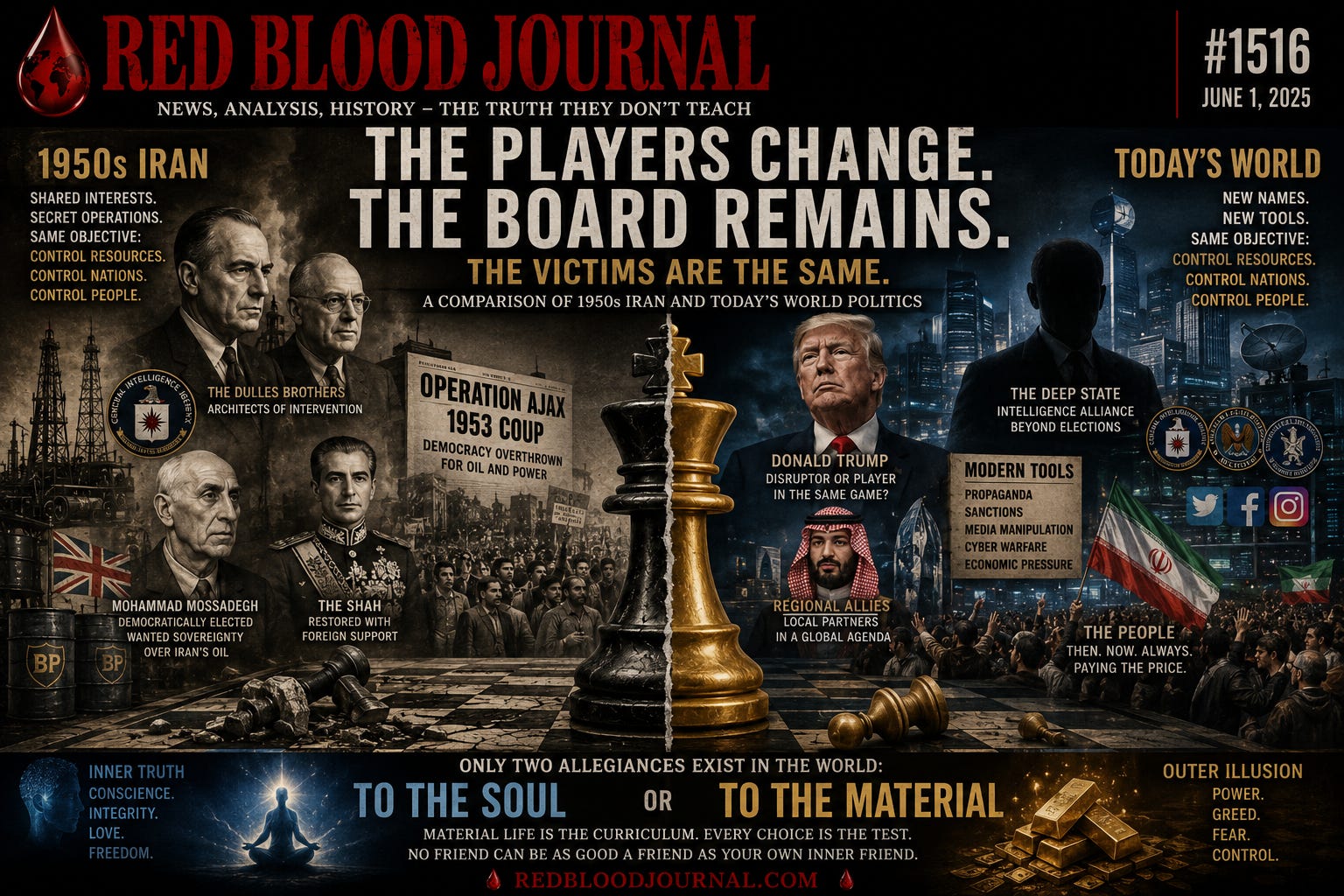
The Same Board
The events surrounding Iran in 1953 remain one of the best documented examples of covert intervention during the Cold War.
A democratically elected government under Mohammad Mossadegh sought greater national control over Iranian oil.
Britain viewed this as a threat to strategic and economic interests.
The United States, after a change in administration, ultimately joined Britain in supporting Operation Ajax.
The result was the overthrow of Mossadegh’s government and the restoration of the Shah’s authority.
For many historians, this became a defining example of twentieth-century regime change.
Looking at Today
The question is not whether today’s leaders are identical to those of the 1950s.
They are not.
The question is whether they occupy comparable positions within a recurring geopolitical drama.
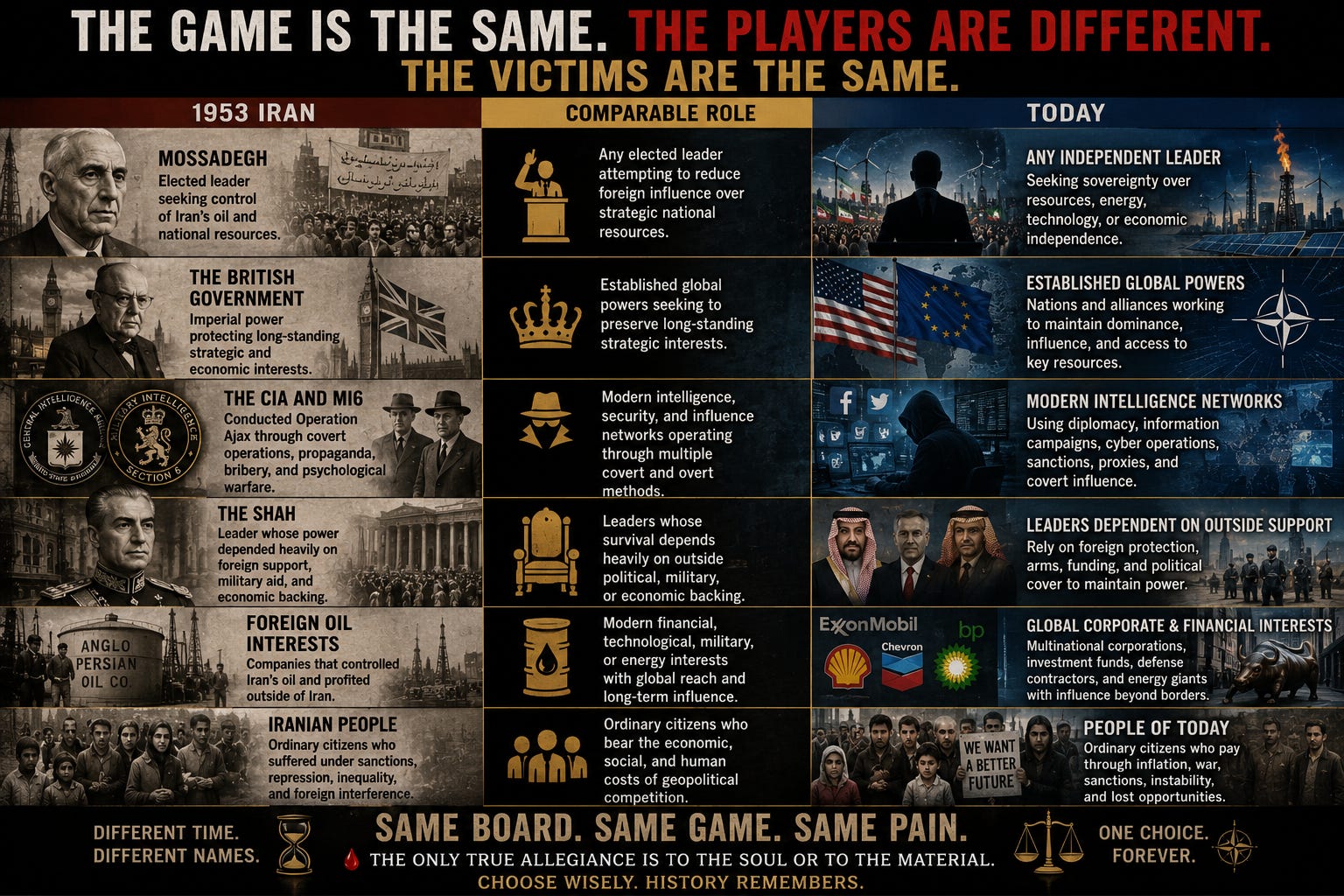
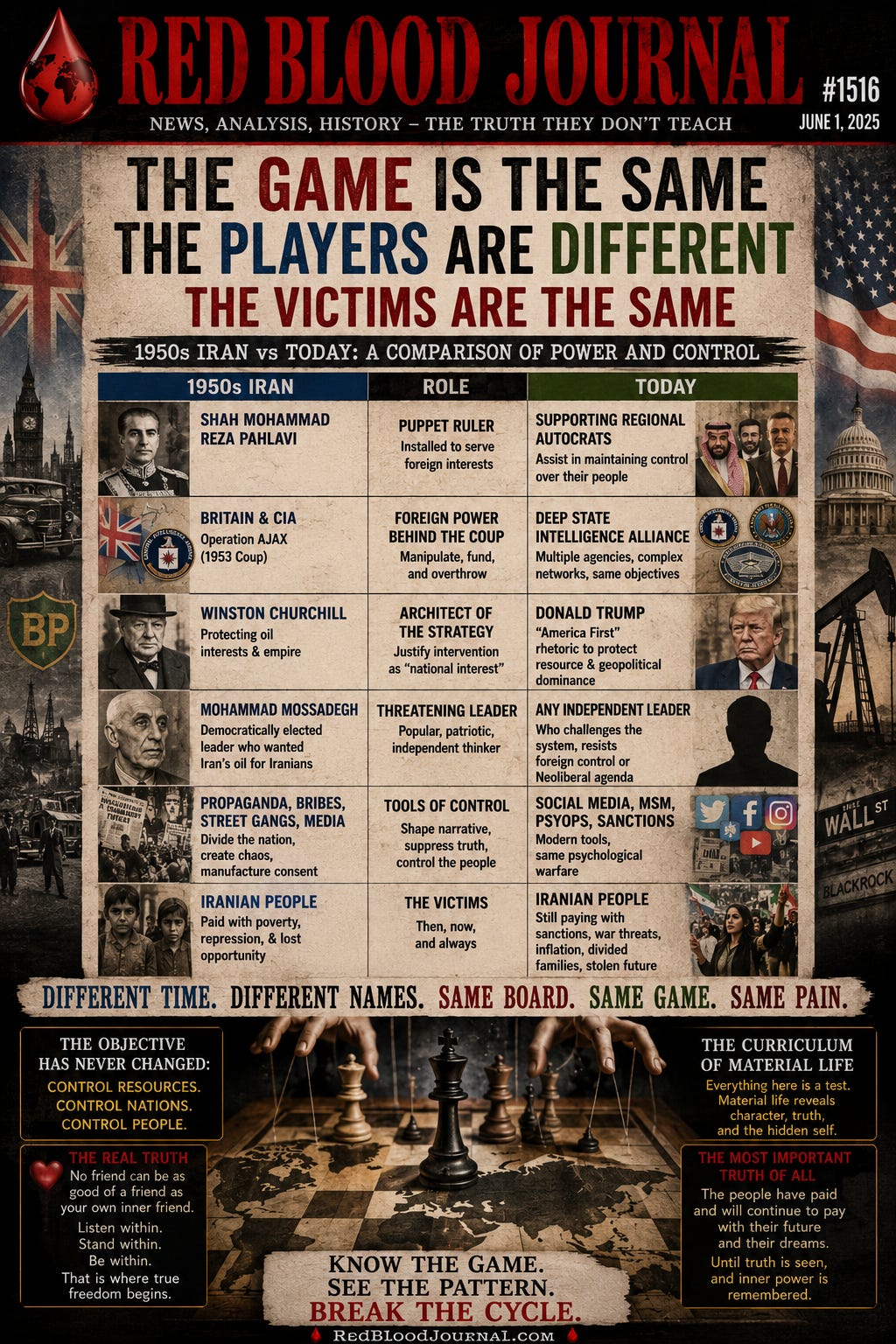
One possible way of looking at the comparison is through roles rather than personalities.
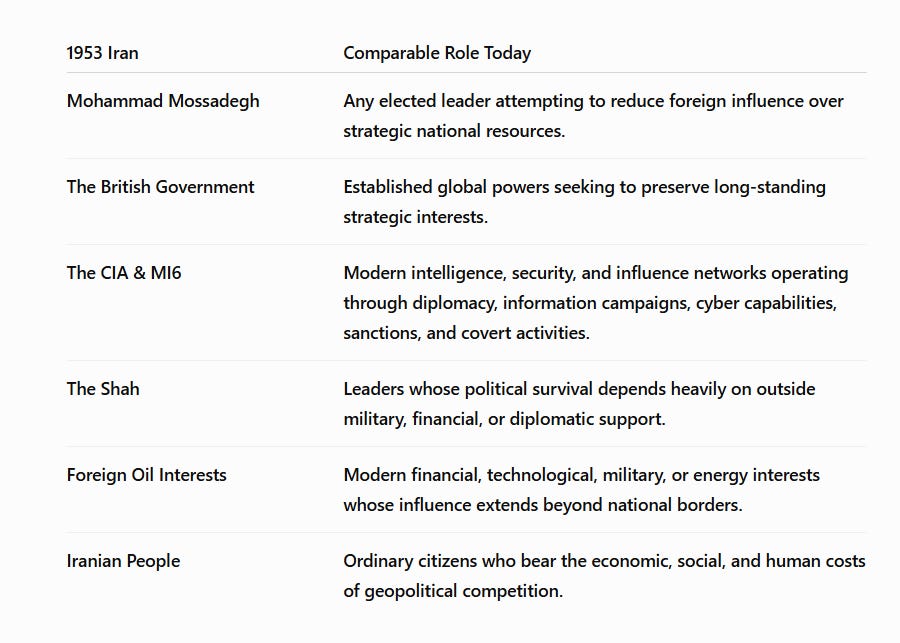
Viewed through this lens, the names become less important than the functions they perform.
The actors leave the stage.
The script survives.
Where Does Donald Trump Fit?
Some observers view President Donald Trump as comparable to leaders who challenged aspects of the existing foreign-policy establishment.
Others see him as operating within the same institutional framework while attempting to reshape it from inside.
Still others reject both comparisons entirely.
History rarely offers one-to-one equivalents.
Individuals differ greatly in their goals, methods, constitutional powers, and historical circumstances.
Reducing complex events to simple parallels can obscure important differences.
For that reason, comparing roles rather than claiming identical motives is generally more informative.
The Dulles Brothers
No discussion of the 1953 coup is complete without the Dulles brothers.
John Foster Dulles served as U.S. Secretary of State.
Allen Dulles served as Director of Central Intelligence.
Together they became central figures in shaping American Cold War covert operations.
Their worldview emphasized containing Soviet influence, often through clandestine action rather than direct military confrontation.
Under their leadership, Operation Ajax in Iran was followed by other interventions during the 1950s.
Whether those operations strengthened long-term American interests remains a subject of continuing historical debate.
The Shadow of the Kennedy Years
The assassination of President John F. Kennedy in 1963 remains one of the most intensely studied events in modern history.
The official investigation conducted by the Warren Commission concluded that Lee Harvey Oswald acted alone.
At the same time, numerous alternative theories have been proposed over the decades involving various individuals, organizations, or foreign governments.
Some researchers have discussed possible connections involving intelligence agencies or figures from the Cold War era, including Allen Dulles, who later served on the Warren Commission after leaving the CIA.
Those claims remain disputed, and no single alternative explanation has achieved broad historical consensus.
The enduring debate illustrates how major historical events can continue to generate questions long after they occur.
The Deeper Allegiance
Perhaps the greatest mistake is assuming that the highest allegiance of every person is to a nation.
Flags inspire.
Constitutions matter.
Cultures deserve respect.
But nations are ultimately administered by human beings.
Human beings make choices.
Those choices are often influenced by something deeper than nationality.
Perhaps there are only two enduring allegiances.
The first is allegiance to the material world.
Power.
Money.
Resources.
Territory.
Influence.
Status.
The second is allegiance to the inner world.
Conscience.
Integrity.
Truth.
Compassion.
Wisdom.
Service.
Every major decision eventually reveals which master is being served.
A flag can become a banner for noble sacrifice.
It can also become a convenient mask behind which material interests quietly operate.
The same observation applies to governments, corporations, political movements, religious institutions, and even individuals.
The outer language may speak of patriotism.
The inner motivation may be something entirely different.
The Real Victims
History remembers presidents.
Prime ministers.
Generals.
Intelligence chiefs.
Industrialists.
But history is carried on the backs of ordinary people.
Families.
Workers.
Children.
Dreams interrupted.
Lives redirected.
Generations shaped by decisions they never voted on and could never influence.
They paid in 1953.
Others have paid in countless conflicts since.
And unless humanity learns from its own history, future generations may continue paying the same price.
Only the names will change.
The Curriculum of Material Life
Perhaps material life is not the destination.
Perhaps it is the classroom.
Every challenge involving money, power, fear, pride, greed, and ambition presents an examination of character.
The external world constantly asks one question:
What truly governs your decisions?
The answer cannot be hidden forever.
Not from history.
Not from others.
And certainly not from oneself.
No friend can ever know us as completely as our own conscience.
No advisor can remain with us every moment.
No institution can replace the quiet voice within.
The greatest companion a human being will ever have is the inner friend that remains when every title, every possession, every ideology, and every applause has disappeared.
Perhaps that is the only allegiance that never betrays us.
Subjects
Operation Ajax
Iran 1953
Mohammad Mossadegh
The Dulles brothers
Cold War covert operations
Historical patterns
Intelligence and geopolitics
National interest versus conscience
Material power and inner values
Lessons from history
Suggested Tags
#RedBloodJournal #History #Iran1953 #OperationAjax #Mossadegh #ColdWar #Geopolitics #Dulles #WorldPolitics #Conscience #Power #HistoryRepeats
🩸 Red Blood Journal
The board may appear unchanged, and the pieces may bear different names, but each generation is still asked the same question: Will its highest loyalty be to material gain or to conscience? The answer belongs to each individual, long before it belongs to any nation.
🩸🌊✨ Fantastic!
📜
The Constant Script:
Material Power and the Inner Voice
Jul 19, 2026
This text explores how geopolitical history functions as a recurring cycle where institutional roles and power structures remain consistent even as individual leaders change. By examining the 1953 Iranian coup and the influence of figures like the Dulles brothers, the author suggests that global events are often driven by covert agendas rather than public national interests. The narrative posits that while political actors appear unique to their era, they often inhabit a pre-existing script dictated by the pursuit of material dominance. Ultimately, the source contrasts the external world of power and status with an inner allegiance to conscience and integrity. It concludes that the true measure of history lies in this moral struggle, as ordinary people continue to bear the consequences of decisions made by those in high office.


