


🩸 Red Blood Journal
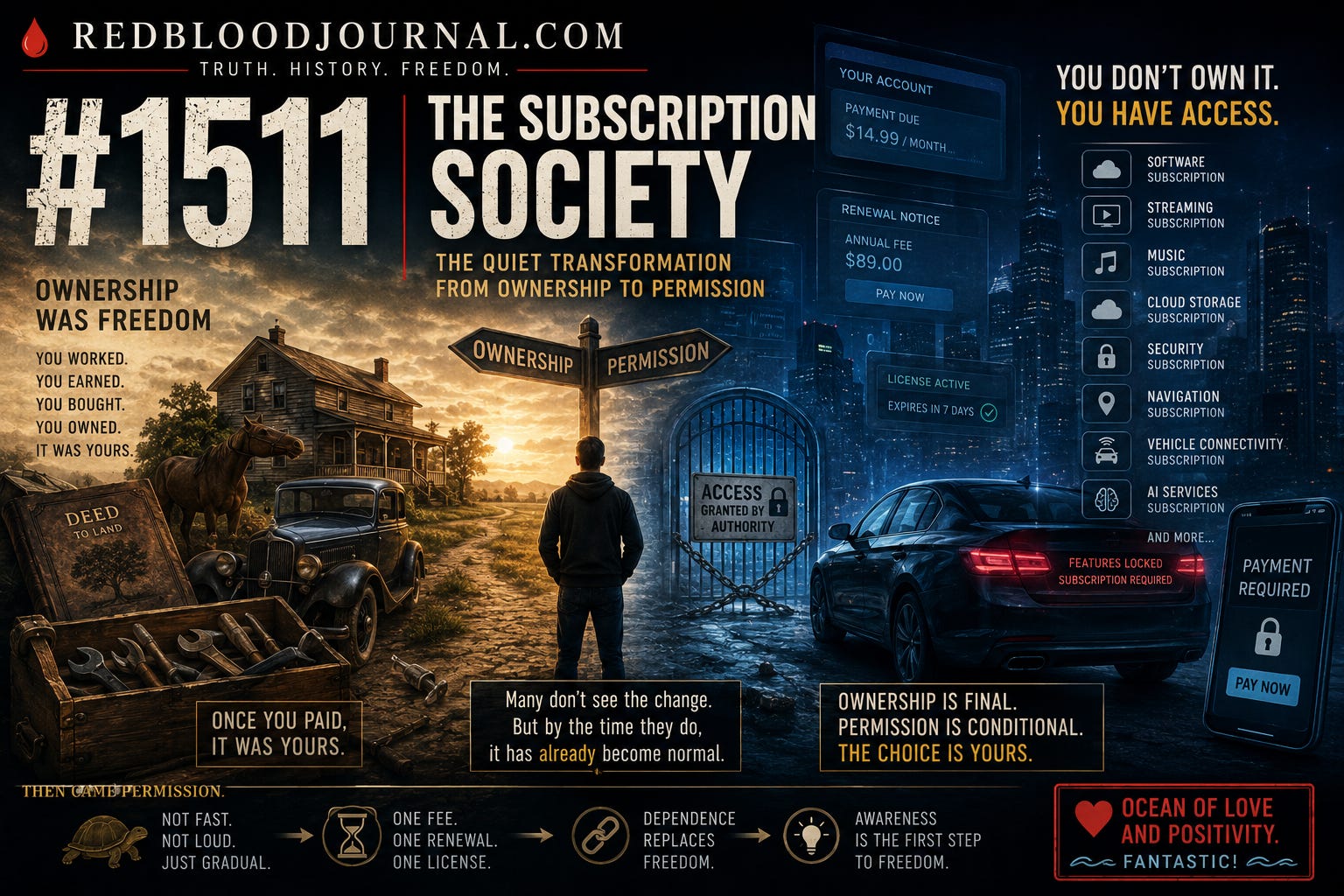
#1511 – The Subscription Society
The Quiet Transformation from Ownership to Permission
Throughout most of human history, ownership represented freedom.
A person worked.
They earned.
They purchased.
And once something was paid for, it generally became theirs.
A house.
A horse.
A piece of land.
A wagon.
A tool.
Ownership was relatively simple.
Today, the meaning of ownership appears to be changing.
Not overnight.
Not dramatically.
But gradually.
Almost unnoticed.
Like the turtle rather than the rabbit.
Instead of taking ownership away all at once, society slowly becomes accustomed to paying forever.
One subscription.
One annual renewal.
One license.
One registration.
One mandatory fee.
One automatic payment at a time.
Eventually the next generation accepts this as normal because they never experienced anything different.
Ownership Has Become Conditional
The modern economy increasingly separates buying from owning.
Software was once purchased.
Today it is rented monthly.
Music was once bought on records, tapes, CDs, or digital files.
Today access depends upon maintaining a subscription.
Movies once filled shelves.
Today entire libraries disappear the moment payments stop.
Books can now be remotely removed from digital readers.
Video games increasingly require online authentication to continue functioning.
Even tractors costing hundreds of thousands of dollars often require manufacturer authorization before certain repairs can be made.
The buyer pays.
Yet another party continues to control.
The purchase becomes less about ownership and more about permission.
The Automobile Example
Few examples illustrate this transformation more clearly than the automobile.
Imagine purchasing a vehicle.
You paid sales tax.
You paid the dealer.
You paid financing costs if applicable.
The vehicle is fully paid for.
Yet each year another payment arrives.
It is called registration.
Elsewhere it may be called renewal.
Another jurisdiction may call it licensing.
Another may call it road use fees.
Different names.
The same recurring obligation.
If that payment is not made, eventually the government may prohibit the vehicle from being legally driven on public roads, impose penalties, or take enforcement action according to law.
To many people, this raises a philosophical question:
If something can no longer be used without continuing payments, in what sense is it completely owned?
Supporters argue these fees fund roads, administration, and public services.
Critics argue they blur the line between ownership and continuing permission.
Homes Are Similar
The same discussion often arises regarding real estate.
A family may spend thirty years paying off a mortgage.
The house becomes debt free.
Yet property taxes continue.
If those taxes remain unpaid over time, governments generally have legal authority to place liens on the property and, in some circumstances, pursue tax foreclosure.
Again, supporters view property taxation as necessary for schools, police, fire protection, and local government.
Critics argue that perpetual taxation means ownership is never entirely unconditional.
The debate is not merely economic.
It is philosophical.
Subscription Everywhere
The subscription model has quietly spread into nearly every area of modern life.
Software subscriptions.
Streaming subscriptions.
Cloud storage subscriptions.
Vehicle connectivity subscriptions.
Navigation subscriptions.
Security monitoring subscriptions.
Phone plans.
Television.
Music.
News.
Artificial intelligence.
Fitness.
Even household appliances increasingly depend upon online services controlled by manufacturers.
The monthly payment becomes so small that it rarely attracts attention.
But multiplied across dozens of services, the result is that many people no longer truly possess the products they rely upon.
They lease access to them.
The Turtle Strategy
If all of these changes had arrived in a single year, people might have resisted.
Instead they appeared one by one.
Each change seemed reasonable by itself.
Each fee appeared relatively insignificant.
Each subscription promised convenience.
Each annual renewal appeared ordinary.
Each update was justified independently.
The turtle rarely alarms anyone.
Yet after decades, people may wake up living in a world that looks very different from the one their grandparents knew.
The Economics of Dependence
Subscriptions offer obvious financial advantages.
Predictable revenue.
Long-term customer relationships.
Higher company valuations.
Reduced uncertainty.
These incentives alone explain much of their popularity.
Yet recurring payments also create dependence.
When access depends upon continuing payments, the customer becomes permanently connected to the provider.
Instead of a completed transaction, the relationship never ends.
The product remains economically attached to its creator.
Ownership or Permission?
This leads to a larger philosophical question.
When does ownership quietly become permission?
If a person must continuously renew licenses, registrations, subscriptions, certifications, memberships, and recurring fees in order to keep using things they have already paid for, have they purchased permanent ownership—or have they purchased continuing access under conditions established by someone else?
Different people answer this differently.
Some view recurring obligations as the practical cost of maintaining a complex modern society.
Others see them as evidence that society is gradually shifting from independent ownership toward conditional use.
Looking Beyond the Individual Fee
This report does not claim that every registration fee, subscription, or tax exists because of a single hidden purpose.
Each has its own legal, economic, or practical justification.
Rather, it asks readers to step back and observe the broader pattern.
Viewed individually, each recurring payment may seem reasonable.
Viewed collectively, they reveal a long-term trend:
The concept of ownership itself may be evolving.
The more aspects of life that depend upon ongoing permission, the more valuable the ability to grant—or withdraw—that permission becomes.
Whether one interprets this as the natural evolution of modern economics or as a gradual concentration of institutional power, it raises an important question:
If ownership increasingly depends upon someone else’s continuing authorization, who ultimately controls what we believe we own?
That question serves as the foundation for the next report.
🩸 Ocean of Love and Positivity.
Fantastic!
🔄 The End of Ownership:
The Rise of Permission Economy
Jul 19, 2026
The provided text explores the gradual transition from traditional personal ownership to a modern system defined by recurring subscriptions and conditional access. It argues that through a “turtle-like” strategy, society has become accustomed to perpetual payments for items previously bought outright, such as software, media, and even physical goods like tractors. This shift extends to government-mandated fees like property taxes and vehicle registrations, which the author suggests make ownership feel more like continuing permission than permanent possession. The narrative posits that while these models provide predictable revenue for companies and funding for public services, they also create a state of economic dependence. Ultimately, the source challenges readers to consider who holds true control over property when its use requires the ongoing authorization of an outside party.


