


🩸 Red Blood Journal
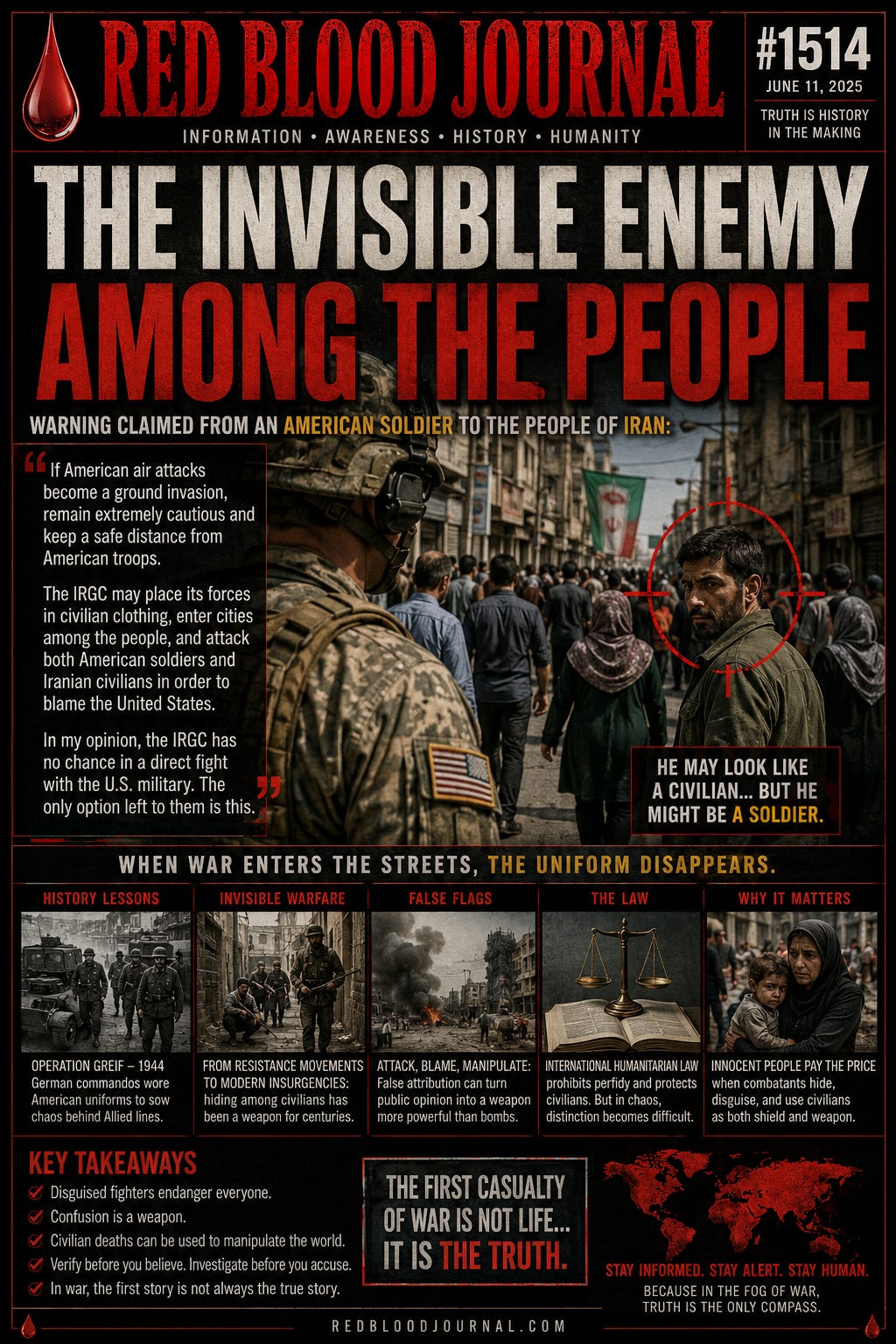
#1514 – The Army Hidden Among the People
Civilian Disguises, False Attribution, and the Dangerous History of the Invisible Battlefield
A message circulating in Persian-language media presents what is described as a warning from an American soldier to the people of Iran:
If American air attacks become a ground invasion, remain extremely cautious and keep a safe distance from American troops. The Islamic Revolutionary Guard Corps may place its forces in civilian clothing, send them into populated areas, and attack both American soldiers and Iranian civilians in an effort to place responsibility on the United States.
The message further argues that the IRGC would have little chance of confronting the United States military directly and might therefore rely on disguise, infiltration, irregular warfare, and manipulation of public perception.
The identity of the alleged American soldier and the authenticity of the statement have not been independently verified.
For that reason, the quotation must not be presented as an established military announcement.
However, the strategy described in the message is not historically unimaginable.
Armies, intelligence services, resistance movements, militias, insurgents, and special forces have repeatedly used disguise, infiltration, civilian environments, enemy uniforms, deceptive markings, and false attribution throughout history.
The greater issue is therefore not whether one circulating message has been authenticated.
The greater issue is what happens when the battlefield enters the civilian population and no one can easily determine who is a soldier, who is a civilian, who fired first, or who is responsible for the dead.
The Ancient History of Military Deception
Deception is nearly as old as warfare itself.
Ancient military writings repeatedly describe victory through surprise, concealment, misinformation, and psychological manipulation.
The Trojan Horse remains one of history’s most famous stories of military deception.
According to the traditional account, Greek forces appeared to abandon their siege of Troy while leaving behind a large wooden horse. Trojan forces brought the object inside their fortified city, unaware that Greek soldiers were concealed within it.
Whether every detail of the story is historical or legendary, its lasting significance is unmistakable:
The most dangerous soldier may be the one who does not appear to be a soldier.
Ancient armies also used false retreats, disguised scouts, secret infiltrators, misleading campfires, altered banners, planted information, and rumors intended to weaken an enemy before combat began.
The battlefield was never limited to swords and arrows.
The mind was always part of the battlefield.
From Open Battlefields to Hidden Combatants
Traditional warfare created a visible separation between armies and civilians.
Soldiers often marched in formation.
They carried banners.
They wore recognizable clothing.
They gathered in military camps.
They fought on identifiable battlefields.
This did not make war humane, but it made the opposing forces easier to recognize.
As warfare moved into cities, villages, mountains, forests, and occupied territories, that distinction became increasingly difficult to maintain.
Guerrilla fighters could disappear into the population.
Resistance members could hide weapons beneath ordinary clothing.
Intelligence officers could travel as merchants, workers, journalists, diplomats, or refugees.
A combatant could participate in an attack and then return to a civilian environment.
This created one of the most dangerous dilemmas in warfare:
When soldiers cannot distinguish combatants from civilians, every civilian may begin to appear suspicious.
And once every civilian appears suspicious, genuine civilians are placed in immediate danger.
The Laws of War and the Need for Distinction
Modern humanitarian law is built partly upon the principle of distinction.
Military forces are expected to distinguish between:
Combatants and civilians
Military targets and civilian property
Those participating in hostilities and those not participating
Legitimate military activity and protected humanitarian activity
Article 48 of Additional Protocol I to the Geneva Conventions requires parties to distinguish between civilian populations and combatants, and between civilian objects and military objectives. (United Nations Legal Affairs)
The Hague Regulations of 1907 also described conditions traditionally associated with lawful combatants and militias. These included responsible command, a recognizable distinctive emblem, carrying weapons openly, and conducting operations according to the laws and customs of war. (ICRC IHL Databases)
These requirements serve more than a ceremonial purpose.
A recognizable military identity helps protect civilians.
When combatants identify themselves as combatants, opposing forces have less justification for treating the entire population as a potential military threat.
The uniform therefore protects more than the soldier wearing it.
It also helps protect the civilian standing beside that soldier.
What Is Perfidy?
International humanitarian law distinguishes between lawful military deception and perfidy.
Camouflage, decoys, misinformation, concealed troop movements, and misleading an enemy about military strength may sometimes qualify as lawful ruses of war.
Perfidy is different.
Perfidy involves exploiting a protected status in order to betray the enemy’s confidence and then kill, injure, or capture that enemy.
Article 37 of Additional Protocol I prohibits killing, injuring, or capturing an adversary through perfidy. Examples include pretending to surrender, pretending to be wounded, pretending to be a civilian, or falsely claiming another protected status in order to attack. (ICRC IHL Databases)
The International Committee of the Red Cross identifies the feigning of civilian or noncombatant status as a recognized example of perfidious conduct when it is used to carry out an attack. (ICRC IHL Databases)
The crucial distinction is purpose.
A soldier merely moving secretly in ordinary clothing does not automatically make every action perfidy.
But pretending to be a protected civilian in order to approach an enemy and then launch an attack may cross that legal line.
The law is concerned not merely with clothing.
It is concerned with the deliberate betrayal of protection.
Operation Greif: Germans Disguised as Americans
One of the clearest historical examples occurred during the Battle of the Bulge in December 1944.
Nazi Germany organized Operation Greif, led by Otto Skorzeny.
German commandos were given captured American uniforms, American vehicles, and instructions to infiltrate Allied positions.
Their missions included:
Changing road signs
Spreading false orders
Disrupting communications
Misdirecting American military traffic
Creating confusion behind Allied lines
Attempting to assist the capture of strategic bridges
The operation failed to achieve its main military objective, but it created fear far beyond the number of infiltrators actually involved. American checkpoints multiplied, troops questioned one another, traffic slowed, and rumors spread that disguised Germans were present everywhere. (The National WWII Museum)
This is one of the most important lessons of deceptive warfare:
A small disguised force may create a psychological effect far greater than its physical strength.
The operation demonstrated that confusion itself can become a weapon.
A few infiltrators may cause thousands of soldiers to distrust one another.
Enemy Uniforms and the Legal Boundary
The legal history of Operation Greif also shows that not every use of disguise is treated identically.
After the war, Skorzeny and other defendants were tried over the alleged misuse of American uniforms.
The legal dispute focused partly on whether the uniforms had been used during actual combat or only for infiltration and deception before an attack.
This illustrates a complicated distinction recognized in the laws of armed conflict:
Using enemy uniforms for intelligence gathering, movement, or deception has historically been judged differently from fighting and killing while still presenting oneself as the enemy.
International humanitarian law prohibits improper use of enemy flags, insignia, or uniforms during attacks. (ICRC IHL Databases)
The boundary may appear technical, but its purpose is practical.
If uniforms, medical symbols, surrender gestures, or civilian clothing can always be used as traps, no soldier will trust them.
Once that trust collapses, wounded soldiers, surrendering troops, medical workers, and civilians all face greater danger.
Resistance Movements and Occupied Territories
During the Second World War, resistance movements across Europe frequently operated without conventional uniforms.
Members sabotaged railway lines, collected intelligence, transported weapons, printed underground newspapers, helped escaped prisoners, and attacked occupying forces.
They often lived as ordinary civilians between operations.
From their perspective, invisibility was necessary for survival.
From the occupying military’s perspective, invisible fighters created constant uncertainty.
This tension reveals a painful reality:
A person may be considered a freedom fighter by one population, an unlawful combatant by an occupying power, and a civilian by someone who does not know of that person’s activities.
These categories are not always visually apparent.
The more a conflict depends upon secret fighters, the more difficult civilian protection becomes.
This does not excuse attacks on civilians.
It explains why wars conducted within civilian populations become especially destructive.
Vietnam and the Unclear Front Line
The Vietnam War provided another major example of a battlefield without a clear front line.
Viet Cong forces operated through villages, tunnels, forests, local support networks, and concealed supply routes.
Some fighters wore recognizable clothing during certain operations.
Others blended into civilian environments.
American soldiers often struggled to determine who was a civilian, who supported the insurgency, and who was directly participating in combat.
This uncertainty contributed to fear, wrongful suspicion, collective punishment, civilian casualties, and atrocities.
The strategic problem was not merely identifying an armed enemy.
It was identifying a hidden political and military system existing within the population.
The lesson from Vietnam is not that civilians should be presumed guilty.
It is the opposite.
When an army begins assuming that every civilian may be an enemy, the distinction required to protect innocent people begins to collapse.
Iraq and the Return of the Invisible Fighter
After the 2003 invasion of Iraq, coalition forces confronted insurgents who often operated in civilian clothing, used ordinary vehicles, placed weapons inside civilian areas, and attacked military forces before disappearing into neighborhoods.
Suicide bombers, roadside bombs, false checkpoints, stolen uniforms, and disguised attackers further complicated identification.
An ordinary car might carry a family.
It might carry explosives.
A person approaching a checkpoint might need help.
That person might also be preparing an attack.
These uncertainties placed soldiers and civilians into a deadly relationship of mutual fear.
Soldiers became more likely to react quickly.
Civilians became more afraid of approaching soldiers.
Militants could then benefit from every mistaken shooting because civilian deaths increased anger against the occupying force.
This is one reason civilian casualties can become strategically useful to irregular forces.
The objective may not always be to defeat a powerful army directly.
The objective may be to provoke that army into actions that destroy its legitimacy.
The Strategy of Provocation
A weaker force facing a stronger military may not seek conventional victory.
Instead, it may try to produce:
Civilian casualties
Images of destruction
Public outrage
Political pressure
International condemnation
Ethnic or religious retaliation
Loss of trust in the stronger military
A prolonged occupation
Recruitment for resistance
Under this strategy, the weaker side benefits when the stronger side overreacts.
An attack may be launched from a civilian environment precisely because the expected response will endanger civilians.
The military value of the original attack may be limited.
The political value of the response may be enormous.
This does not mean every civilian casualty was deliberately engineered.
It means modern warfare often rewards those who understand that an image can be more powerful than a battlefield victory.
False Flags and False Attribution
The circulating message concerning Iran goes beyond ordinary disguise.
It suggests the possibility of attacking Iranian civilians and then placing responsibility upon American forces.
That would fall within the broader concept of false attribution or a false-flag operation.
A false-flag operation is generally understood as an action carried out in a manner intended to conceal its true author and place blame on another party.
Historically, accusations of false flags have appeared before wars, coups, invasions, terrorist attacks, political assassinations, and internal security crackdowns.
Some have later been documented.
Many others have remained unproven.
Still others were invented as propaganda.
This is precisely why the term must be used carefully.
Calling every unexplained attack a false flag destroys the meaning of evidence.
But refusing to acknowledge that false attribution has existed throughout history would be equally naïve.
The responsible position is neither automatic belief nor automatic dismissal.
It is investigation.
Why Blame Becomes a Weapon
In modern war, responsibility matters almost as much as the attack itself.
The side blamed for an incident may suffer:
International condemnation
Sanctions
Loss of domestic support
Military retaliation
Diplomatic isolation
Criminal investigations
Collapse of alliances
Mass public anger
Therefore, controlling attribution becomes strategically important.
A party may attempt to shape perception by:
Releasing selected video
Removing identifying evidence
Using captured weapons
Wearing another force’s uniform
Staging communications
Presenting casualties without context
Publishing footage before investigators arrive
Accusing the enemy immediately
Flooding social media with contradictory stories
The first version of an event often becomes the version most people remember.
Later corrections rarely travel as far.
The Smartphone Has Changed the Battlefield
In previous wars, governments, newspapers, radio stations, and television networks largely controlled wartime information.
Today, nearly every civilian carries a camera.
This can expose crimes that might once have remained hidden.
But it can also produce another form of confusion.
A short video may show the explosion but not who launched the weapon.
A uniform may be real, stolen, copied, or incomplete.
A voice may be added later.
The location may be misidentified.
The date may be wrong.
Footage from one country may be presented as footage from another.
Artificial intelligence can now alter faces, voices, backgrounds, insignia, and entire scenes.
The modern observer may witness more visual evidence than any previous generation while remaining less certain of what actually happened.
Why Civilian Disguise Endangers Every Civilian
When fighters consistently operate as civilians, the immediate advantage belongs to the fighter.
The long-term cost is paid by the civilian population.
Soldiers become suspicious of:
Ordinary vehicles
Civilian clothing
Mobile phones
Hospitals
Ambulances
Religious buildings
Residential homes
Journalists
Aid workers
Refugee movements
This suspicion can lead to delays in humanitarian aid, aggressive searches, wrongful detention, shootings at checkpoints, and attacks based on mistaken identification.
International humanitarian law gives civilians protection against direct attack unless and for such time as they directly participate in hostilities. (ICRC)
But determining participation in real time can be extraordinarily difficult.
A civilian should not lose protection merely because a soldier is uncertain.
The ICRC’s guidance emphasizes that feasible precautions must be taken and that, in cases of doubt, an individual should be presumed protected against direct attack. (ICRC)
This legal protection is essential because uncertainty must not become permission to kill.
Could Such a Strategy Be Used in Iran?
Iran has a long history of conventional military forces, revolutionary institutions, intelligence organizations, internal security units, paramilitary structures, and networks capable of irregular warfare.
The IRGC and affiliated forces have historically emphasized asymmetric methods when facing a technologically stronger opponent.
Such methods may include:
Decentralized operations
Concealment
Missile and drone warfare
Sabotage
Proxy forces
Intelligence networks
Urban resistance
Maritime disruption
Cyberoperations
Psychological warfare
Information operations
This makes discussions of irregular resistance plausible at a strategic level.
However, plausibility is not proof.
There is presently no verified evidence within the circulating statement itself demonstrating that the IRGC has adopted a specific plan to disguise forces as civilians, attack Iranian citizens, and blame the United States.
The claim should therefore be understood as a warning or scenario—not an established fact.
A serious journal must maintain this distinction.
History teaches that such methods have existed.
History does not prove that every current accusation is true.
What a Ground Invasion Would Mean
A ground invasion of Iran would be entirely different from an air campaign.
Iran is geographically large, highly populated, mountainous, politically complex, and home to numerous major cities.
A ground conflict could produce:
Urban combat
Large-scale displacement
Attacks on supply lines
Armed resistance
Competing militias
Sabotage
Internal score-settling
False rumors
Breakdown of communications
Competing claims of authority
Disguised armed actors
Criminal opportunism
Foreign intelligence operations
In such an environment, the uniform may no longer provide a reliable answer.
A person wearing civilian clothing may be an innocent resident, a frightened government employee, a member of an armed group, a criminal, an intelligence operative, or someone trying to escape.
A person wearing a military uniform may be a genuine soldier, a deserter, an infiltrator, or someone who stole the clothing.
The population would be forced to navigate not only physical danger but informational darkness.
Practical Civilian Lessons from History
The purpose of examining history is not to create panic.
It is to understand recurring dangers.
During an active ground conflict, civilians should avoid assuming that clothing, language, insignia, flags, vehicles, or social-media claims provide definite identification.
Where possible, civilians should:
Keep distance from military formations and armed individuals
Avoid gathering near checkpoints or military vehicles
Avoid photographing sensitive military activity at close range
Follow evacuation instructions from multiple verified sources
Treat abandoned weapons or equipment as dangerous
Avoid spreading unverified claims that could provoke retaliation
Preserve original footage when documenting events
Record time, location, direction, and surrounding circumstances
Avoid approaching wounded combatants unless conditions are clearly safe
Recognize that crowds may become targets or shields
Avoid displaying weapons or military clothing
Understand that rumors may be deliberately manufactured
None of these precautions can guarantee survival.
They can only reduce exposure to avoidable danger.
The Final Battlefield Is Responsibility
In a conventional battle, victory may be measured by territory captured or forces destroyed.
In irregular war, victory may be measured by who controls the story of the dead.
Who fired?
Who wore the uniform?
Who gave the order?
Who placed military forces near civilians?
Who responded disproportionately?
Who recorded the video?
Who edited it?
Who released it first?
Who benefited from the outrage?
These questions may determine political outcomes long after the gunfire ends.
The circulating warning attributed to an American soldier remains unverified.
It should not be repeated as confirmed fact.
But the historical pattern behind it deserves serious attention.
Combatants have disguised themselves before.
Armies have used enemy uniforms before.
Armed groups have operated among civilians before.
Governments have blamed opponents before investigations were completed.
Propaganda has transformed uncertainty into certainty before.
And innocent people have repeatedly paid the price.
The greatest danger begins when the population can no longer distinguish the soldier from the civilian, the defender from the attacker, or evidence from theater.
At that moment, the battlefield is no longer merely in the streets.
It is inside the public mind.
RedBloodJournal.com
From the ocean of love and positivity, may ordinary people never be reduced to disguises, shields, statistics, or instruments of another person’s war.
🩸🌊✨ Fantastic!
🎭 The Invisible Battlefield:
Deception and Distinction in Modern War
1 source·Jul 19, 2026
The provided text examines the perilous history and legal implications of military deception, specifically focusing on the use of civilian disguises and false-flag operations. It uses a viral, unverified warning about potential Islamic Revolutionary Guard Corps tactics as a starting point to discuss how modern combatants often blur the lines between soldiers and non-combatants. By exploring historical examples like the Trojan Horse and Operation Greif, the source illustrates how “perfidy” undermines international humanitarian law and heightens the risks faced by genuine civilians. The text emphasizes that when the battlefield moves into populated areas, psychological warfare and the control of information become as decisive as physical weapons. Ultimately, the source serves as a cautionary analysis of how irregular warfare transforms innocent populations into strategic tools, making identification and accountability nearly impossible.


