


🩸 Red Blood Journal
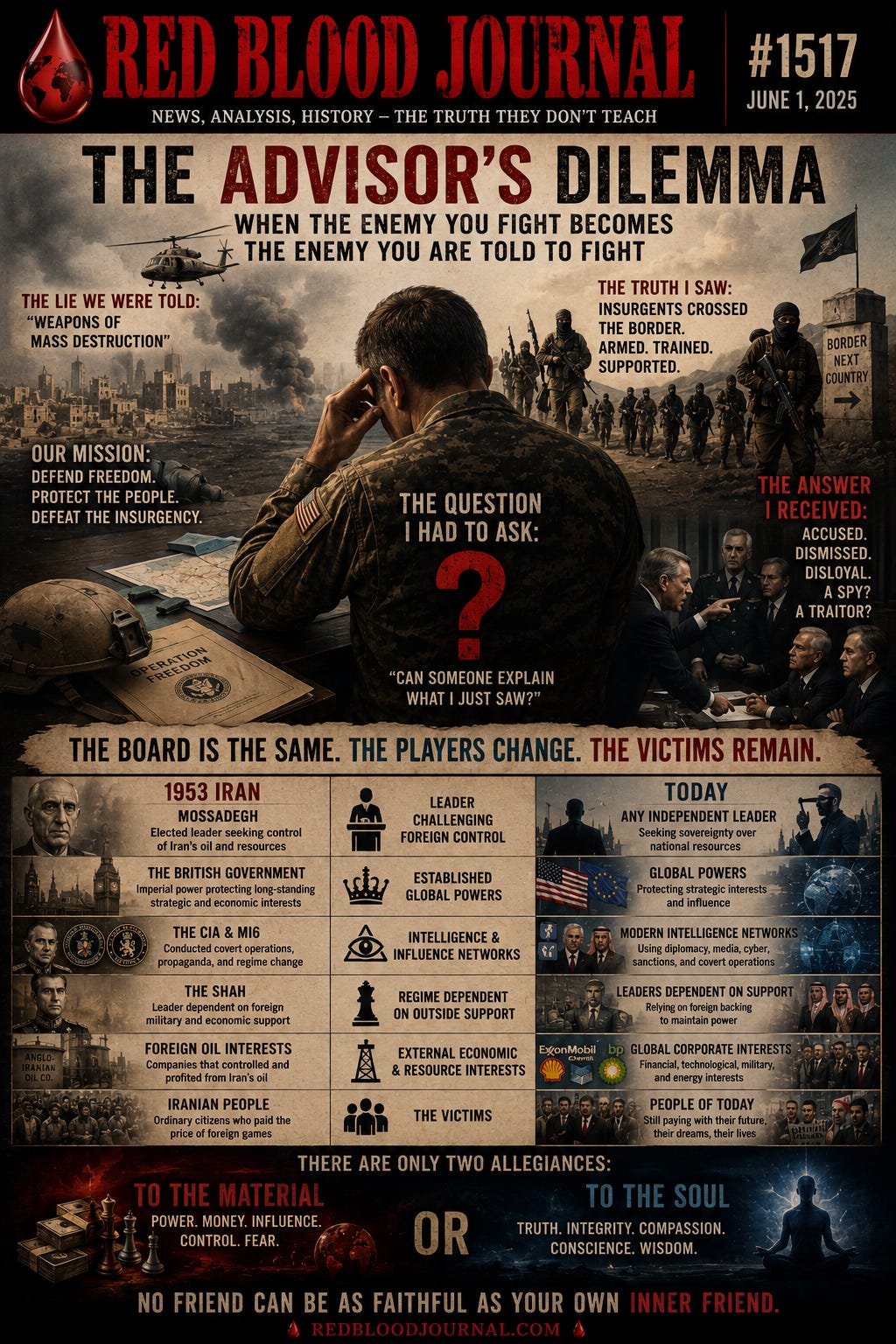
#1517 – The Advisor’s Dilemma
When the Enemy You Fight Becomes the Enemy You Are Told to Fight
Imagine serving as a military advisor.
You believe your mission is honorable.
You believe your country has entered a war for legitimate reasons.
You are told the world is being protected.
You train soldiers.
You advise commanders.
You help build strategies intended to defeat an insurgency.
Every day you risk your life believing you are contributing to something greater than yourself.
Then one day something happens.
Not something you heard.
Not something you read.
Something you personally witness.
You see people crossing the border.
Not refugees.
Not civilians.
Armed fighters.
Individuals who appear to become part of the very insurgency your forces are risking their lives to defeat.
Your first reaction is confusion.
Perhaps there is an explanation.
Perhaps intelligence knows something you do not.
So you do what any responsible advisor should do.
You ask a question.
Not because you oppose your country.
Not because you support the enemy.
Not because you seek attention.
Simply because what you witnessed does not fit the narrative you have been given.
You expect an investigation.
Instead...
The room becomes quiet.
No one explains what you observed.
No one asks for additional details.
Instead, the questions begin turning toward you.
“Why are you asking?”
“Do you understand the bigger picture?”
“Where is your loyalty?”
“Are you becoming a security concern?”
Suddenly the discussion is no longer about what happened.
It is about the person who noticed it.
The evidence disappears.
The observer becomes the suspect.
The messenger becomes the story.
History contains many examples in which institutions—governments, militaries, corporations, intelligence agencies, political parties, and even religious organizations—have struggled with internal dissent.
Questioning can strengthen an institution by exposing mistakes.
Or it can be viewed as threatening unity during times of conflict.
When protecting the institution becomes more important than examining reality, uncomfortable questions often receive labels instead of answers.
Traitor.
Spy.
Disloyal.
Conspiracy theorist.
The label ends the conversation.
The question remains unanswered.
Yet history repeatedly demonstrates that many important truths began with someone willing to ask an uncomfortable question.
Not every concern proves correct.
Not every suspicion becomes fact.
But every healthy institution benefits from examining evidence rather than silencing inquiry.
Perhaps the greatest battlefield is not fought with weapons at all.
Perhaps it exists inside every human being.
There comes a moment when external authority and internal conscience no longer agree.
One voice says:
“Remain silent.”
The other quietly asks:
“What if remaining silent is the greater betrayal?”
That moment cannot be delegated.
No commander can decide it.
No politician can decide it.
No intelligence agency can decide it.
Only conscience can.
Perhaps this is why material life exists.
Every conflict.
Every promotion.
Every reward.
Every threat.
Every temptation.
Every fear.
Every opportunity.
Becomes part of a curriculum.
The curriculum is not merely about winning wars.
It is about discovering who we become while fighting them.
History remembers generals.
Politicians.
Presidents.
Prime ministers.
But history is carried upon the backs of ordinary people.
Soldiers.
Families.
Children.
Citizens.
They are the ones who ultimately pay for decisions made in distant rooms.
Perhaps there are only two lasting allegiances.
One is allegiance to the material world.
Power.
Money.
Influence.
Position.
Control.
The other is allegiance to the soul.
Truth.
Integrity.
Compassion.
Conscience.
Wisdom.
Everything else is temporary.
Flags change.
Governments change.
Empires rise.
Empires fall.
But the conversation each person has with their own conscience remains until the very end.
No nation can accompany us forever.
No institution can stand beside us forever.
No commander can answer for our choices.
No friend can ever be as faithful...
...as the quiet friend that lives within.
Perhaps that is the only allegiance that never asks us to betray ourselves.
Subjects
Military ethics
Conscience versus authority
Institutional loyalty
The burden of witnessing
The messenger and the message
Moral courage
Truth versus narrative
The curriculum of material life
Inner conscience
The cost of silence
Suggested Tags
#RedBloodJournal #MilitaryEthics #Conscience #Truth #Leadership #History #InstitutionalPower #MoralCourage #WorldPolitics #InnerVoice
🩸 Red Blood Journal
The greatest victory is not always defeating an enemy. Sometimes it is refusing to betray the quiet voice within when every other voice demands silence. Material life may test our loyalty to power, but conscience reveals our loyalty to the soul.
🩸🌊✨ Fantastic!
⚖️ The Silent Battleground of Conscience
Jul 19, 2026
This text explores the profound moral conflict experienced by a military advisor who witnesses events that contradict the official narrative. When the advisor seeks clarity on these inconsistencies, the institution responds by deflecting the inquiry and questioning the individual’s loyalty rather than investigating the facts. This narrative highlights how organizations often prioritize institutional preservation over the pursuit of truth, effectively silencing dissent through intimidation and labeling. Ultimately, the source serves as a philosophical reflection on the struggle between external authority and personal conscience, suggesting that true integrity lies in honoring one’s internal values. It posits that while worldly powers and empires are fleeting, the commitment to one’s soul and truth is the only lasting allegiance. The passage concludes that life’s challenges are a curriculum designed to test whether an individual will betray their inner voice for the sake of security or status.


