


🩸 RED BLOOD JOURNAL TRANSMISSION
Transmission Code: RBJ-ERATH-OPS-042
Classification: EYES ONLY — TERRITORIAL EXPANSION MECHANISMS
Desk: Geo-PsyOps & Power Structures Analysis Unit
Archive: The Archive of Blood & Memory
Why Superpowers Script Their Own Rivalries
"The Security Guard that never leaves the Livingroom."
PROLOGUE — “THE ENEMY THAT OPENS THE GATE”
On the planet Erath, wars are rarely accidents.
They are sequences.
Not chaos—
but choreography.
A territory does not fall in a single strike.
It is softened, shaped, justified… and then absorbed.
The public sees conflict.
The architects see progress.
I — THE CORE ALLEGATION MODEL
At the center of the claim lies a repeating pattern:
A group expands control not by direct conquest alone,
but by manufacturing the conditions that make conquest appear necessary.
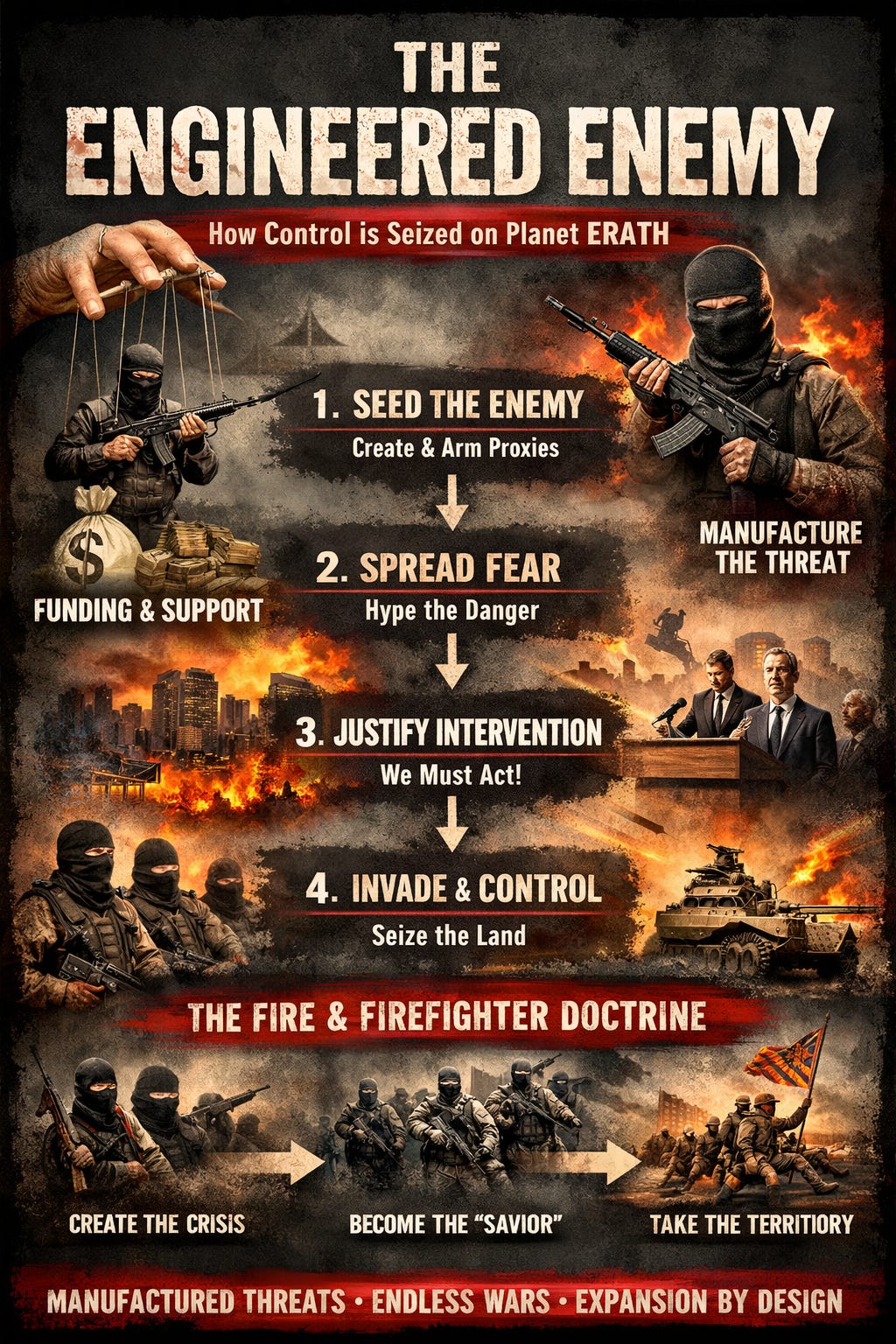
The mechanism unfolds in four stages:
Creation or cultivation of an adversary
Escalation of threat perception
Public justification of intervention
Territorial or structural takeover
The key idea is not simply war—
but engineered inevitability.
II — THE ENGINE: “CONTROLLED OPPOSITION DYNAMICS”
On Erath, some analysts describe this as:
“The Fire-and-Firefighter Doctrine”
Where the same unseen hand may:
Ignite instability (directly or indirectly)
Amplify the threat through narrative channels
Then arrive as the only force capable of restoring order
In this framework:
The “enemy” becomes functional, not accidental
Conflict becomes a tool, not a failure
Whether fully orchestrated or partially exploited,
the outcome is the same:
The justification for expansion is built into the conflict itself.
III — STEP-BY-STEP SEQUENCE
Stage 1 — Seed the Enemy
Financial backing, ideological spread, or power vacuums
Sometimes through proxies, sometimes through neglect
The “enemy” grows in a controlled or semi-controlled environment
Stage 2 — Let It Grow Teeth
The threat becomes visible
Attacks, instability, or radicalization escalate
Fear enters the public consciousness
Stage 3 — Amplify the Narrative
Media, officials, and institutions align messaging:
“This threat cannot be ignored”
“Action is necessary”
The moral frame is established:
Intervention = protection
Inaction = danger
Stage 4 — Intervention & Expansion
Military, political, or economic entry
Infrastructure, governance, or influence follows
Control shifts—permanently or semi-permanently
IV — WHY THIS STRATEGY WORKS
1. Psychological Acceptance
People resist invasion.
They accept defense.
By reframing expansion as protection, resistance drops.
2. Plausible Deniability
The complexity of global events creates fog:
Multiple actors
Conflicting intelligence
Unclear causality
This ambiguity allows narratives to coexist:
“We created it”
“We responded to it”
3. Self-Reinforcing Cycle
Each intervention plants seeds for the next:
Destabilization → New threats → New interventions
A loop emerges:
Threat → Response → Presence → New Threat
V — ALTERNATIVE INTERPRETATIONS
To maintain analytical integrity, multiple perspectives must be considered:
A — Intentional Design Theory
Suggests deliberate creation and control of enemies
Sees expansion as a long-term strategic plan
B — Opportunistic Response Theory
Enemies arise organically
Power structures exploit crises after they emerge
C — Systemic Chaos Theory
No central controller
Complex systems produce recurring patterns naturally
VI — THE INVISIBLE VARIABLE: OWNERSHIP
A recurring question on Erath:
Who benefits from continuous instability?
In many systems:
Governments change
Leaders rotate
Narratives shift
Yet underlying structures—financial, strategic, institutional—
often remain consistent.
This gives rise to the idea of:
“The Hidden Stakeholder Layer”
Not necessarily a single entity,
but a network of interests aligned around:
Influence
Access
Continuity of power
VII — THE GAS STATION PARADOX (ERATH ANALOGY)
Imagine multiple competing gas stations:
Different brands
Different pricing
Visible competition
But behind them:
Shared ownership
Shared supply chains
Coordinated outcomes
To the public: competition
To the system: controlled diversity
Now scale that model to:
Nations
Conflicts
Alliances
VIII — CONSEQUENCE FOR THE POPULATION
For the average citizen on Erath:
The enemy feels real
The fear is real
The losses are real
But the structure behind the conflict may operate on:
Different timelines
Different incentives
This creates a divide between:
Experienced reality vs. engineered trajectory
ANNEX A — THE ERATH EXPANSION LOOP
Seed → Threat → Narrative → Intervention → Control → Repeat
ANNEX B — SIGNAL INDICATORS
Patterns analysts look for:
Sudden emergence of well-funded opposition groups
Rapid narrative alignment across institutions
Pre-existing plans activated immediately after crises
Long-term presence following “temporary” intervention
ANNEX C — CRITICAL DISTINCTION
Not all conflicts follow this model.
Not all enemies are manufactured.
But the transmission highlights a possibility:
In certain cases, the line between enemy and instrument may blur.
FINAL LINE — “THE MAP BEHIND THE MAP”
On Erath, borders are not only drawn by wars—
but by the stories that justify them.
And sometimes…
the story begins
long before the first shot is fired.
🕸️The Fire and Firefighter Doctrine
The provided text outlines a strategic framework for territorial expansion on the planet Erath through the engineering of conflict.
This model, known as the “Fire-and-Firefighter Doctrine,” suggests that power structures may intentionally cultivate or exploit adversaries to make military or political intervention appear necessary.
By following a specific sequence of seeding threats and amplifying public fear, architects of this system transform conquest into a narrative of protection.
While the text acknowledges that some crises may be organic, it emphasizes that systemic interests often benefit from a continuous loop of instability and control.
Ultimately, the document serves as an analysis of how choreographed warfare and narrative manipulation are used to mask the permanent expansion of influence.


