


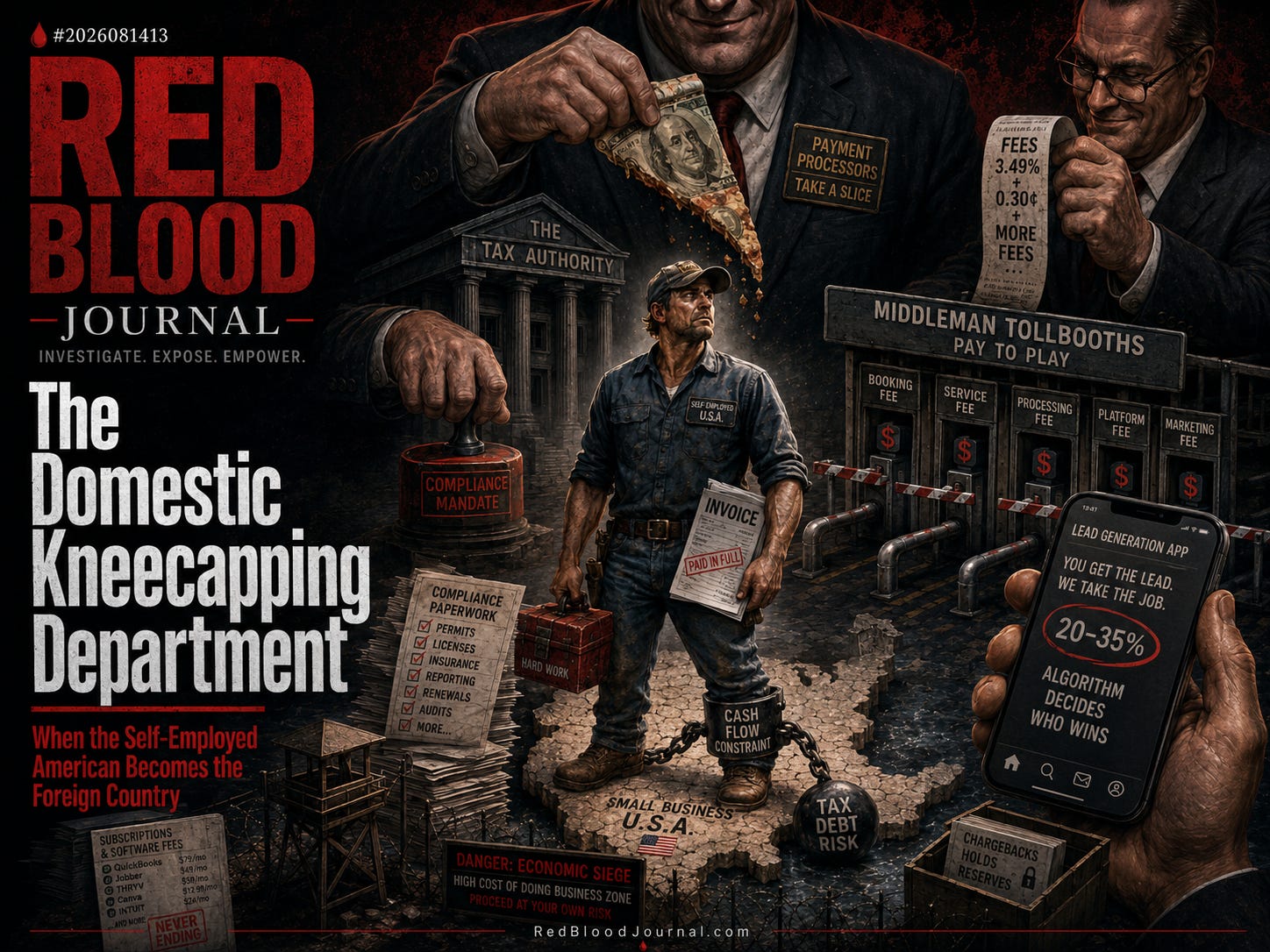
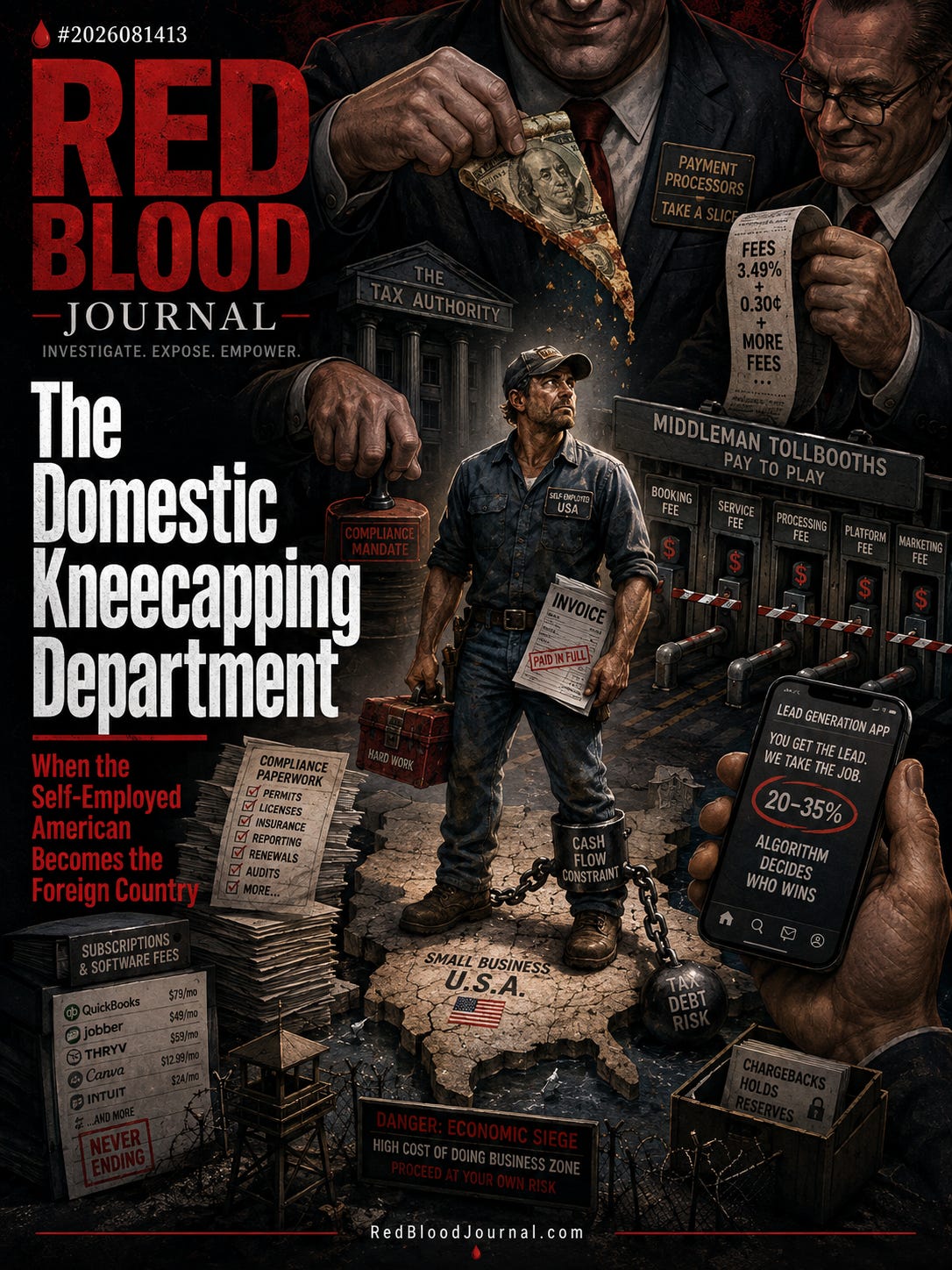
🩸 🛡️ #2026081413 — The Domestic Kneecapping Department
When the Self-Employed American Becomes the Foreign Country
RedBloodJournal.com
In #2026081411, the joke was international.
A country says:
“We want to stand on our own two feet.”
The superpower answers:
“Wonderful. Independence is sacred.”
The country stands up.
The superpower looks concerned.
“Not like that.”
Then come the sanctions, pressure, conditions, intermediaries, financial restrictions, approved channels, disapproved channels, experts, consultants, regulators, committees and men wearing suits who begin explaining why the country’s independence requires supervision.
Very funny.
Now bring the exact same joke home.
Because somewhere in America, at this very moment, a citizen is making an equally dangerous declaration:
“I want to work for myself.”
Sir.
Please remain calm.
The Domestic Kneecapping Department has been notified.
The Most Dangerous Man in America
He is not carrying a rifle.
He does not command an army.
He has no political party.
He has no nuclear program.
He has no aircraft carrier.
He has a pressure washer.
His name is Bob.
Bob has decided that instead of working for a large corporation, he will buy a pressure washer and clean driveways.
This seems innocent.
It is not.
Bob has discovered something civilization has spent decades trying to complicate:
One human can provide something another human wants.
Customer:
“My driveway is dirty.”
Bob:
“I can clean it.”
Customer:
“How much?”
Bob:
“$200.”
Customer:
“Done.”
Ladies and gentlemen, we have a crisis.
There appears to be no middleman.
Unauthorized Direct Commerce
The transaction is horrifying in its simplicity.
Bob performs $200 worth of work.
Customer pays Bob $200.
Bob receives $200.
Nobody took a commission.
Nobody generated a lead.
Nobody sold the lead to Bob.
Nobody charged Bob to bid on the lead.
Nobody charged the customer a service fee.
Nobody charged Bob a processing fee.
Nobody charged both of them a platform fee while congratulating each for saving money.
Nobody sold Bob a monthly premium membership.
Nobody ranked Bob beneath three companies that paid for advertising.
Nobody asked Bob whether he would like to boost his driveway-cleaning visibility for only $12.99.
Nobody sent Bob an email titled:
“Grow Your Business With Bob Pro Plus Premium Elite.”
This cannot continue.
Operation: Save Bob From Himself
Bob says:
“I just want to clean driveways.”
Excellent.
First, please choose a business structure.
Then determine licensing requirements.
Then insurance.
Then permits.
Then tax registration.
Then bookkeeping.
Then estimated taxes.
Then payroll obligations if Bob hires somebody.
Then sales-tax rules where applicable.
Then local requirements.
Then banking.
Then payment processing.
Then advertising.
Then website hosting.
Then scheduling software.
Then accounting software.
Then customer-review software.
Then lead generation.
Then business phone.
Then commercial vehicle expenses.
Then fuel.
Then repairs.
Then merchant fees.
Then perhaps a platform that promises to make Bob’s life simpler by adding seven more monthly subscriptions.
Bob looks at the pressure washer.
The pressure washer looks at Bob.
The pressure washer begins quietly applying for a job at Amazon.
Congratulations, Bob. You Are Free.
This is the magnificent part.
Everybody continues telling Bob:
“You are your own boss.”
Fantastic.
Bob’s bosses now include:
The customer.
The algorithm.
The bank.
The payment processor.
The insurer.
The tax authorities.
The licensing authorities.
The advertising platform.
The review platform.
The marketplace.
The landlord.
The software subscriptions.
The fuel pump.
And whichever website suddenly changed its terms of service at 2:14 Tuesday morning.
But technically Bob is self-employed.
So please clap.
The Foreign Country Comparison
Now imagine Bob as a small nation.
His pressure washer is the oil field.
His labor is the natural resource.
His customer list is the export market.
His bank account is the sovereign wealth fund.
Bob declares:
“The resource belongs to me. I performed the work. I would like to keep most of the proceeds.”
Suddenly everyone becomes nervous.
“Bob, Bob, Bob.
Nobody is saying you cannot keep your money.
We are merely saying there are several important institutions standing between you and your money.”
Bob asks:
“How many?”
A PowerPoint presentation begins.
The Middleman United Nations
Around Bob’s $200 invoice sits an emergency summit.
Representative of Payment Processing:
“We require 3 percent.”
Representative of Advertising:
“We introduced the customer.”
Bob:
“My neighbor introduced the customer.”
Advertising:
“We still feel involved.”
Representative of Insurance:
“We protect Bob.”
Bob:
“From what?”
Insurance:
“Primarily from not having insurance.”
Representative of Software:
“Bob requires our platform.”
Bob:
“I used a notebook.”
Software:
“That is not scalable.”
Representative of Accounting:
“Bob must maintain accurate records.”
Bob:
“Fair enough.”
Representative of Everyone Else:
“We will also be needing something.”
Bob:
“Did anybody here actually clean the driveway?”
Silence.
Security escorts Bob from the meeting.
The Lion’s Share
The fascinating thing is that nobody needs to take the entire lion’s share.
That would be too obvious.
The modern system is more elegant.
Everybody takes a mouse-sized share.
A little here.
A little there.
One percent.
Three percent.
Five percent.
Subscription.
Premium tier.
Renewal.
Permit.
Insurance.
Lead fee.
Listing fee.
Transaction fee.
Processing fee.
Platform fee.
Fuel tax.
Property-related cost.
Compliance cost.
Accounting cost.
Administrative cost.
Convenience fee.
Bob eventually receives his portion.
He is delighted to learn that, after personally performing 100 percent of the labor, he may retain enough money to buy lunch.
No drink.
The drink is available under Bob Premium.
Government Inc.
Now we arrive at the part that deserves care.
Some people describe government itself as though it were a giant hidden corporation.
Legally and literally, that is not how the United States government works.
But as satire, the comparison is irresistible.
Because to the self-employed person, government can sometimes feel remarkably like the largest silent business partner imaginable.
It does not wash the driveway.
It does not repair the roof.
It does not cut the hair.
It does not drive the passenger.
It does not build the cabinet.
It does not design the website.
Yet whenever income appears, paperwork soon follows.
Thus, for purposes of comedy only, allow us to introduce:
UNITED STATES OF AMERICA HOLDINGS, LLC*
*Not an actual corporation. Please do not send this report to the Secretary of State requesting corporate records.
Mission statement:
“Empowering independent Americans through a carefully engineered system ensuring they never experience independence without administrative companionship.”
Corporate slogan:
You Earn It. We Notice.
Welcome to Government Holdings
Bob receives his first check.
A siren sounds somewhere.
Revenue detected.
An analyst turns toward a screen.
“Sir, we have an independent economic event.”
“How serious?”
“Two citizens exchanged value directly.”
“My God.”
“Should we intervene?”
“Immediately. Send Form 28-B.”
“What does Form 28-B do?”
“Nobody knows. That’s why it is important.”
The American Regime Change Program
Foreign-policy regime change can replace an inconvenient government.
Domestic economic regime change is simpler.
You do not need tanks.
You do not need covert operations.
You do not need a coup.
You simply transform the self-employed person into an employee.
Watch carefully.
Bob starts independently.
Then costs rise.
Compliance grows.
Customer acquisition becomes expensive.
Insurance rises.
Vehicle expenses rise.
Platforms become necessary.
Payment systems become unavoidable.
Advertising becomes expensive.
Administration consumes evenings.
Taxes arrive.
Bob spends Sunday doing paperwork instead of seeing his family.
Then one afternoon Bob notices a sign:
NOW HIRING
$31 PER HOUR
BENEFITS
NO BUSINESS LICENSE REQUIRED
NO ESTIMATED TAXES
NO CUSTOMER ACQUISITION
NO INVOICING
Bob stares at his pressure washer.
The pressure washer whispers:
“We had a good run.”
Regime change complete.
No Coup Necessary
Nobody outlawed Bob.
That would be crude.
Nobody arrested Bob for entrepreneurship.
That would look terrible.
Nobody announced:
“Independent Americans are hereby prohibited.”
Instead, the system merely makes independence progressively less attractive.
This is much more sophisticated.
Bob voluntarily shuts down.
The government reports:
No evidence of forced closure.
Technically correct.
Bob merely chose between:
Running his business,
or
Remaining sane.
Freedom prevailed.
The Platform Liberation Army
Fortunately, corporations arrive to save Bob.
“Bob, don’t quit!”
“We can bring you customers!”
Wonderful.
“How much?”
“Only 20 percent.”
Bob pauses.
“Twenty percent of what?”
“Your independence.”
The platform creates Bob’s profile.
Bob uploads a picture.
Bob gets rated.
Bob gets ranked.
Bob gets scored.
Bob gets reviewed.
Bob gets promoted.
Bob gets demoted.
Bob gets suspended.
Bob gets reinstated.
Bob receives a badge reading:
INDEPENDENT PROFESSIONAL
Bob notices that the platform controls whether customers can see him.
He asks:
“If you control my customers, my ranking, my payment and my access to work, exactly which portion of this arrangement is independent?”
The app crashes unexpectedly.
The Incredible Disappearing Business Owner
This is where the comedy becomes serious.
Independent operators do not necessarily disappear because somebody passes a law saying:
“Small business shall cease.”
They can disappear slowly.
One retirement.
One closure.
One impossible rent increase.
One insurance renewal.
One regulation.
One platform dependency.
One giant competitor.
One year without enough margin.
One exhausted owner finally saying:
“I cannot keep doing this.”
Then the storefront becomes a chain.
The independent driver becomes a platform worker.
The neighborhood seller becomes a marketplace account.
The craftsman becomes a subcontractor.
The independent restaurant becomes a delivery-app kitchen.
The seller becomes a “creator.”
The customer becomes a “user.”
The human being becomes an account number.
Progress.
The Tollbooth Miracle
Imagine every road in America worked this way.
You leave your driveway.
Toll.
Turn left.
Toll.
Stop at traffic light.
Convenience fee.
Cross intersection.
Infrastructure fee.
Drive another mile.
Mobility-platform charge.
Arrive at work.
Destination-access fee.
Someone would eventually ask:
“Why does it cost $37 to drive three miles?”
Now apply that model to commerce.
Create product.
Toll.
Advertise product.
Toll.
Find customer.
Toll.
Accept payment.
Toll.
Deliver product.
Toll.
Report income.
Toll.
Remain compliant.
Toll.
Renew everything next year.
Toll.
Then newspapers publish an article:
WHY DON’T MORE AMERICANS START BUSINESSES?
Experts remain baffled.
We Need More Entrepreneurs
Every election season:
“Small business is the backbone of America.”
Bob smiles.
Finally.
Somebody appreciates him.
Then:
“We must support entrepreneurship.”
Wonderful.
Bob waits.
A new program is announced.
Bob becomes excited.
He reads the eligibility requirements.
Forty-three pages.
Minimum revenue threshold.
Maximum revenue threshold.
Approved industry codes.
Documentation requirements.
Application portal.
Certification.
Deadline.
Processing period.
Possible audit.
Bob closes the website.
“Maybe I’ll just go clean another driveway.”
Government:
“We admire your entrepreneurial spirit.”
The Fictitious Corporate Meeting
For comedy purposes, imagine the annual board meeting of Government Holdings & Associated Middlemen International.
Chairman:
“Ladies and gentlemen, how is Bob doing?”
Accountant:
“He earned $80,000.”
Chairman:
“Excellent. How much did Bob keep?”
Accountant:
“We are still investigating.”
Chairman:
“What happened?”
Accountant:
“Everyone got there before we finished counting.”
Chairman:
“Splendid.”
Platform executive:
“We have increased Bob’s independence fee.”
Insurance executive:
“We increased his protection expense.”
Software executive:
“We converted his one-time purchase into a monthly subscription.”
Bank:
“We charged him because his balance became too low.”
Bob:
“Why did my balance become too low?”
Bank:
“That information is available through Premium Banking Insights for $14.99 per month.”
Applause.
The Corporation Hiding Behind the Corporation Hiding Behind the Corporation
Perhaps the funniest part of modern commerce is how difficult it becomes to identify exactly who took what.
Bob’s customer pays $200.
The transaction travels through:
Customer.
Card network.
Processor.
Platform.
Bank.
Business account.
Software system.
Tax system.
Operating expenses.
Bob.
By the time the money reaches the person who actually performed the work, it has traveled farther than Marco Polo.
Bob asks:
“Where has my $200 been?”
Bank:
“For security reasons we cannot disclose that.”
Independence™, Now Available by Subscription
Perhaps the future will simplify everything.
BASIC INDEPENDENCE — $19.99/month
Includes:
Permission to call yourself self-employed.
Up to five invoices.
Limited access to your own money.
INDEPENDENCE PLUS — $49.99/month
Includes:
Ten invoices.
Priority access to customers.
Ability to speak to human support once per quarter.
INDEPENDENCE PREMIUM — $129.99/month
Includes:
Unlimited invoices.
Reduced fees on fees.
Advanced tax anxiety dashboard.
Complimentary sticker:
I AM MY OWN BOSS
Terms and conditions apply.
Boss status may be revoked without notice.
The Domestic Sanctions Program
In #2026081411, sanctions were part of the international joke.
Pressure the country until it changes behavior.
Domestic sanctions look different.
The independent worker is not formally sanctioned.
He simply experiences:
Higher costs.
Higher barriers.
Higher administrative demands.
More intermediaries.
Reduced margins.
Greater platform dependency.
And less time actually doing the work that generates income.
Eventually Bob changes behavior.
He closes.
Sanctions successful.
Target government removed.
Target government was Bob.
The Most Beautiful Irony
America was built culturally around a powerful image:
The independent farmer.
The independent merchant.
The craftsman.
The shopkeeper.
The inventor.
The mechanic.
The contractor.
The person who owned something small and answered primarily to himself.
Then modern society evolved.
Now the independent American may spend half the day satisfying institutions that did not exist when the phrase self-employed was invented.
And we still call him:
Independent.
That is magnificent comedy.
The Red Blood Perspective
#2026081411 asked what happens when a nation tries to stand on its own two feet.
#2026081413 asks:
What happens when an American does the same thing?
The comparison is metaphorical, not literal.
A self-employed American is not Venezuela.
A platform fee is not a military invasion.
A tax bill is not a coup.
A regulation is not a sanction.
But the underlying economic question deserves examination:
How many institutions can stand between producer and customer before independence becomes mostly a slogan?
How much of each dollar generated by labor reaches the person who performed the labor?
How much goes to necessary public functions?
How much buys legitimate services?
How much exists because concentration has made certain middlemen difficult to avoid?
How much administrative complexity can a one-person company absorb before the owner gives up?
And most importantly:
Is America still producing independent economic citizens, or increasingly converting them into dependent participants inside systems owned by somebody larger?
That is worth investigating.
Ocean of Love and Positivity Perspective
Middlemen are not automatically villains.
Government is not automatically an enemy.
Taxes can fund legitimate public functions.
Regulation can protect customers, workers and communities.
Platforms can connect people who otherwise would never meet.
Corporations can create enormous value.
The problem begins when the supporting structure becomes heavier than the person it supposedly supports.
An economy should not merely create employment.
It should preserve the possibility of independence.
One person.
One skill.
One customer.
One fair price.
One transaction.
Enough room for everyone providing genuine value to earn something—
without requiring the person doing the actual work to stand at the end of the line hoping somebody remembered to leave him lunch money.
Because if a nation believes countries should be allowed to stand on their own two feet, perhaps it should begin by making sure its own citizens still can.
And if Bob ever manages to earn $200, wash the driveway, pay everyone, file everything, renew everything, insure everything, document everything and still have $200 left—
please contact the Smithsonian.
We may have discovered the last truly independent American.
In an Ocean of Love and Positivity.
🩸🌊✨ Fantastic!
🛡️
The Domestic Kneecapping of the Independent American
Aug 14, 2026
This text uses a satirical lens to examine the modern extinction of true self-employment in America by comparing the struggles of a small business owner to a sanctioned nation. Through the story of “Bob,” a driveway cleaner, the author illustrates how a maze of middlemen, including government regulators, software platforms, and financial institutions, systematically siphon away the profits of independent labor. The narrative argues that excessive administrative burdens and hidden fees act as domestic sanctions that eventually force entrepreneurs back into corporate employment. While technically free, the individual is portrayed as trapped by a system that makes direct commerce nearly impossible without extensive supervision. Ultimately, the source questions whether the economic independence celebrated in American culture remains a reality or has become a paid subscription service.


