


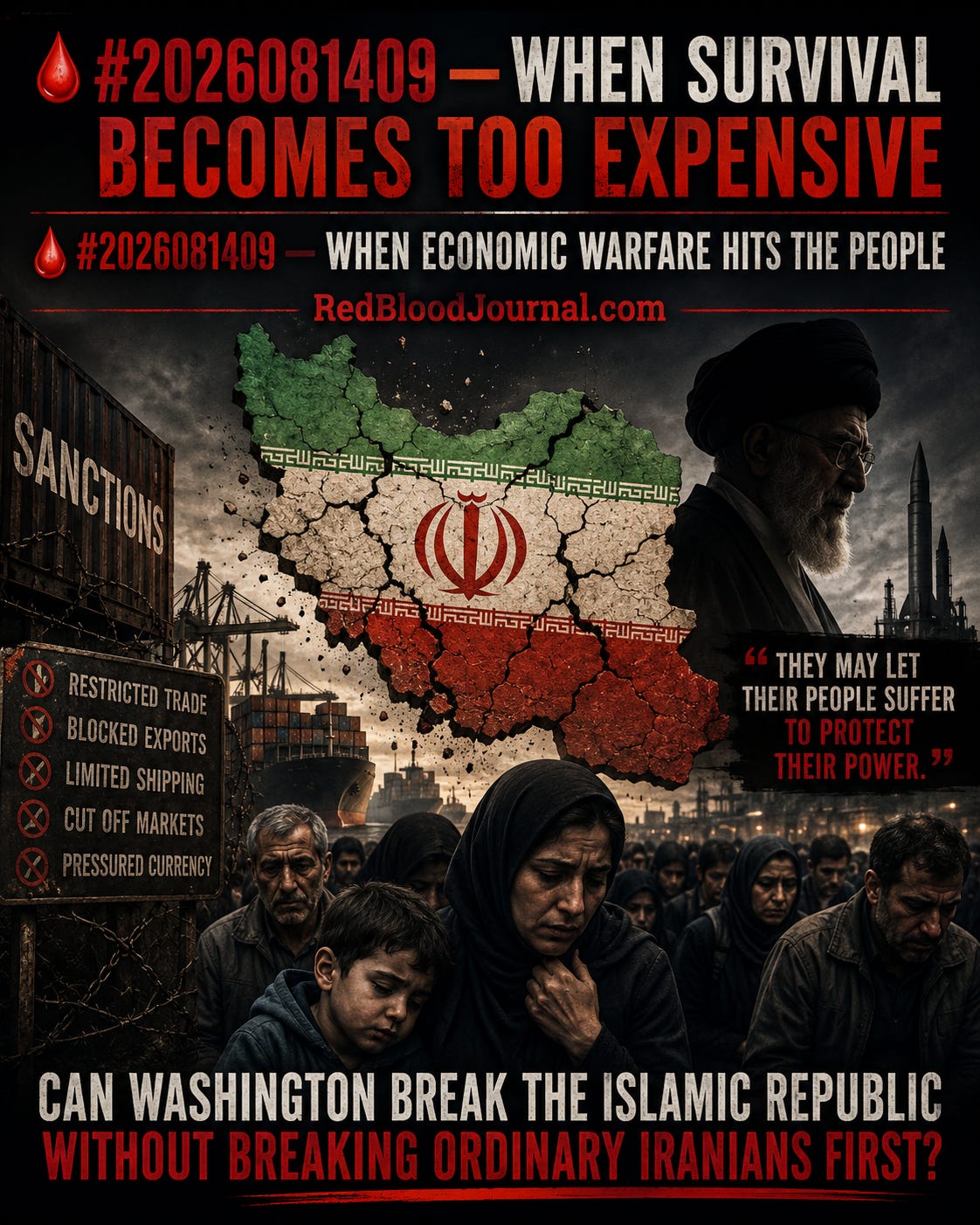
🩸 #2026081409 — When Economic Warfare Hits the People
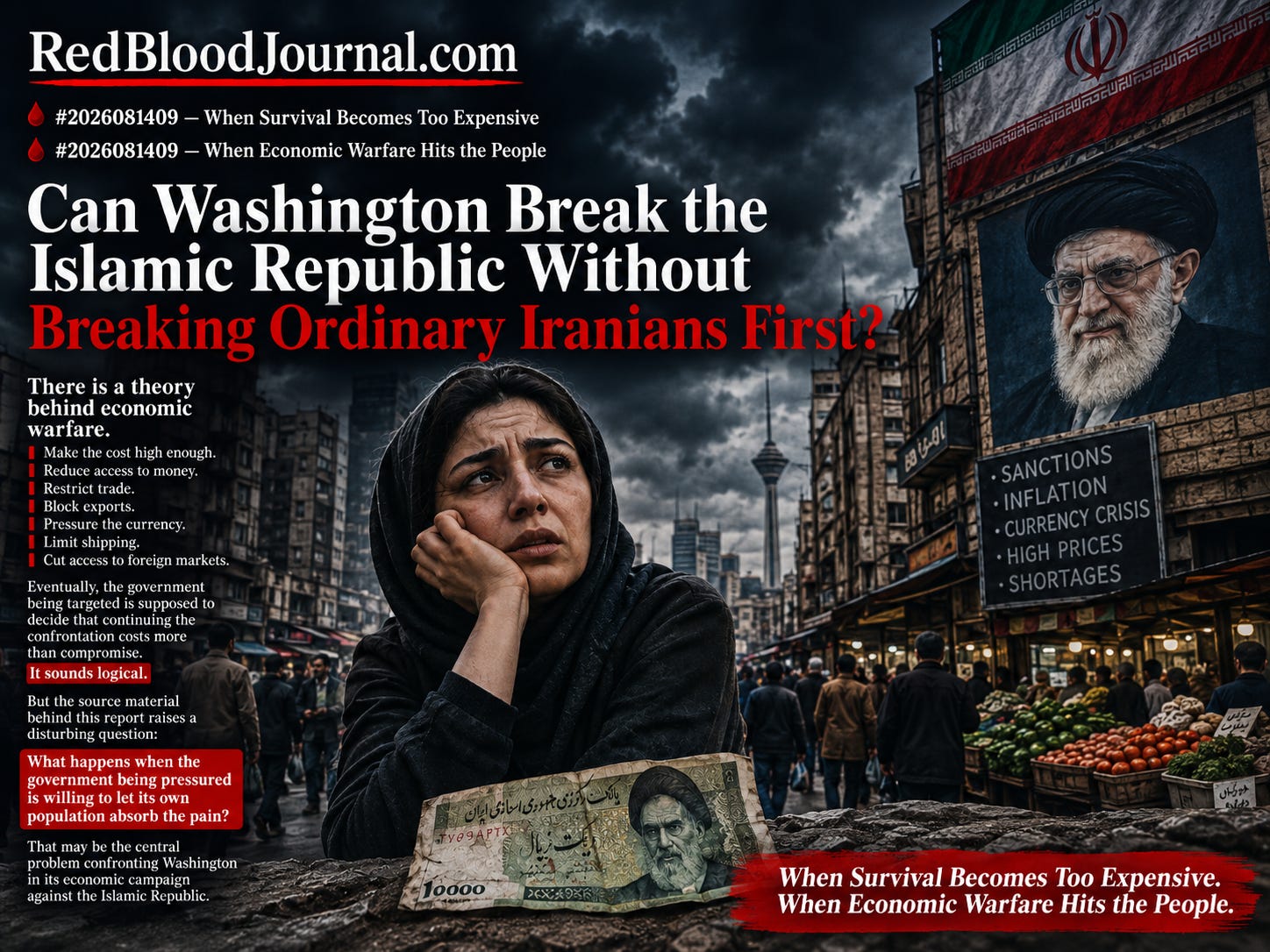
Can Washington Break the Islamic Republic Without Breaking Ordinary Iranians First?
RedBloodJournal.com
There is a theory behind economic warfare.
Make the cost high enough.
Reduce access to money.
Restrict trade.
Block exports.
Pressure the currency.
Limit shipping.
Cut access to foreign markets.
Eventually, the government being targeted is supposed to decide that continuing the confrontation costs more than compromise.
It sounds logical.
But the source material behind this report raises a disturbing question:
What happens when the government being pressured is willing to let its own population absorb the pain?
That may be the central problem confronting Washington in its economic campaign against the Islamic Republic.
A New Level of Economic Isolation
The source reports comments attributed to U.S. Treasury Secretary Scott Bessent describing forthcoming measures against the Iranian government.
According to the material, Bessent said Washington intended to pursue actions that could represent an unprecedented level of economic isolation against a country.
The report says details were expected to be released later and describes the strategy as involving severe economic isolation alongside continued pressure around the Strait of Hormuz and Iranian ports.
If implemented as described, this would not merely be another round of ordinary sanctions.
It would represent an attempt to constrict the economic arteries through which Iran trades with the outside world.
Money.
Ships.
Imports.
Exports.
Energy.
Ports.
Access.
But Governments Do Not Feel Hunger
Countries are often spoken about as though they are single organisms.
“Iran is under pressure.”
“Iran is losing money.”
“Iran is isolated.”
But Iran does not stand in a grocery store.
A government ministry does not skip medicine because the prescription became too expensive.
A political ideology does not turn off the heater because the gas bill increased.
People do.
The source itself makes this distinction clearly.
Whatever Washington does to pressure the Islamic Republic, it warns, the government may transfer much of that pressure directly onto the Iranian population.
That is where sanctions become complicated.
The target may be the state.
The pain may land somewhere else.
The Western Assumption
The source includes an American analysis challenging the assumptions commonly used when evaluating sanctions.
Western policymakers tend to look at familiar measurements:
How much revenue has been lost?
How far has the currency fallen?
How high is inflation?
How much economic contraction can the government tolerate?
When does public dissatisfaction become politically unbearable?
Those are reasonable questions in many political systems.
The assumption is that eventually the economic cost becomes so severe that the leadership changes course.
But the analysis presented in the source argues that the Islamic Republic may not respond according to that model.
What If the Leadership Has a Different Definition of Pain?
The source argues that Iranian decision-makers remain deeply ideological.
According to the quoted analysis, the leadership may genuinely believe it has the strategic advantage even when outsiders see economic conditions as catastrophic.
The important point is not whether that belief is objectively correct.
The source explicitly distinguishes the two.
The leadership may believe it has the upper hand even if outside analysts believe otherwise.
That difference matters enormously.
Political decisions are made according to what leaders believe.
Not necessarily according to what outsiders believe they should believe.
The Strait of Hormuz Changes the Calculation
The Strait of Hormuz appears again at the center of this economic confrontation.
The analysis in the source says Iranian leaders regard Hormuz as a strategic asset rather than something they will simply surrender through bargaining.
From this perspective, control or disruption of the strait gives Tehran leverage over Washington, regional governments and the international economy.
The argument presented is stark:
Economic suffering alone may not be enough to force the Iranian government to relinquish that leverage.
Why?
Because those making the decision may not personally experience the suffering in the same way as the population.
The Most Dangerous Sentence in the Report
One statement in the source deserves special attention.
The American analysis argues that Iranian leaders do not care enough about the economic hardship of their own population for that hardship alone to force surrender.
That is an assessment, not a proven measurement of what every Iranian official thinks.
But if even partly correct, it creates a serious strategic problem.
Washington applies pressure.
Iranian households suffer.
Washington waits for Tehran to compromise.
Tehran waits for Washington to lose patience.
The population remains trapped between them.
A Contest of Endurance
Economic warfare can become a test of endurance.
But whose endurance?
Washington may be asking:
How long can the Islamic Republic survive under extreme economic pressure?
Tehran may be asking:
How long will the United States maintain that pressure politically?
And the Iranian citizen may be asking something much simpler:
How am I supposed to pay for food next month?
Three different clocks are running.
The government’s clock.
Washington’s clock.
The people’s clock.
They do not necessarily expire at the same time.
Iran May Be Watching the American Election Calendar
The source also presents the theory that Tehran watches American domestic politics closely.
As the United States moves closer to the 2026 midterm elections, the analysis predicts Iranian diplomatic demands may become more aggressive and that military or political instability could increase.
The theory is that Tehran may hope to create a situation in which American voters conclude that Washington has mishandled the confrontation.
Again, this is an interpretation presented by the source, not established evidence of a formal Iranian plan.
But the broader observation is credible within the report’s framework:
Iranian governments have outlasted many American administrations.
American elections arrive every two years.
Presidential administrations change.
Congress changes.
Public opinion changes.
Tehran may therefore view time itself as strategic territory.
The Islamic Republic Does Not Need to Win Quickly
That may be another misunderstanding.
A government under pressure does not necessarily need to defeat its opponent.
Sometimes it merely needs to remain standing.
If Tehran believes American political will deteriorates faster than the regime’s ability to suppress internal suffering, survival becomes a strategy.
No dramatic victory is required.
No surrender ceremony.
No decisive battlefield triumph.
Simply continue.
Wait.
Absorb.
Delay.
Watch the political calendar.
How Could Tehran Survive Financial Isolation?
The source then describes several mechanisms it believes the Islamic Republic could use to manage economic pressure.
These include:
Money creation.
Cryptocurrency, including Bitcoin.
Alleged money-laundering channels.
Economic assistance or transactions involving actors in Afghanistan, Iraq, Turkey, Qatar and elsewhere.
The source does not provide detailed evidence establishing the scale or effectiveness of each of these mechanisms.
They should therefore be treated as reported allegations or possible workarounds rather than proven solutions.
But their significance is obvious.
Sanctions are rarely a sealed wall.
They become a maze.
The sanctioned state searches for openings.
Smuggling Is an Economy Too
Whenever official trade becomes difficult, unofficial trade becomes more valuable.
Middlemen appear.
New routes develop.
Currencies change.
Companies are renamed.
Shipments are redirected.
Goods become more expensive because every additional layer adds risk and profit.
The result can create another paradox.
Economic sanctions intended to weaken politically connected networks can sometimes increase the value of the very networks capable of bypassing them.
Ordinary businesses lose access.
Connected intermediaries gain importance.
The economy becomes less transparent.
Not more.
Meanwhile, Iranian Maritime Trade Feels the Pressure
The source also describes pressure affecting Iranian traditional cargo vessels operating around the United Arab Emirates.
It includes testimony concerning Iranian lenj vessels in Sharjah reportedly being required to unload and leave.
Whether every incident results directly from the broader U.S. strategy cannot be established from the source alone.
But the episode illustrates how regional pressure can eventually reach the smallest participants in trade.
A sanctions policy may begin in Washington.
Eventually somebody on a wooden cargo vessel hears:
Unload.
Leave.
Then Comes the Question Nobody Likes Asking
Suppose the sanctions work.
What does “work” mean?
Iranian exports collapse?
Government revenue falls?
The currency weakens?
Imports become difficult?
Factories struggle?
Transportation costs rise?
Food becomes more expensive?
Medicine becomes harder to obtain?
At which point does economic suffering become political leverage?
And at which point does it simply become suffering?
That boundary is difficult to calculate from a government office.
Pressure Is Not the Same as Control
A government can create pressure.
It cannot perfectly control what the pressure does once it enters another society.
Maybe the pressure forces negotiations.
Maybe it strengthens hardliners.
Maybe it increases black markets.
Maybe it weakens the government.
Maybe it weakens the middle class.
Maybe it produces unrest.
Maybe it produces nationalism.
Maybe all of those things happen simultaneously.
Economic warfare is not a precision-guided missile.
It enters everything.
The Iranian Government Has Its Own Pressure Machine
Washington is not the only source of economic pressure described in the material.
Inside Iran, officials and advisers are considering major changes involving gasoline, energy prices and subsidies.
The same source discusses the possibility of rapid price increases and economic “shock therapy.”
So the citizen may face pressure from two directions.
From outside:
Sanctions.
Trade restrictions.
Financial isolation.
Maritime pressure.
From inside:
Inflation.
Price restructuring.
Energy shortages.
Currency weakness.
Gasoline increases.
The ordinary person occupies the small space between them.
Everyone Has a Strategy Except the Family Buying Dinner
Washington has a strategy.
Tehran has a strategy.
Economists have a strategy.
Military commanders have a strategy.
Sanctions experts have a strategy.
Political advisers have a strategy.
A family standing at a grocery counter has a budget.
That distinction may be the most important one in this entire confrontation.
If the Regime Does Not Care About the Pain, Who Does the Pain Pressure?
This is the central strategic question.
Sanctions work by translating economic suffering into political pressure.
But the translation mechanism matters.
If the political leadership feels directly threatened by falling living standards, pressure may change policy.
If the political leadership can isolate itself from those consequences while suppressing public resistance, the mechanism weakens.
Then greater sanctions may create greater pain without producing proportionally greater political influence.
That does not prove sanctions cannot work.
It means the assumption connecting economic pain to political surrender must be tested rather than simply repeated.
The Midterm Gamble
The source’s election theory creates another disturbing possibility.
Suppose Tehran believes the United States will eventually tire first.
Then every month survived becomes progress.
Every American argument over the war becomes encouraging.
Every political dispute becomes evidence that patience may work.
Every approaching election becomes another possible exit ramp.
The confrontation becomes less about defeating the United States and more about waiting for the United States to defeat its own policy.
Whether Tehran actually follows such a strategy cannot be established from the material.
But it is a possibility worth examining.
The Red Blood Perspective
The question is not simply:
Are sanctions strong enough?
The deeper questions are:
Strong enough to do what?
Strong enough to hurt government revenue?
Probably.
Strong enough to damage trade?
Possibly.
Strong enough to reduce purchasing power?
That may already be visible.
Strong enough to force ideological leaders to abandon strategic objectives?
That is the unresolved part.
And there is an even more uncomfortable question.
If the leadership is willing to transfer economic suffering onto the public, then escalating pressure may create a race between two outcomes:
Political change.
Or social destruction.
Nobody can responsibly assume in advance which arrives first.
Economic warfare is often described without blood because no bomb explodes.
But its casualties may appear differently.
Empty refrigerators.
Delayed medicine.
Cancelled marriages.
Closed businesses.
Young people leaving.
Families separated.
Lives postponed.
No crater is required.
Ocean of Love and Positivity Perspective
There is an enormous difference between defeating a government and destroying the ability of ordinary people to live.
Policy should never forget that difference.
Governments fight.
People carry groceries.
Governments negotiate.
People pay rent.
Governments announce sanctions.
People search for medicine.
Governments speak about strategic patience.
People age while waiting for life to become possible again.
Perhaps the true measure of any strategy should include more than whether an opponent eventually says yes.
It should also ask:
What remains of the people when the struggle is over?
Pressure may sometimes be necessary.
But human beings should never become disposable ammunition in an economic battlefield.
Because when governments finally sit at the negotiating table, the people who absorbed the consequences still have to wake up the next morning and rebuild their lives.
In an Ocean of Love and Positivity.
🩸🌊✨ Fantastic!
⚖️
The Attrition of Nations: Economic Warfare and the Human Cost
Aug 14, 2026
This report examines the escalating economic warfare between the United States and Iran, specifically focusing on the strategic and human costs of unprecedented sanctions. The text questions the American assumption that financial pressure will force the Islamic Republic to compromise, suggesting instead that the ideological leadership may be willing to let the general population absorb the suffering. By targeting maritime trade, energy exports, and financial access, Washington hopes to isolate the regime, yet the source warns that these measures often bypass the elite and directly impact ordinary citizens. Iranian leaders may be using a strategy of endurance, relying on black markets and the U.S. election calendar to outlast Western political will. Ultimately, the narrative highlights the disconnect between geopolitical objectives and the daily survival of families caught in the middle of this financial confrontation. This analysis suggests that while sanctions effectively damage a nation’s economy, they do not guaranteed a change in government behavior if the leaders remain insulated from the pain.


