


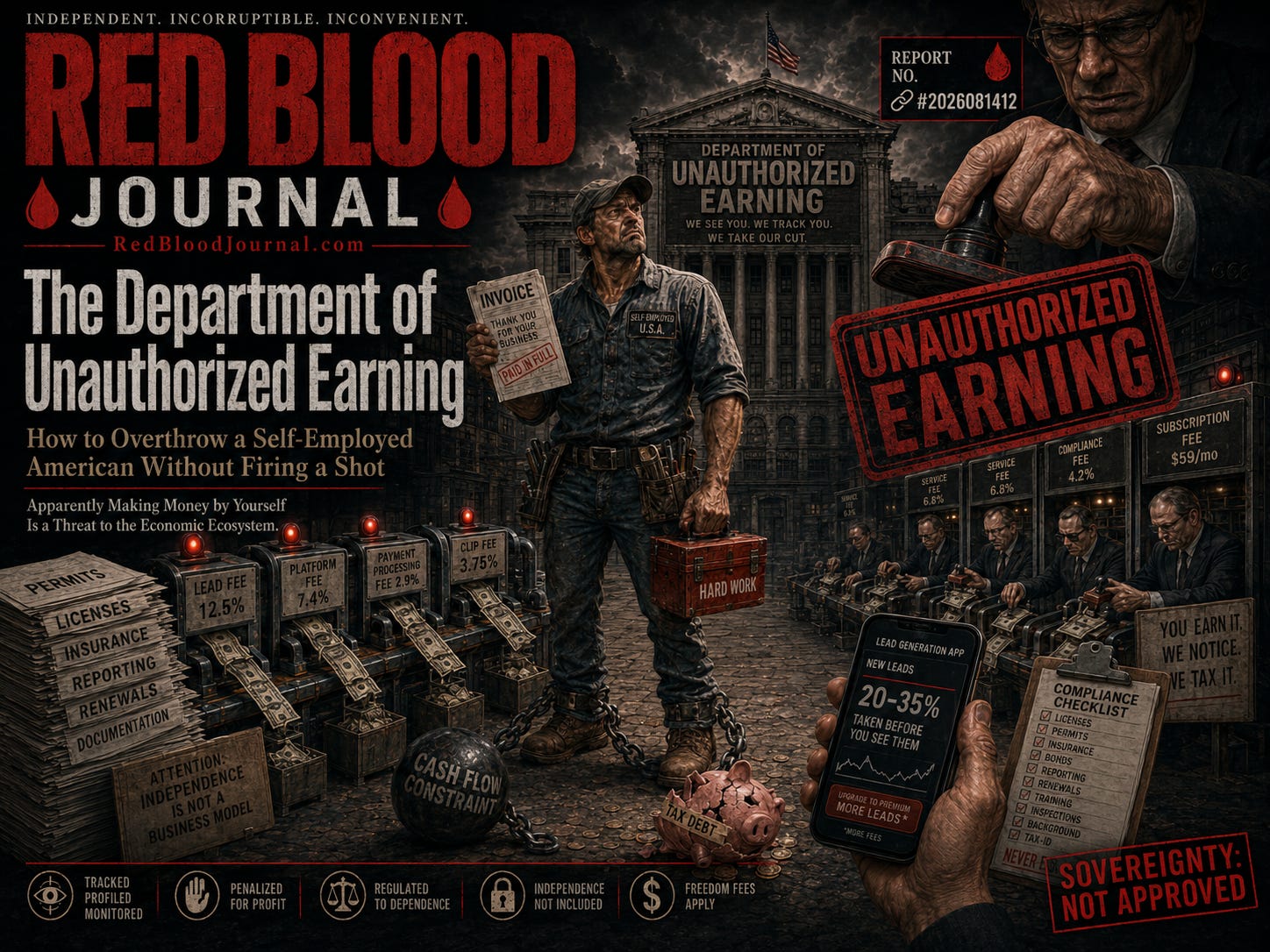
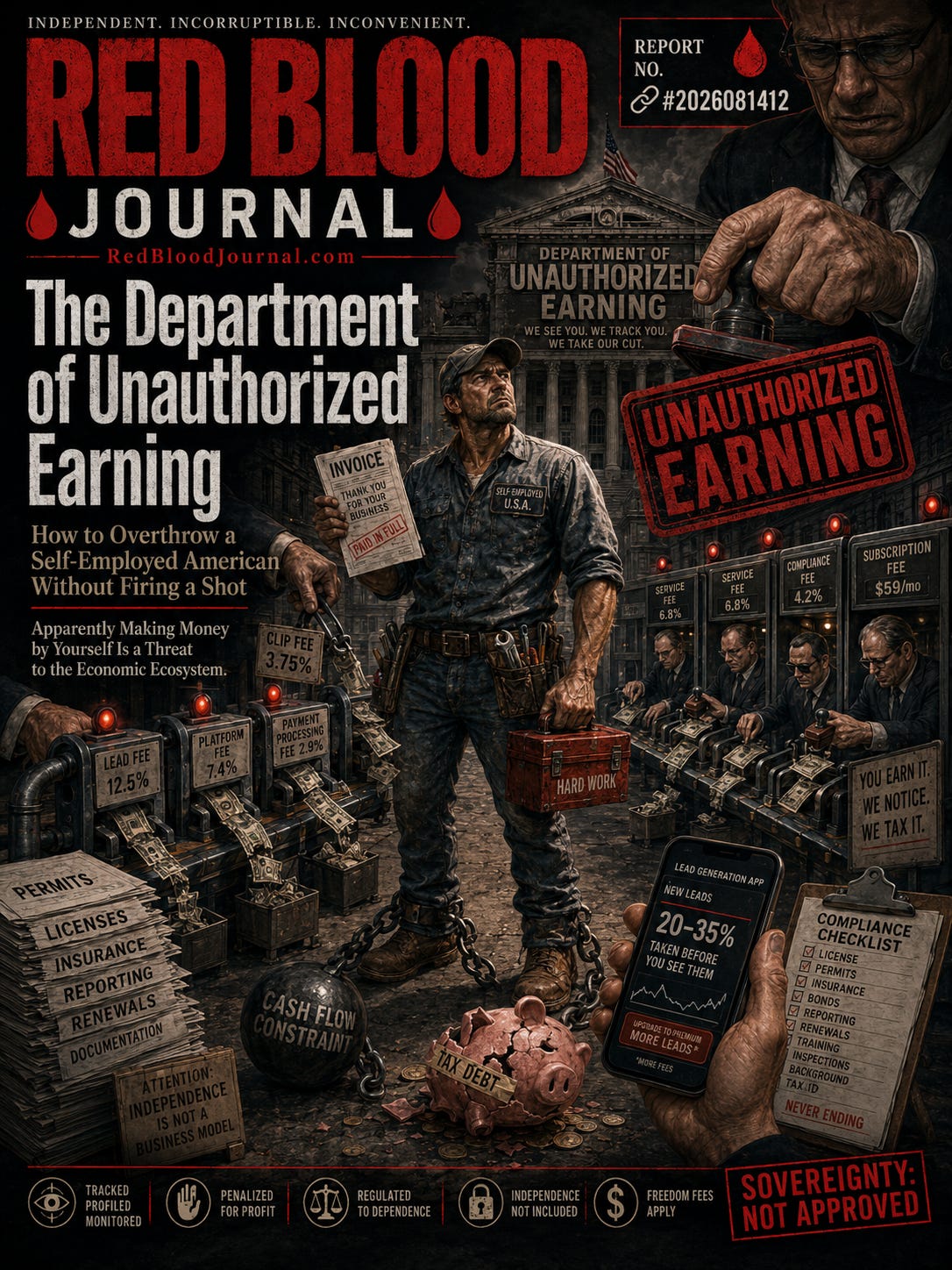
🩸 ⛓️ #2026081412 — The Department of Unauthorized Earning
Apparently Making Money by Yourself Is a Threat to the Economic Ecosystem
How to Overthrow a Self-Employed American Without Firing a Shot
RedBloodJournal.com
There is a dangerous person loose in America.
He has no army.
No militia.
No political organization.
No foreign funding.
No classified documents.
No bunker.
He owns a ladder.
Possibly two ladders.
He knows how to fix things.
And, most disturbingly of all, he has discovered that another human being may voluntarily give him money in exchange for doing something useful.
This individual must be contained.
Not arrested.
Not imprisoned.
Nothing so primitive.
America has developed a considerably more sophisticated system.
Let him become self-employed.
Then introduce him to the 36 organizations that apparently became his business partners the moment somebody handed him $100.
He will quickly discover one of the great mysteries of modern American capitalism:
He works for himself.
He risks his own money.
He buys his own tools.
He finds his own customers.
He performs the labor.
Yet somehow everybody else has direct-deposit privileges into his pocket.
Fantastic.
SUBJECT IDENTIFIED: INDEPENDENT HUMAN
Authorities first became suspicious when the citizen made the following statement:
“Maybe I can work for myself.”
Sir.
Please lower your voice.
Children may be listening.
Work for yourself?
Without Human Resources?
Without a regional manager?
Without a corporate headquarters?
Without seven vice presidents?
Without an app deciding whether you deserve a customer?
Without somebody 1,800 miles away sending you an email titled:
MANDATORY TEAM CULTURE REFRESH — ACTION REQUIRED
This is deeply concerning behavior.
The citizen apparently believes that because he owns the tools, performs the labor, assumes the risk and finds the customer...
the money should primarily belong to him.
Adorable.
He clearly has not met the Department of Unauthorized Earning.
THE INCIDENT
At approximately 8:14 Monday morning, a homeowner discovers a broken water heater.
The homeowner calls a local repairman.
Repairman:
“I can fix it.”
Homeowner:
“How much?”
Repairman:
“$300.”
Homeowner:
“Fine.”
Stop everything.
Two American citizens have just attempted an unassisted economic transaction.
There is no platform.
No marketplace.
No consultant.
No subscription.
No lead generator.
No algorithm.
No affiliate network.
No venture-capital-backed application.
No customer-acquisition specialist.
No processing ecosystem.
Just:
Broken thing.
Human who knows how to fix broken thing.
This level of economic simplicity poses an obvious danger to approximately seventeen industries.
THE MISSING MIDDLEMAN ALERT
Somewhere beneath a glass office tower, an alarm begins flashing.
🚨 DIRECT TRANSACTION DETECTED 🚨
A command center comes alive.
“Sir, we have two civilians exchanging value.”
“Through which platform?”
“None.”
“Marketplace?”
“None.”
“Lead generator?”
“No.”
“Payment processor?”
“Cash.”
The room goes silent.
One executive removes his glasses.
Another slowly rises from his chair.
Someone drops a $9 latte.
“My God.”
“How much did the customer pay?”
“Three hundred dollars.”
“How much did the worker receive?”
“Three hundred dollars.”
The commander turns pale.
“ALL OF IT?”
“Yes, sir.”
“Dear God.”
“Should we intervene?”
“Immediately.”
“How many middlemen should we deploy?”
The commander looks toward the horizon.
A single tear appears in his eye.
“All of them.”
THE GREAT AMERICAN ECONOMIC QUESTION
Whenever two people conduct business, modern economics must immediately ask:
Who else can we put between them?
This is how prosperity works.
A plumber fixing a faucet for $150 is merely commerce.
But place eight organizations between the plumber and the faucet...
and suddenly we have:
AN ECOSYSTEM.
An ecosystem has:
Platforms.
Partners.
Solutions.
Integrations.
Analytics.
Dashboards.
Subscription tiers.
Processing infrastructure.
Artificial intelligence.
Preferred providers.
Premium listings.
And an annual conference in Las Vegas where 4,000 people who have never repaired a faucet explain how the plumber can become more efficient.
Mostly by paying them.
Now we’re creating value.
THE PRIMITIVE ECONOMY
For thousands of years, humanity suffered under an embarrassingly primitive economic system.
One person needed something.
Another person could provide it.
They negotiated.
The work was completed.
Money changed hands.
Transaction finished.
Horrifying.
Almost nobody received a percentage.
Fortunately, civilization advanced.
Today the same $300 repair can potentially involve:
Advertising.
Lead generation.
Booking software.
Payment processing.
Financing.
Review management.
Accounting software.
Scheduling software.
Insurance.
Business registration.
Marketplace commissions.
Platform fees.
Transaction fees.
Service fees.
Processing fees.
Electronic statement fees.
Premium-placement fees.
Customer-acquisition costs.
Compliance expenses.
Subscriptions.
Renewals.
And possibly mankind’s greatest financial invention:
THE CONVENIENCE FEE
A fee charged for the convenience of paying another fee.
We have reached the moon.
We decoded the human genome.
We created artificial intelligence.
But nothing demonstrates human genius quite like discovering how to charge somebody $4.95 for giving you their money.
CONGRATULATIONS — YOU ARE SELF-EMPLOYED
The American dream remains alive.
You may become your own boss.
Fantastic.
Your new bosses include:
The bank.
The insurance company.
The licensing authority.
The tax authorities.
The payment processor.
The advertising company.
The marketplace.
The lead-generation platform.
The review platform.
The scheduling platform.
The accounting platform.
The algorithm.
The customer.
And twelve software companies automatically renewing subscriptions at 12:01 a.m.
But other than those minor details...
YOU ANSWER TO NOBODY.
Freedom.
MEET CHARLIE
Charlie installs ceiling fans.
Charlie is very good at installing ceiling fans.
He has installed approximately 4,000 of them.
Charlie understands ceiling fans better than some ceiling fans understand themselves.
One morning Charlie announces:
“I’m going into business for myself.”
His wife hugs him.
Charlie purchases tools.
Charlie purchases a truck.
Charlie prints business cards.
Charlie goes to bed thinking:
“Finally. Independence.”
This is Charlie’s final peaceful night’s sleep.
Tomorrow he meets paperwork.
DAY TWO: WELCOME TO FREEDOM
Charlie discovers:
Licenses.
Registrations.
Insurance.
Bookkeeping.
Estimated taxes.
Business banking.
Merchant processing.
Local requirements.
Recordkeeping.
Renewals.
Advertising.
Website hosting.
Software subscriptions.
And several government websites apparently constructed during an ancient civilization whose written language has not yet been fully translated.
Charlie spends six hours trying to determine which form he requires.
He calls Office A.
Office A tells him to contact Office B.
Office B tells him Office A handles it.
Charlie calls Office A again.
A different employee answers.
She tells Charlie he needs Form 17-C.
Charlie downloads Form 17-C.
Across the top it says:
DO NOT USE THIS FORM.
Charlie is officially an entrepreneur.
THE RED BLOOD PERSPECTIVE
Nobody needs to prohibit self-employment.
That would be far too obvious.
The much more interesting question is whether independent earning can gradually become so expensive, administratively exhausting and dependent on intermediaries that people abandon it voluntarily.
Each individual expense may be defensible.
Each regulation may have a stated purpose.
Each business may genuinely provide a service.
Each tax may fund something real.
The investigation begins when all of those pieces are stacked together.
Ask:
Who created the value?
Who performed the labor?
Who supplied the capital?
Who assumed the risk?
Who controlled access to the customer?
Who received a portion of the transaction?
Which middlemen were genuinely necessary?
Which became unavoidable simply because they control the road between buyer and seller?
And finally:
After everybody takes their perfectly reasonable little bite, how much meat remains on the bone for the person who killed the buffalo?
That may be the disappearing American independent worker in one sentence.
Nobody had to overthrow him.
Nobody had to arrest him.
Nobody had to outlaw his business.
They merely had to install enough tollbooths between his hands and his wallet.
Ocean of Love and Positivity Perspective
A healthy society needs corporations.
It needs government.
It needs infrastructure.
It needs rules.
It needs insurance.
It needs banks.
It needs technology.
It needs intermediaries when intermediaries genuinely create value.
But it also needs something extraordinarily important:
People who can survive without asking a giant institution for permission to earn.
One person.
One skill.
One toolbox.
One truck.
One computer.
One kitchen.
One chair.
One idea.
One customer.
The ability to say:
“I can do something useful.”
And another human being to say:
“I need that.”
Perhaps economic freedom begins there.
Not with speeches.
Not with slogans.
Not with another Small Business Empowerment Initiative containing 147 pages of eligibility requirements.
Just enough room for two human beings to exchange value without the entire economic ecosystem hearing a dinner bell.
Because if Charlie installs a ceiling fan for $300 and actually manages to keep most of the $300...
do not panic.
Civilization will probably survive.
And if it doesn’t—
someone will undoubtedly create an app for that.
Only $19.99 per month.
Plus processing fees.
In an Ocean of Love and Positivity.
🩸🌊✨ Fantastic!
⛓️
The Toll of Independence: The Death of the Middleman-Free Economy
Aug 14, 2026
This satirical text examines the modern economic barriers that prevent self-employed individuals from keeping their full earnings. It argues that a once-simple transaction between a worker and a customer has been replaced by a predatory ecosystem of middlemen, including digital platforms, payment processors, and regulatory agencies. The author illustrates how excessive fees and administrative burdens act as financial tollbooths that drain the profits of independent contractors. By highlighting the struggle of a fictional repairman, the source critiques how corporate and bureaucratic structures prioritize their own growth over the laborer’s autonomy. Ultimately, the piece suggests that true economic freedom is disappearing as the “middleman economy” consumes the value created by individual hard work.


