


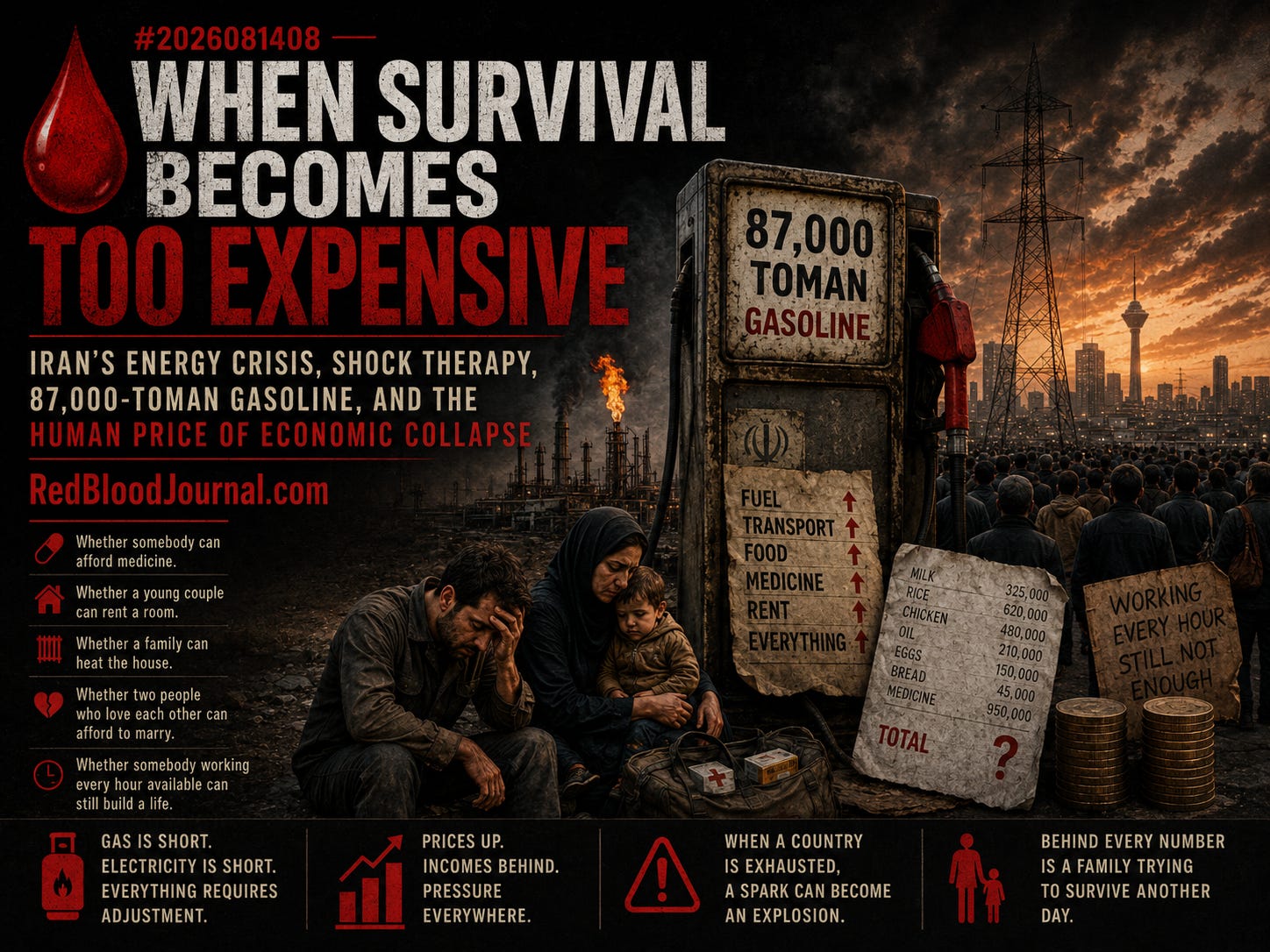
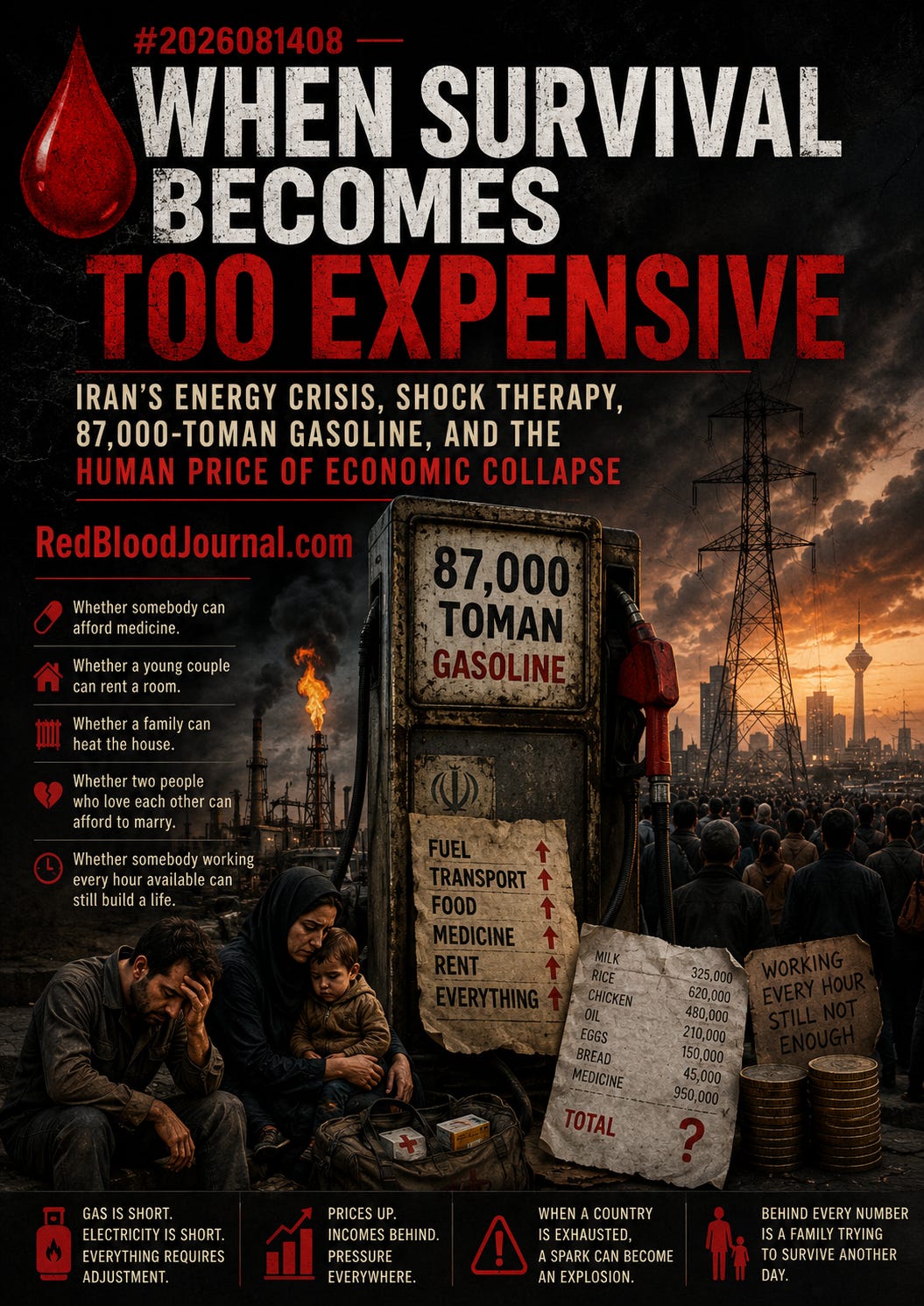
🩸 #2026081408 — When Survival Becomes Too Expensive
Iran’s Energy Crisis, Shock Therapy, 87,000-Toman Gasoline, and the Human Price of Economic Collapse
RedBloodJournal.com
There is a point where an economic crisis stops being about economics.
It stops being about charts.
It stops being about inflation percentages.
It stops being about government budgets, exchange rates, subsidies and economists arguing on television.
It becomes about whether someone can afford medicine.
Whether a young couple can rent a room.
Whether a family can heat the house.
Whether two people who love each other can afford to marry.
Whether somebody working every hour available can still build a life.
The source material behind this report describes an Iran moving dangerously close to that point.
And while ordinary people are calculating whether they can afford food, medicine, gasoline or rent, some advisers around the government are discussing something extraordinary:
Shock therapy.
Not gradual increases.
Not small adjustments.
A shock.
“Raise the Prices Quickly”
The source presents comments attributed to economist Sadegh al-Hosseini, described there as an adviser associated with the Pezeshkian administration.
His argument, as presented in the report, is that economic reform should not necessarily be gradual.
Prices, according to this reasoning, may need to rise rapidly and dramatically.
The source describes him openly using the expression “shock therapy” and arguing that major price adjustments should happen suddenly rather than incrementally.
He reportedly points to examples from China and postwar Germany as evidence that rapid economic restructuring can succeed.
That is the theory.
Then there is Iran.
The Laboratory Is a Country Full of People
Economic theories often sound clean in a studio.
Raise prices.
Remove distortions.
Eliminate subsidies.
Let markets adjust.
Restore equilibrium.
But every economic adjustment eventually lands on somebody’s kitchen table.
The source describes an Iranian population already under enormous financial pressure.
Workers.
Government employees.
Pensioners.
Families.
Young people.
Patients.
People whose salaries do not increase at the same speed as the prices around them.
If prices suddenly multiply while incomes remain behind, “shock therapy” stops being an economic phrase.
The shock belongs to the population.
The 87,000-Toman Gasoline Question
One number dominates the report:
87,000 toman.
The source discusses controversy around a proposed or discussed gasoline price of approximately 87,000 toman and says implementation had, at that point, been stopped or remained unresolved.
Government officials are described as considering several different gasoline policies and stating that any finalized plan would be explained before implementation.
But the number itself matters psychologically.
Gasoline is not simply gasoline.
Gasoline moves taxis.
Delivery vehicles.
Food.
Workers.
Goods.
Services.
Agriculture.
Families.
Raise transportation costs dramatically and the increase does not remain at the fuel pump.
It travels through the economy.
A liter of fuel becomes a grocery bill.
A grocery bill becomes a wage demand.
A wage demand becomes a business expense.
A business expense becomes another price increase.
And around the circle it goes.
When Gasoline Becomes the Match
Near the end of the source, one commentator compares Iran to a powder keg.
The report says the 87,000-toman gasoline price would not merely be a spark.
It could be a bomb placed inside the barrel.
That is rhetoric, not a prediction.
But Iran has historical reasons to understand the political sensitivity surrounding fuel prices.
The deeper point is simple:
When a population is already financially exhausted, even a technically defensible economic reform can become socially explosive.
The government may see an accounting problem.
The population may see the disappearance of another part of ordinary life.
Gas Is Short.
Electricity Is Short.
Everything Requires Adjustment.
The gasoline problem is only part of the energy story.
The source describes serious natural-gas and electricity pressures.
It includes discussion suggesting that significant portions of the country may need to reduce consumption in order for supplies to remain manageable.
Elsewhere, the report cites energy officials warning that households may no longer be able to heat unused rooms as casually as they did in previous years.
On paper that sounds like conservation.
Inside a household, it may mean something different.
Close the door.
Turn off the heater.
Use fewer rooms.
Drive less.
Buy less.
Eat differently.
Delay the doctor.
Delay marriage.
Delay having children.
Delay life.
Eventually “temporary adjustment” becomes a lifestyle.
Then Comes the Doctor
Perhaps the most revealing section of the source has nothing to do with economists.
A doctor speaks.
She describes patients unable to buy medications.
Patients reportedly ask her to prescribe less because they cannot afford the full amount.
She says she struggles to recommend proper nutrition because patients tell her they cannot afford the foods being recommended.
That is where macroeconomics becomes biology.
A government can redefine the exchange rate.
It cannot redefine hunger.
A ministry can change the gasoline formula.
It cannot negotiate with diabetes.
An economist can explain why prices must reach their “real” level.
The human body still needs food.
The patient still needs medicine.
What Does “Affordability” Mean When Everything Is Being Cut?
Economic hardship does not arrive as one bill.
It arrives as decisions.
Do I buy the medicine?
Do I pay rent?
Do I buy meat?
Do I repair the car?
Do I visit my parents?
Do I keep the heater on?
Do I marry?
Do we have a child?
Every financial crisis eventually becomes a series of personal amputations.
Something gets removed.
Then something else.
At first it is luxury.
Then entertainment.
Then travel.
Then better food.
Then medical care.
Then marriage.
Then children.
Eventually the question becomes:
What remains?
18 Million People Who Never Married?
The source then presents one of its most striking social claims.
It cites commentary referring to government-related statistics indicating that approximately 18 million Iranian men and women had entered their forties without ever marrying.
The same section adds another approximately six million people over forty described as unmarried because of divorce or the death of a spouse, producing a claimed total of roughly 24 million unmarried people over forty.
The source does not provide the underlying statistical tables, methodology or demographic definitions needed to independently validate those figures.
So the numbers should be treated as claims presented in the report, not automatically as established demographic fact.
But even without accepting every figure literally, the underlying problem described is unmistakable:
Young Iranians are finding marriage increasingly difficult to afford.
Marriage Has Become an Economic Project
Marriage was once largely a social and personal decision.
Now, for many people, it resembles a capital project.
Housing deposit.
Rent.
Furniture.
Food.
Transportation.
Employment stability.
Wedding expenses.
Healthcare.
Children.
School.
When wages cannot approach those costs, marriage becomes something people postpone.
Then postpone again.
Eventually postponement becomes permanence.
The source argues that many young people are not necessarily choosing permanent single life.
They are being pushed toward it economically.
That distinction matters.
There is a difference between:
“I do not want to marry.”
and
“I cannot afford to build a life.”
Pari and Mehdi
Then the report stops talking about millions.
It tells the story of two people.
A woman identified as Pari reportedly sent a message to political commentator Mehdi Salimi describing her relationship with a young man named Mehdi.
They loved each other.
They wanted to marry.
Money stood between them and the life they wanted.
They worked.
They tried.
According to Pari’s account, Mehdi was driving long distances for work.
One night, after completing a trip to Iraq, he reportedly fell asleep while returning and crashed into a truck.
He died at the scene.
Pari wrote that she still considered herself in love with him years later.
She described continuing to wear clothing and perfume connected to him and said she remained alive largely because she was caring for her elderly mother.
This is one person’s account.
It cannot represent every unmarried Iranian.
It should not be turned into a statistical argument.
But perhaps that is why it matters.
Statistics describe populations.
Stories describe consequences.
They Were Trying to Afford a Beginning
The commentary following Pari’s story asks a painful question.
Why should two young people need to work so relentlessly simply to obtain a basic home and begin an ordinary life?
The report argues that housing has become so expensive that even the level of work undertaken by Pari and Mehdi might no longer be enough to secure an ordinary rental today.
That gives the economic crisis another dimension.
This is not merely about what people possess.
It is about what never happens.
The marriage that never takes place.
The child who is never born.
The home that is never rented.
The business that is never started.
The medical treatment that is postponed.
The family dinner that becomes bread and tea.
Economic destruction is not only the destruction of existing wealth.
It is the destruction of possible futures.
The Population Pays Twice
Iran now faces another complication.
The source says Washington is considering even more severe economic pressure against the Islamic Republic.
U.S. Treasury Secretary Scott Bessent is quoted there as saying that additional measures could produce a degree of economic isolation unprecedented in the history of isolating a country.
The source then makes an important observation:
Whatever pressure is placed on the government, the government may transfer much of that pressure downward to the population.
That creates a brutal equation.
The Iranian government raises prices.
Foreign governments increase sanctions.
Energy becomes scarce.
Currency loses purchasing power.
Businesses increase prices.
And the ordinary Iranian stands in the middle of all of it.
Everyone is applying pressure.
The citizen absorbs it.
Can Economic Pain Defeat an Ideological Government?
The source includes a U.S.-side argument warning that Washington may misunderstand how the Islamic Republic responds to economic pain.
Western analysts often measure pressure through familiar indicators:
Inflation.
Currency collapse.
Lost revenue.
Falling GDP.
Public dissatisfaction.
The assumption is that enough pain eventually forces a government to compromise.
But the analysis quoted in the source argues that Iran’s leadership may not behave according to that model.
It may be ideologically willing to tolerate economic suffering among the population for far longer than outsiders expect.
If that is correct, sanctions create a disturbing possibility.
The government may survive.
The population may deteriorate.
And each side may continue believing that more pressure will eventually produce victory.
Shock Therapy From Inside.
Economic Warfare From Outside.
And the Iranian citizen between them.
That may be the central contradiction in this entire story.
Inside the country, advisers discuss rapid price restructuring.
Outside the country, policymakers discuss unprecedented isolation.
One side calls it reform.
The other calls it pressure.
The household may experience both under one name:
expensive.
The Red Blood Perspective
The important question is not whether Iran needs economic reform.
Almost every heavily distorted economy eventually requires reform.
The question is who absorbs the reform.
If subsidies disappear before wages adjust, who pays?
If gasoline reaches dramatically higher prices, who changes behavior first?
Government officials?
Wealthy families?
Politically connected businesses?
Or the taxi driver?
The nurse?
The teacher?
The pensioner?
The newly married couple?
The patient?
There is also another question.
If Washington believes worsening economic conditions will force Tehran to surrender, while Tehran believes it can transfer that suffering onto ordinary citizens indefinitely, then whose strategy ultimately gets tested?
Not the politicians.
The people.
The source presents shock therapy as an economic argument.
Perhaps it is.
But Iran’s larger crisis raises a more uncomfortable possibility.
Maybe the country has already been receiving shock therapy for years.
Currency shock.
Housing shock.
Food shock.
Sanctions shock.
Energy shock.
Medical shock.
Political shock.
And now gasoline may simply be the next electrode.
Ocean of Love and Positivity Perspective
Every economy eventually comes back to one simple purpose:
Human life.
Money is a tool.
Energy is a tool.
Markets are tools.
Government is a tool.
None of them should become more important than the people they were created to serve.
A society should not measure success merely by balancing an account.
It should ask whether two people who love each other can build a home.
Whether a patient can buy medicine.
Whether a mother can feed her child.
Whether an elderly person can stay warm.
Whether young people can imagine a future without first calculating whether the future is affordable.
Perhaps the greatest measure of an economy is not how powerful the government becomes.
It is how possible ordinary life remains.
When ordinary life becomes a luxury, something deeper than economics has failed.
In an Ocean of Love and Positivity.
🩸🌊✨ Fantastic!
📉
Iran’s Economic Crossroads: Shock Therapy and the Human Cost
Aug 14, 2026
The provided text examines the looming economic collapse in Iran, focusing on the devastating intersection of internal “shock therapy” reforms and external international sanctions. Proponents within the government suggest aggressive price hikes for gasoline and utilities to fix market distortions, yet critics warn this could be socially explosive for a population already exhausted by inflation. The narrative illustrates how macroeconomic shifts translate into human suffering, preventing young couples from marrying and forcing patients to forgo life-saving medicine. Beyond mere statistics, the source highlights a growing disconnect between ideological leadership and the basic survival of citizens. Ultimately, the report suggests that when fundamental needs like housing and food become unaffordable luxuries, the success of a nation’s economic policy has fundamentally failed. Under current pressures, the future of ordinary Iranians remains caught between domestic restructuring and unprecedented global isolation.


