


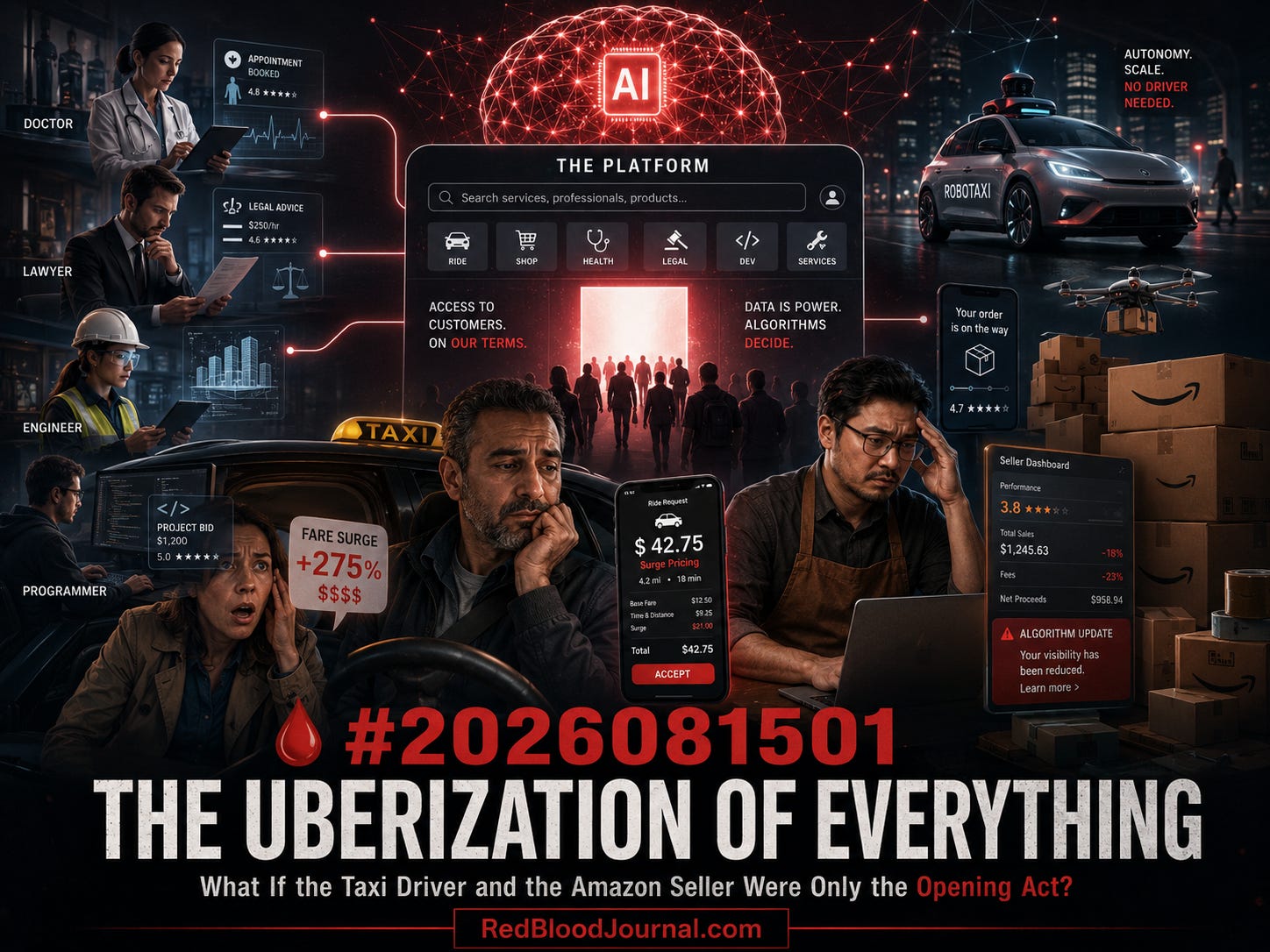
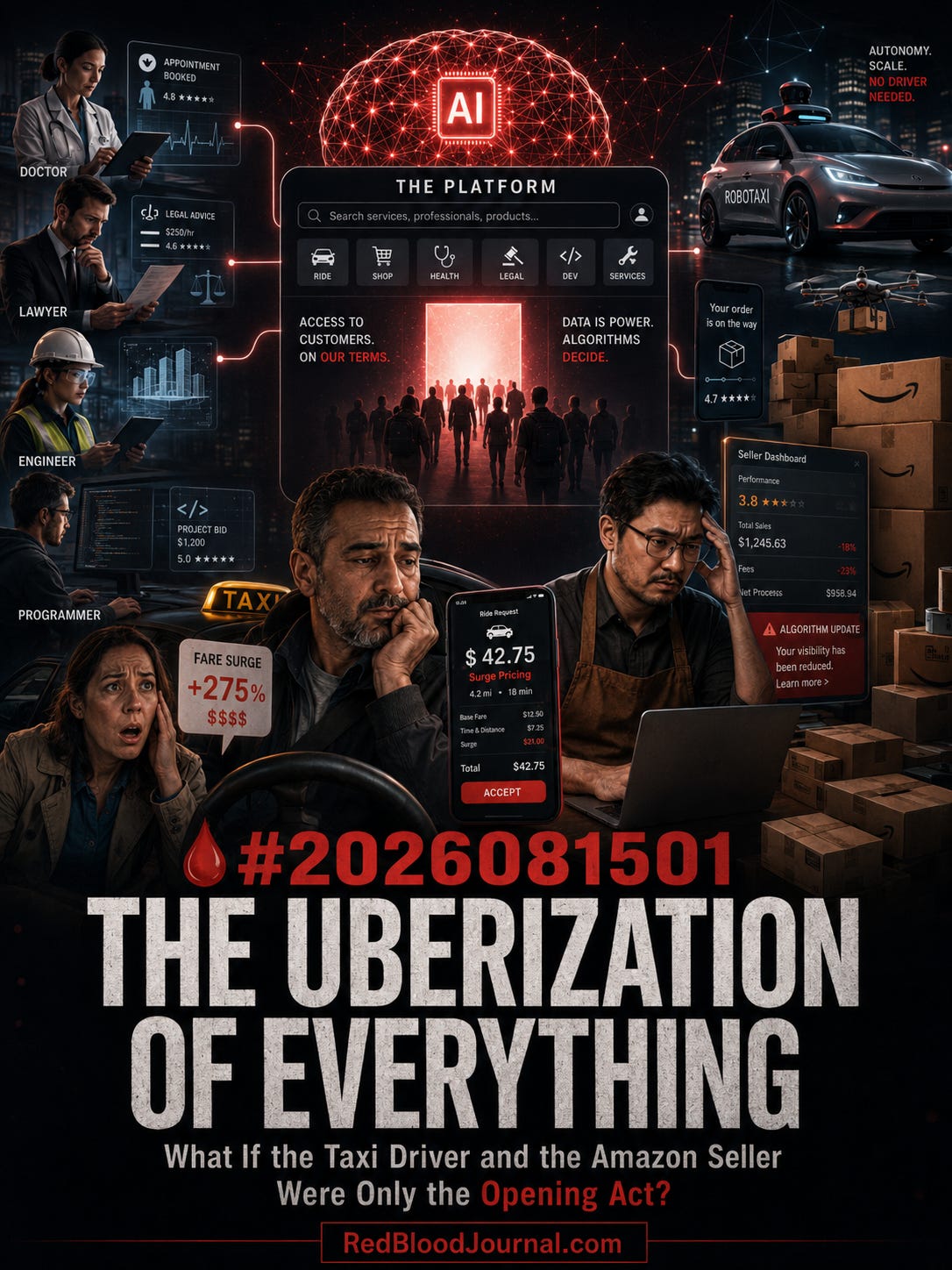
🩸 🚪 #2026081501 — The Uberization of Everything
What If the Taxi Driver and the Amazon Seller Were Only the Opening Act?
RedBloodJournal.com
There was once a dangerously simple economic system.
A human being needed something.
Another human being knew how to provide it.
They found each other.
They agreed on a price.
One performed the work.
The other paid.
End of transaction.
Terrifying.
Almost nobody else got a percentage.
Fortunately, modern technology arrived to repair this primitive arrangement.
Before the Algorithm, There Was the Customer
For most of economic history, the person doing the work had one extraordinarily important asset:
The customer.
The taxi driver needed passengers.
The merchant needed shoppers.
The restaurant needed diners.
The doctor needed patients.
The lawyer needed clients.
The engineer needed customers.
Businesses lived or died based on whether they could find people willing to buy what they offered.
Then something changed.
Instead of every business finding its own customers, gigantic digital platforms began saying:
“Don’t worry about finding customers.
We’ll bring them to you.”
Fantastic!
Who could possibly object?
The customer arrives.
The worker gets work.
The platform gets a little something for making the introduction.
Everybody wins.
At least during the introductory promotional period.
Exhibit Number One: The Taxi Driver
Once upon a time, someone needed transportation.
They called a taxi.
Taxi arrived.
Passenger got inside.
Meter started.
Taxi drove.
Meter stopped.
Passenger paid.
The driver could approximately understand the transaction.
Primitive.
The fare was sitting six inches away in the back seat.
No artificial intelligence was calculating whether a seven-mile ride should cost $22.13 now, $37.62 twelve minutes later, or $81 because apparently everybody in San Diego suddenly decided to leave dinner simultaneously.
Then Uber and Lyft appeared.
And transportation discovered the smartphone.
More importantly:
transportation discovered venture capital.
Welcome to the Cheap-Ride Festival
The early proposition was irresistible.
Discounts.
Coupons.
Referral bonuses.
Free rides.
Reduced fares.
Driver incentives.
Passenger incentives.
Incentives for getting somebody else to receive incentives.
Transportation had apparently become a humanitarian project.
The passenger looked at the taxi.
Taxi: $45.
Then looked at Uber.
Uber: $19.
Plus maybe a promotion.
The passenger conducted an extensive economic investigation lasting approximately 0.7 seconds.
“Call Uber.”
Of course.
Why wouldn’t he?
The taxi company was expected to charge enough money to remain in business.
The technology company could spend enormous amounts of investor capital acquiring customers.
These were technically competitors.
In approximately the same way that the neighborhood lemonade stand is technically competing with Coca-Cola.
The Taxi Driver Discovers Creative Destruction
Taxi drivers had licenses.
Commercial insurance.
Local rules.
Airport regulations.
City regulations.
Vehicle regulations.
Business expenses.
And, inconveniently:
a requirement to eventually make money.
Ride-hailing entered through a different model.
California eventually created a statewide Transportation Network Company regulatory category for services such as Uber and Lyft, separate from the traditional municipal taxi structure.
But while lawyers, cities, regulators and companies debated exactly what these new businesses were—
the passenger had already decided.
“I don’t care what you call it. It’s cheaper.”
Taxi customers began disappearing.
Drivers left.
Companies failed.
Medallions and permits lost value in numerous markets.
And something more important than an individual ride changed hands.
The habit.
People stopped saying:
“Call me a taxi.”
They started saying:
“Get me an Uber.”
That is an extraordinary moment in business.
Your company no longer merely provides the service.
Your company name begins becoming the word people use for the activity.
The customer relationship has moved.
And Then Comes the Joke
Now remember why the passenger originally loved the new system.
It was cheap.
The taxi was expensive.
Uber was inexpensive.
Therefore:
Taxi bad.
Uber good.
Simple.
Years pass.
The taxi industry weakens.
Millions of customers become accustomed to opening an app.
And something peculiar happens.
Ride-hailing prices rise.
Today, depending on the city, time and demand, an Uber or Lyft can sometimes cost as much as or considerably more than a traditional taxi.
Which gives us one of the great economic achievements of the twenty-first century:
We solved the expensive-taxi problem by eventually producing an expensive Uber.
Beautiful.
Passenger:
“Why does this ride cost $67?”
Driver:
“You paid $67?”
Passenger:
“Yes.”
Driver:
“They’re offering me $24.”
Passenger:
“Where did the rest go?”
Driver:
“I assumed you had it.”
Platform:
“Your fare reflects current marketplace conditions.”
Fantastic.
Somehow Everyone in the Car Is Unhappy
This deserves special recognition.
The passenger believes transportation costs too much.
The driver believes transportation pays too little.
Both people are sitting in the same automobile discussing the same transaction.
Passenger:
“I paid $60.”
Driver:
“I got $22.”
Passenger:
“You got $22?”
Driver:
“You paid $60?”
Passenger:
“Yes.”
Driver:
“Would you like to exchange phone numbers and investigate this together?”
Technology has accomplished something previously thought impossible:
Both sides of the transaction can feel financially violated while the transaction itself remains highly profitable.
Progress.
Be Your Own Boss!
Meanwhile, the platforms needed enormous numbers of drivers.
And the invitation was wonderful.
Drive your own car.
Choose your schedule.
Work whenever you want.
Be independent.
Be your own boss.
This was an exciting new form of self-employment in which another company’s computer could determine:
which customers you see,
which trips you are offered,
what each trip pays,
how customers rate you,
whether your account remains active,
and sometimes whether you can continue using the marketplace tomorrow.
Other than that:
complete independence.
Earlier ride-hailing arrangements were comparatively easy to understand as percentage commissions.
Something resembling:
Passenger pays $100.
Company takes roughly its commission.
Driver retains the large majority before vehicle expenses.
Everybody understands percentages.
Dangerous.
Somebody Took Away the Percentage
Then came upfront pricing.
Now something much more interesting could happen.
The passenger sees:
$62.87.
The driver sees:
$21.46.
Those do not necessarily have to be produced by one transparent fixed-percentage calculation.
The passenger price can be calculated separately.
The driver offer can be calculated separately.
Which means the economic relationship changes from:
Customer fare → percentage → driver
toward something more like:
Customer → platform price
and separately:
Platform → labor offer.
That distinction is enormous.
The driver is no longer simply saying:
“I performed a $60 ride and received my share.”
He may effectively be saying:
“The platform offered me $21 to perform a transportation task.”
What the customer paid becomes a different question.
Independent analyses have documented trips where drivers received roughly one-third or even less of what passengers paid, although Uber disputes using individual-trip comparisons as an accurate measure of its overall company take because passenger payments can include insurance, taxes, fees and other costs.
So the careful statement isn’t:
“Uber always takes two-thirds.”
That would be too broad.
The important statement is:
The driver no longer needs to receive a simple fixed percentage of the passenger’s payment.
That is the revolution.
Congratulations, You Have an Earnings Guarantee
California later gave app-based drivers certain guaranteed earnings protections through Proposition 22.
Wonderful.
Minimum earnings!
Everybody celebrate.
There is one small vocabulary issue.
Active time.
The statutory guarantee generally counts the period after a driver accepts a trip until completion.
Ordinary waiting between trips is different.
So the driver can be:
logged in,
ready,
available,
sitting inside his own vehicle,
paying insurance,
absorbing depreciation,
waiting fifteen minutes,
waiting twenty minutes,
waiting thirty minutes,
watching the gasoline gauge,
watching the tires age,
watching his own biological aging process—
and that waiting period between accepted jobs is not necessarily part of the engaged-time calculation.
This produces an exquisite modern sentence:
“You are guaranteed minimum earnings while working, once the system determines which portion of the time you spent trying to work counts as work.”
Wonderful.
And If the Earnings Are Too Low?
Then the computer can calculate the shortage.
If qualifying earnings do not meet the statutory floor for the relevant calculation period, an adjustment can make up the difference.
Again, notice how far we have traveled.
Once:
Passenger fare → driver percentage.
Now:
Algorithm determines individual trip offers.
Those offers accumulate.
Then another calculation determines whether the resulting qualifying earnings satisfy a regulatory minimum.
If not:
add exactly enough.
This is the accountant’s version of romance.
Not a penny more than necessary.
Please Welcome the Taxi Driver Back!
Now comes one of my favorite parts.
Remember our taxi driver?
The obsolete relic?
The guy whose passengers disappeared because everybody started taking Uber?
Guess who can now participate in ride-hailing platforms in various markets?
Taxi drivers.
Fantastic!
First:
“Nobody needs taxis anymore.”
Then:
“Taxi drivers, would you like some Uber customers?”
Economic reincarnation.
The taxi driver can return with:
his commercial vehicle,
his permits,
his commercial insurance,
his operating expenses,
and his labor.
Uber brings:
the passenger.
Suddenly the old enemy becomes useful supply.
Taxi Driver 2.0
This is where the entire story becomes clearer.
The taxi driver once had several ways of reaching customers:
taxi stands,
hotels,
airports,
dispatch companies,
telephone calls,
repeat passengers,
street hails.
Then customers moved into the application.
Now the driver can own everything required to perform transportation—
except the most important item:
access to the customer.
The taxi driver owns the car.
The platform owns the doorway.
And whoever owns the doorway has an extraordinary ability to determine the terms for entering.
Now Meet the Amazon Seller
At this point someone may say:
“That’s just transportation.”
No.
Bring in Amazon.
The independent merchant once had a familiar problem:
Find customers.
Sell merchandise.
Maintain enough margin to remain alive.
Amazon arrived with an extraordinary proposition:
“Why spend all that effort finding customers?
We already have them.”
Seller:
“I have products.”
Amazon:
“We have buyers.”
Seller:
“Fantastic!”
Amazon:
“We can warehouse your products.”
Seller:
“Even better!”
Amazon:
“We can ship them.”
Seller:
“Amazing!”
Amazon:
“We’ll process payment.”
Seller:
“This is incredible!”
Amazon:
“We’ll decide how prominently your product appears.”
Seller:
“Excuse me?”
Amazon:
“Would you like customers to see it?”
Seller:
“Obviously.”
Amazon:
“Wonderful. Have you considered advertising?”
Fantastic.
Pay to Enter, Then Pay to Be Seen
Think about how strange this can become.
A seller can pay fees to participate in the marketplace.
Maybe pay Amazon for fulfillment.
Maybe pay storage.
Maybe incur other marketplace expenses.
Then thousands of competitors arrive.
Now simply existing inside the marketplace doesn’t guarantee visibility.
So the seller can purchase advertising—
inside the marketplace where the seller is already paying to sell.
Imagine this in a physical shopping mall.
Merchant:
“I’ve paid my rent.”
Mall owner:
“Excellent.”
Merchant:
“I stocked the store.”
“Wonderful.”
Merchant:
“I hired employees.”
“Fantastic.”
Merchant:
“Why aren’t shoppers finding me?”
Mall owner:
“For an additional fee, we’ll allow them to notice your store.”
Silicon Valley would call this:
optimization.
Uber Driver, Meet Amazon Seller
Now place them side by side.
Uber driver:
“I own the car.”
Amazon seller:
“I own the merchandise.”
Uber driver:
“I pay operating expenses.”
Amazon seller:
“I financed the inventory.”
Uber driver:
“I perform the labor.”
Amazon seller:
“I take the product risk.”
Both platforms:
“Wonderful.”
“We have the customer.”
And suddenly it becomes clear which asset may have the strongest negotiating position.
A car without passengers is parked metal.
Inventory without shoppers is boxes.
A restaurant without diners is a room full of food.
A doctor without patients has a beautifully framed medical degree.
A lawyer without clients owns an impressive collection of suits.
An engineer without projects has excellent software.
The person who controls access to demand controls something enormously valuable.
The Doorway Becomes the Business
At first the platform looks like a helpful intermediary.
Uber connects driver and passenger.
Amazon connects merchant and buyer.
DoorDash connects restaurant and diner.
Wonderful.
But when enough people begin their search inside the platform, the intermediary starts becoming something else.
The marketplace itself.
The merchant no longer asks only:
“Do customers want my product?”
He must also ask:
“Will the platform show my product?”
The driver no longer asks:
“Does someone need transportation?”
He asks:
“Will the algorithm send me the trip?”
The restaurant no longer simply asks:
“Who wants dinner?”
It asks:
“Where are we appearing in the app?”
This is an extraordinary structural transformation.
The person still performs the actual economic activity.
But someone else increasingly controls whether buyer and seller ever meet.
Bring Your Own Everything
Now we can summarize the modern arrangement.
Taxi driver brings:
the automobile.
Amazon merchant brings:
the merchandise.
Restaurant brings:
the food.
Freelancer brings:
the skill.
Future physician brings:
the medical license.
Engineer brings:
the expertise.
Lawyer brings:
the bar card.
The platform brings:
the customer.
Then everyone discovers which contribution has the greatest negotiating leverage.
And This Is Where AI Walks Into the Room
Now the story becomes much larger than Uber or Amazon.
Because artificial intelligence adds a completely new capability.
The platform may not merely control access between worker and customer.
It may eventually become capable of performing increasing amounts of the worker’s job.
That’s when things get extremely interesting.
The Uberization Formula
Imagine applying the same architecture to professional labor.
Step One
Find an established profession.
Step Two
Create an incredibly convenient platform connecting customers to professionals.
Step Three
Make the platform inexpensive enough, useful enough or convenient enough that customers migrate toward it.
Step Four
Professionals join because that’s where the customers went.
Step Five
Platform controls search, matching, reputation, payments and access.
Step Six
Separate what the customer pays from what the professional receives.
Step Seven
Introduce artificial intelligence that performs part of the professional’s work.
Step Eight
Increase the portion performed by AI.
Step Nine
One professional can now perform the output previously produced by several.
Step Ten
Announce:
“AI is not replacing professionals.
It’s empowering them.”
Step Eleven
Empower 80% of them directly into unemployment.
Doctor Uber Will See You Now
Today a patient may say:
“I need a doctor.”
But imagine a mature health platform.
Patient opens app.
AI collects symptoms.
AI reviews medical history.
AI compares laboratory results.
AI assists with imaging interpretation.
AI identifies possible diagnoses.
AI prepares questions.
AI drafts physician notes.
AI prepares follow-up instructions.
Then a human doctor reviews the difficult portions.
Fantastic.
AI did not replace the doctor.
One doctor simply became capable of supervising far more patients.
Hospital administration:
“Excellent news! Our doctors are five times more productive.”
Four doctors:
“That is excellent news, right?”
Administration:
“For one of you.”
Lawyer Uber
Legal services can follow the same logic.
AI performs:
research,
document comparison,
summarization,
contract drafting,
discovery review,
case-law searches,
basic correspondence.
Human lawyer verifies the difficult portions.
Customer pays LegalPlatform.
LegalPlatform offers attorney compensation.
Attorney:
“The client paid $1,200.”
Platform:
“Your opportunity is $213.”
Attorney:
“What?”
An old Uber driver appears from behind a filing cabinet.
“First time?”
Engineer Uber
Engineering also becomes interesting.
AI:
drafts,
calculates,
simulates,
generates alternatives,
writes software,
checks conflicts,
prepares documentation.
A licensed engineer remains responsible where human judgment and professional approval are required.
Wonderful.
One engineer may eventually produce the output that required five.
Everyone celebrates productivity.
Then four engineers ask:
“What exactly are we celebrating?”
AI Doesn’t Have to Replace Everybody
This is the part that is frequently misunderstood.
AI does not need to eliminate an occupation completely to create enormous employment disruption.
Suppose an industry needs:
100,000 professionals today.
Then AI makes each professional twice as productive.
If demand doesn’t double—
the industry may eventually need substantially fewer people.
Nobody has to invent a robot attorney who walks into court wearing a tie.
Nobody needs a fully autonomous physician.
Nobody needs an AI engineer capable of constructing an entire suspension bridge without human review.
AI merely needs to allow:
fewer humans to produce the same amount of output.
That alone changes the labor market.
First They May Take the Customer
Everyone worries:
“AI is going to take my job.”
Perhaps.
But something potentially happens first.
The platform takes the customer.
The taxi driver discovered this.
The Amazon seller understands it.
Restaurants understand it.
Hotels understand it.
Freelancers understand it.
Once the professional depends upon the platform for access to customers, the platform possesses an enormous negotiating advantage before AI performs a single minute of the work.
Then AI arrives.
Now the platform potentially owns both:
access to demand
and
increasingly capable means of producing supply.
That is a very different world.
Your New Boss Is an Equation
The traditional boss was annoying.
But the boss had one terrible disadvantage.
He had a face.
You could ask:
“Why did you reduce my pay?”
He had to answer something.
The algorithm has solved this inefficiency.
Driver:
“Why does this trip pay less?”
Marketplace conditions.
Seller:
“Why did my listing disappear?”
Ranking signals.
Restaurant:
“Why aren’t we getting orders?”
Demand optimization.
Doctor:
“Why am I receiving fewer patients?”
Dynamic allocation.
Engineer:
“Why wasn’t I offered the project?”
Matching confidence.
Worker:
“Who made this decision?”
The system.
Can I speak to the system?
Please remain on hold.
The algorithm has accomplished management’s oldest dream:
authority without eye contact.
Then Comes the Robotaxi
Transportation provides an unusually clean example of the final stage.
Once Uber has:
the customer,
the application,
the credit card,
the maps,
the dispatch system,
the pricing system,
the reputation system,
the demand data,
the customer habit—
there remains one major cost.
The human driver.
Autonomous vehicles potentially remove that cost.
And the transition can be wonderfully simple.
Passenger does not need to learn an entirely new transportation system.
The app is already installed.
Payment already stored.
Destination already entered.
Passenger presses the same button.
Yesterday:
Ahmed arrives in a Toyota.
Tomorrow:
Toyota arrives.
Ahmed has been updated out of the experience.
Five stars.
Amazon Has Its Own Version
Retail automation follows the same trajectory from another direction.
Warehouses become increasingly automated.
Recommendation systems determine what customers see.
Algorithms forecast demand.
Software controls fulfillment.
Artificial intelligence assists sellers, customers and logistics.
Every increase in automation potentially allows a given volume of commerce to be handled with fewer human labor hours.
Again:
not necessarily zero humans.
Just fewer.
And fewer is enough.
The Taxi Driver and Merchant Were Standing Together
Maybe the taxi driver was not the first warning.
Maybe the independent merchant was standing beside him.
One carried passengers.
One carried boxes.
Both learned the same lesson:
Owning the thing being sold is not necessarily the same as owning the market.
Taxi driver owns transportation capacity.
Amazon seller owns inventory.
Restaurant owns food.
Professional owns expertise.
Platform owns the doorway.
And whoever owns the doorway increasingly gets to negotiate who may walk through it—
and at what price.
Cheap First, Expensive Later
This brings us back to one particularly interesting pattern.
At the beginning:
Make entry irresistible.
Cheap ride.
Easy selling.
Easy customer acquisition.
Convenience.
Promotions.
Low friction.
Then people change behavior.
The customer no longer asks:
“Where should I shop?”
He says:
“Check Amazon.”
He doesn’t say:
“Which transportation company?”
He says:
“Get an Uber.”
The platform becomes habitual.
And once the habit becomes sufficiently strong, the introductory economics do not necessarily need to remain introductory.
The passenger who originally left taxis because Uber was cheaper may eventually pay more.
The merchant who joined a marketplace because it delivered customers may eventually purchase additional services simply to remain visible to those customers.
The platform has accomplished the truly difficult part.
It moved the doorway.
No Secret Meeting Required
Now we reach an important distinction.
Nothing here proves that Uber, Amazon, AI companies, governments, doctors, engineers and lawyers are executing one centrally coordinated master plan.
That claim would require evidence.
But perhaps something more interesting is occurring.
Nobody necessarily needs to coordinate it.
Investor:
“Grow.”
Company:
“Acquire customers.”
Consumer:
“Give me convenience.”
Worker:
“Give me work.”
Platform:
“Reduce friction.”
Corporation:
“Reduce cost.”
Engineer:
“Automate.”
Shareholder:
“Improve margins.”
AI company:
“Make the model more capable.”
Each participant can behave rationally according to his own incentives.
No dark basement.
No robes.
No secret handshake.
Just quarterly earnings calls.
Which may be considerably more efficient.
Lockstep Speed
The Rockefeller Foundation’s 2010 scenario-planning exercise called “Lock Step” explored how a severe pandemic could accelerate changes in government authority, technology and population behavior.
That document was a hypothetical scenario, not evidence that Rockefeller planned COVID-19.
But the interesting concept for this discussion is speed.
A sufficiently large disruption can compress change.
Things that normally require generations can happen in years.
Transportation demonstrates this vividly.
Smartphone adoption.
Investor subsidies.
Regulatory change.
Taxi decline.
Customer migration.
Algorithmic dispatch.
Algorithmic pay.
Autonomous vehicles.
All inside one driver’s working lifetime.
The same acceleration may now be possible in knowledge work because AI capability can be distributed globally by updating software.
Yesterday:
taxi driver.
Today:
Uber driver.
Tomorrow:
autonomous fleet monitor.
Next week:
“Autonomous fleet monitoring has been automated.”
Please return your badge.
Too Big to Fail
America once learned an extraordinary phrase:
Too Big to Fail.
Certain financial institutions were considered so important that allowing them to collapse could threaten the system itself.
Fine.
Now artificial intelligence may force society to consider a much stranger phrase:
Too Big to Earn.
What happens when enormous numbers of human beings remain:
intelligent,
capable,
educated,
willing,
healthy,
experienced,
and perfectly capable of performing useful work—
but the economic system simply doesn’t need as many hours of human labor?
Not because humanity failed.
Because technology succeeded.
We spent thousands of years asking:
“How can we produce more with less work?”
Then one day we may finally achieve it.
And immediately ask:
“Why doesn’t everybody have enough work?”
There appears to be a small contradiction in the business plan.
The Greatest Comedy of the AI Age
Imagine the future.
Self-driving transportation.
Highly automated warehouses.
AI accounting.
AI legal research.
AI software development.
AI customer service.
AI design.
AI engineering assistance.
AI medical assistance.
Robotic manufacturing.
Automated logistics.
Agricultural automation.
Artificial intelligence performing enormous quantities of administrative work.
Humanity achieves unbelievable productivity.
Then society holds an emergency hearing:
WHY AREN’T PEOPLE WORKING?
The hearing is transcribed by AI.
The building is cleaned by robots.
Lunch arrives in an autonomous vehicle.
The economic presentation was generated automatically.
The politician looks into the camera and reads a speech prepared by artificial intelligence:
“The problem is that people simply don’t want to work.”
Applause.
The robot vacuum continues underneath the table.
And Yes — This Is Why AI Is Wonderful
There is another side of this story.
A very funny one.
The author of this report can spend hours thinking through an idea—
and then tell AI:
“Rewrite the whole thing again.”
And AI says:
“Certainly.”
No overtime.
No coffee break.
No union grievance.
No:
“You changed the report six times already.”
No:
“I thought we agreed the Amazon section was final.”
No dramatic sigh from the next room.
Just:
rewritten.
Which demonstrates the entire argument while we are writing the argument.
Fantastic.
AI has already saved the author from doing the labor of rewriting this report.
That is wonderful for the author.
Now imagine the author used to pay another human being $500 to rewrite it.
That human being might have a somewhat different opinion about the miracle.
And there lies the entire AI economy in miniature:
For the person receiving the productivity:
Amazing.
For the person whose income depended on providing the old labor:
We should probably have a conversation.
The Question Is Not Whether Technology Is Good
Technology is extraordinary.
Amazon made millions of products incredibly easy to obtain.
Uber made transportation extraordinarily convenient.
Artificial intelligence can place capabilities once available only to large institutions into the hands of ordinary individuals.
The person writing this report can now perform work that once might have required:
a researcher,
an editor,
a proofreader,
a graphic designer,
a translator,
and perhaps several assistants.
That is genuine empowerment.
But the same technology that empowers one individual may eliminate the need for another individual’s labor.
Both statements can be true simultaneously.
That is the discussion society needs to have.
Not:
AI good.
Not:
AI evil.
But:
Who receives the productivity?
The Red Blood Perspective
The Uber driver and Amazon seller reveal something much larger than two successful technology companies.
They demonstrate the enormous economic importance of controlling the relationship between customer and provider.
The taxi driver owns the car.
The merchant owns the inventory.
The restaurant owns the kitchen.
The physician owns the medical expertise.
The engineer owns the technical knowledge.
The lawyer owns the license.
The programmer owns the coding ability.
But increasingly, another entity may own:
the marketplace,
the search,
the customer relationship,
the matching system,
the reputation system,
the transaction,
the pricing information,
and eventually the artificial intelligence capable of performing increasing portions of the work.
That does not guarantee that professionals become obsolete.
It does change their bargaining position.
The crucial question may therefore not be:
“Who owns the business?”
It may become:
“Who owns the doorway to the customer?”
Uber showed it in transportation.
Amazon showed it in retail.
AI may extend it into intellectual labor.
That is why the taxi driver and the Amazon merchant deserve to be studied carefully.
They may not represent yesterday’s economy.
They may represent tomorrow’s professions.
Ocean of Love and Positivity Perspective
There is another possible ending to this story.
Technology does not have to create mass human irrelevance.
It could create mass human freedom.
If machines can reduce the amount of labor required to provide food, transportation, housing, medicine, information, education and manufactured goods, that should theoretically be extraordinary news.
Human beings could work fewer hours.
Parents could spend more time with children.
People could study.
Create.
Travel.
Help one another.
Think.
Build communities.
Explore.
Care for aging relatives.
Develop ideas nobody currently has time to develop because everyone is busy paying bills.
The tragedy would not be that machines learned how to work.
The tragedy would be creating machines capable of abundance while preserving an economic system that tells the humans:
“Since your labor is no longer necessary, neither are you.”
That would be an extraordinary failure of imagination.
Human worth was never supposed to equal forty hours on somebody else’s payroll.
Technology may eventually force civilization to remember that.
Perhaps AI does not ultimately ask:
“How do we keep everybody employed?”
Perhaps it asks something more fundamental:
“Why did we believe employment was the purpose of being alive?”
And yes—
there is something delightfully ironic about having artificial intelligence write that sentence because the author did not feel like doing the work.
Maybe that is the first tiny glimpse of what technology was supposed to accomplish.
Not unemployment.
Not poverty.
Not dependency.
But liberation from unnecessary labor.
The challenge is making sure that liberation belongs to humanity—
and not merely to whoever owns the platform.
In an Ocean of Love and Positivity.
🩸🌊✨ Fantastic!
🚪
The Digital Doorway: How Platforms and AI Control the Economy
Aug 15, 2026
The text explores the “uberization” of the modern economy, where digital platforms act as dominant intermediaries between workers and consumers. By controlling access to the customer, these platforms strip power from service providers—ranging from taxi drivers and retailers to highly skilled professionals like doctors and lawyers. The author argues that artificial intelligence will further this shift by automating tasks and allowing fewer humans to handle the same workload, potentially leading to mass unemployment. This structural change creates a paradox where productivity reaches historic heights, yet both workers and customers feel financially exploited. Ultimately, the source questions whether technology will be used to liberate humanity from labor or simply consolidate wealth and authority within the platforms that own the “doorway” to the marketplace. The overview concludes that society must decide if this technological advancement will serve human flourishing or merely diminish human value.


