


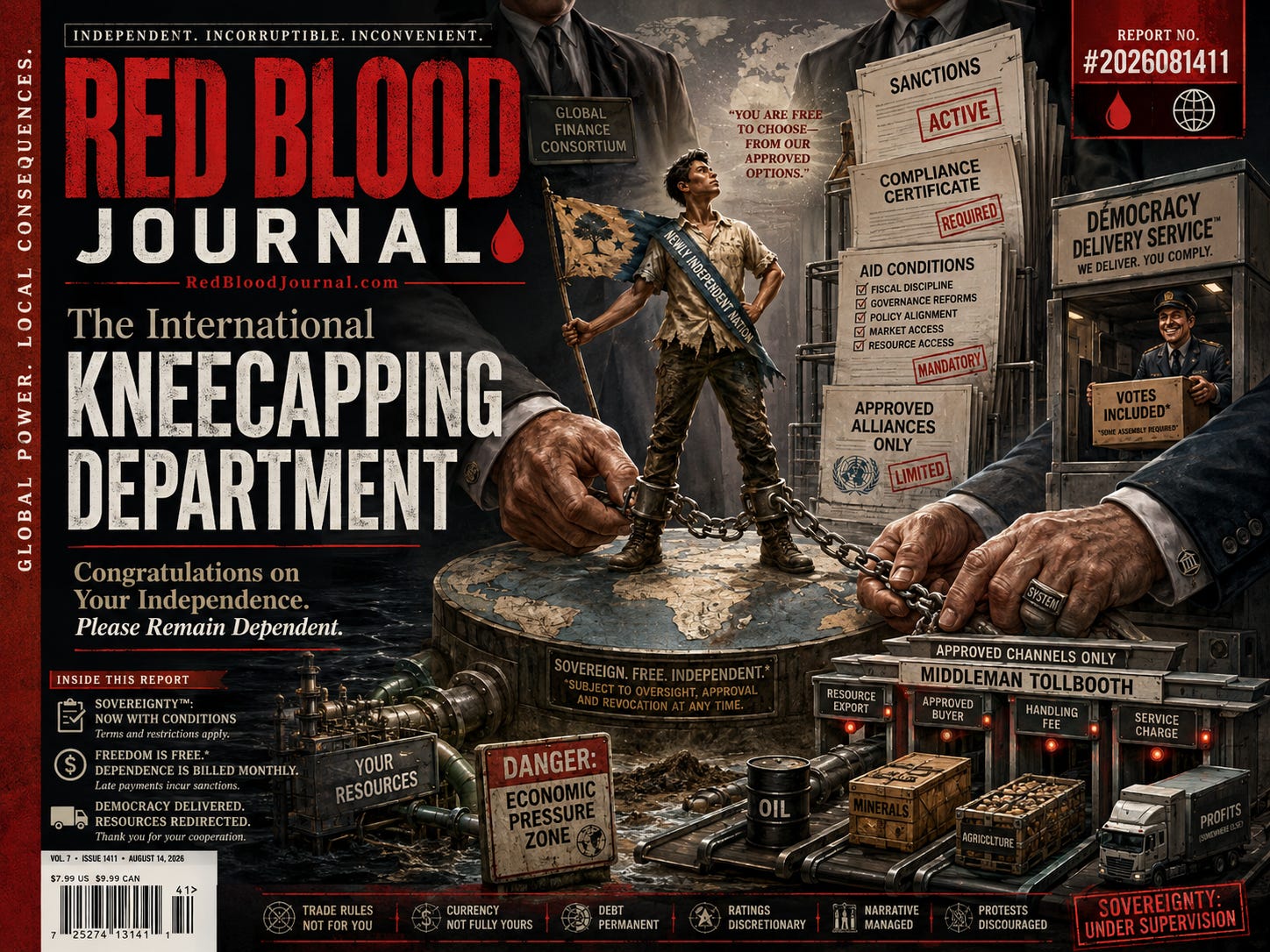
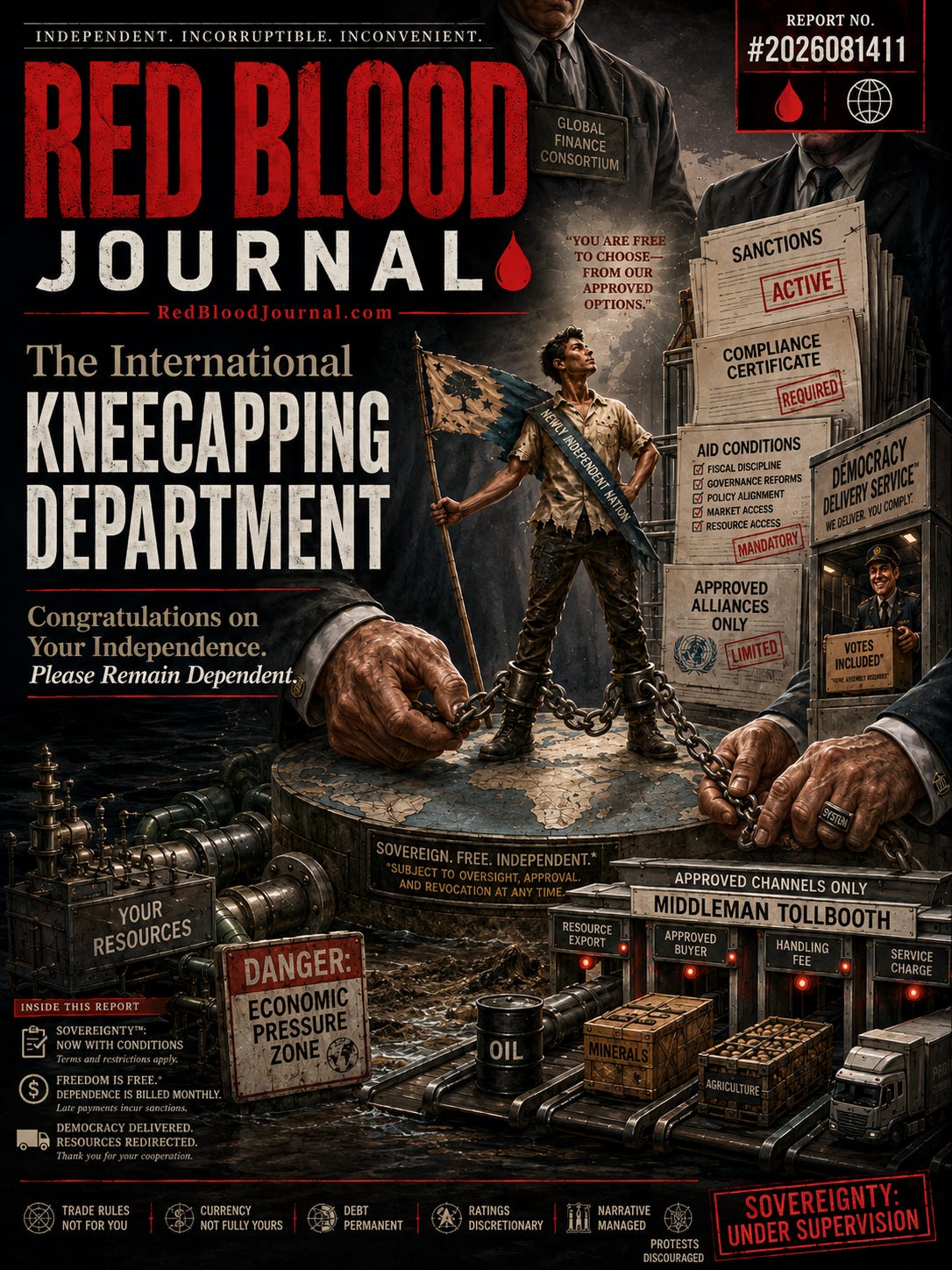
🩸 #2026081411 — The International Kneecapping Department
Congratulations on Your Independence. Please Remain Dependent.
There appears to be an unwritten rule in international politics:
Every country is free.
Completely free.
Absolutely sovereign.
Independent beyond question.
Provided, of course, that it does not become too independent.
That is when the paperwork begins.
A country wakes up one morning and says:
“We would like to control our own oil.”
A nervous man somewhere drops his coffee.
Another country says:
“We would like to trade with whoever gives us the best deal.”
Three committees are immediately formed.
A third announces:
“We would like to manufacture our own products, develop our own banking system, protect our own industries, and perhaps stop asking permission every time we sneeze.”
Emergency meeting.
Someone has apparently attempted unauthorized sovereignty.
Welcome to the Department of Standing on Your Own Two Feet
The brochure is beautiful.
United States Foreign Policy Independence Program
Step 1: Encourage nations to become free.
Step 2: Celebrate their freedom.
Step 3: Explain exactly what they are permitted to do with it.
Step 4: Become deeply concerned when they ignore Step 3.
The country says:
“But you said we should stand on our own two feet.”
Correct.
Unfortunately, those feet appear to be walking in an unauthorized direction.
This is unacceptable.
Please report immediately to the International Kneecapping Department.
The Sovereignty Starter Package
Every newly independent nation receives:
One flag.
One national anthem.
One seat at the United Nations.
One speech about self-determination.
One complimentary photograph of important officials shaking hands.
And approximately eleven thousand pages of invisible terms and conditions.
Somewhere around page 7,842:
Independence may be suspended if customer attempts to independently determine its economic, military, natural-resource, monetary, diplomatic, or strategic future.
Nobody reads the fine print.
That is how they get you.
“We Want to Control Our Resources”
This sentence has historically caused more heartburn in powerful capitals than questionable seafood.
Imagine the conversation.
Country:
“These resources are beneath our soil.”
Superpower:
“Correct.”
Country:
“Our people should benefit from them.”
Superpower:
“Obviously.”
Country:
“So we will decide how they are sold.”
Superpower:
“Whoa, whoa, whoa.
Nobody said anything about becoming radical.”
Suddenly economists appear.
Think tanks awaken.
Television experts discover the country on a map.
A gentleman who could not identify the country yesterday is now explaining its “complex internal democratic challenges” for forty-seven minutes.
The Miracle of Vocabulary
International politics possesses a magical dictionary.
When friendly governments protect domestic industries:
Economic strategy.
When unfriendly governments do it:
Dangerous nationalism.
When allies control strategic resources:
Energy security.
When adversaries control strategic resources:
Weaponization of commodities.
When friends influence another country’s politics:
Diplomatic engagement.
When opponents do it:
Foreign interference.
When allies build military bases around the world:
Global stability.
When someone else builds one:
Aggressive expansionism.
It is a wonderful language.
Every word comes with reversible upholstery.
The Great Independence Test
Imagine a small country attempting the examination.
Question 1: Are you sovereign?
“Yes.”
Correct.
Question 2: May you choose your own economic partners?
“Yes.”
Incorrect.
Question 3: May you control your own currency?
“Maybe?”
Suspicious.
Question 4: May you refuse military cooperation with a superpower?
“Technically?”
Security concern detected.
Question 5: May you nationalize something valuable?
The exam has ended.
Please remain seated.
Some gentlemen would like to speak with your president.
The Emergency Democracy Delivery Service
Occasionally a government becomes extremely inconvenient.
Perhaps it starts moving too far outside the preferred geopolitical lane.
Fortunately, democracy comes with express shipping.
Nobody knows exactly who ordered the package.
Nobody remembers approving the delivery.
But suddenly crates labeled:
FREEDOM
STABILITY
HUMAN RIGHTS
DEFINITELY NOT GEOPOLITICAL INTERESTS
begin arriving.
The recipient country looks confused.
“We already have a political system.”
Yes.
But have you considered having one we like better?
The Sanctions Fitness Program
When direct kneecapping would look impolite, there is always the economic treadmill.
The theory sounds elegant:
“We will pressure the government.”
Then food becomes expensive.
Medicine becomes difficult to obtain.
Businesses fail.
Currency collapses.
Ordinary families lose savings.
The ruling elite somehow still find dinner.
This is one of the extraordinary mysteries of sanctions.
The minister still has steak.
The grandmother is dividing an egg between three grandchildren.
Officials then announce:
“The pressure is working.”
On whom?
Excellent question.
Please do not ruin the presentation.
Meanwhile, the Government We Were Supposed to Weaken
Another remarkable phenomenon occurs.
Economic siege can give authoritarian governments a fantastic excuse for everything.
No electricity?
Foreign enemy.
Inflation?
Foreign enemy.
Corruption?
Foreign enemy.
Government incompetence?
Foreign enemy.
President’s cousin mysteriously owns fourteen companies?
Please stop helping the foreign enemy by asking inappropriate questions.
Thus an external policy designed to weaken a government can sometimes hand that same government the most useful propaganda gift imaginable:
A real external enemy.
Fantastic.
Everyone wins.
Except the people.
They appear to have misplaced their invitation.
The Restaurant Version
Imagine international politics as a restaurant.
America is sitting at the largest table.
Several friends are eating nearby.
A new customer enters.
Waiter:
“What would you like?”
Country:
“I will decide for myself.”
The room becomes silent.
Someone whispers:
“Did he just say what I think he said?”
Country:
“Yes. I would like the local special.”
Waiter:
“The approved menu is over here.”
Country:
“But I want that.”
Waiter:
“That entrée is supplied by China.”
Country:
“So?”
Security Council meeting.
Standing on Two Feet, Properly
Perhaps the real requirement is not that countries remain permanently on their knees.
That would be vulgar.
No.
Countries may stand.
They may even walk.
They simply must walk within the designated international pedestrian zone.
There are painted lines.
Friendly alliances over here.
Approved financial institutions over there.
Acceptable weapons suppliers around the corner.
Authorized energy arrangements upstairs.
Independent foreign policy?
Basement.
Door locked.
The Truly Comical Part
Americans are taught one of the most beautiful ideas ever written into political culture:
Do not allow distant powers to rule your destiny.
Govern yourself.
Protect your independence.
Resist tyranny.
Control your own future.
Then sometimes the same political establishment looks across the ocean at another country attempting something similar and says:
“Not like that.”
That is where comedy becomes tragedy.
Because the principle sounds magnificent until another nation tries using it.
The Red Blood Perspective
The question is not whether every government resisting Washington is noble.
Some are corrupt.
Some are brutal.
Some imprison opponents.
Some steal from their own populations.
Some use nationalism as camouflage for dictatorship.
But those facts do not erase another question:
Does opposing a bad government automatically give another government the right to determine that nation’s future?
And if economic punishment crushes ordinary people while political elites remain protected, perhaps we should stop calling the policy pressure on government without examining who is actually absorbing the pressure.
There is an enormous difference between:
“We oppose your government.”
and:
“Therefore we will decide your country’s economic destiny.”
One is foreign policy.
The other begins looking suspiciously like ownership.
Ocean of Love and Positivity Perspective
Perhaps one day nations will learn the same lesson individuals eventually must learn:
Strength does not require domination.
A powerful person does not need everyone else to crawl.
A powerful nation should not need weaker nations permanently dependent upon it.
Helping another stand does not diminish the helper.
And if freedom means anything, it must include the freedom to make choices powerful neighbors dislike.
Otherwise independence becomes a comedy:
“You are completely free.
Now please sign here confirming that you will do exactly what we say.”
In an Ocean of Love and Positivity.
🩸🌊✨ Fantastic!
🌍
The Fine Print of Global Sovereignty
Aug 14, 2026
This satirical critique examines the paradox of sovereignty in modern international relations, suggesting that global powers grant nations independence only if they remain subservient. The author argues that powerful states use economic sanctions, diplomatic pressure, and propaganda to penalize smaller countries that attempt to control their own natural resources or dictate their own foreign policy. By highlighting a double standard in political vocabulary, the text exposes how “freedom” is often redefined as a compliance-based system where unauthorized autonomy is met with intervention. Ultimately, the source contends that true self-determination is frequently undermined by a geopolitical hierarchy that prioritizes the interests of superpowers over the actual welfare of ordinary citizens.


