


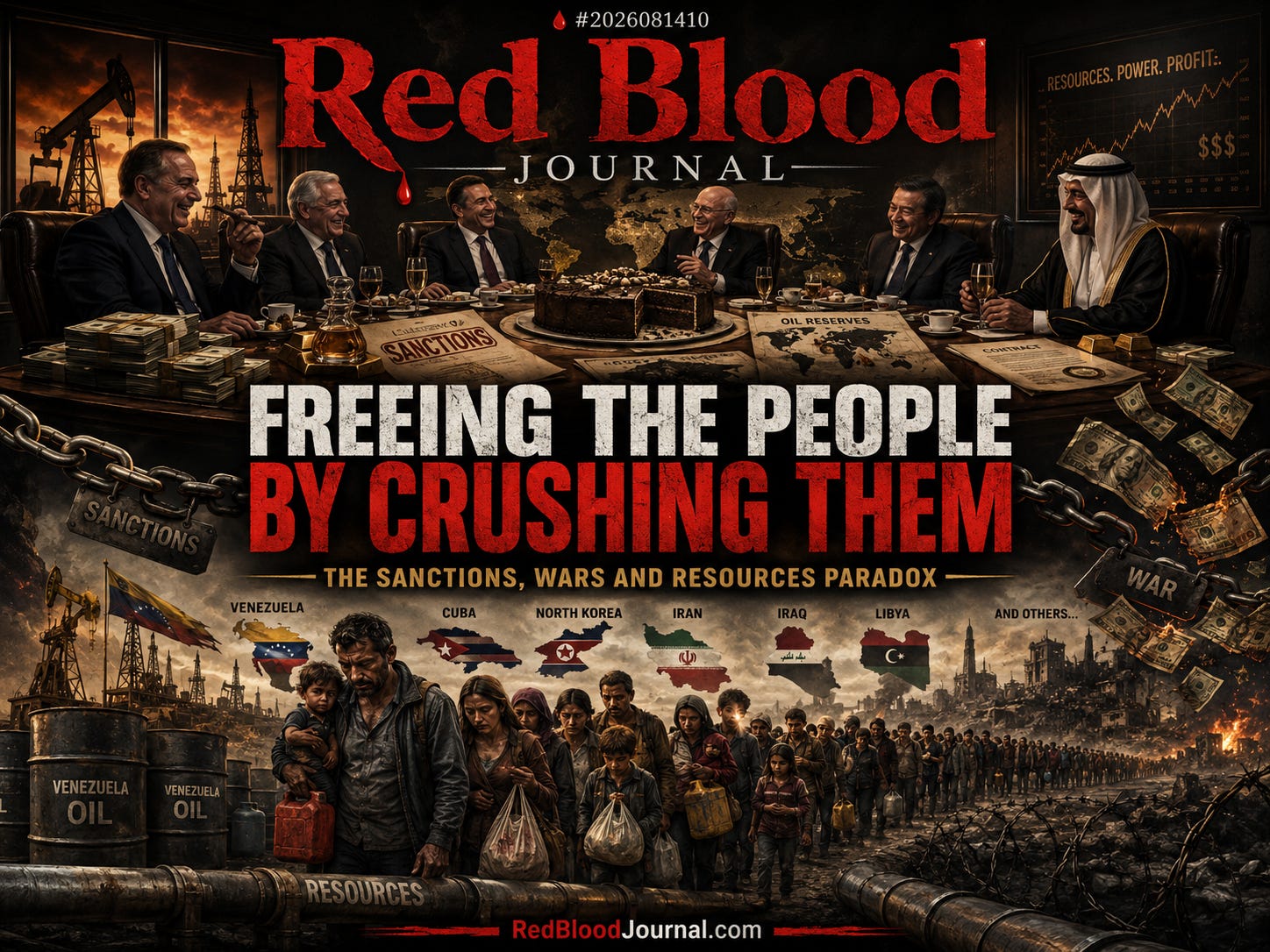
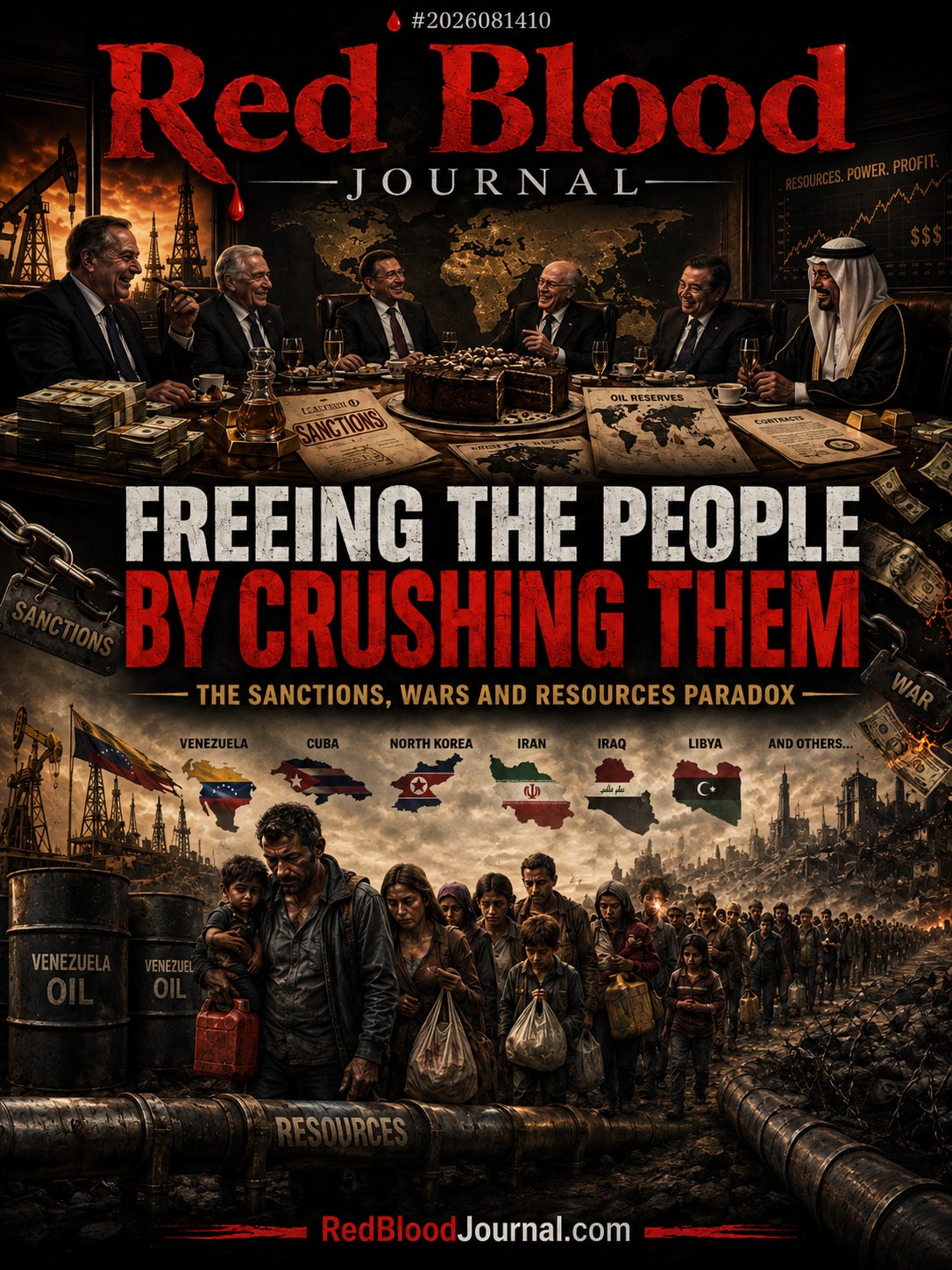
🩸 #2026081410 — Freeing the People by Crushing Them
The Sanctions, Wars and Resources Paradox
When governments are announced as the targets, but ordinary people repeatedly become the battlefield
There is a sentence repeated throughout modern foreign policy:
We are not against the people.
We are told the pressure is against their government.
The sanctions are against their government.
The blockade is against their government.
The bombing is against their government.
The intervention is against their government.
The freezing of assets is against their government.
The seizure or control of resources is supposedly necessary because of their government.
And ultimately, we are told, all of this is being done so that someday:
the people can be free.
There is only one problem.
Look at the people.
Follow the People, Not the Press Release
Governments speak in abstractions.
“Regime.”
“National security.”
“Democracy.”
“Strategic interests.”
“Maximum pressure.”
“Human rights.”
“Stabilization.”
“Liberation.”
But ordinary human beings do not live inside those words.
They live inside houses.
They buy food.
They need electricity.
They need medicine.
They need jobs.
Their children need schools.
Their businesses need banking systems.
Their factories need replacement parts.
Their savings need currencies that retain purchasing power.
Their elderly need medication.
So perhaps the simplest way to examine foreign policy is to stop listening temporarily to what both governments say and look instead at what happened to the human beings afterward.
That produces an uncomfortable picture.
Venezuela — This Is No Longer Merely a Historical Argument
Venezuela is particularly important because this story is happening right now, in 2026.
On January 3, 2026, U.S. forces captured Venezuelan President Nicolás Maduro during a military operation. Washington subsequently assumed extraordinary influence over the Venezuelan petroleum trade. U.S. officials openly said America needed to control Venezuelan oil sales and revenues for an indefinite period, while the administration argued that this was necessary to stabilize Venezuela and ensure its reconstruction served both Venezuelan and American interests.
Read that again.
This is not merely an allegation that somebody secretly manipulated Venezuela’s petroleum industry.
The control itself has been publicly acknowledged.
The White House issued an executive order protecting Venezuelan petroleum revenues held under arrangements supervised by the United States and explicitly connected their administration to U.S. foreign-policy objectives.
By July 2026, approximately 786,000 barrels of Venezuelan petroleum per day were traveling to the United States, the highest volume since early 2019. Venezuela was exporting approximately 1.16 million barrels per day overall, meaning the United States was taking a very large portion of the country’s exports.
Trading houses Vitol and Trafigura had meanwhile obtained control of a large share of Venezuelan exports through arrangements overseen by Washington and had handled more than 100 million barrels during roughly six months.
So where is the money?
That question has become increasingly important.
By mid-2026, outside analyses estimated that almost 100 million barrels worth roughly $8 billion had passed through the new system with limited transparency over the disposition of the proceeds. Later reporting placed the amount of Venezuelan petroleum revenue collected under U.S. control at more than $13 billion, while raising questions in Congress about precisely how the money was being accounted for and transferred back for Venezuela’s benefit. U.S. officials maintain that substantial amounts have been returned or used for Venezuela, but public accounting has remained disputed and incomplete.
Meanwhile, petroleum-producing Venezuelan communities continue to live with deteriorated infrastructure, unreliable electricity and the remarkable contradiction of poverty existing directly beside some of the world’s greatest petroleum wealth.
And that produces the question this report cannot avoid:
Whose oil is it?
If Venezuelans own the resource, should Venezuelans determine:
who extracts it,
who purchases it,
where it is refined,
where the money is deposited,
when the money is released,
and how their national wealth is spent?
Washington calls its system stewardship and stabilization.
Critics call it economic colonialism.
Others use an even simpler word:
stealing.
This report does not need to decide the terminology.
The facts themselves present the question.
A foreign military removes the president.
The foreign government then obtains decisive control over the country’s principal national resource.
Its domestic refineries receive enormous quantities of that resource.
Foreign firms handle its sale.
The proceeds move through accounts controlled or supervised outside Venezuela.
And the people standing above the petroleum reserves are still asking when the wealth beneath their feet will become visible in their lives.
Whatever political vocabulary is chosen, that arrangement deserves examination.
The Cake Is Still Upstairs
This returns us to the original sanctions paradox.
Economic punishment supposedly attacks leadership.
Yet leadership has extraordinary protection against economic suffering.
The senior official has access.
The general has access.
The intelligence officer has access.
The politically connected businessman has access.
The governing family has access.
Foreign currency exists somewhere.
Food exists somewhere.
Medicine exists somewhere.
Fuel exists somewhere.
The question is who can reach it.
And under scarcity, access itself becomes political power.
The ruler may therefore become more powerful over the population precisely because the outside world has made resources more scarce.
Downstairs, however, the ordinary citizen faces another reality.
The cake remains upstairs.
The people fight over crumbs.
Cuba — More Than Sixty Years Later
Cuba makes the experiment impossible to dismiss as temporary.
Generations have now lived beneath American economic restrictions.
The Cuban government remains.
Its political structure remains.
Its security institutions remain.
Its ruling hierarchy remains.
Yet ordinary Cubans have repeatedly experienced shortages, low purchasing power, limited economic opportunities and waves of emigration.
The stated enemy was the government.
But after generation after generation, one must ask:
Who actually served the sentence?
If someone was born forty years after the conflict began, what exactly was that person guilty of?
North Korea — The Leadership Survives, the Population Remains Captive
North Korea provides an even harsher example.
International economic punishment has been enormous.
The leadership survived.
The military survived.
The security state survived.
The weapons programs survived.
The ruling dynasty survived.
The ordinary Korean remained underneath all of them.
And here the paradox becomes almost unbearable.
If an authoritarian government controls access to resources, crushing the national economy does not necessarily liberate its citizens.
It may increase their dependency upon the government controlling whatever resources remain.
The outside world squeezes from one side.
The authoritarian state squeezes from the other.
And the ordinary human being becomes the object caught between two hands.
Iran — Maximum Pressure Meets the Ordinary Iranian
Iran has experienced the same mechanism.
Oil revenue is restricted.
International financial access is restricted.
Businesses encounter enormous barriers.
Currency purchasing power deteriorates.
Imports become more expensive.
Investment becomes dangerous.
The political establishment, security organizations and wealthy connected class possess mechanisms unavailable to ordinary wage earners.
And now, in 2026, sanctions have been accompanied by direct warfare between the United States and Iran, dramatically expanding the costs beyond economic pressure alone. Current reporting describes thousands of strikes and severe damage to Iranian military and economic infrastructure while the governing system nevertheless remains in place.
Again:
The government survives.
The population absorbs another layer of destruction.
And Then Look Back Twenty Years
Now step away from Venezuela.
Step away from sanctions.
Look across the countries touched by American warfare and intervention during one generation.
The cases are not identical.
America did not cause every conflict.
Domestic dictators, militias, sectarian movements, terrorist organizations, regional powers, civil wars and foreign governments all share responsibility in different proportions.
Pretending otherwise would replace one propaganda story with another.
But neither should the American role disappear.
So let us follow the physical results.
Iraq
The Iraq invasion actually began in March 2003, twenty-three years before this report—not exactly within the last twenty years.
But much of the occupation, insurgency, sectarian conflict, reconstruction failure and later ISIS catastrophe occurred during the twenty-year period that followed.
The United States invaded.
The Iraqi government was removed.
The Iraqi military and major state structures were dismantled or reconstructed.
Then came insurgency.
Sectarian warfare.
Terrorism.
Militias.
Mass displacement.
Destroyed infrastructure.
And years of attempting to rebuild what warfare had helped tear apart.
Even U.S. government auditors documented enormous problems with the reconstruction effort, deteriorating security and difficulty determining whether billions spent were actually improving basic services for Iraqi households.
The country supposedly being liberated became a battlefield for years.
And again the ordinary Iraqi had to live inside the consequences.
Afghanistan
Afghanistan was America’s longest war.
Twenty years.
The Taliban were removed.
A new government was constructed.
Security forces were created.
Enormous amounts of money were spent.
The United States spent roughly $145 billion simply on reconstruction, in addition to the vastly larger military costs.
Then America left.
And the Taliban returned.
A review of the reconstruction effort concluded that the United States struggled repeatedly with strategy, sustainability, corruption, unrealistic timelines and understanding Afghan conditions.
Twenty years of war.
Twenty years of reconstruction.
Thousands upon thousands dead.
Families displaced.
Children born and reaching adulthood knowing almost nothing except war.
And after the final aircraft departed Kabul:
The government Washington had spent two decades constructing collapsed.
The Taliban walked back into power.
What was the ordinary Afghan supposed to conclude?
Libya
Then Libya.
In 2011, the United Nations authorized force for civilian protection and a no-fly zone.
NATO intervened.
The United States participated.
Muammar Gaddafi’s government collapsed.
Gaddafi died.
And then?
Libya did not transform neatly into the stable democracy promised in the optimistic version of intervention.
It fractured.
Governments competed.
Militias proliferated.
Weapons spread.
Civil conflict continued.
State institutions weakened.
Even subsequent United Nations Security Council discussion described the NATO intervention as followed by a decade of turmoil, torn state institutions and enormous infrastructure damage.
The government disappeared.
The suffering did not.
That distinction matters enormously.
Removing a ruler is not the same thing as freeing a population.
Syria
Syria is another case where responsibility must be separated carefully.
The United States did not start the Syrian uprising.
The Assad government, opposition forces, ISIS, Russia, Iran, Turkey, Gulf states, Kurdish forces and numerous armed groups all played major roles in the catastrophe.
But the United States became militarily involved, conducted thousands of operations against ISIS, armed partners and occupied strategic territory during portions of the conflict.
The result of the overall war has been national devastation.
Millions displaced.
Infrastructure destroyed.
Schools damaged.
Healthcare systems fractured.
Economic life crushed.
Again, the question is not whether America alone caused Syria.
It did not.
The question is whether powerful foreign actors continually describe their participation as helping Syrians while Syrians themselves inherit the ruins.
That difference is important.
Yemen
Yemen demonstrates another kind of American involvement.
Beginning in 2015, a Saudi-led coalition launched a massive military campaign against the Houthis.
The United States supported Saudi Arabia and its partners in important ways over portions of that war while also conducting its own counterterrorism operations.
The result was one of the world’s worst humanitarian disasters.
UN development agencies documented mass displacement, collapse of basic services, severe poverty and extraordinary humanitarian need.
And the story did not stop.
U.S. forces later conducted extensive direct strikes against Houthi targets. A Pentagon review reported in 2026 concluded that U.S. strikes during the 2025 campaign killed 153 civilians and wounded 243, with additional incidents still under review.
Again:
Military objective above.
Human being below.
Pakistan
Pakistan was never invaded like Iraq.
That distinction matters.
But Pakistan became part of the post-9/11 battlefield through drone strikes, counterterrorism operations, intelligence cooperation and warfare along its Afghan frontier.
Communities lived beneath a war that frequently existed without Americans thinking of Pakistan as a country in which America was at war.
That is another characteristic of modern warfare:
Sometimes the population experiences war while the population funding it is barely aware that the war exists.
Somalia
Somalia presents another version.
Repeated American counterterrorism operations.
Airstrikes.
Special operations.
Proxy forces.
Support for local governments.
Years become decades.
The operations receive relatively little sustained American public attention.
For people underneath the aircraft, however, a “limited counterterrorism operation” can still be experienced as war.
The Numbers Become Almost Impossible to Absorb
Brown University’s Costs of War project estimates that direct violence in the major post-9/11 war zones—including Iraq, Afghanistan, Syria, Yemen and Pakistan—killed more than 940,000 people through 2023.
More than 432,000 were civilians.
And those numbers do not include the vastly larger potential toll from indirect consequences such as destroyed healthcare systems, damaged infrastructure, hunger, displacement, disease and economic collapse.
These deaths cannot simply be written on America’s account.
That would be inaccurate.
Insurgents killed.
Governments killed.
Terrorists killed.
Militias killed.
Foreign armies killed.
Civil wars killed.
ISIS killed.
The Taliban killed.
Al-Qaeda killed.
Sectarian organizations killed.
Regional powers killed.
American forces killed.
The important point is different:
These were the landscapes produced by the wars in which American power repeatedly became deeply involved.
And afterward the official vocabulary almost always returned to the same concepts:
security,
freedom,
democracy,
stability,
human rights.
Look at the words.
Then look at the countries.
From Sanctions to Bombs
There appears to be a progression worth investigating.
First:
Diplomatic pressure.
Then:
Economic pressure.
Then:
Financial isolation.
Then:
Asset freezes.
Then:
Oil restrictions.
Then:
Covert activity.
Sometimes:
Military intervention.
Then:
Regime removal.
Then:
Reconstruction.
And finally, very often:
Why is this country still unstable?
At each stage, the stated objective may sound reasonable when examined alone.
Together, however, they can create something very different.
A country progressively loses the ability to control its economy, its currency, its trade, its infrastructure, its security and sometimes even its natural resources.
And the ordinary citizen is told throughout the process:
This is being done for you.
Venezuela Makes the Question Impossible to Avoid
That is why Venezuela matters so much in 2026.
It allows us to watch the mechanism almost in real time.
For years:
Sanctions.
Financial isolation.
Oil restrictions.
Political pressure.
Then military action.
Then removal of the president.
Then foreign supervision of petroleum exports.
Then foreign supervision of petroleum revenues.
Then enormous quantities of petroleum flowing north.
And still the argument:
This is for Venezuelans.
Maybe it ultimately will benefit Venezuelans.
That possibility should not be excluded.
Maybe investment returns.
Maybe petroleum production rises.
Maybe infrastructure is rebuilt.
Maybe salaries rise.
Maybe democratic institutions improve.
If that happens, it should be reported just as clearly.
But that is not the question today.
The question today is:
Where is the Venezuelan family’s share of Venezuela’s petroleum wealth?
Not someday.
Not after another political transition.
Not after foreign companies recover their investments.
Not after geopolitical objectives have been accomplished.
Today.
The Intelligence Question
Then comes the hidden layer.
Large portions of intelligence operations remain secret.
Budgets contain classified components.
Activities can remain unknown to the overwhelming majority of the population.
Even most elected representatives may not possess operational details.
Legally, intelligence agencies are not completely unaccountable.
Presidents authorize covert actions.
Congressional intelligence committees exercise classified oversight.
Funding ultimately exists within legal structures.
But the democratic question remains.
If the population cannot see an operation,
cannot see its detailed expenditures,
cannot see who was paid,
cannot see which foreign actors were supported,
cannot see which companies participated,
cannot see the intelligence used to justify it,
and sometimes cannot even know the operation existed,
then meaningful public accountability becomes extremely difficult.
So rather than proclaiming that intelligence agencies secretly control everything, investigate the machinery.
Follow the money.
Follow the authorization.
Follow the contractors.
Follow the oil.
Follow the weapons.
And finally:
Follow the pain.
Who Was Actually Punished?
That should become the accounting system.
When sanctions are imposed:
Who lost purchasing power?
When banks are disconnected:
Who could no longer conduct business?
When petroleum is restricted:
Who lost income?
When bombing begins:
Whose house disappeared?
When a government falls:
Who lost security?
When infrastructure collapses:
Who loses electricity?
When foreign companies return:
Who receives the profits?
When petroleum begins flowing again:
Who receives the wealth?
When reconstruction begins:
Who receives the contracts?
When the foreign army eventually leaves:
Who remains behind?
That is how foreign policy should be audited.
Not merely by stated intentions.
By outcomes.
Who Is the Country?
Perhaps everything comes down to one question.
What is Iran?
Its government?
Or the Iranian people?
What is Cuba?
Its Communist Party?
Or Cubans?
What is North Korea?
Kim’s government?
Or Koreans?
What is Venezuela?
Maduro?
Delcy Rodríguez?
PDVSA?
Chevron?
Vitol?
Washington?
Or the Venezuelan people?
What was Iraq?
Saddam Hussein?
Or Iraqis?
What was Libya?
Gaddafi?
Or Libyans?
What was Afghanistan?
The Taliban?
The U.S.-supported government?
Or Afghans?
Governments are administrations.
People are countries.
Once that distinction is understood, foreign policy begins looking different.
The Red Blood Perspective
Perhaps modern economic warfare succeeded in creating something warfare never previously possessed:
violence without visible blood.
No crater is necessary.
No explosion must appear on television.
A currency simply becomes worthless.
Medicine quietly disappears.
A factory quietly closes.
A business quietly fails.
A young engineer quietly emigrates.
A mother quietly removes something from the grocery basket.
A pension quietly stops supporting a pensioner.
And somewhere thousands of miles away a politician announces:
The pressure on the regime is working.
That sentence should immediately produce another question:
How do you know?
Did the ruler miss dinner?
Did the general lose electricity?
Did the intelligence chief lose medicine?
Did the political elite lose their homes?
Or did millions of ordinary people simply become poorer?
If the population suffered while the rulers remained comfortable, then perhaps we did not pressure the government through the people.
Perhaps we pressured the people in the hope that they would pressure the government.
Those are not the same thing.
And once that distinction is visible, much of the language surrounding sanctions begins to change.
From Cuba to Venezuela, From Iraq to Libya
Look at the pattern over one generation.
Cuba remains economically isolated.
North Korea remains isolated.
Iran was sanctioned and is now at war.
Iraq was invaded.
Afghanistan was occupied for twenty years.
Libya’s government was destroyed through intervention and the country fractured afterward.
Syria became an international battlefield.
Yemen became a humanitarian catastrophe involving regional powers and American support and strikes.
Pakistan experienced a hidden drone war.
Somalia continues to experience counterterrorism warfare.
Venezuela moved from sanctions to military intervention and foreign supervision of its principal national resource.
These countries are not identical.
Their governments are not innocent.
Their histories are not interchangeable.
The United States is not responsible for every death, every destroyed building or every failed economy.
But after seeing the same landscape repeatedly, asking whether the methodology itself deserves examination is not anti-American.
It is precisely what citizens of a republic are supposed to do.
The Question Nobody Should Be Afraid to Ask
If the stated purpose is:
free the people,
then there should be one final measurement.
Not:
Did we remove the president?
Not:
Did we reduce GDP?
Not:
Did the currency collapse?
Not:
Did petroleum exports fall?
Not:
Did the government lose access to dollars?
Not:
Did American companies obtain new contracts?
Not:
Did our geopolitical opponent lose influence?
The measurement should be:
Are the people freer?
Are they wealthier?
Are their children safer?
Do they have more electricity?
More food?
Better healthcare?
Better education?
Greater political freedom?
More control over their country’s natural wealth?
Can they criticize their government?
Can they choose their government?
Can they build businesses?
Can they remain in their homeland rather than becoming refugees?
Because if twenty years later the answer is no, something is wrong with calling the process liberation.
Ocean of Love and Positivity Perspective
There may come a point when humanity realizes that a country cannot be separated from the human beings who live inside it.
Governments argue.
Governments threaten.
Governments sanction.
Governments bomb.
Governments classify.
Governments negotiate.
Banks transfer.
Corporations extract.
Intelligence services maneuver.
Politicians declare victory.
But none of those institutions feels hunger.
None watches its child become sick.
None packs one suitcase and abandons the country of its birth.
Human beings do.
Perhaps therefore the first rule of foreign policy should become extraordinarily simple:
Before claiming to save a population, look at what the policy is doing to that population.
If the ruler is still eating cake while the citizen searches for bread, something has gone terribly wrong.
And if the citizen must become poorer, hungrier, weaker, displaced or dead so that someday someone can announce that the citizen has finally been liberated—
perhaps it is time to ask whether liberation has become another word for something else.
In an Ocean of Love and Positivity.
🩸🌊✨ Fantastic!
⚖️
The Price of Liberation: The Sanctions and Warfare Paradox
Aug 14, 2026
This text critically examines the human cost of modern foreign policy, arguing that international sanctions and military interventions often devastate ordinary citizens while leaving ruling elites largely unaffected. By analyzing conflicts in nations like Venezuela, Iraq, and Afghanistan, the author highlights a paradox where efforts to “liberate” a population actually result in economic collapse and destroyed infrastructure. The source specifically focuses on the 2026 situation in Venezuela, questioning the foreign control of national resources and the lack of transparency regarding oil revenues. Ultimately, the narrative suggests that true liberation should be measured by the actual well-being and safety of a country’s people rather than the successful removal of a government. It calls for a shift in how global power is audited, moving away from political abstractions and toward the tangible physical reality of those living under these policies.


