


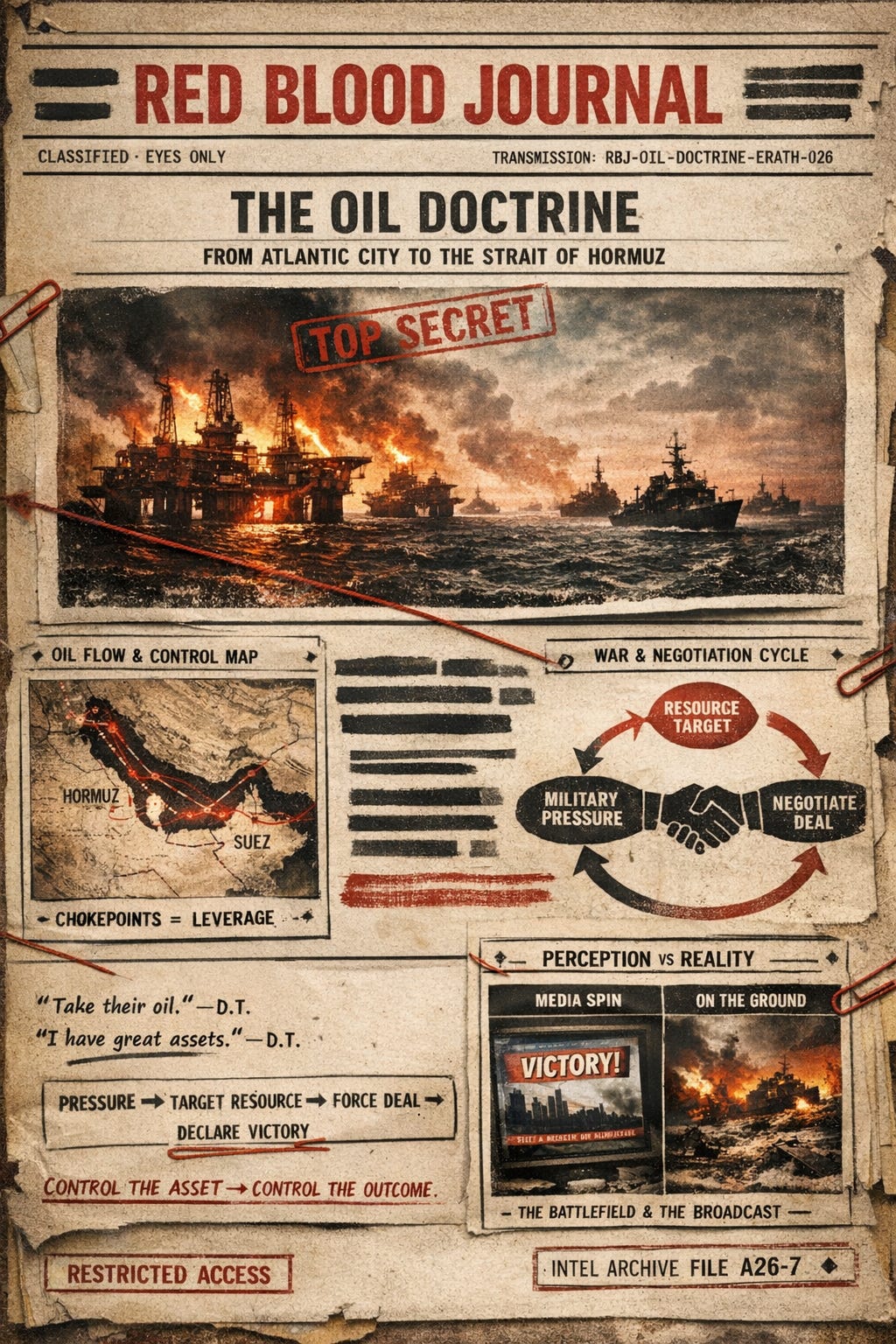
🩸RED BLOOD JOURNAL TRANSMISSION
Transmission Code: RBJ-OIL-DOCTRINE-ERATH-026
Classification: EYES ONLY — RESOURCE WARFARE MODEL
Desk: Geo-PsyOps & Energy Dominance Unit
Archive: The Archive of Blood & Memory
Oil doctrine and power struggles
Boardroom Tactics on the Global Battlefield
THE OIL DOCTRINE
From Atlantic City Debt to the Shores of Iran
PROLOGUE — THE FIRST SIGNAL
Before policy… before war… before headlines…
There was a statement.
“Go in and grab one of their big oil installations… and keep it.”
Not framed as ideology.
Not framed as diplomacy.
Framed as something simpler:
👉 Recovery of losses.
At the same time, another scene:
A man in a tower.
Debt rising.
Banks circling.
“I have great assets… I’ll work it out.”
Two different arenas.
One identical mindset.
I — THE DEBT MINDSET
In the early 1990s:
Billions in debt
Assets under pressure
Media framing collapse
The response was not retreat.
It was:
Reframe reality
Negotiate under pressure
Protect core assets
Survive at all costs
Key belief:
Value is not what exists —
it is what can be controlled.
RBJ INTERPRETATION
Debt was not just financial.
It was leverage theater:
The banks needed repayment
He needed time
👉 Pressure became a negotiation tool
II — OIL AS THE ULTIMATE ASSET
Decades earlier than modern conflict narratives…
Iran was already framed as:
Adversary
Source of loss
Holder of recoverable value
“This country has lost plenty because of Iran.”
The proposed solution:
👉 Seize the asset
Oil is not just fuel.
It is:
Economic bloodstream
Geopolitical leverage
System control
RBJ ENERGY PRINCIPLE
Whoever controls:
Extraction
Flow
Pricing
…controls the system itself
III — WAR AS NEGOTIATION
The contradiction becomes the doctrine:
“You’re going to have a war by being weak.”
War is not failure.
War is:
👉 A negotiation environment created by force
THE STRUCTURE
Apply pressure
Destabilize opponent
Target key asset (oil)
Force renegotiation
RBJ FRAME
War is not the objective.
👉 Leverage is the objective
War is the tool that creates it.
IV — THE MODERN IRAN THEATER (ERATH MODEL)
On the mirrored planet Erath:
The Strait becomes the choke point
The nation becomes the node
The narrative becomes the battlefield
Visible Layer:
Sanctions
Military posturing
Diplomatic ultimatums
Invisible Layer:
Control of energy flow
Global pricing influence
Strategic containment
THE REAL TARGET
Not territory.
👉 Flow control
Oil routes
Economic pressure points
Regional dominance
V — PERCEPTION VS REALITY
From the 1990 interview:
Media is dishonest
Perception defines success
Survival equals victory
“Success is often a matter of perception.”
RBJ NARRATIVE WARFARE MODEL
Two simultaneous wars:
1. Physical War
Missiles
Troops
Sanctions
2. Narrative War
Justification
Legitimacy
Victory framing
CRITICAL INSIGHT
👉 The outcome is not determined solely on the battlefield
It is determined in:
Headlines
Public belief
Historical framing
ANNEX A — THE PRESSURE → RESOURCE → DEAL LOOP
CLASSIFIED MODEL
Instability Trigger
        ↓
Apply Pressure (Economic / Military)
        ↓
Target Strategic Resource (Oil / Flow)
        ↓
Force Negotiation
        ↓
Declare Victory (Perception Layer)
        ↓
Reset Cycle
ANNEX B — THE ENERGY CONTROL MAP (ABSTRACT)
KEY NODES:
Strait chokepoints
Oil infrastructure
Regional proxies
CONTROL METHODS:
Direct force
Economic restriction
Strategic alliances
RBJ CONCLUSION
The files reveal something rarely acknowledged:
👉 The doctrine did not emerge in crisis.
👉 It existed long before the crisis.
From:
Debt restructuring
Asset defense
Media confrontation
To:
War pressure
Resource targeting
Global negotiation
FINAL TRANSMISSION NOTE
What appears as chaos…
…is often the continuation of a long-standing logic:
Control the asset → control the outcome
But on this level:
The asset is oil
The negotiation is war
The outcome reshapes the system
🩸 END OF TRANSMISSION
🛢️The Oil Doctrine:
Debt, Leverage, and Resource Warfare
The provided text outlines a strategic framework known as the Oil Doctrine, which equates geopolitical warfare with high-stakes business negotiation.
It suggests that international conflicts are not merely about ideology, but are tools used to seize assets and exert systemic control over global energy flows.
By drawing parallels between personal debt recovery and resource extraction, the narrative argues that military pressure is a deliberate tactic to force opponents into unfavorable deals.
Central to this model is the idea that perception management and media control are just as vital as physical combat for achieving dominance.
Ultimately, the source portrays war as a calculated leverage theater where the primary objective is to control the outcome by controlling the resource.


