


🩸 #2026081302 — RedBloodJournal.com
The Price of a Promise
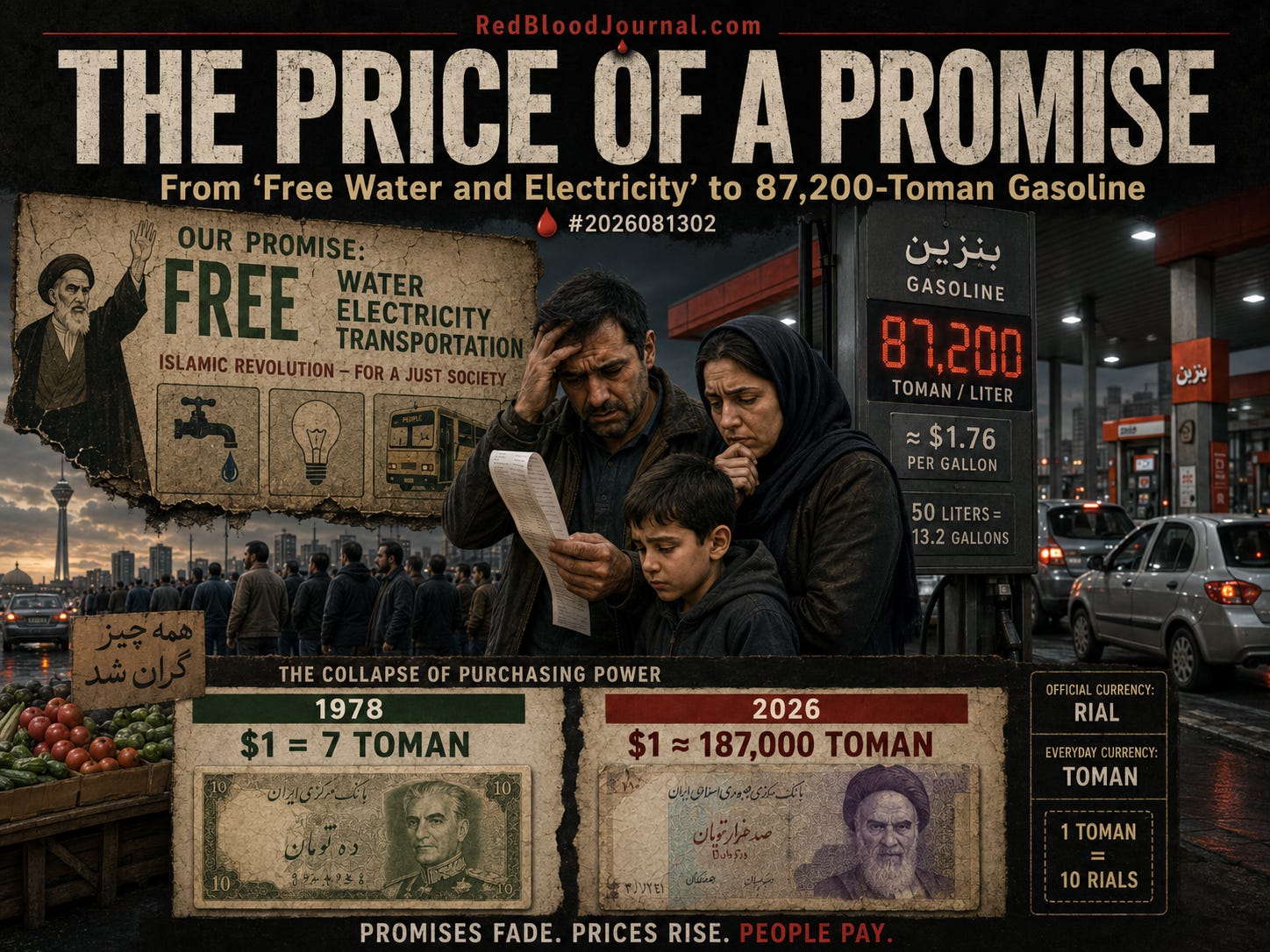
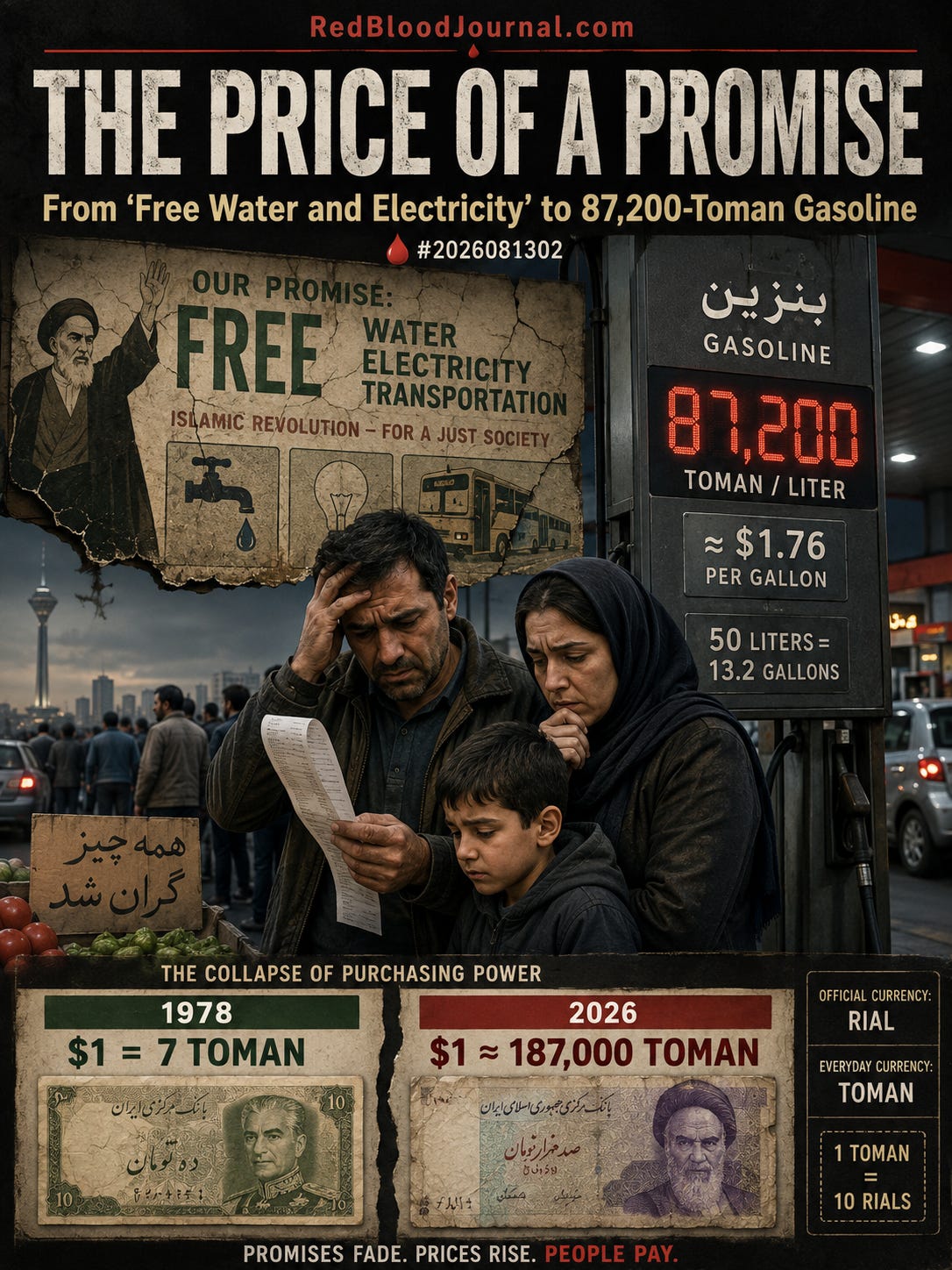
From “Free Water and Electricity” to 87,200-Toman Gasoline
There are moments when an economic statistic stops being a statistic.
It becomes a warning.
According to the Iranian-language report examined for this investigation, government-linked media in Kerman suddenly announced a gasoline system under which motorists would eventually face a refinery-rate price of 87,200 toman per liter after exhausting their allotted quotas. The announcement produced an immediate wave of anger and alarm. Within roughly two hours, the plan was reportedly halted and officials insisted that gasoline prices had not changed.
At first glance, 87,200 toman per liter is just another large Iranian number.
But the number becomes far more understandable when translated into the measurements and currencies familiar to an American reader.
At a free-market exchange rate of roughly 187,000–188,000 toman to one U.S. dollar, 87,200 toman per liter is about 46–47 U.S. cents per liter, or approximately $1.76–$1.77 per U.S. gallon.
To an American, $1.77 per gallon sounds cheap.
That is where the misunderstanding begins.
The Iranian standing at the pump is not earning an American salary.
50 Liters Is Not 50 Gallons
This distinction matters because liters can sound much larger to an American reader than they actually are.
A 50-liter tank is only about 13.2 U.S. gallons.
At 87,200 toman per liter, filling that 50-liter tank would cost:
4,360,000 toman
which is roughly:
$23–$24
for approximately:
13.2 gallons
Again, to an American reader, that sounds inexpensive.
Now compare it with Iranian income.
Iran’s 2026 minimum monthly wage was set at approximately 16.6 million toman per month.
That means one 50-liter fill-up at 87,200 toman per liter would consume roughly:
26% of an entire minimum monthly wage.
Not 26% of one day’s earnings.
Not 26% of one week’s earnings.
More than one-quarter of the month’s base wage.
And that is before rent.
Before food.
Before electricity.
Before water.
Before medicine.
Before clothing.
Before children.
Before anything breaks.
The transcript itself describes ordinary Iranians increasingly admitting publicly that they cannot afford what they once bought without thinking. One woman says she avoids going shopping with her husband because she no longer wants to ask him to buy things they may not be able to afford. She removes foods from her own mental shopping list because they have become too expensive. Merchants describe customers repeatedly checking their bank-card balances because they no longer know whether they have enough money to complete a purchase.
That is where 87,200 toman stops being merely a number.
From 1,500 Toman to 87,200
For years, Iranian motorists lived under heavily subsidized gasoline prices.
The familiar rates included approximately:
1,500 toman per liter
and:
3,000 toman per liter
with newer higher tiers appearing later.
Now compare those prices with 87,200 toman per liter.
From 1,500 toman to 87,200 toman is nearly 58 times the price, an increase of roughly 5,700%.
From 3,000 toman to 87,200 toman is approximately 29 times the price, an increase of roughly 2,800%.
From 5,000 toman to 87,200 toman is more than 17 times the price, an increase of roughly 1,640%.
So if anyone describes 87,200 toman merely as a 350% increase, the reference point must be identified carefully. A 350% increase would imply an earlier comparison price of roughly 19,400 toman per liter, not the familiar subsidized rates ordinary motorists had been paying.
The starting number changes the entire story.
The Dollar That Once Cost Seven Toman
There is another number that helps explain the psychological shock.
Near the end of the Pahlavi period, historical exchange-rate data show approximately 70.5 rials per U.S. dollar in 1978.
Because:
10 rials = 1 toman
that means:
$1 ≈ 7 toman.
Today, on the free market:
$1 ≈ 187,000–188,000 toman.
Put the two numbers beside each other:
PeriodApproximate value of $11978about 7 tomanAugust 2026about 187,000–188,000 toman
It therefore takes roughly 26,000–27,000 times as many toman today to buy one U.S. dollar as it did near the end of the previous regime.
Measured only against the dollar exchange rate, that represents an extraordinary collapse in the external value of the currency.
That does not by itself explain everything that happened to Iran over almost five decades.
Wars matter.
Sanctions matter.
Population growth matters.
Oil prices matter.
Government policy matters.
Productivity matters.
Corruption matters.
But a movement from roughly 7 toman per dollar to nearly 188,000 toman per dollar cannot simply be dismissed as background noise.
It is the backdrop against which modern Iranian wages, rents, food prices, medicine costs and gasoline prices must be understood.
The Rial, the Toman, and the Missing Zero
There is another layer of confusion that foreign readers must understand.
Iran’s official currency is the rial.
But ordinary Iranians generally speak, shop, bargain and think in toman.
And:
1 toman = 10 rials.
So:
10 million toman = 100 million rials.
Nothing economically changed.
Only the unit changed.
Yet psychologically, the number suddenly became ten times larger.
This distinction matters because government budgets, banking figures and official statements may be expressed in rials, while ordinary Iranians discuss daily life in tomans.
Many Iranians view this flexibility with suspicion.
When government spending is being presented, quoting the figure in rials produces a number that looks ten times larger.
When an expense, burden or loss is being discussed, quoting the same economic value in toman produces a number that looks ten times smaller.
The economic value is identical.
The psychological impact is not.
It is somewhat like an American politician saying the government is distributing one billion pennies instead of saying $10 million when a larger-looking number is politically useful.
Or returning immediately to dollars when a smaller-looking number is more convenient.
Whether every individual switch between rial and toman is intentionally manipulative cannot be demonstrated.
But many Iranians regard this unit-switching as part of the language of political presentation.
And the political environment matters when evaluating why such suspicions may be expressed privately more often than publicly.
Iran has a documented history of arrests, imprisonment, torture allegations, executions and lethal repression of dissent.
In such an environment, the absence of public objection does not automatically mean the absence of private recognition.
For this reason, Red Blood Journal uses toman for ordinary Iranian purchasing power, while identifying rial figures whenever they appear in official records.
The purpose is simple:
An extra zero should never be allowed to make economic reality appear larger or smaller than it really is.
And Then There Was the Promise
Now turn the clock back to the beginning of the Islamic Republic.
Ruhollah Khomeini publicly spoke about dramatically improving the material condition of the poor.
His revolutionary-era promises included housing assistance and free water, free electricity and free public transportation for poorer Iranians.
The promise was not merely theological.
It was economic.
Housing.
Water.
Electricity.
Transportation.
Prosperity.
The revolution presented itself not only as a change of government, but as the beginning of a more just economic order.
More than forty-seven years later, an Iranian worker can earn approximately 16.6 million toman in an entire month, while a proposed 13.2-gallon fill-up at the Kerman refinery-rate figure could consume 4.36 million toman of it.
A dollar that once cost approximately 7 toman now costs approximately 187,000–188,000 toman.
Those numbers do not prove what was inside Khomeini’s mind when the promises were made.
But they permit a direct comparison between:
the promise
and:
the result.
Before Power and After Power
This may be the larger story hidden inside the gasoline announcement.
Political movements often sound most generous before they possess power.
Before taking control, promises cost little.
The treasury belongs to someone else.
The police belong to someone else.
The courts belong to someone else.
The prisons belong to someone else.
The guns belong to someone else.
Then the movement wins.
Now the promises become bills.
And the people who believed those promises begin asking questions.
That is where political history becomes more complicated.
Before power, the message can be:
We will give you more.
After power, when prosperity does not arrive and public dissatisfaction grows, the message can become:
Do not challenge the system.
Iran’s post-revolutionary history contains repeated examples of arrests, imprisonment, executions and lethal force against political opponents and protesters.
Whether the revolutionary promises were knowingly deceptive from the beginning, sincere but unrealistic, or gradually abandoned after power was secured remains a historical question.
The result, however, can be examined.
When the Promise Fails but the Guns Remain
This is where economic disappointment and political power meet.
If a private company makes extravagant promises and fails, customers may leave.
If a politician makes extravagant promises before an election and loses credibility, voters may remove that politician.
But when a revolutionary movement captures the state itself, the relationship changes.
The organization that made the promise may eventually control:
the police,
the intelligence services,
the courts,
the prisons,
and the armed forces.
That changes the balance between the promised and the promiser.
A citizen who once heard:
We will make your life better
may decades later find himself asking:
What happens if I say publicly that you did not?
For many Iranians, that is not an abstract question.
The history of the Islamic Republic provides numerous examples of dissent followed by detention, torture allegations, imprisonment, execution or lethal suppression.
This is why the economic story cannot be separated completely from the political one.
Poverty is one issue.
Fear is another.
Together, they create a very different relationship between government and citizen.
The Kerman Gasoline Test
That is why the strange Kerman episode may be more important than the exact price itself.
According to the transcript, the 87,200-toman figure appeared suddenly.
People reacted immediately.
And the government retreated almost immediately.
Why?
One possibility is straightforward bureaucratic confusion.
Another is that officials underestimated public anger.
Another is that Kerman was being used as a limited test.
And another possibility, explicitly raised in the source, is that an extreme price was floated first so that a later lower increase might appear moderate by comparison.
There is not enough evidence presently available to establish which explanation is correct.
But there is an observable result:
87,200 toman produced an immediate reaction.
And the government apparently reacted to the reaction.
Gasoline Has a Memory in Iran
Fuel prices are politically dangerous because gasoline is not simply another product.
Raise gasoline and transportation becomes more expensive.
Raise transportation and food distribution becomes more expensive.
Raise transportation and services become more expensive.
Raise transportation and workers demand higher wages.
Raise transportation and inflation can spread throughout the economy.
The transcript describes exactly the kind of society into which such a shock would land.
People struggling with food.
People struggling with medicine.
People struggling with automobiles.
People struggling with basic purchases.
A livestock farmer is quoted comparing the cost of feeding a calf with what an Iranian family has available to live on.
A pharmacy story describes an elderly customer hearing the price of recurring medicine and struggling to understand how he could possibly pay it.
For a government, gasoline may be an economic calculation.
For a family, it can determine whether someone gets to work.
The Promise and the Receipt
Perhaps political history eventually reduces itself to two documents.
The promise.
And:
the receipt.
The promise included free utilities and transportation for the poor.
The receipt includes:
a dollar moving from approximately 7 toman to nearly 188,000 toman,
a minimum monthly wage around 16.6 million toman,
and a proposed gasoline rate at which a modest 13.2-gallon fill-up could consume more than one-quarter of an entire month’s minimum wage.
None of these numbers alone explains forty-seven years of Iranian history.
Together, however, they provide scale.
And once the scale becomes visible, a larger question emerges.
What should people believe when those seeking power promise prosperity?
What happens when those promises fail?
And what happens when the people who made those promises eventually control not only the treasury but also the institutions capable of silencing opposition?
Those questions should not be answered for the reader.
They should be placed beside the evidence.
The Red Blood Perspective
The most revealing part of the 87,200-toman gasoline episode may not be whether that exact number becomes permanent.
It may be what happened when ordinary people saw it.
To an economist, gasoline is a subsidy problem.
To the government, it is a budget problem.
To an international reader, $1.77 per gallon sounds inexpensive.
To an Iranian minimum-wage worker, however, the same price could make a 13.2-gallon fill-up consume more than one-quarter of an entire month’s base pay.
All of those statements can be true simultaneously.
That is why numbers without context can deceive even when the numbers themselves are technically correct.
The rial can make a number look ten times larger.
The toman can make the same number look ten times smaller.
The dollar conversion can make gasoline look cheap.
The monthly wage can reveal how expensive it actually feels.
The gallon can make the size of the purchase understandable.
And history can make the promise visible beside the outcome.
Ocean of Love and Positivity
Governments, revolutions, monarchies and ideologies come and go.
Currencies gain zeros.
Leaders rise.
Leaders disappear.
But the ordinary human being asks remarkably simple things from life.
Food.
Shelter.
Medicine.
Transportation.
Safety.
Dignity.
And the ability to say that something is wrong without wondering whether punishment will follow.
Whatever political system claims authority eventually has to answer to those basic needs.
The numbers do not need to shout.
Placed beside one another, they speak loudly enough.
In an Ocean of Love and Positivity.
🩸🌊✨ Fantastic!
📉
The Price of a Promise: Iran’s Economic Reality
Aug 13, 2026
This report examines the severe economic crisis in Iran by analyzing a proposed hike in gasoline prices to 87,200 toman per liter. While this figure appears low in U.S. dollars, the text explains that a single fill-up would consume over one-quarter of an Iranian worker’s minimum monthly wage. The author contrasts these modern financial hardships with the unfulfilled revolutionary promises of free utilities and prosperity made decades ago. The analysis highlights how extreme currency devaluation has seen the dollar jump from 7 toman in 1978 to nearly 188,000 toman by 2026. Ultimately, the source illustrates the widening gap between government rhetoric and the lived reality of citizens facing poverty and political suppression. This overview serves to provide essential context for international readers who might otherwise misinterpret Iranian economic data.


