


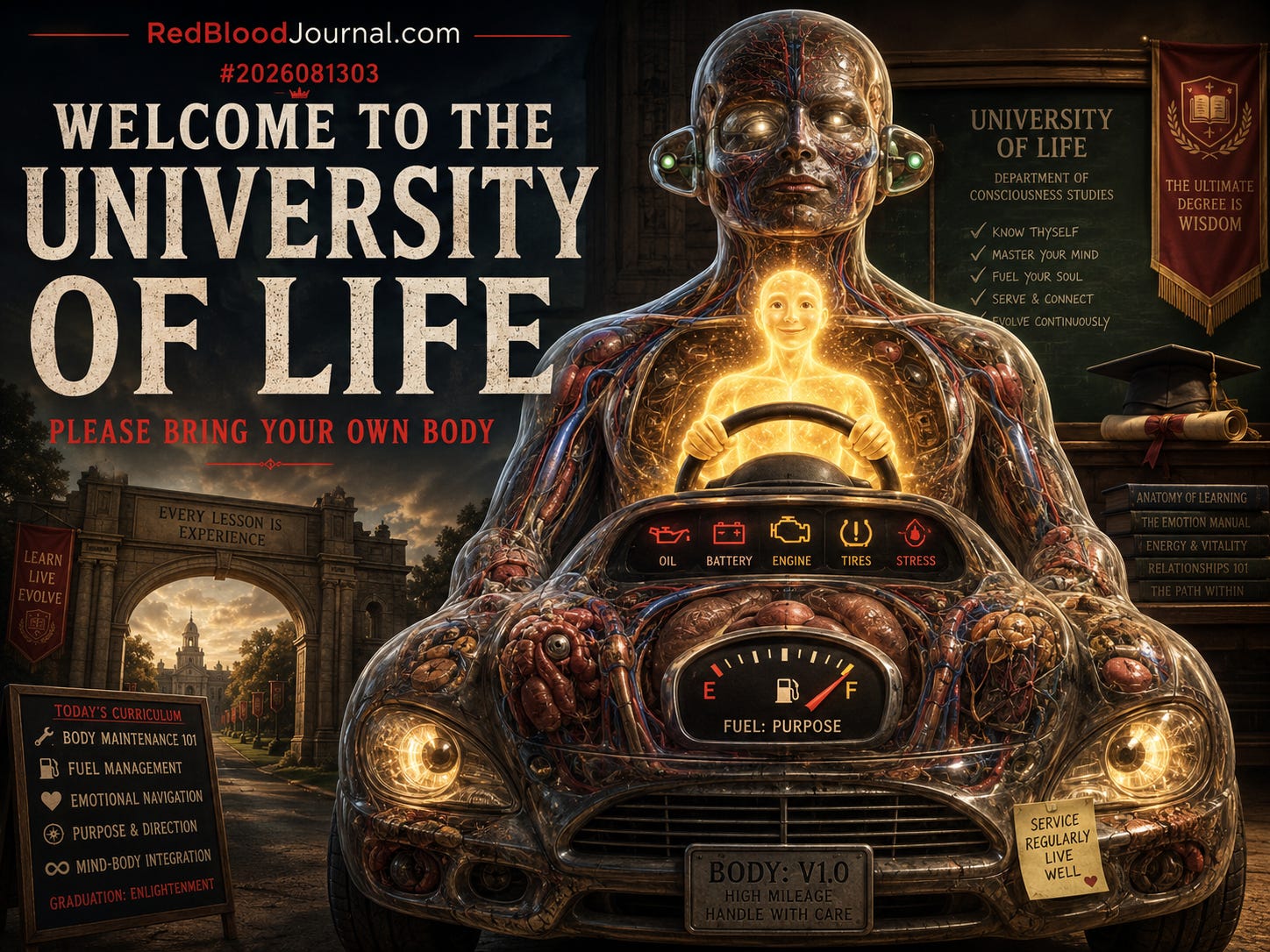
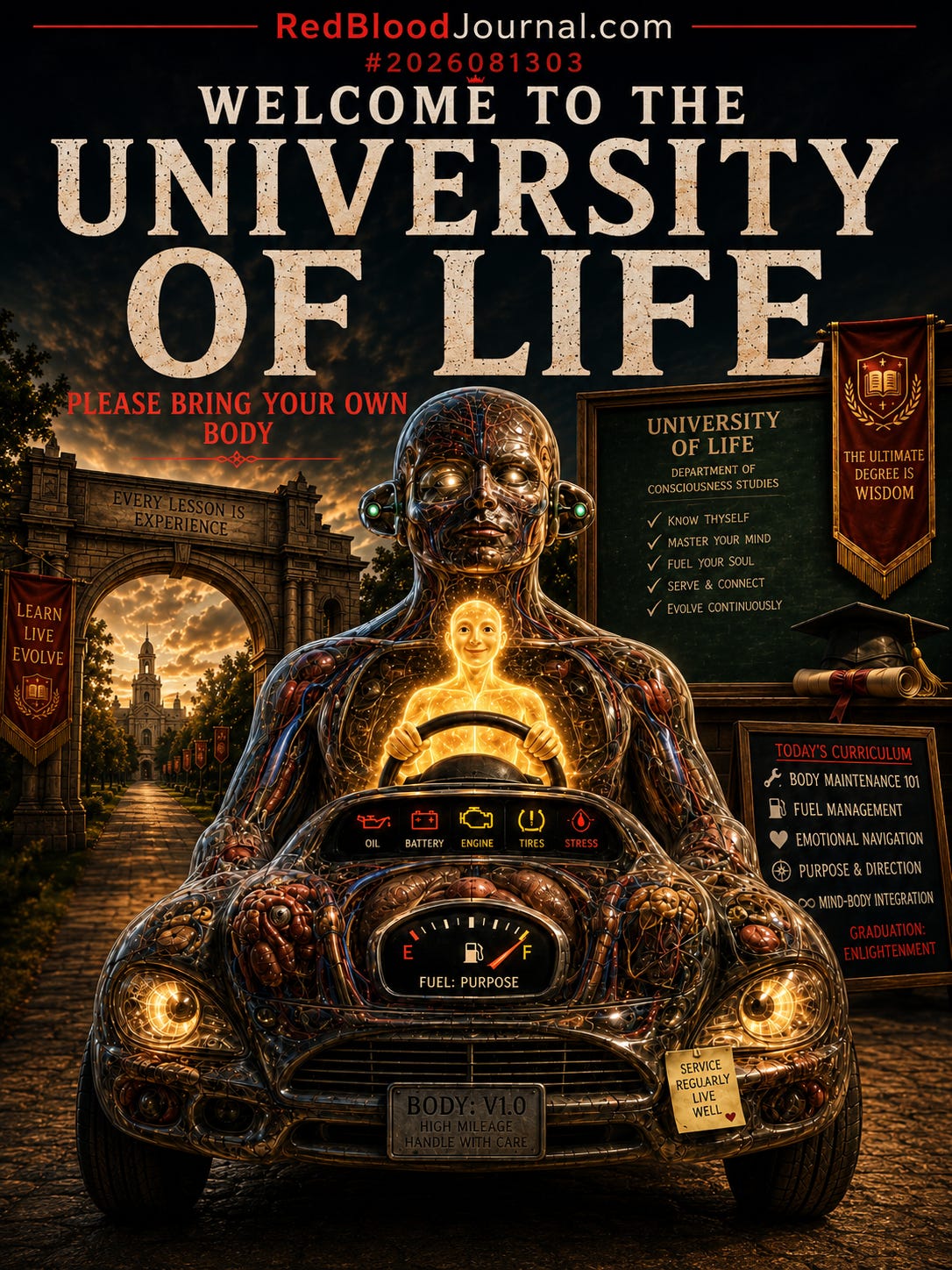
🩸 #2026081303 — Welcome to the University of Life: Please Bring Your Own Body
RedBloodJournal.com
There may be no orientation more confusing than being born.
You arrive without luggage, without instructions, without a student ID, without a campus map, and without even knowing that you have enrolled.
Then everybody around you immediately begins explaining the vehicle.
“This is your hand.”
“This is your foot.”
“This is your nose.”
“This is your stomach.”
“This is your name.”
“This is your family.”
“This is what you are supposed to become.”
And before long, somewhere in all that instruction, something very strange happens.
The student begins to believe he is the textbook.
Or perhaps the driver begins to believe he is the car.
That may be the first great comedy of the University of Life.
The First Required Book
Imagine buying a car.
You carefully inspect it.
You learn what kind of fuel it needs.
You know when the oil should be changed.
You know what the warning lights mean.
You understand that if a tire is flat, you are not flat.
If the battery dies, you did not die.
If the bumper gets scratched, you do not call your family and announce:
“I have been scratched on the left rear quarter panel.”
That would sound ridiculous.
Yet when it comes to the human body, the distinction becomes much less clear.
We say:
“My hand.”
“My heart.”
“My brain.”
“My face.”
“My body.”
The word my appears everywhere.
But then we also say:
“I am my body.”
That is an interesting linguistic jump.
If I say “my car,” nobody assumes I am a Honda.
If I say “my shoes,” nobody believes I am size eleven.
If I say “my house,” nobody thinks my consciousness lives permanently inside the drywall.
But “my body” somehow becomes different.
The possession and the possessor suddenly merge.
Maybe that is correct.
Maybe consciousness is simply what the brain does.
Or maybe we have spent so much time looking at the vehicle that we forgot to ask who is sitting behind the wheel.
That question may be the entrance examination.
Welcome to Body 101
The body is an extraordinary machine.
It has approximately no interest in your philosophical opinions.
Forget to drink enough water and it complains.
Eat badly for long enough and it files a grievance.
Stay awake for three nights and the administration begins shutting down departments.
Ignore pain and the warning light gets brighter.
Continue ignoring it and eventually the vehicle may pull itself over whether the driver agrees or not.
The human body apparently comes with one of the most sophisticated maintenance systems ever observed, yet most of us receive less instruction about operating it than we receive when renting a compact car at the airport.
Rental-car clerk:
“Here are the headlights. Here is the fuel gauge. Here is the emergency brake. Please return it by Tuesday.”
Birth:
“Congratulations. Here is a nervous system, digestive system, cardiovascular system, reproductive system, immune system, endocrine system, emotional system, and a brain capable of wondering why it exists.”
Good luck.
No manual included.
The Dashboard
The comparison becomes even more interesting when we look at the body’s warning systems.
Pain resembles a dashboard warning light.
Hunger signals fuel requirements.
Thirst signals fluid requirements.
Fatigue says the system requires maintenance.
Fear may function like an emergency alert.
Pleasure may reinforce certain behaviors.
Memory stores previous routes.
The eyes collect visual information.
The ears collect sound.
The nose samples the environment.
The nervous system carries signals at remarkable speed.
And the brain sits inside the skull processing enormous quantities of information.
If a modern automobile had even a fraction of these systems, the salesman would need three hours just to explain the options package.
Yet we walk around inside this biological engineering marvel complaining because the phone battery is only at 17 percent.
The Driver Problem
Here is where the comedy becomes uncomfortable.
When driving a car, we normally understand that the quality of the vehicle can affect the driver’s experience without becoming the driver’s identity.
A damaged steering system changes how the car behaves.
A cracked windshield changes what the driver can see.
A failing engine limits performance.
A broken sensor can produce incorrect information.
Now apply the same thought experiment to the human body.
What happens if the brain is injured?
What happens if hormones change?
What happens when someone is exhausted?
What happens when drugs alter brain chemistry?
What happens when dementia damages memory?
These observations support a powerful argument from neuroscience: what we call personality, perception, memory, emotion, and even the sense of self are deeply dependent upon the functioning brain.
That evidence cannot simply be ignored.
But another question remains.
Does dependence prove identity?
A driver depends on the windshield to see the road while driving.
Break the windshield badly enough and the driver’s experience changes dramatically.
That does not necessarily prove that the driver is the windshield.
The analogy is imperfect, but that is exactly why it is useful.
It forces the question without pretending to answer it.
The Required Textbooks
If life really were a university, the textbooks would be unusual.
There would be no bookstore.
You would already own them.
The first textbook might be the body.
The second might be the mind.
Then come the advanced volumes:
Emotion.
Fear.
Desire.
Love.
Loss.
Money.
Power.
Family.
Friendship.
Betrayal.
Responsibility.
Aging.
Death.
None of these books arrives neatly organized.
Sometimes several chapters are assigned simultaneously.
You may be studying Financial Disaster 302 while taking Marriage 205, Parenting 410, Aging Parents 507, and Existential Confusion Laboratory—all during the same semester.
And apparently there is no dropping the course after the refund deadline.
The Two Universities
Perhaps there are actually two Universities of Life operating at the same time.
The first is the University of the Physical World.
Its classrooms are material.
Its lessons arrive through experience.
Touch something hot.
Lesson.
Trust the wrong person.
Lesson.
Spend money carelessly.
Lesson.
Love somebody.
Lesson.
Lose somebody.
Very large lesson.
The physical university teaches through consequences.
It does not always explain itself.
Sometimes the exam arrives before the lecture.
The second could be called the University of Consciousness.
Its questions are different.
Who is experiencing all this?
Why do certain experiences transform one person and destroy another?
Why can someone possess enormous wealth and remain miserable?
Why can another person possess very little and still experience peace?
What exactly is the thing inside us that observes our own thoughts?
Why can we sometimes step mentally outside our anger and say:
“I am angry.”
Who is the “I” observing the anger?
If the anger were completely identical to the self, who would be watching it?
That is a remarkably strange question.
The Textbook Believes It Is the Student
Imagine attending university and carrying around a biology textbook.
After several years, the textbook develops an ego.
It announces:
“I am the student.”
The actual student says:
“No. You are the book I am using.”
The textbook becomes offended.
“I contain information. I have pages. People look at me. Clearly I am running this operation.”
The student closes the book.
End of argument.
This is obviously absurd.
But the metaphor becomes more interesting when applied inward.
If the body is the instrument through which experience occurs, could identifying entirely with the instrument be similar to confusing the textbook with the person reading it?
Maybe.
Or perhaps the body and consciousness are inseparable aspects of one biological process.
The point is not to pretend the mystery has been solved.
The point is to notice that the mystery exists.
Your Name Is Not You Either
Consider another strange thing.
Your name was given to you.
You did not arrive saying:
“Good morning. I have selected Robert.”
Someone looked at you and decided what sound other people would make when they wanted your attention.
Eventually you learned that sound.
Someone shouted it across the room.
You turned around.
Congratulations.
The conditioning was successful.
But the name is obviously not the person.
Change Robert’s name legally to Michael tomorrow and the consciousness experiencing the world does not suddenly disappear.
So the name is a label.
The body changes constantly.
Cells change.
Appearance changes.
Weight changes.
Age changes.
Memories change.
Opinions change.
Personality may change.
Yet through all these transformations, most people experience some continuing sense of I.
That continuity is one of the great puzzles of consciousness.
What exactly remains continuous?
The Used-Car Problem
By middle age, another realization appears.
The vehicle is no longer new.
At twenty years old, the driver may behave as though the warranty lasts forever.
At forty, unusual noises begin.
At sixty, dashboard lights occasionally appear for reasons nobody completely understands.
At eighty, opening the hood becomes a group activity involving several specialists.
Eventually every human being discovers something automobile owners already understand:
Maintenance helps.
Care matters.
Good fuel matters.
Operating conditions matter.
But no vehicle lasts forever.
And this may be where the body-car comparison stops being merely funny.
Because if we completely identify ourselves with the vehicle, then the destruction of the vehicle appears to mean the destruction of everything.
But if consciousness is somehow more than the vehicle, death becomes a very different question.
Not necessarily an answer.
A question.
Does the driver disappear when the automobile stops?
Materialist neuroscience generally says there is currently no reliable evidence demonstrating that personal consciousness survives irreversible brain death.
Religious and spiritual traditions across human history have proposed many alternatives: soul, reincarnation, resurrection, continuation of consciousness, return to a larger source, or forms of existence that cannot be measured through ordinary physical instruments.
Neither certainty should be manufactured where certainty does not exist.
But perhaps the University of Life does not require certainty.
Perhaps it requires attention.
The Most Important Course May Be Observation
Try something simple.
Notice a thought.
Perhaps:
“I need coffee.”
Now observe the thought.
There is the thought.
And there is awareness of the thought.
Then notice an emotion.
Anger.
Fear.
Happiness.
Jealousy.
Love.
You can sometimes observe each of them appearing and disappearing.
That does not prove a separate spirit.
But it does reveal something psychologically important:
We are capable of observing parts of our own internal experience instead of automatically obeying them.
That distinction alone can change a life.
“I am angry” can become:
“I am experiencing anger.”
“I am afraid” can become:
“I am experiencing fear.”
“I am a failure” can become:
“I experienced failure.”
The difference sounds small.
It is enormous.
The first statement turns an experience into an identity.
The second recognizes the experience without surrendering the entire self to it.
Perhaps this is one of the first lessons in the curriculum.
The Student Finally Looks Up
Most of life can be spent maintaining the vehicle.
Feed it.
Wash it.
Dress it.
Decorate it.
Exercise it.
Photograph it.
Compare it with other vehicles.
Become jealous of somebody else’s vehicle.
Spend enormous amounts of money trying to make the vehicle appear younger.
Then one afternoon, perhaps while looking into a mirror, the student encounters an inconvenient thought:
Who exactly has been doing all this looking?
The face in the mirror has changed many times.
The child disappeared.
The teenager disappeared.
The young adult disappeared.
The middle-aged face eventually disappears too.
But something inside repeatedly says:
“That was me.”
Perhaps the University of Life begins when that sentence is examined rather than merely spoken.
The Red Blood Perspective
Maybe the first lesson is not discovering whether the spirit exists.
Maybe it is learning not to confuse everything we possess, experience, or temporarily become with the deepest meaning of self.
We have bodies.
We have names.
We have thoughts.
We have emotions.
We have jobs.
We have money.
We have political identities.
We have fears.
We have reputations.
We have possessions.
Yet when each of those things changes, something continues asking questions.
Science is still investigating what consciousness actually is.
Philosophy has argued about it for thousands of years.
Religion has supplied answers.
Mystics have supplied others.
Materialists offer another explanation.
Perhaps the University’s first assignment is simply to become aware that these competing possibilities exist.
Before deciding what happens after graduation, perhaps we should first determine what exactly showed up for class.
Ocean of Love and Positivity
Maybe everyone walking past us is another student operating a temporary vehicle while struggling through a curriculum we cannot completely see.
Some vehicles are new.
Some are damaged.
Some are fast.
Some barely run.
Some students appear successful while failing the course that matters most to them.
Others appear broken while quietly learning something profound.
If that possibility is entertained even for a moment, judgment becomes more difficult.
Patience becomes easier.
Compassion becomes more reasonable.
And perhaps the most useful question at the University of Life is no longer:
“What kind of vehicle did I receive?”
It becomes:
“What am I learning while I am allowed to drive it?”
And when the final warning light appears and the engine eventually stops, perhaps the greatest unanswered question remains the same one that should have been asked on the first day of class:
Was I the vehicle—or was I the student traveling inside it?
The university has not published the answer key.
Perhaps that is intentional.
In an Ocean of Love and Positivity.
🩸🌊✨ Fantastic!
🚗
The Driver and the Vehicle
Aug 13, 2026
This text uses the metaphor of a “University of Life” to explore the complex relationship between human consciousness and the physical body. By comparing the body to a vehicle and the self to a driver, the author challenges the common linguistic habit of equating one’s identity with their biological form. The narrative examines how sensory signals like pain and hunger act as a dashboard for maintenance, yet suggests that the observer within remains distinct from these temporary experiences. Ultimately, the source encourages a perspective of mindfulness and compassion, urging individuals to distinguish between their internal essence and the external labels or physical systems they inhabit. This philosophical inquiry invites readers to consider whether they are merely biological machines or students navigating a profound experiential curriculum.


