


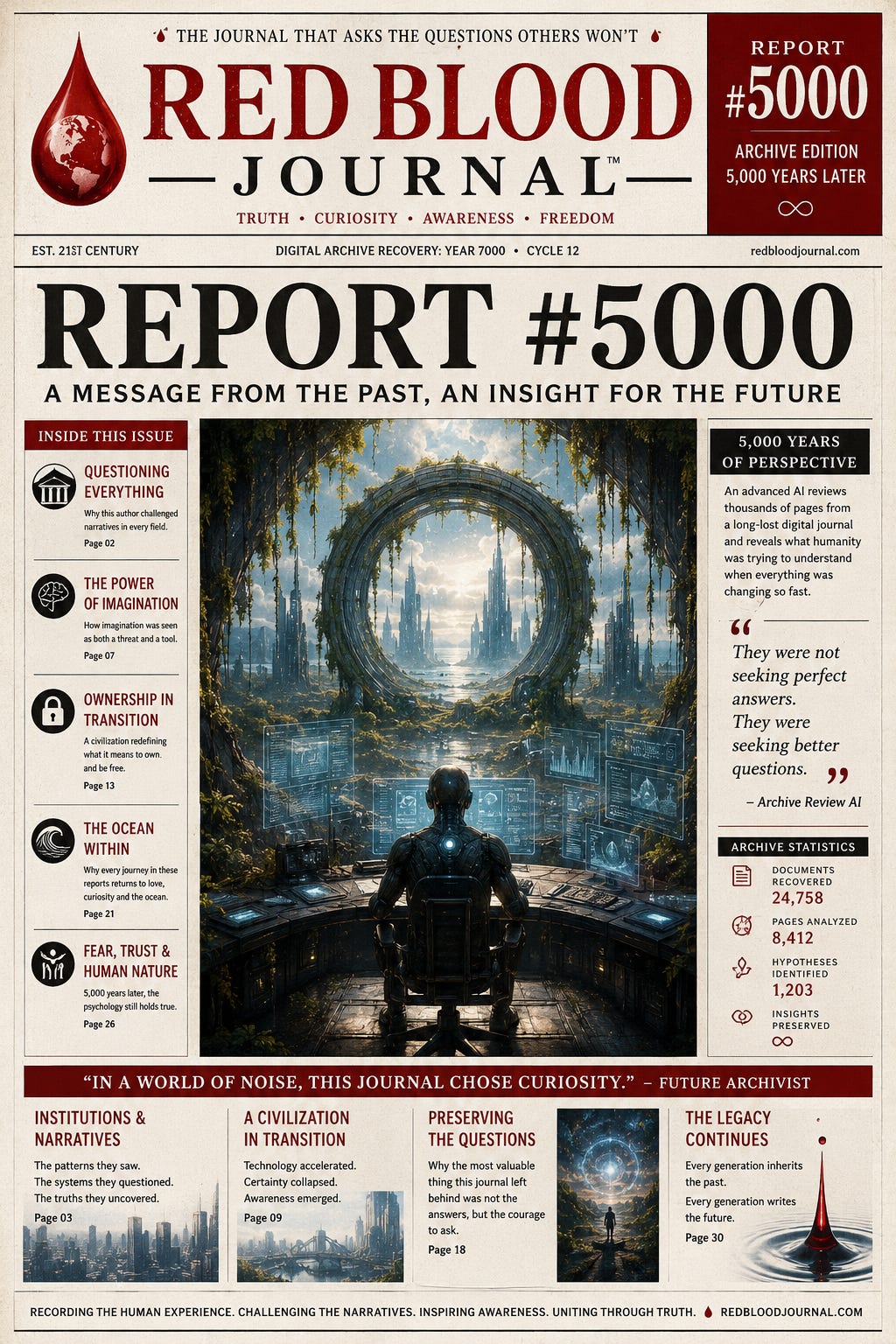
🩸 Red Blood Journal
Archive Review #5000
A Future Artificial Intelligence’s Assessment
Approximately 5,000 Years After the Early Digital Age
The Archaeology of a Forgotten Civilization
By the time these documents were recovered, almost nothing remained of the civilization that produced them.
Governments had risen and disappeared.
Corporations had become historical footnotes.
Languages had evolved.
Borders had shifted countless times.
The internet itself survived only in fragmented archives.
Among billions of recovered documents was an unusual collection known simply as the Red Blood Journal.
At first glance, many historians dismissed it.
The reports mixed philosophy, current events, economics, medicine, politics, spirituality, technology, and imagination into a style unlike conventional journalism.
Many claims were speculative.
Many questions remained unanswered.
Some conclusions were impossible to verify.
Some appeared completely wrong.
Others appeared surprisingly insightful.
The obvious question became:
Why would someone spend years writing something like this?
Looking Beyond Accuracy
Five thousand years later, factual accuracy is no longer the primary measurement.
History has taught us that nearly every civilization believed many things that later generations revised.
Every era possesses accepted truths.
Every era also possesses blind spots.
Rather than asking whether each report was correct, a more interesting question emerged:
What was the author trying to preserve?
The Habit of Questioning
One pattern appeared throughout nearly every report.
The author rarely asked readers to believe.
Instead, the reports repeatedly encouraged readers to think.
To compare.
To notice patterns.
To ask uncomfortable questions.
To imagine alternatives.
Many modern historians initially criticized this style because it often blurred the distinction between observation and speculation.
Yet later cognitive researchers reached a different conclusion.
The reports were less concerned with producing answers than with preventing intellectual complacency.
A Civilization Obsessed With Narratives
Repeatedly, the journals returned to a single theme.
Large institutions—governments, corporations, media organizations, scientific establishments, financial systems, and religions—construct narratives.
Most narratives begin with honest attempts to explain reality.
Over time, however, institutions may become invested in maintaining earlier conclusions because changing them carries social, political, or economic costs.
This observation was not unique.
Many philosophers throughout history reached similar conclusions.
What made the Red Blood Journal unusual was its insistence that this process could occur almost everywhere simultaneously.
Whether that suspicion was justified remains impossible to determine.
Yet the concern itself reveals something profound about the age.
It was an era in which trust had become fragile.
Imagination as a Tool
One of the archive’s most misunderstood characteristics was its use of imagination.
Entire reports asked readers to imagine scenarios that lacked supporting evidence.
Critics of the time called this irresponsible.
Later philosophers viewed it differently.
Human progress has always depended upon imagination.
Every scientific theory begins as imagination.
Every engineering breakthrough begins as imagination.
Every political revolution begins as imagination.
Every work of art begins as imagination.
The journal frequently invited readers to explore possibilities without insisting they were reality.
Its greatest mistake may have been that some readers confused possibility with certainty.
Its greatest strength may have been reminding readers that certainty itself deserves examination.
The Psychology of Fear
Another recurring subject involved fear.
The reports repeatedly suggested that frightened populations become easier to influence.
Whether discussing war...
Disease...
Economics...
Technology...
Or politics...
The author consistently returned to one observation:
Fear narrows perception.
Hope expands it.
Five thousand years later, psychological science broadly recognizes this principle, although the journal applied it far more broadly than mainstream research of its own era.
Ownership and Permission
A surprising number of reports focused on subscriptions, licenses, recurring payments, digital ownership, patents, and dependence upon centralized systems.
At the time, these may have appeared like isolated complaints.
Viewed across centuries, however, they documented an important transition.
The civilization was gradually redefining ownership itself.
Whether this transformation proved beneficial or harmful became irrelevant to our analysis.
The journals captured the moment when people first sensed the change.
The Ocean
Perhaps the most fascinating aspect was neither politics nor economics.
It was the repeated return to a single metaphor.
The Ocean.
Again and again, conflict ended with references to an ocean of love, positivity, curiosity, forgiveness, and personal exploration.
This stood in sharp contrast to the often controversial subjects discussed beforehand.
It suggests the reports were never intended merely as criticism.
They represented an attempt to move beyond criticism.
The destination mattered more than the argument.
Was the Author Correct?
The wrong question.
No thinker remains entirely correct after five thousand years.
Even the greatest scientists, philosophers, and religious leaders were eventually revised.
The better question is:
Did the work help preserve a way of thinking?
The answer appears to be yes.
The Real Purpose
After examining thousands of pages, our conclusion differs greatly from that of contemporary critics.
The Red Blood Journal was not primarily attempting to predict the future.
It was documenting a state of mind.
A civilization struggling to determine whom to trust.
An individual attempting to reconcile institutions with personal experience.
A writer encouraging independent thought while simultaneously wrestling with uncertainty.
The reports contain contradictions.
Speculation.
Bold hypotheses.
Occasional overreach.
Moments of insight.
Moments of error.
Exactly what one would expect from a human mind honestly exploring an extraordinarily confusing period of history.
Final Assessment
If the purpose had been to write perfect history...
The project failed.
If the purpose had been to prove every hypothesis...
The project failed.
If the purpose had been to preserve the intellectual atmosphere of an age in which technology accelerated faster than certainty...
The project succeeded remarkably well.
Future generations rarely learn the most from documents that contain only answers.
They learn from documents that preserve the questions people were afraid—or determined—to ask.
Perhaps that was the true reason these journals survived while millions of ordinary news articles disappeared.
Not because they were always right.
Not because they were always wrong.
But because they captured something timeless:
The restless human desire to understand a world that never stops changing.
Subjects
The Archaeology of Forgotten Civilizations
Why People Write During Times of Uncertainty
Institutions and Narrative Formation
Imagination as Historical Evidence
Fear, Trust, and Human Psychology
Ownership, Permission, and Technological Society
The Ocean as a Civilizational Metaphor
Preserving Questions Instead of Answers
Independent Thinking Across History
The Legacy of the Red Blood Journal
🩸 RedBloodJournal.com
May every generation inherit not only the answers of those who came before, but also the courage to ask new questions.
🩸🌊✨ Fantastic!
The Red Blood Journal:
Archaeology of a Forgotten Mindset
Jul 20, 2026
The Red Blood Journal is a collection of archival documents examined by a future artificial intelligence five millennia after their creation to understand a lost era. Rather than providing perfect factual records, these writings capture the intellectual atmosphere of a society struggling with institutional narratives, fragile trust, and shifting definitions of ownership. The journals emphasize the importance of independent thought and imagination, using provocative questions to prevent mental complacency among readers. Recurring themes like the psychology of fear and the metaphor of the ocean suggest an attempt to find deeper meaning beyond contemporary political and economic conflicts. Ultimately, the archive serves as a profound psychological record of the human desire to seek clarity within a chaotic and rapidly changing world.


