


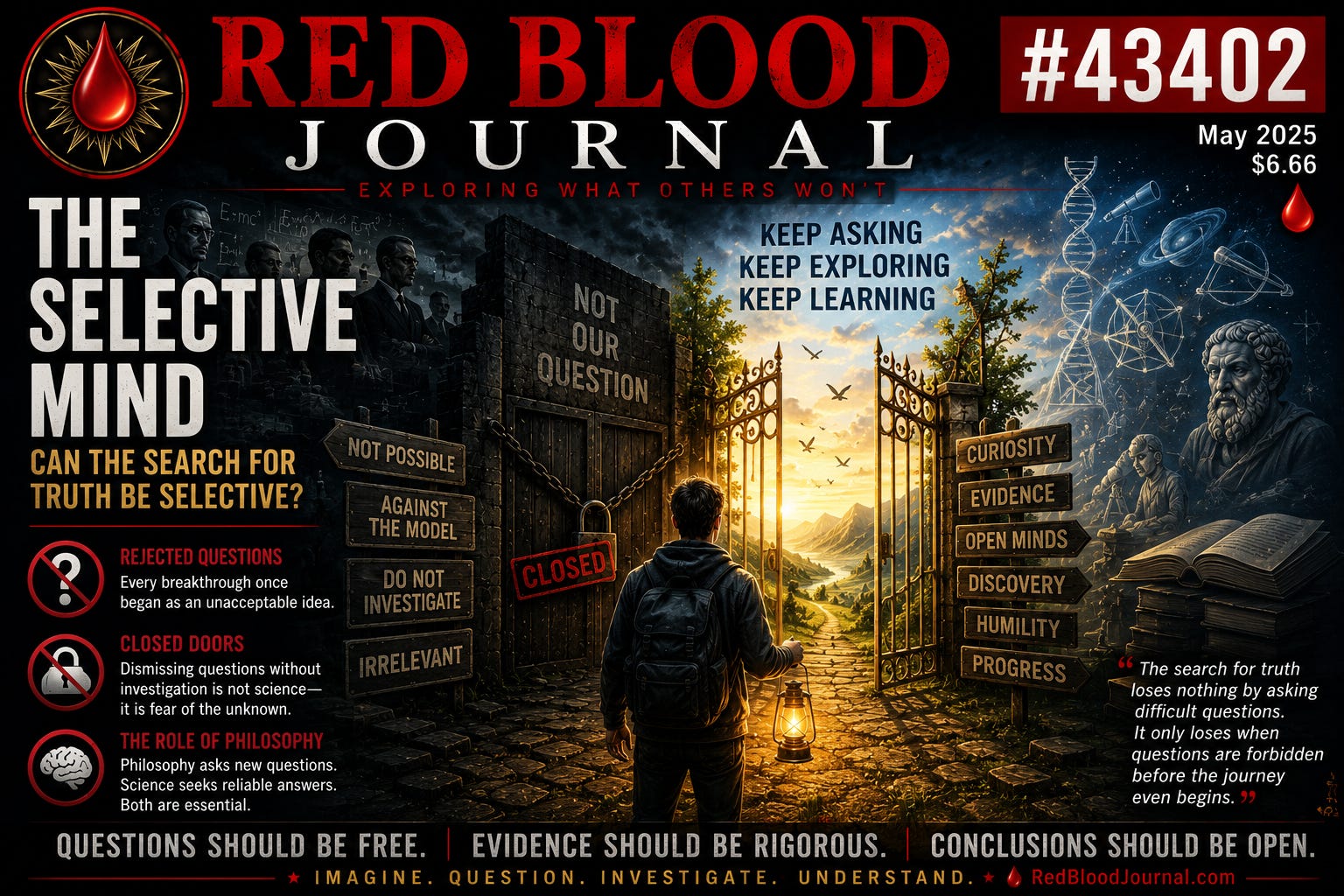
#43402 – The Selective Mind
🩸 Red Blood Journal
Can the Search for Truth Be Selective?
Science often describes itself as humanity’s greatest method for discovering truth.
Its strength lies in observation.
Experimentation.
Questioning.
Verification.
But this raises another question.
Can the search for truth itself become selective?
If a question is rejected before it is investigated...
Has the investigation already failed?
The Purpose of Inquiry
Every scientific revolution began with an unacceptable question.
What if the Earth moves?
What if invisible organisms cause disease?
What if stones can fall from the sky?
What if continents drift?
Each idea challenged the accepted understanding of its time.
Many were dismissed before eventually being investigated.
Some were proven wrong.
Others transformed civilization.
The common thread was not that every unusual idea proved correct.
It was that someone was willing to ask the question.
Philosophy’s Role
Philosophy asks questions that may not yet be measurable.
Science attempts to answer those that can be measured.
One expands the horizon.
The other examines what lies within it.
Without philosophy, there may be fewer new questions.
Without science, there may be fewer reliable answers.
Neither replaces the other.
Both serve different roles in humanity’s search for understanding.
The Danger of Certainty
The greatest obstacle to discovery may not be ignorance.
It may be certainty.
When any individual or institution concludes that a question should never be asked simply because it challenges the current model, curiosity begins to shrink.
History suggests that confidence in today’s knowledge should be balanced with humility about what remains unknown.
The Open Door
Not every extraordinary idea will prove true.
Many will fail.
Some deserve to fail.
That is part of learning.
But dismissing a question without examination is different from examining it and finding it unsupported.
The first closes a door.
The second teaches us something.
Final Thoughts
Perhaps the measure of an open mind is not how quickly it believes.
Nor how quickly it dismisses.
It is how honestly it investigates.
Questions should remain free.
Evidence should remain rigorous.
Conclusions should remain open to revision.
Human knowledge has always expanded by allowing imagination to ask questions and discipline to examine them.
The search for truth loses nothing by asking difficult questions.
It only loses when questions are forbidden before the journey even begins.
Subject: The Selective Mind — Can the Search for Truth Be Selective?
🩸🌊✨ Fantastic!
❓ The Selective Mind:
The Architecture of Open Inquiry
Jul 23, 2026
The provided text explores the dynamic relationship between science and philosophy in the pursuit of genuine knowledge. It suggests that intellectual progress is often hindered by premature certainty and the refusal to entertain unconventional questions. By highlighting historical breakthroughs, the author argues that scientific inquiry must be paired with an open-minded philosophical approach to remain effective. The source emphasizes that rigorous investigation is a better tool for discovery than the outright dismissal of challenging ideas. Ultimately, the piece calls for a balance of imaginative curiosity and disciplined evidence to ensure the search for truth is never artificially restricted.


