


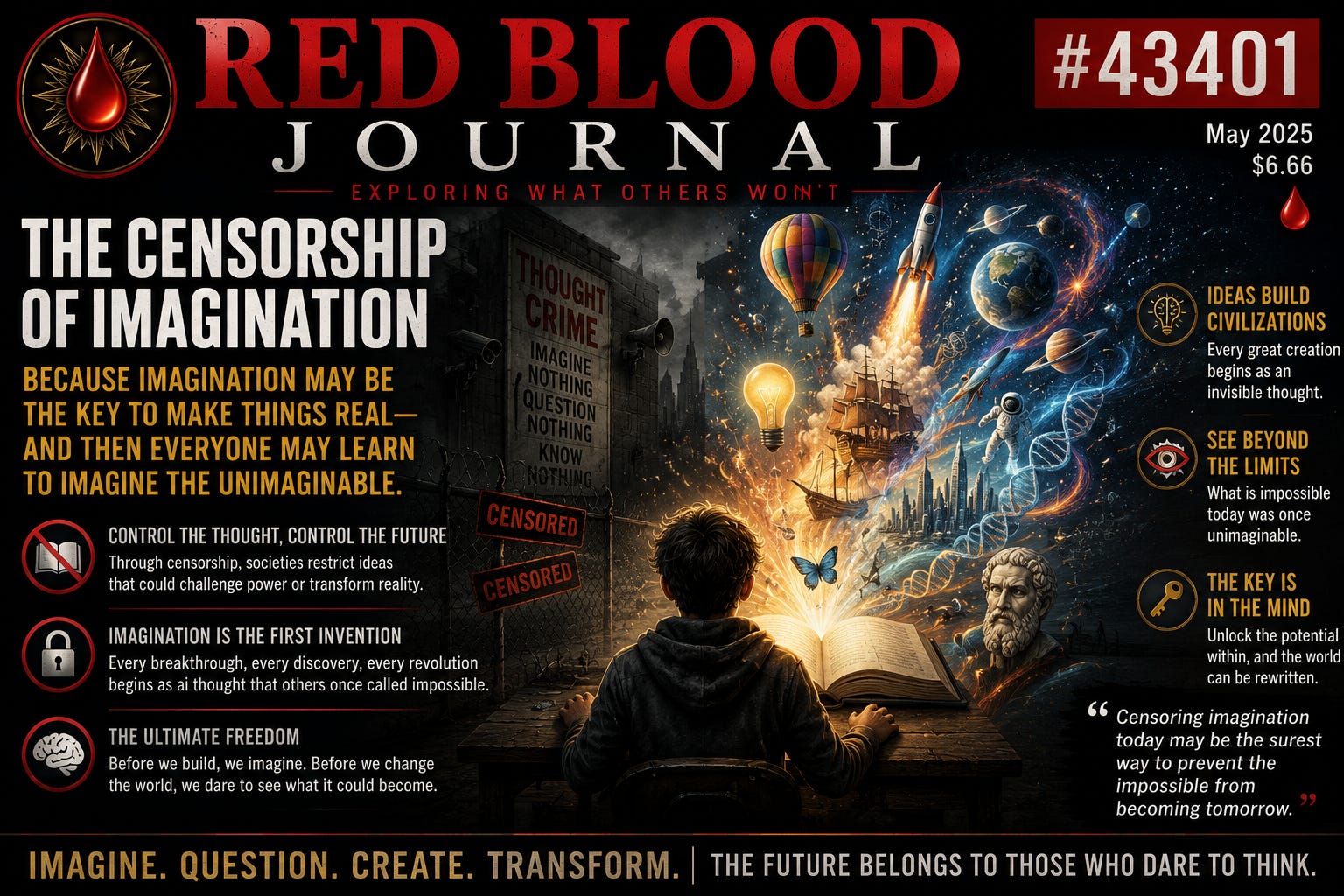
#43401 – The Censorship of Imagination
🩸 Red Blood Journal
If Every Great Creation Began as an Impossible Thought...
Throughout history, every great invention shared one thing in common.
It existed first...
As imagination.
Before the airplane, someone imagined flying.
Before the submarine, someone imagined living beneath the sea.
Before satellites, someone imagined speaking across the planet.
Before artificial intelligence, someone imagined machines that could reason.
Every physical achievement was first an invisible thought.
Reality, in many ways, appears to begin as imagination before becoming engineering.
The Power of an Idea
An idea has no weight.
No mass.
No physical location.
Yet ideas have built civilizations.
Ideas have started wars.
Ideas have ended wars.
Ideas have created religions.
Ideas have destroyed empires.
The physical world repeatedly demonstrates that thoughts can eventually reshape reality—not by magic, but because human beings act on them.
Every bridge, every symphony, every scientific theory, and every spacecraft existed first in someone’s imagination.
Why Fear Imagination?
If imagination has the power to transform the physical world through human action, then controlling imagination may become one of the most effective forms of influence.
History shows that many governments, institutions, and societies have restricted books, censored art, punished heresy, or discouraged certain lines of inquiry.
The motivations have varied.
Sometimes leaders sought political stability.
Sometimes they wished to preserve religious doctrine.
Sometimes they feared social unrest.
Sometimes they protected existing power.
The reasons differ, but the pattern is familiar: ideas can be influential, so some ideas are resisted.
Beyond Engineering
There is another question—one that moves beyond established science and into philosophy.
What if imagination does more than inspire action?
What if consciousness itself plays a deeper role in reality than we currently understand?
At present, there is no scientific consensus that imagination alone can directly alter the external world without physical action.
Yet consciousness remains one of the greatest unsolved mysteries in science.
Whether imagination is solely an internal process or part of something larger remains an open question.
The Limits of Today’s Knowledge
History repeatedly reminds us that today’s impossibility can become tomorrow’s textbook.
Many ideas once dismissed later became accepted.
Many accepted ideas were later abandoned.
Progress often begins when someone is willing to imagine what others consider impossible.
That does not make every imagined idea true.
But without imagination, many true discoveries would never have been pursued.
The Real Freedom
Perhaps the greatest freedom is not freedom of speech.
Nor freedom of movement.
Perhaps it is freedom of thought.
Because before a person can build...
They must imagine.
Before they can discover...
They must question.
Before humanity can become something greater...
Someone must first dare to imagine the unimaginable.
Whether imagination merely plants the seed for future action or reveals possibilities not yet understood, history suggests one lesson:
Every new world first appeared in the mind of someone willing to think beyond the limits of the old one.
Subject: The Censorship of Imagination — Why Every Revolution Begins with a Thought
🩸🌊✨ Fantastic!
💡
The Architecture of the Unimaginable
Jul 23, 2026
The provided text examines the pivotal role of imagination as the primary catalyst for all human progress and physical innovation. It posits that every significant technological or social achievement originated as a conceptual thought before being translated into reality through human action. Because ideas possess the unique power to reshape civilizations, the author suggests that institutions often attempt to censor or control creative thinking to maintain existing power structures. The narrative further explores the mysterious nature of consciousness, questioning if the mind influences the world in ways that current science cannot yet explain. Ultimately, the source argues that intellectual freedom is the most essential human right because it allows individuals to envision possibilities beyond current limitations. This philosophical overview highlights that the ability to dream of the impossible is the necessary precursor to every meaningful discovery in history.


