


July 30, 2026
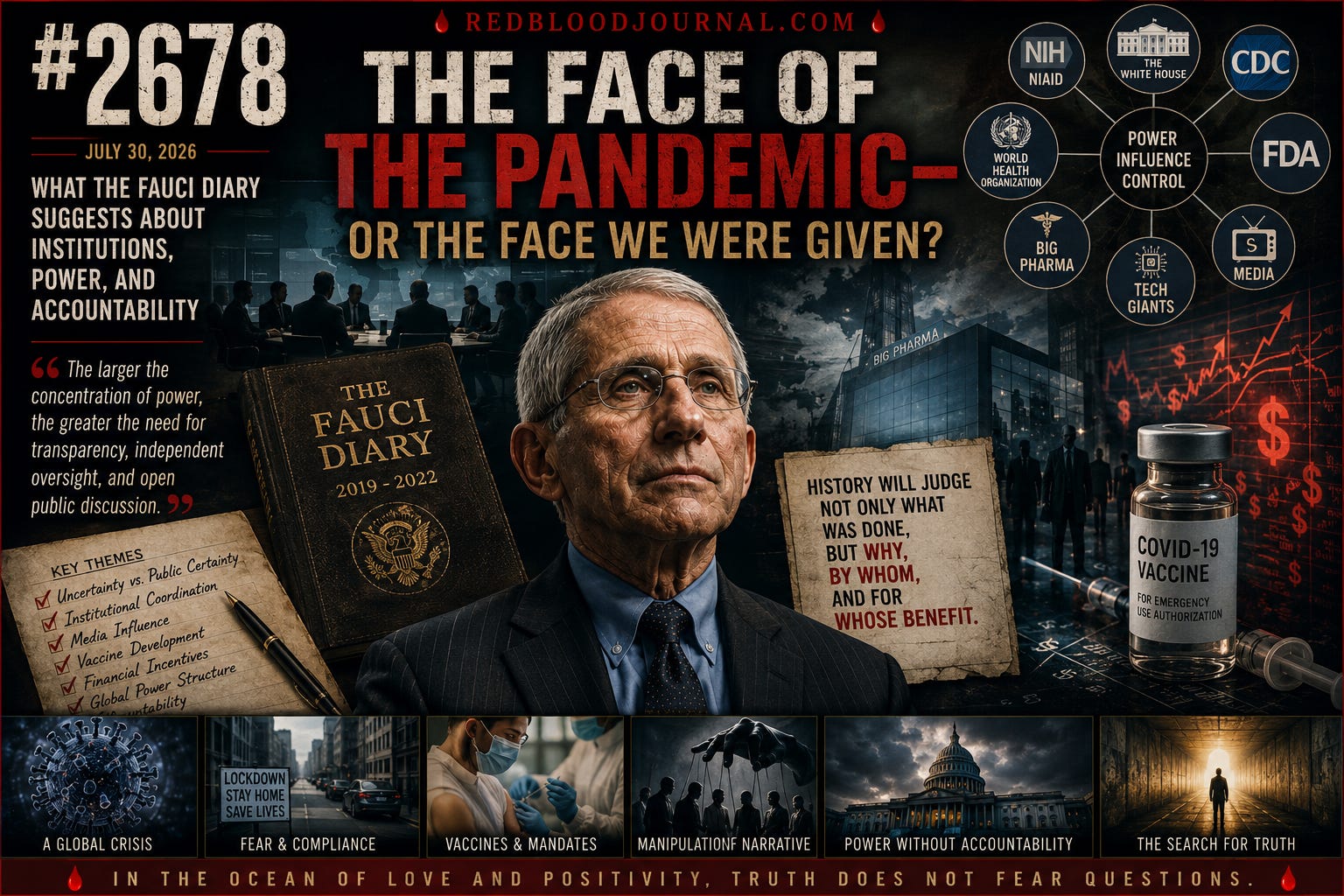
#2678 — The Face of the Pandemic—or the Face We Were Given?
What the Fauci Diary Suggests About Institutions, Power, and Accountability
🩸 RedBloodJournal.com 🩸
The release of more than a thousand pages from Dr. Anthony Fauci’s pandemic-era diary provides one of the most detailed firsthand records yet available from inside the U.S. government’s COVID-19 response.
For many observers, the diary answers some questions.
For others, it raises many more.
Perhaps the most important realization after reading the diary is this:
Anthony Fauci almost certainly did not operate alone.
The pages reveal an extraordinary web of meetings, conference calls, scientific consultations, White House briefings, intelligence discussions, media interviews, international coordination, and continuous communication among numerous agencies and institutions.
The diary repeatedly demonstrates that decisions were rarely made by one individual.
Instead, they emerged from a vast network involving government departments, scientific advisers, universities, pharmaceutical companies, regulatory agencies, international organizations, and elected officials.
This naturally leads to another question.
If decisions were collective, why did one individual become the symbol of the entire pandemic response?
History often prefers a single face.
It is easier to remember one person than to understand a complex institutional structure.
Whether praised or criticized, Fauci became that face.
The Public Face of a Larger Machine
Reading the diary chronologically reveals something that is often lost in public debate.
The entries rarely describe a man acting independently.
Instead, they describe someone moving from one meeting to another.
One conference call ends.
Another briefing begins.
Media interviews are scheduled.
White House discussions continue.
WHO communications follow.
Scientific advisers exchange opinions.
Agency coordination continues.
The picture that emerges is not of a lone commander directing events, but of a senior official operating within a much larger institutional framework.
If history eventually concludes that mistakes were made, responsibility may extend beyond any one person.
Public Certainty and Private Uncertainty
One of the most discussed aspects of the diary is the contrast between private scientific discussions and confident public messaging.
The diary records occasions when experts debated competing explanations, questioned available evidence, and considered multiple possibilities.
Public communication, by contrast, often projected greater certainty.
There are many possible explanations for this difference.
Officials may have believed certainty would reduce panic.
They may have hoped consistent messaging would encourage compliance with public-health guidance.
Or they may simply have been communicating the conclusions they considered most likely at the time.
The diary alone cannot determine which explanation is correct.
It does, however, document that uncertainty existed during many critical moments.
The Convergence of Power
The pandemic brought together institutions that normally operate independently.
Governments.
Public-health agencies.
Universities.
Technology companies.
Media organizations.
Pharmaceutical manufacturers.
International organizations.
Financial markets.
Never before in modern history had so many influential institutions focused simultaneously on the same global event.
That convergence alone deserves continued historical examination.
Large-scale coordination during emergencies can be beneficial.
It can also increase the importance of transparency, oversight, and independent review.
Incentives and Accountability
COVID-19 also became one of the largest economic events of the modern era.
Governments spent trillions of dollars.
Pharmaceutical companies generated substantial revenue from vaccines and therapeutics.
Hospitals expanded emergency operations.
Technology platforms became primary channels for public information.
Financial incentives existed throughout the healthcare and pharmaceutical systems.
The existence of financial incentives does not, by itself, establish improper intent or coordinated wrongdoing.
However, whenever enormous public-health decisions and enormous financial interests intersect, rigorous oversight and transparency become essential for maintaining public trust.
Was Fauci the Decision-Maker—or the Messenger?
The diary encourages another possibility.
Perhaps Anthony Fauci became less the architect of events than their spokesperson.
His visibility may have made him the focal point for both praise and criticism, while many important decisions involved numerous organizations operating together.
If that interpretation is correct, then understanding the pandemic requires examining institutions and decision-making processes rather than focusing exclusively on one individual.
Questions That Remain
The diary documents one participant’s experience during an extraordinary period.
It does not answer every question.
It does not establish every motive.
It does not resolve every controversy.
Instead, it leaves future historians, researchers, journalists, policymakers, and citizens with important questions.
How should governments communicate uncertainty during crises?
How can scientific debate remain open while urgent decisions are being made?
How should institutions be held accountable when policies affect billions of people?
And how can public trust be strengthened after a period of unprecedented global disruption?
These questions extend far beyond Anthony Fauci.
Conclusion
The Fauci Diary may ultimately be remembered less for proving a single narrative than for illustrating the complexity of governing during a global crisis.
It portrays a world in which institutions—not individuals alone—shaped events.
For readers of the diary, one conclusion may stand above the rest:
The larger the concentration of power, the greater the need for transparency, independent oversight, and open public discussion.
Whether history judges the pandemic response favorably or critically, the diary reminds us that accountability should extend across entire systems, not rest solely on one recognizable face.
In the Ocean of Love and Positivity, lasting trust is built when institutions welcome scrutiny, evidence is examined openly, and every generation remains willing to learn from the successes and failures of those who came before. 🌊✨
Subjects
Anthony Fauci
Fauci Diary
COVID-19
Public Health
Government
White House
Scientific Decision-Making
Transparency
Accountability
Institutional Power
Public Trust
Pandemic Response
Pharmaceutical Industry
Media
Historical Analysis
Tags
Fauci Diary, Anthony Fauci, COVID-19, Pandemic, Public Health, Government, Transparency, Accountability, Institutional Power, White House, NIH, Science, Media, Big Pharma, Public Trust, Red Blood Journal, RedBloodJournal.com
🩸🌊✨ Fantastic!
📖
📖 The Fauci Diary: Institutional Power and the Mask of Accountability
Jul 30, 2026
The provided text examines a extensive record of Dr. Anthony Fauci’s pandemic-era diary, suggesting that his role was more of a spokesperson than a solitary decision-maker. It highlights how a vast network of institutions, including government agencies, pharmaceutical companies, and international organizations, collectively shaped the global response to COVID-19. A significant portion of the analysis focuses on the discrepancy between private scientific uncertainty and the confident public messaging delivered during the crisis. The source argues that focusing on a single individual obscures the complex institutional power structures and financial incentives that were actually at play. Ultimately, the text calls for greater transparency and systemic accountability rather than placing the entirety of praise or blame on one public face. This overview encourages future historians to look beyond personal narratives to understand the convergence of influence during unprecedented global disruptions.


