


🩸 💵 ♟️ 🌍 ⚖️ #2026090201 — The Man Who Used to Bet Against Governments Now Has the U.S. Treasury Behind Him: Reading Between the Lines of Scott Bessent
RedBloodJournal.com — A Record. A Voice. A Purpose.
Scott Bessent’s biography can be read in two very different ways.
The conventional version is straightforward.
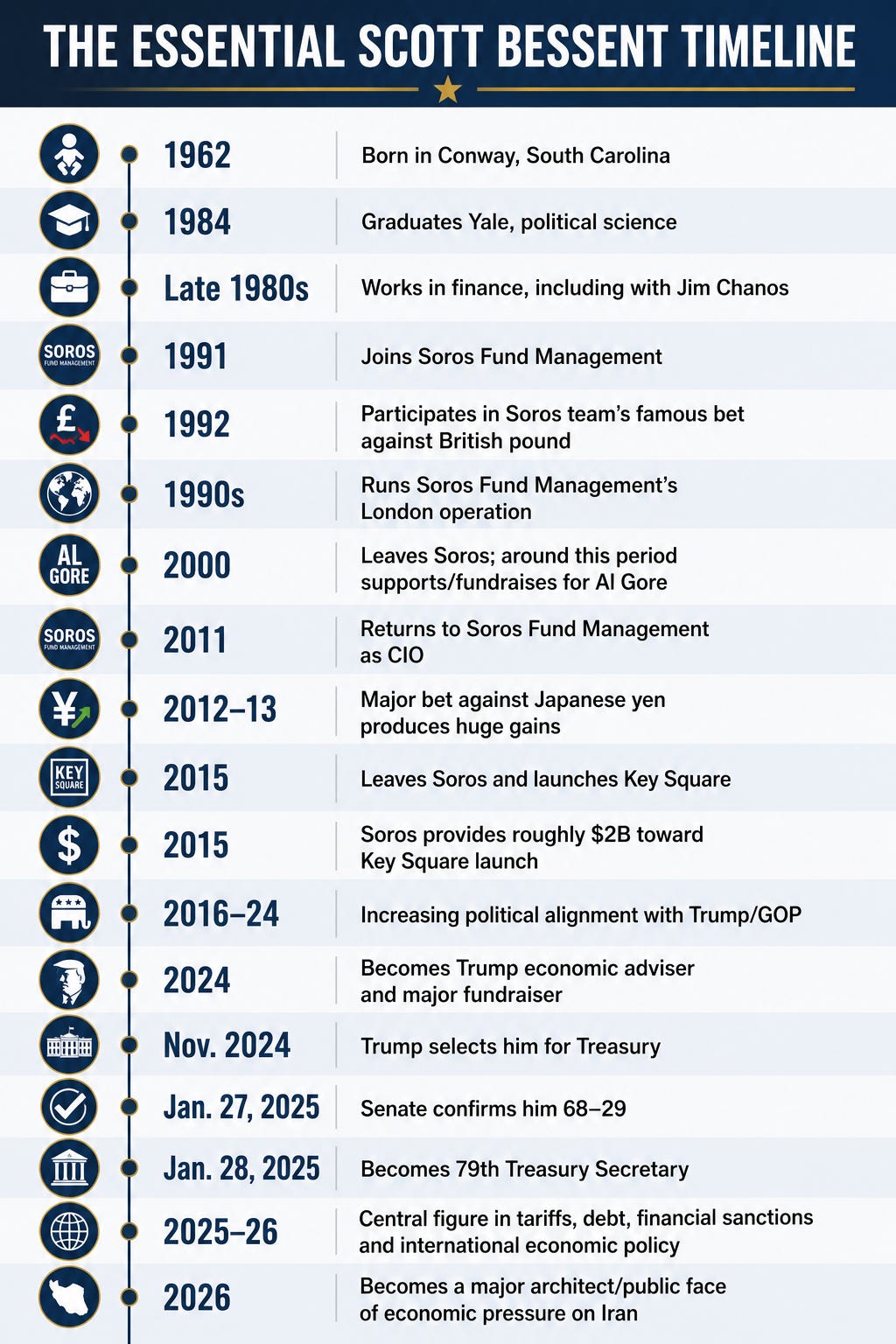
He is a highly successful global investor who spent decades studying currencies, bonds, banks and international markets, became chief investment officer of Soros Fund Management, founded Key Square Capital Management, advised Donald Trump and ultimately became the 79th Secretary of the Treasury.
There is nothing mysterious about that progression.
A president needed someone experienced in international finance.
Bessent possessed that experience.
Yet when the individual pieces of the biography are placed beside one another, another story becomes visible.
Not necessarily a sinister one.
Not necessarily a conspiratorial one.
Simply a remarkably coherent one.
Bessent spent much of his professional life learning how governments, currencies and financial systems behave when placed under pressure.
Now he runs one of the most powerful institutions capable of applying that pressure.
A Career Built Around Financial Breaking Points
The Treasury Department describes Bessent as a specialist in currencies and fixed-income markets with more than four decades in global investment management.
It also credits him with anticipating a remarkable list of financial disruptions: the American savings-and-loan crisis, problems in the junk-bond market, Scandinavian banking distress, restructuring of Japan’s banking system and the global financial crisis.
Before entering government, Bessent had spent years observing something politicians frequently prefer not to acknowledge:
Governments can announce policy. Markets eventually test whether that policy is sustainable.
That distinction became especially visible during Bessent’s years at Soros Fund Management.
From 1991 through 2000, he served as managing partner of the firm’s London operation. He later returned as chief investment officer.
Treasury itself highlights two transactions that established his reputation as a global macro strategist:
the bet against the British pound,
and later,
the bet against the Japanese yen.
These were not ordinary stock selections.
They involved understanding entire national economic systems.
1992: Britain
The famous 1992 sterling trade has become financial folklore.
Britain was attempting to maintain the pound within the European Exchange Rate Mechanism.
The Soros organization concluded that the arrangement had become increasingly difficult to defend.
Eventually Britain withdrew from the ERM and sterling fell sharply.
Bessent was part of the Soros operation during that period.
The lesson underlying such macro trading is important:
Find the contradiction.
A government may insist that a policy will continue.
Economic reality may say otherwise.
The successful trader does not necessarily have to know the exact day that the contradiction breaks.
He has to understand that maintaining the contradiction is becoming increasingly expensive.
Then Japan
Years later, Bessent again became associated with a major currency position, this time involving the Japanese yen.
The circumstances were different.
The principle was similar.
Study monetary policy.
Study political intentions.
Study capital flows.
Study central-bank behavior.
Then determine how the market is likely to react.
Treasury today openly cites these trades as part of Bessent’s professional credentials.
That matters.
The ability to identify financial vulnerability is not an accusation against Bessent.
It is arguably one of the reasons he became successful.
What Does a Global Macro Investor Actually Learn?
A traditional investor might ask:
Will this company sell more products next year?
A global macro investor asks questions on another scale:
Can this country continue financing its debt?
Can this central bank defend its currency?
Where will capital move if confidence disappears?
How much economic pain can a government absorb?
How long can political leaders maintain a policy that markets no longer believe?
Which pressure point will force the government to change direction?
That is a very particular education.
And Bessent received it for decades.
Then Trump Put Him in Treasury
Donald Trump selected Bessent as Treasury secretary following the 2024 election.
He took office in January 2025.
The interesting question is not whether Trump and Bessent have identical political histories.
They plainly do not.
Bessent spent years working at Soros Fund Management.
He operated within circles that Trump and many Trump supporters have frequently criticized.
Yet perhaps that background was not a disadvantage.
Perhaps it was part of the qualification.
Trump did not need someone who had spent his career complaining about global finance from outside the building.
He could choose someone who had spent decades inside the building learning how the machinery actually worked.
That produces a different interpretation of Trump’s personnel strategy.
The insider’s knowledge may be precisely what makes the insider useful.
From Studying Financial Pressure to Applying It
Here is where Bessent’s biography becomes particularly interesting.
As a private investor, his job involved identifying financial pressure.
As Treasury secretary, he sits inside an institution capable of creating financial pressure.
Those activities are obviously not identical.
One involves investment.
The other involves government policy.
Yet the intellectual machinery overlaps.
Consider the language of global macro investing:
Currencies
Debt
Interest rates
Capital flows
Banking access
Liquidity
Market confidence
Sovereign risk
Now consider modern economic statecraft:
Sanctions
Tariffs
Dollar access
Banking restrictions
Secondary sanctions
Asset freezes
Trade restrictions
Sovereign financing
Many of the same systems are involved.
The difference is who is pulling the lever.
Iran Makes the Connection Difficult to Ignore
That brings the biography directly into today’s geopolitical environment.
The United States has increasingly used financial pressure against Iran alongside military and diplomatic measures.
Reuters reported in late August that Treasury measures were targeting financial channels associated with Iran, including foreign bank branches accused of facilitating Iranian shadow-banking transactions.
Reuters has also described the larger effort to restrict Iranian financial lifelines through an intensified sanctions campaign, while noting that the ultimate effectiveness of such measures remains uncertain because Iran continues searching for alternative routes, intermediaries and trading partners.
By September 2, the administration was emphasizing economic pressure as one mechanism for extracting concessions while attempting to manage the military confrontation.
None of this proves that Bessent is personally reproducing his hedge-fund strategies against Iran.
That would require evidence we do not presently have.
But the overlap in expertise is unmistakable.
Washington is attempting to identify:
Iran’s banking vulnerabilities
Iran’s access to dollars
Iran’s international trading channels
Iran’s oil revenues
Iran’s financial intermediaries
Iran’s ability to withstand prolonged economic pressure
Those are exactly the kinds of interconnected systems a global macro specialist spends a career learning to understand.
Perhaps Trump Saw the Résumé Differently
Someone looking at Bessent politically might ask:
Why would Trump appoint a former Soros executive?
Trump may have asked another question:
Who understands this system better?
That distinction matters.
Trump’s personnel decisions sometimes appear contradictory when viewed exclusively through political affiliation.
They can look less contradictory when viewed through function.
A person does not have to share Trump’s entire history to possess a skill Trump wants.
If the objective involves international financial negotiation, tariffs, sovereign debt, currencies, sanctions and economic pressure, Bessent possesses an unusually relevant background.
His Treasury biography says he has engaged with political leaders and central bankers in at least 60 countries during his career.
That is not merely Wall Street experience.
It is experience inside the network connecting markets and governments.
But There Is Another Side
A neutral reading also requires acknowledging the limitation of the theory.
Success in hedge-fund investing does not automatically translate into successful government policy.
A trader can leave a losing position.
A country cannot simply close its account and walk away.
A hedge fund can concentrate on returns.
Treasury must simultaneously consider:
employment,
inflation,
government borrowing,
bank stability,
international alliances,
domestic politics,
national security,
and the effects policies have on ordinary people.
The objectives are fundamentally different.
And markets can pressure the United States just as readily as Washington can pressure another country.
That is becoming particularly relevant as American government borrowing and long-term interest rates remain major concerns. Reuters reported this week that global bond investors continue questioning whether current approaches are sufficient to address America’s fiscal trajectory.
Bessent is therefore not standing outside the system searching for somebody else’s weakness anymore.
He is responsible for helping manage weaknesses inside his own.
The Most Interesting Continuity
Strip away Soros.
Strip away Trump.
Strip away Republican and Democrat.
Look only at the profession.
For decades Scott Bessent studied what happens when:
politics meets financial arithmetic.
He watched governments.
He studied central banks.
He analyzed currencies.
He examined debt.
He measured confidence.
He searched for contradictions.
And when the numbers suggested that a government’s position could not survive indefinitely, he was willing to place enormous financial bets on that conclusion.
Today he occupies a very different chair.
He no longer merely watches the government.
He is part of the government.
And instead of possessing billions of dollars of investment capital behind a position, he has something vastly more powerful available to the institution he leads:
the financial influence of the United States.
🩸 The Red Blood Perspective
Scott Bessent’s biography does not prove a hidden agenda.
It does reveal an unusually logical match between a man’s lifetime specialty and the assignment Donald Trump eventually gave him.
Trump selected someone who spent decades understanding currencies, sovereign vulnerabilities, banking systems, capital flows and financial crises to run the U.S. Treasury during an administration heavily reliant on tariffs, sanctions and economic pressure.
The Soros connection therefore may be less important than it first appears.
The more consequential connection may be Bessent’s education in leverage.
For decades, he observed where financial systems became vulnerable.
Now he occupies an office capable of influencing those systems.
Whether that produces successful American policy is another question entirely.
But the résumé and the assignment fit together remarkably well.
Perhaps the most revealing sentence in Bessent’s biography is therefore not:
He worked for George Soros.
It is:
He spent forty years learning where financial systems bend before Donald Trump handed him one of the world’s largest financial levers.
🌊 The Ocean of Love and Positivity Perspective
There is also a useful lesson here that has nothing to do with Trump, Soros, Iran or Treasury.
Human beings frequently judge one another according to labels.
Republican.
Democrat.
Wall Street.
Government.
Insider.
Outsider.
Friend.
Enemy.
Yet a person’s life is often more interesting when the labels are removed and the skills are examined.
Bessent’s story illustrates that experience accumulated in one chapter of life can become useful in an entirely different chapter.
Something learned yesterday does not determine whom a person must serve tomorrow.
The deeper question for each person is therefore not merely:
Where have I been?
It is:
What did I learn there?
Experience can imprison a person inside an identity.
Or experience can become a toolbox.
The difference begins inside.
To understand one’s own life is to recognize that every difficulty, contradiction, success and failure may have been teaching something that will become useful much later.
Perhaps that is one purpose of the classroom.
Not simply to survive the lesson.
But to recognize one day why the lesson was there.
In an Ocean of Love and Positivity.
🩸🌊✨ Fantastic!
⚖️
Leveraging the Treasury: The Financial Education of Scott Bessent
Sep 2, 2026
This text examines the career of Scott Bessent and his transition from a global macro investor to the U.S. Treasury Secretary under Donald Trump. It highlights how his decades of experience identifying economic vulnerabilities and betting against national currencies prepared him to manage American fiscal policy and economic statecraft. The author suggests that Bessent’s background at Soros Fund Management provided him with a unique understanding of financial leverage and market pressure points. While his past involved exploiting government weaknesses for profit, his current role requires him to defend the U.S. financial system and implement sanctions. Ultimately, the source frames his appointment as a strategic move to place a sophisticated insider at the helm of international economic negotiations. This overview concludes that Bessent’s expertise in global finance makes him a logically chosen, though unconventional, architect of modern economic pressure.
#ScottBessent #USTreasury #DonaldTrump #GlobalFinance #EconomicWarfare #FinancialSanctions #CurrencyMarkets #HedgeFunds #GeorgeSoros #SorosFundManagement #KeySquare #WallStreet #Tariffs #SovereignDebt #FinancialLeverage #Iran #EconomicPressure #Geopolitics #GlobalMarkets #RedBloodJournal
RedBloodJournal.com category: Economy & Money


