


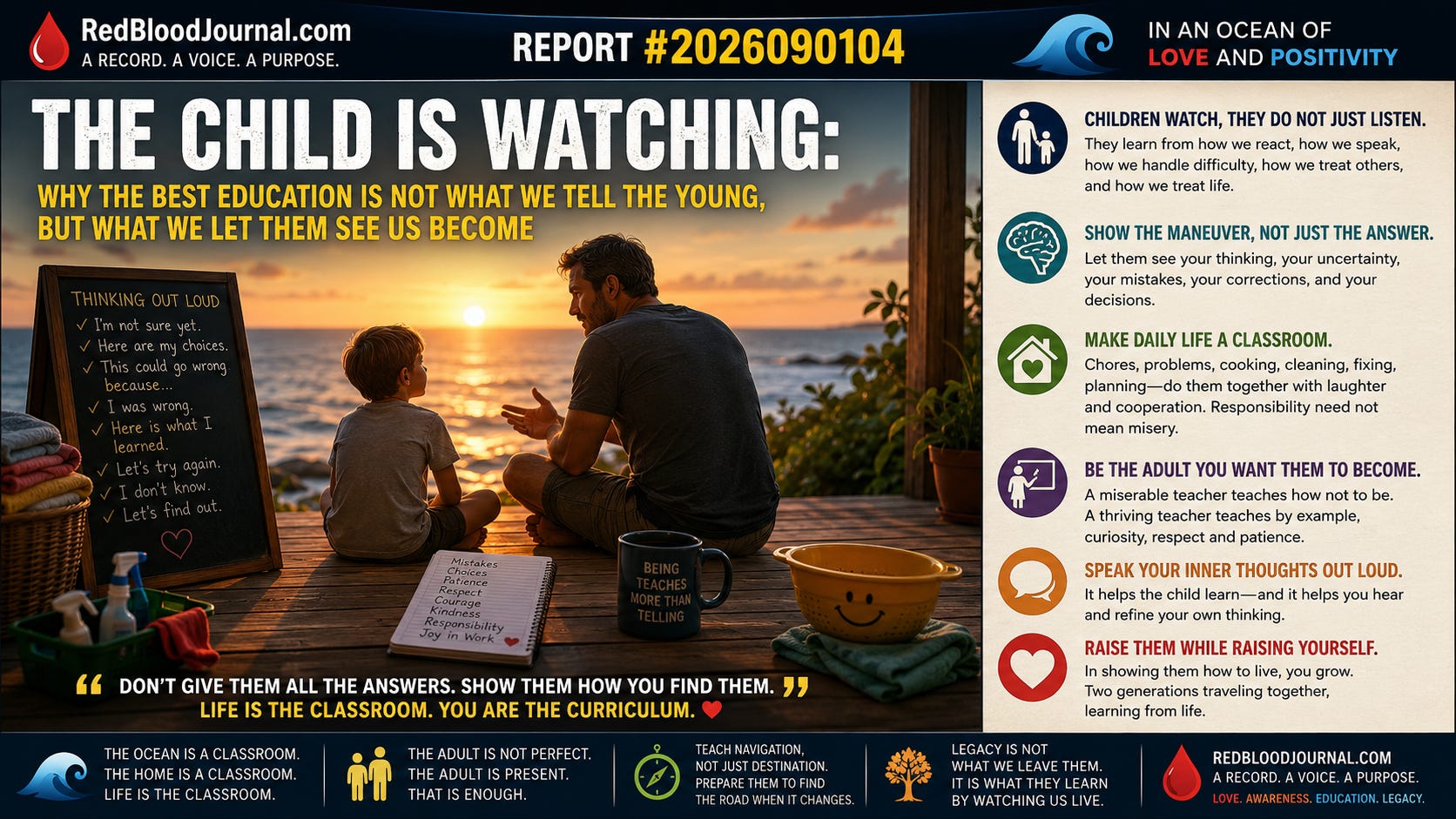
🩸 🧠 👶 🏠 🎓 #2026090104 — The Child Is Watching: Why the Best Education Is Not What We Tell the Young, but What We Let Them See Us Become
🩸 RedBloodJournal.com — A Record. A Voice. A Purpose.
There may be one mistake adults make more often than almost any other when raising children:
They ask their offspring to become what they themselves are not.
The impatient parent demands patience.
The angry parent demands self-control.
The dishonest parent lectures about honesty.
The miserable teacher insists that learning should be exciting.
The undisciplined adult demands discipline.
And then everyone wonders why the lesson does not take hold.
Perhaps the problem is not with the child.
Perhaps the child learned perfectly.
Children do not only listen to adults.
They study them.
They watch the face.
They hear the sigh.
They notice how the adult reacts when something breaks.
They notice how the adult behaves when money is tight.
They notice whether the adult becomes cruel when frustrated.
They notice whether mistakes are admitted or hidden.
They notice whether difficult work becomes misery or becomes part of life.
The child may forget the lecture.
The child rarely forgets the atmosphere.
The Ocean Already Knows This
The animal examples in the source material reveal something remarkable.
Young orcas are not merely born with a complete manual for survival.
Adults have been observed capturing and releasing prey so calves can practice pursuit, timing and contact. The transcript describes this process as cultural transmission — learned behavior carried from one generation to another.
In shoreline hunts, younger animals are exposed to experienced adults navigating sand, waves, timing and the risk of becoming stranded.
The young are not merely told:
“Be careful.”
They watch what careful looks like.
They see the maneuver.
They see the timing.
They see the danger.
They see the correction.
They see when to continue.
And they see when not to.
That may be much closer to real education than much of what humans call teaching.
Do Not Merely Give the Child the Answer
The most valuable thing an adult can share may not be the conclusion.
It may be the thinking that produced the conclusion.
Instead of:
“Do this because I said so.”
Imagine:
“Here are the three choices I see. This one looks easiest, but it may create another problem. This one is harder now, but it may make tomorrow easier. I am not completely sure yet, so let me think through it.”
Now the child is not merely being directed.
The child is inside the adult’s mental process.
The invisible machinery has become visible.
That is education.
A child who hears:
“I was wrong.”
learns that being wrong does not destroy a person.
A child who hears:
“I am angry right now, so I do not want anger making the decision for me.”
learns what self-control actually is.
A child who hears:
“I don’t know. Let’s find out.”
learns perhaps one of the most important intellectual lessons possible:
Intelligence does not mean knowing everything.
It means knowing how to move when the answer is not yet known.
Let the Child Into the Cockpit
Most children are treated like passengers.
Adults drive.
Adults decide.
Adults hide the uncertainty.
Then the child receives the final command.
Turn left.
Sit down.
Be quiet.
Study.
Clean this.
Do that.
What would happen if the child were occasionally invited into the cockpit?
Not to run the airplane.
To watch how it is flown.
“This is what I am looking at.”
“This is why I am worried.”
“This is what I think might happen.”
“This is where I made the wrong turn.”
“This is how I am finding the road again.”
The child cannot experience every problem in advance.
No parent can prepare a young person for every relationship, employer, disappointment, financial crisis, betrayal, mistake, technological change or moral dilemma that may appear later.
So memorizing answers is insufficient.
The deeper education is learning:
how to maneuver when the map runs out.
The House Can Become the Classroom
Consider something as ordinary as cleaning the house.
One household teaches:
Cleaning is suffering.
Someone sighs.
Someone complains.
Someone says:
“I have to do everything around here.”
Everyone becomes irritated.
The room eventually gets cleaned.
But another lesson was also taught.
The child has learned that responsibility is misery.
Now imagine the exact same chore differently.
Music is playing.
Someone jokes while folding clothes.
A child is given a simple job.
Two people race to put things away.
Someone drops something.
Everybody laughs.
The kitchen gets cleaned while people talk.
The house becomes orderly.
Nothing about the chore itself changed.
But the education changed completely.
The child has learned:
Necessary work does not have to poison the moment.
That may be one of the most useful lessons adulthood can offer.
Because adult life contains endless chores.
Bills.
Repairs.
Cooking.
Laundry.
Appointments.
Paperwork.
Waiting.
Maintenance.
Problems nobody requested.
If young people grow up watching adults greet every obligation with resentment, they may eventually conclude that adulthood itself is resentment.
But if they see adults turn ordinary necessity into conversation, humor, cooperation and even enjoyment, something different becomes possible.
The house gets clean.
And the child quietly learns how to live.
You Are Teaching Even When You Are Not Teaching
A parent may believe education begins when the lecture begins.
It probably began much earlier.
The child watched how the parent treated the cashier.
The child watched how the parent spoke about someone weaker.
The child watched what happened after an argument.
The child watched whether the parent apologized.
The child watched whether the adult cheated when cheating was convenient.
The child watched what happened when nobody was looking.
And those lessons may be stronger than anything said afterward.
Perhaps this is why demanding from children qualities that adults themselves refuse to practice produces such poor results.
The message from the mouth says:
“Be like this.”
The message from life says:
“Be like me.”
And life is louder.
The Miserable Teacher
This principle extends beyond parents.
Consider the miserable classroom teacher.
A teacher can successfully transfer mathematics while accidentally teaching:
Never become like me.
A teacher may lecture about curiosity while making every question feel like an inconvenience.
A teacher may talk about respect while humiliating students.
A teacher may insist education is important while appearing to hate every minute spent educating.
What did the students learn?
Perhaps they learned algebra.
But they also learned something about adulthood.
Something about authority.
Something about work.
Something about what happens to curiosity when people grow older.
A miserable teacher can still educate.
The problem is that the lesson may be:
This is what I never want to become.
A great teacher produces a different reaction.
Not:
“I must obey this person.”
But:
“I want to know how this person thinks.”
Curiosity becomes contagious.
Patience becomes visible.
Failure becomes part of discovery.
Knowledge becomes something alive.
That is teaching by attraction rather than enforcement.
Children Copy What Adults Rehearse
The young orca watches the mature animal perform the maneuver.
Human children do something remarkably similar.
They copy emotional maneuvers.
They copy reactions.
They copy tone.
They copy relationships with work.
They copy relationships with failure.
They copy relationships with themselves.
This means the adult’s responsibility is not to perform perfection.
Quite the opposite.
Perfection may be one of the least educational performances imaginable.
Let the child see the mistake.
Let the child hear:
“I got that wrong.”
Let the child see the frustration.
Then let the child see what happens next.
Let the child see the apology.
The recalculation.
The second attempt.
The decision to stop.
The decision to ask for help.
The change of mind.
Those moments expose something far more useful than perfection:
the mechanics of recovery.
Speaking the Inner Thoughts Out Loud
Humans possess one educational advantage the animals in the ocean do not possess in the same way:
Language.
We can expose the invisible maneuver.
An adult can say:
“Part of me wants to quit because this is frustrating.”
Then:
“But quitting because something is difficult is different from deciding something is not worth doing.”
Or:
“I am angry with that person, but I am trying to figure out whether I am angry because they actually did something wrong or because they did not do what I wanted.”
Now something remarkable happens.
The child hears the adult examining the self.
But the adult hears it too.
That may be equally important.
Thoughts inside the head can move rapidly.
They can contradict one another without being noticed.
They can disguise fear as certainty.
Pride as principle.
Anger as justice.
Excuses as reasoning.
Speaking the process aloud forces thought into the open.
Suddenly the adult becomes both teacher and student.
The child receives the lesson.
And the adult hears the lesson again.
Perhaps Raising Children Also Raises the Adult
This leads somewhere deeper.
What if part of raising a child is that the child forces the adult to confront themselves?
It is easy to tell another human being:
Be patient.
Be kind.
Do not lie.
Do not give up.
Control your anger.
Think before acting.
But when a child is watching, a question quietly appears:
Am I doing these things myself?
The teacher becomes accountable to the lesson.
And perhaps this is part of life’s design.
The adult tries to show the child how to live.
In doing so, the adult must look more closely at how they themselves are living.
The child becomes the student of the parent.
And the parent becomes a student of themselves.
Purpose of Life: Finding Yourself While Showing Another How to Find Themselves
Perhaps the purpose of life is not to discover yourself first and then become qualified to teach.
Perhaps nobody becomes fully qualified.
Perhaps the discovery continues.
The parent is still learning.
The teacher is still learning.
The grandparent is still learning.
The young are simply joining the journey later.
Then education becomes something very different.
Not:
“I have reached the destination. Follow my instructions.”
But:
“I have traveled farther down this road. Walk with me for a while. Watch what I have learned. Watch where I still stumble.”
Eventually the child walks beyond the parent.
That should not represent failure.
That may represent success.
The purpose of education should not be to manufacture a duplicate.
It should be to help create someone capable of navigating without us.
The Adult Is the Curriculum
Schools often imagine curriculum as books, lessons and examinations.
But perhaps every child is studying another curriculum simultaneously.
The adults.
How do adults deal with inconvenience?
What do adults do when they lose?
How do adults behave when nobody agrees with them?
How do adults treat people who cannot benefit them?
What happens when adults are afraid?
Can adults laugh during difficulty?
Can adults change their minds?
Can adults admit ignorance?
Can adults enjoy necessary work?
Can adults remain peaceful while solving an unpleasant problem?
Those may become some of the most durable lessons of childhood.
Which means every ordinary day carries educational possibilities.
The broken faucet.
The dirty kitchen.
The overdue bill.
The disagreement.
The flat tire.
The failed recipe.
The wrong turn.
The difficult conversation.
The boring afternoon.
These are not interruptions to education.
These are the classroom.
🩸 The Red Blood Perspective
We have turned education into something adults administer to children.
Perhaps education is actually something children observe in adults.
The difference is enormous.
Telling a child how to live requires words.
Showing a child how to live requires living.
That does not mean adults must become flawless.
It means allowing the process to be seen.
Expose the mental acrobatics.
Share the maneuver.
Show the uncertainty.
Show the recovery.
Show how ordinary chores become enjoyable.
Show how difficulty can be approached without becoming miserable.
Show how failure becomes information.
Show how anger can be felt without becoming the ruler.
Show how a person can say:
“I don’t know.”
and then begin looking.
The child does not need a perfect adult.
The child needs access to the process through which an imperfect adult keeps becoming more mature.
Perhaps the best educational philosophy could fit into one sentence:
Do not merely tell the young what kind of person to become. Let them watch you practicing how to become that person yourself.
🌊 The Ocean of Love and Positivity Perspective
The ocean does not lecture the young.
It surrounds them with life.
The young watch.
They follow.
They practice.
They fail.
They try again.
They inherit not merely instincts, but accumulated experience.
Human beings have the opportunity to make this process even richer.
We can combine example with consciousness.
We can say what is happening inside.
We can allow the young to witness not just the action, but the inner journey behind the action.
And perhaps in doing so, something wonderful happens.
The parent who is trying to teach patience becomes more patient.
The adult explaining why anger should not make the decision hears their own wisdom.
The person trying to show a child how to enjoy ordinary life begins enjoying ordinary life more themselves.
The teacher becomes part of the lesson.
The student becomes part of the teacher’s growth.
The home becomes a classroom without needing desks.
Cleaning becomes cooperation.
Problems become puzzles.
Mistakes become information.
Daily life becomes practice.
And generations stop merely handing commandments downward.
They begin handing awareness forward.
Perhaps that is part of finding ourselves.
Not disappearing alone into some distant search for purpose.
But discovering who we are while another human being is watching us discover it.
The child sees.
The child hears.
The child learns.
And while trying to show the child how to live—
the adult learns to live more consciously too.
In an Ocean of Love and Positivity.
🩸🌊✨ Fantastic!
👁️
The Child Is Watching: Education Through Example
Sep 2, 2026
The provided text explores the idea that true education stems from what children observe in adults rather than what they are told. By using examples from both nature and daily life, the author argues that young people mirror the emotional reactions and behaviors of their mentors. Real learning occurs when adults make their internal thought processes visible, demonstrating how to navigate failure, uncertainty, and mundane responsibilities with integrity. Instead of performing a facade of perfection, parents and teachers are encouraged to expose their own growth and recovery to their students. Ultimately, this transparency transforms the home into a dynamic classroom where both the adult and the child evolve together. This perspective suggests that living consciously is the most powerful curriculum an adult can offer.
#RedBloodJournal #Education #Parenting #Children #ChildDevelopment #LearningByExample #LifeEducation #ConsciousParenting #PersonalGrowth #Teaching #Family #LifeLessons #EmotionalIntelligence #LeadingByExample #PurposeOfLife #Learning #HomeEducation #RaisingChildren #SelfDiscovery #OceanOfLoveAndPositivity


