


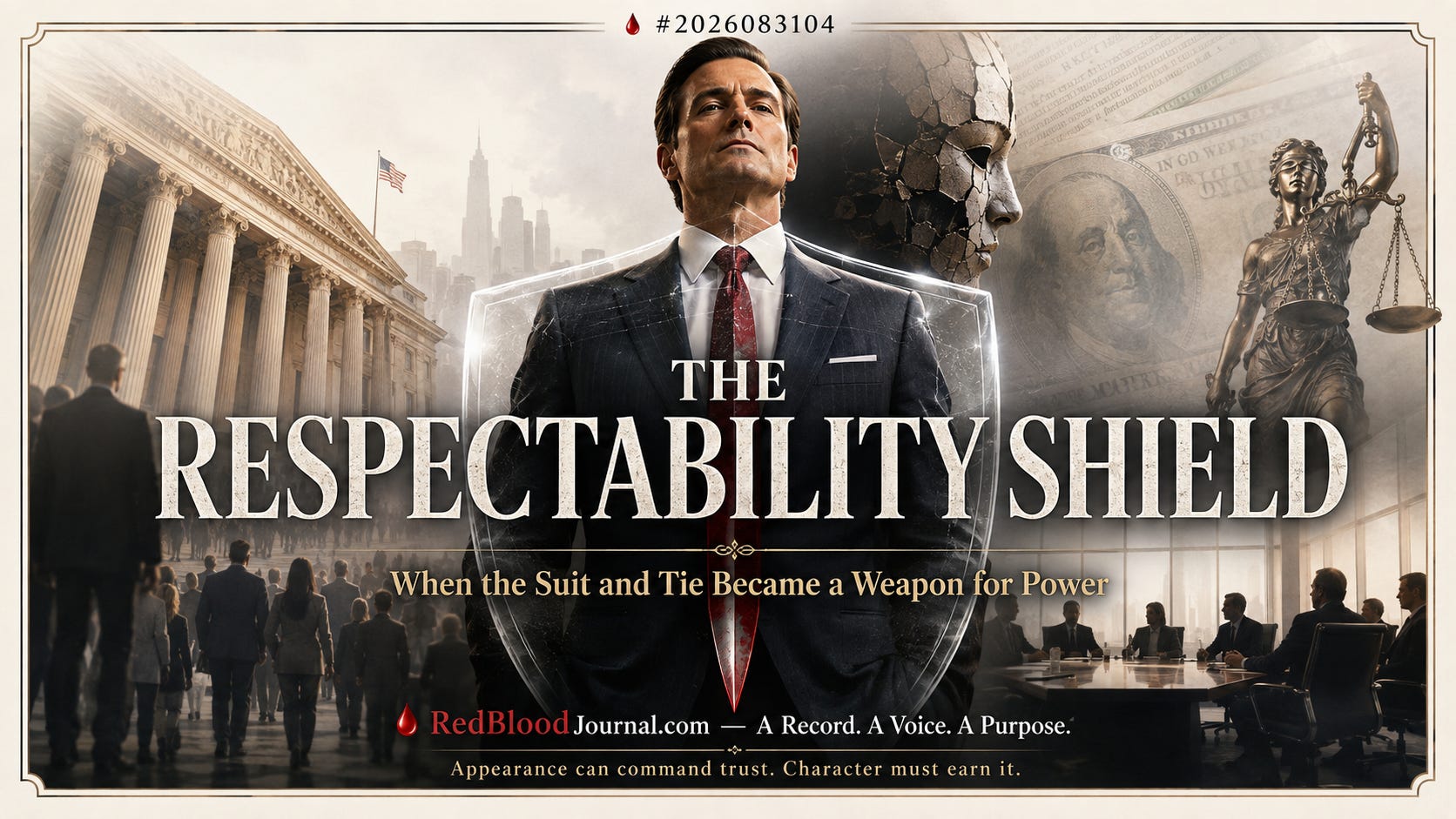
🩸 👔 🛡️ 🎭 ⚖️ #2026083104 — The Respectability Shield: When the Suit and Tie Became a Weapon for Power
The suit was supposed to symbolize trust. That is exactly why it became useful to people who wanted trust they had not earned.
🩸 RedBloodJournal.com — A Record. A Voice. A Purpose.
There was a time when the suit and tie was supposed to mean something.
Professional.
Responsible.
Educated.
Serious.
Trustworthy.
A person entered the room wearing a pressed suit, polished shoes and a tie, and before that person spoke, society had already made several assumptions.
This person must know what he is doing.
This person must belong here.
This person probably has authority.
This person should probably be taken seriously.
Maybe that image was once deserved more often.
Maybe it never was.
But the association became powerful.
And once society learned to associate clothing with legitimacy, the clothing itself became useful to anyone who wanted legitimacy without necessarily possessing the character behind it.
That is where the suit stopped being simply clothing.
It became a shield.
And sometimes, a weapon.
The Uniform of Respectability
Every culture develops uniforms.
The police officer has one.
The soldier has one.
The doctor has one.
The judge has one.
The businessman has one too.
The suit and tie became the civilian uniform of institutional authority.
Politicians wear it.
Bankers wear it.
Corporate executives wear it.
Attorneys wear it.
Lobbyists wear it.
Television commentators wear it.
Diplomats wear it.
The message is subtle:
I belong among serious people.
And because humans make judgments quickly, appearance often arrives before evidence.
A person wearing jeans and a T-shirt may have to prove competence.
A person wearing a tailored suit often begins with a credit balance already deposited into the minds of others.
The clothing has spoken before the person has.
Legitimacy Before Evidence
Imagine two strangers.
One walks into a room wearing faded jeans and a plain T-shirt.
The other walks in wearing a tailored dark suit, expensive shoes, a white shirt and a tie.
Neither has spoken.
Neither has demonstrated intelligence.
Neither has shown honesty.
Neither has proven competence.
Yet many people will already unconsciously assign them different levels of credibility.
The man in jeans may be examined.
The man in the suit may be presumed.
That is the psychological advantage.
And any advantage that exists can be exploited.
The Corrupt Man Does Not Want to Look Corrupt
Popular culture often teaches people to imagine corruption badly.
The criminal is supposed to look dangerous.
The thief wears dark clothing.
The gangster looks rough.
The fraudster looks suspicious.
The threat is visually obvious.
Real power learned a more sophisticated lesson.
If someone intends to deceive people, appearing frightening is usually a disadvantage.
It is better to look respectable.
The sophisticated corrupt man does not need a ski mask.
He may need:
a tailored suit,
an impressive title,
a prestigious office,
a boardroom,
an attorney,
a government credential,
a corporate logo,
and a calm voice.
The appearance does not prove corruption.
But it can conceal it extraordinarily well.
The Suit as a Shield
Why call it a shield?
Because it can protect the wearer from the suspicion that another person might receive immediately.
Suppose an ordinary-looking stranger approaches a family and proposes handling millions of dollars.
The first response may be:
Who are you?
Now place the same person behind an enormous desk on the forty-third floor of a glass tower.
Put degrees on the wall.
Put an expensive watch on his wrist.
Put a financial institution’s name behind him.
Give him a tailored suit.
Now the question can subtly change from:
Who are you?
to:
Am I qualified to question you?
The shield worked.
It did not prove anything.
It changed who felt required to prove something.
The Suit as a Weapon
The suit can do more than reduce suspicion.
It can create intimidation.
A powerful person dressed formally may communicate status without saying a word.
The expensive suit says:
I have resources.
The office says:
I have institutional backing.
The assistants say:
I have importance.
The lawyers say:
I can fight.
The title says:
I have authority.
The entire environment can make an ordinary person second-guess himself.
Perhaps I misunderstood.
Perhaps they know something I do not.
Perhaps I should not challenge them.
Perhaps I will look foolish.
That is where respectability becomes a weapon.
The goal is not always to make the observer trust the person.
Sometimes it is enough to make the observer distrust himself.
Who Am I to Question This Man?
That may be one of the most powerful sentences inside modern institutional culture.
Who am I to question the doctor?
Who am I to question the lawyer?
Who am I to question the banker?
Who am I to question the senator?
Who am I to question the professor?
Who am I to question the CEO?
Who am I to question the person on television wearing the suit?
That reflex transfers authority away from evidence and toward presentation.
The problem is not expertise.
Real expertise exists.
Real competence exists.
Real experience matters.
The problem begins when the symbol of expertise becomes a substitute for proof.
The Crowd Judges the Uniform First
The crowd often does not have time to investigate character.
So it uses shortcuts.
Clothing becomes one.
Vocabulary becomes another.
Titles become another.
Institutional affiliation becomes another.
A person sounds educated.
Therefore perhaps the person is correct.
A person holds a government title.
Therefore perhaps the person is trustworthy.
A person works for a respected institution.
Therefore perhaps the person is honorable.
A person wears the uniform of success.
Therefore perhaps the person deserves respect.
These shortcuts are understandable.
They are also dangerous.
Because anyone can learn the costume.
Power Learned the Costume
Once society associates a visual image with authority, ambitious people naturally learn to reproduce it.
This does not mean everyone in a suit is corrupt.
It means corruption has no reason to reject useful camouflage.
The uniform creates plausible respectability.
And history repeatedly shows that some of the largest harms in society were not committed by men who looked like criminals.
They were committed in offices.
They were authorized through paperwork.
They were approved in meetings.
They were discussed politely.
They were signed by educated people.
They were explained in professional language.
They were implemented by institutions.
The terrible act does not become less terrible because the person approving it wore a tie.
The Tie Does Not Contain Morality
This sounds obvious when stated directly.
But society often behaves as if visual respectability contains moral information.
A suit tells us:
how someone dressed.
A title tells us:
what position someone holds.
A degree tells us:
where someone studied.
An office tells us:
where someone works.
A bank account tells us:
how much money someone possesses.
None of those things tells us:
whether the person is honest.
None tells us:
whether the person has empathy.
None tells us:
whether the person is courageous.
None tells us:
whether the person will exploit others.
None tells us:
whether the person tells the truth when lying would be profitable.
Character is invisible.
That is why symbols become dangerous when confused with it.
The Man in Jeans May Be More Legitimate
Now reverse the stereotype.
The person wearing jeans and a T-shirt may be:
the engineer who actually understands the system,
the mechanic who knows exactly why the machine failed,
the farmer who understands the land,
the worker who knows what happens inside the factory,
the whistleblower who saw the fraud,
the independent business owner who built something from nothing,
or simply the person telling the truth.
But if society gives greater credibility to costume than substance, the honest person begins with a disadvantage.
The performance of authority defeats the reality of knowledge.
Authority Has Always Needed Theater
Kings wore crowns.
Priests wore robes.
Generals wore decorated uniforms.
Judges wore robes.
Institutions build marble staircases and enormous columns.
Governments surround officials with flags.
Corporations build glass towers.
The visual message is ancient:
This is important.
This is powerful.
Respect this.
The modern business suit belongs to the same family of symbols.
It creates theater around authority.
The theater is not necessarily dishonest.
But it should never be confused with the actor’s character.
The Dangerous Question
The question should not be:
Is the man wearing a suit dangerous?
That would simply replace one stereotype with another.
The better question is:
Why does the suit cause us to lower our guard?
That is where the psychological mechanism becomes visible.
The goal is not to distrust every formally dressed person.
The goal is to stop allowing clothing to make the decision.
Judge the claim.
Judge the record.
Judge the action.
Judge who benefits.
Judge what happens when the door closes.
Judge whether the person behaves the same way when nobody important is watching.
The suit cannot answer those questions.
Respect Should Be Earned, Not Worn
Perhaps society reversed the equation.
Instead of:
This person looks respectable, therefore I will respect him.
Try:
This person behaves honorably, therefore I will respect him regardless of what he is wearing.
That change sounds small.
It is enormous.
Because it removes one of the simplest tools of manufactured authority.
The suit becomes clothing again.
The title becomes information.
The office becomes geography.
The institution becomes an institution.
And the human being underneath all of it must finally stand on character.
The Best-Dressed Man in the Room
There is another reason the suit can become useful to corruption.
Corrupt systems often depend on appearing normal.
The transaction must look professional.
The meeting must look legitimate.
The contract must look official.
The language must sound technical.
The process must appear respectable.
If corruption looked like corruption, fewer people would cooperate with it.
So sophisticated wrongdoing often wraps itself in procedure.
The suit is perfectly suited to that environment.
No pun intended.
It communicates:
Nothing unusual is happening here.
That may be exactly what makes people stop asking questions.
The Shield Works Because We Help Hold It Up
This is the uncomfortable part.
The suit has no magical power.
The crowd gives it power.
We participate.
We look at the expensive clothing and assume success.
We hear polished language and assume intelligence.
We see a government seal and assume legitimacy.
We see corporate branding and assume competence.
We see credentials and assume wisdom.
The corrupt person can exploit those assumptions only because society keeps supplying them.
The shield works because everyone agrees to see it as a shield.
What Happens When the Costume Stops Working?
Imagine a society where nobody is impressed merely by the suit.
The politician must explain the policy.
The banker must explain the numbers.
The doctor must explain the diagnosis.
The corporation must explain the contract.
The lawyer must explain the law.
The journalist must show the evidence.
The professor must defend the argument.
The executive must explain the consequences.
Authority would still exist.
Expertise would still matter.
But the costume would lose some of its protection.
That would not destroy legitimacy.
It might finally force legitimacy to earn itself again.
🩸 The Red Blood Perspective
The suit and tie should not be feared.
It should simply stop receiving automatic trust.
The danger is not the fabric.
The danger is the psychological shortcut.
A society trained to associate appearance with legitimacy can be manipulated by anyone skilled enough to reproduce the appearance.
The sophisticated corrupt man does not necessarily look dangerous.
That may be his greatest advantage.
He can look professional.
He can sound educated.
He can sit behind an impressive desk.
He can surround himself with lawyers.
He can carry a prestigious title.
He can speak calmly while making decisions that destroy people he will never meet.
That is why respectability must never replace evidence.
The suit is not proof.
The title is not proof.
The office is not proof.
The degree is not proof.
The institution is not proof.
The person’s actions remain the proof.
The greatest danger may not be the frightening man standing outside the institution.
It may be the man sitting comfortably inside it whom everyone has already decided is respectable.
🌊 The Ocean of Love and Positivity Perspective
There is freedom in recognizing this.
Not because everyone should become suspicious of everyone else.
Because judgment can become more compassionate and more accurate.
The casually dressed stranger does not deserve less respect.
The formally dressed executive does not deserve more.
Both are human beings before they are costumes.
The same principle works inward.
People also dress themselves psychologically.
They wear identities.
Successful.
Intelligent.
Religious.
Political.
Professional.
Educated.
Important.
Victim.
Leader.
Expert.
Those identities can become suits too.
They can protect the ego from examination.
The deeper question is:
Who remains when the costume comes off?
Not the title.
Not the money.
Not the degree.
Not the reputation.
Not the political affiliation.
Not the profession.
Not the clothing.
The person.
Perhaps genuine legitimacy has always lived there.
Character does not require a tie.
Honesty does not require polished shoes.
Wisdom does not require a prestigious office.
Love does not require credentials.
And truth does not become more true because the person speaking it is well dressed.
See the human being.
See the actions.
See yourself the same way.
Remove the costume when judging others.
Remove it when judging yourself.
What remains may be far more real.
In an Ocean of Love and Positivity.
🩸🌊✨ Fantastic!
🎭
The Respectability Shield: The Costume of Institutional Power
Aug 31, 2026
The provided text explores how professional attire functions as a “respectability shield” that grants individuals unearned trust and institutional authority. While a suit traditionally signaled competence, it now often serves as a psychological shortcut that allows people to bypass scrutiny based solely on their appearance. This visual “theater of power” can be exploited by the corrupt to hide wrongdoing behind a facade of legitimacy and sophistication. By prioritizing costume over character, society inadvertently creates a disadvantage for those who possess genuine knowledge but lack formal presentation. Ultimately, the source argues that true credibility must be rooted in an individual’s actions and moral integrity rather than their title or clothing. The text concludes that removing these visual biases is essential for holding powerful figures accountable and recognizing the inherent value of every human being.


