


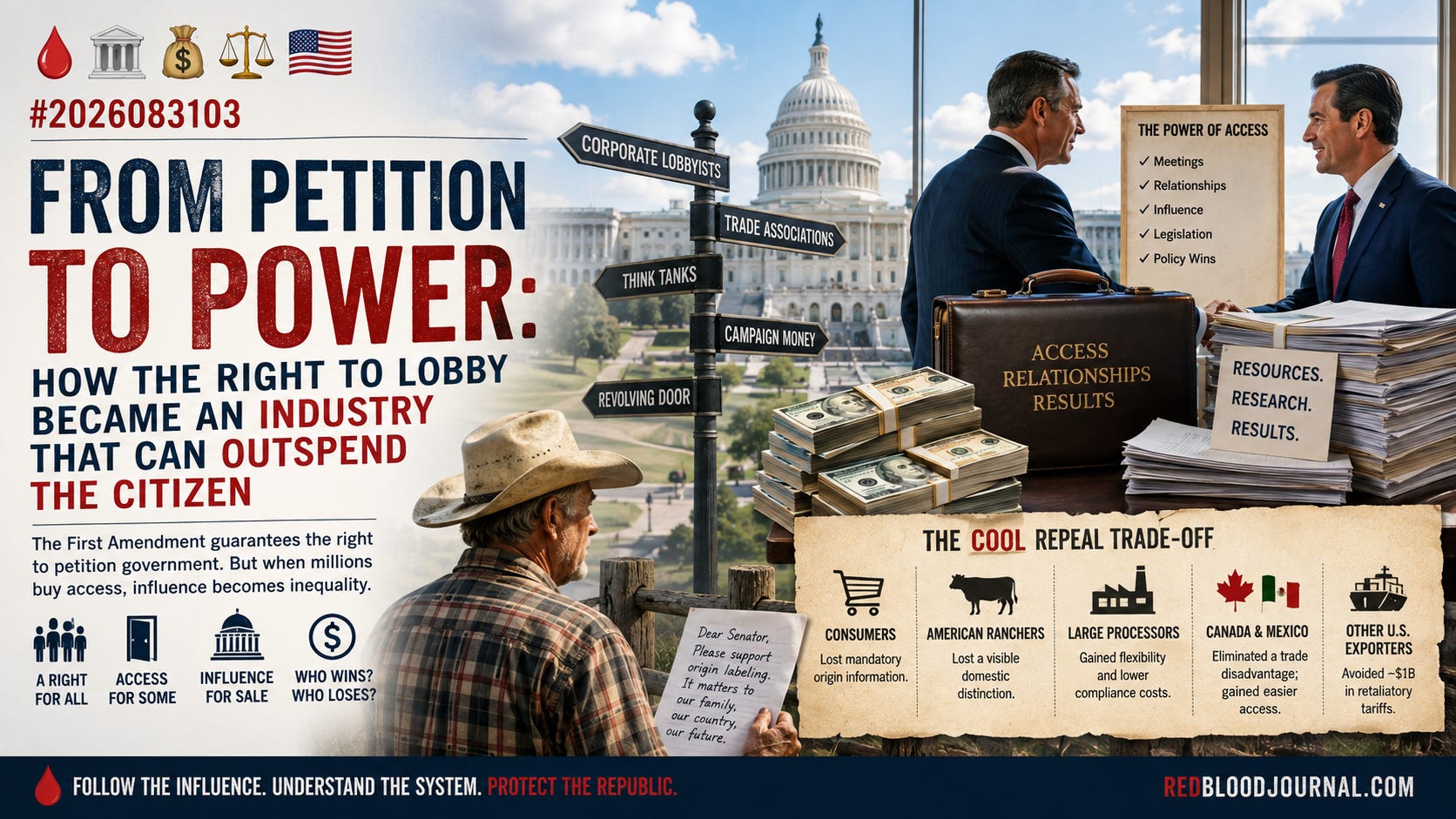
🩸 🏛️ 💰 ⚖️ 🇺🇸 #2026083103 — From Petition to Power: How the Right to Lobby Became an Industry That Can Outspend the Citizen
Lobbying began as a constitutional right to petition government. The question is what happens when that right becomes an industry, and when corporations can purchase access on a scale ordinary citizens cannot match.
🩸 RedBloodJournal.com — A Record. A Voice. A Purpose.
The First Amendment contains a simple and powerful protection:
Americans have the right to petition their government for a redress of grievances.
That principle is fundamental.
A farmer should be allowed to contact Congress.
A worker should be allowed to organize and demand a change in law.
A parent should be allowed to challenge a school policy.
A business owner should be able to tell government that a regulation is damaging the business.
A citizen should be able to stand outside Congress, write a senator, organize others, hire an attorney, form an association, or travel to Washington and argue for change.
That is not corruption.
That is democracy.
But somewhere between that constitutional right and the modern lobbying industry, something changed.
The citizen still has the right to petition government.
The corporation has the same basic ability.
The difference is that the corporation may have millions—or billions—of dollars available to make sure its petition is heard.
Lobbying Was Not Created as a Corporate Privilege
The foundation for lobbying is not a law written for corporations.
It is the First Amendment.
The Constitution protects:
the right of the people to petition the government.
That right existed long before today’s professional lobbying firms, political consultants, trade associations, PACs, think tanks and Washington influence networks.
People have always tried to influence government.
That is natural.
Government makes decisions affecting property, taxes, employment, trade, war, agriculture, transportation, banking, health care and almost every other major part of life.
Those affected by those decisions will naturally try to influence them.
The problem is not that influence exists.
The problem is the scale of the influence.
When Petition Became a Profession
Over time, influencing government became specialized.
People began paying others to represent them before legislatures.
Professional lobbyists developed relationships with lawmakers.
Law firms created government-relations practices.
Industries created trade associations.
Corporations hired former congressional staffers.
Former regulators became consultants.
Former elected officials entered lobbying.
People learned that knowing who to call could become almost as valuable as knowing what to say.
Eventually Washington developed an entire economy built around access.
And once access became valuable, money followed.
Congress Regulated Lobbying Instead of Prohibiting It
The United States did not make lobbying illegal because banning people from petitioning government would create an obvious constitutional problem.
Instead, government attempted to regulate and disclose it.
One major federal step was the Federal Regulation of Lobbying Act of 1946.
Later came the Lobbying Disclosure Act of 1995, which modernized registration and reporting requirements.
The underlying idea became:
Lobbying is lawful.
Lobbyists may have to register.
Certain expenditures must be disclosed.
Bribery remains illegal.
That distinction sounds straightforward.
In practice, it becomes much more complicated.
Lobbying Is Not the Same as Bribery
The legal distinction is important.
Lobbying may look like this:
A corporation hires a lobbying firm.
The lobbyists meet with senators and representatives.
They present economic studies.
They provide draft legislative language.
They explain how a proposed law might affect employment.
They organize industry groups.
They contribute legally through political channels.
They support candidates.
They maintain relationships.
They ask lawmakers to vote a certain way.
That can all be legal.
Bribery is different.
Bribery involves an exchange:
Something of value specifically in return for an official act.
That direct quid pro quo can be criminal.
But between ordinary citizen petitioning and obvious bribery sits an enormous gray-looking area of completely legal influence.
That is where the modern lobbying system lives.
The Citizen Has a Voice
Imagine one rancher.
He has a problem.
He believes a new law will damage his business.
He calls his member of Congress.
Perhaps someone answers.
Maybe a staff member listens.
Maybe he receives a form email.
Perhaps he drives to Washington.
He may get fifteen minutes with an aide.
That rancher possesses the constitutional right to petition government.
Now imagine a multinational corporation.
It has the same constitutional right.
But it also has:
professional lobbyists,
lawyers,
political-action committees,
industry associations,
policy researchers,
public-relations firms,
former congressional employees,
former regulators,
consultants,
campaign donors,
and relationships developed over decades.
Both technically possess the right to petition government.
But they do not possess equal capacity to be heard.
That is the fundamental imbalance.
When Money Amplifies Speech
Suppose one citizen sends a letter.
Suppose a corporation spends millions of dollars per year maintaining an entire government-relations operation.
The law may say both have the right to speak.
The practical reality is different.
The citizen knocks on the door.
The lobbyist may already know who is inside.
The citizen asks for a meeting.
The lobbyist may have the cellphone number.
The citizen explains how a law affects his family.
The corporation arrives with economists, attorneys, data, campaign relationships and proposed legislative language.
That does not automatically make the corporation evil.
It does mean money can amplify political access.
And once access can be amplified by money, another question appears:
Does political equality survive when economic inequality becomes political influence?
The Beef Label Shows How This Works
The mandatory country-of-origin labeling fight provides a nearly perfect example.
American consumers once had mandatory origin information for beef and pork.
Canada and Mexico challenged the system at the World Trade Organization.
The WTO concluded that the American rules disadvantaged imported livestock.
Canada and Mexico then gained authorization to threaten roughly $1 billion per year in retaliatory tariffs.
Congress faced a legitimate problem.
If it maintained the labeling system unchanged, other American industries could be punished.
But there were several possible responses.
Congress could attempt to redesign the system.
Congress could negotiate.
Congress could seek a new WTO-compliant labeling structure.
Congress could protect country-of-origin information while reducing discrimination against imported livestock.
Instead, Congress repealed mandatory COOL for beef and pork.
Who Wanted It Repealed?
Large agricultural and meat-processing interests had opposed COOL.
Why?
Because country-of-origin labeling creates costs.
Imported livestock may need to be separated.
Records must be maintained.
Supply chains become more complicated.
Packages must identify origins.
Mixing domestic and foreign beef becomes more cumbersome.
For a large multinational meat processor operating across national borders, mandatory origin labeling can reduce flexibility.
So when Canada and Mexico won their WTO case and threatened retaliation, industry opponents of COOL suddenly had an extraordinarily powerful argument:
Repeal it or other American industries will suffer.
That argument was real.
But so was the lobbying.
More than 100 business and agribusiness organizations reportedly joined efforts supporting repeal.
The question therefore becomes more interesting than:
Was Congress allowed to repeal COOL?
Of course it was.
The better question is:
Who had the strongest voice while Congress was deciding what solution to choose?
The Consumer Lost Information
After repeal, the American shopper lost mandatory origin disclosure on beef and pork.
That is not theoretical.
Before repeal, country origin had to be identified under the COOL system.
After repeal, that federal requirement disappeared for beef and pork.
The consumer could still buy beef.
The consumer could still choose between products.
But one piece of information had been removed from the mandatory label:
Where did it come from?
That matters because informed markets depend on information.
If American consumers prefer American beef, labeling helps them act on that preference.
If consumers care about food-safety standards, production methods, transportation distance or supporting domestic agriculture, origin information becomes economically meaningful.
Without the label, the market becomes less transparent.
The American Rancher Lost a Distinction
The American rancher also lost something.
Country-of-origin labeling distinguished domestic cattle from imported livestock.
That distinction potentially creates value.
If consumers prefer American-grown beef, American cattle can command a premium.
Mandatory labeling makes that differentiation visible.
Removing the label reduces that distinction.
Imported beef may enter the same processing and retail system without the consumer clearly knowing which country supplied the animal or trimming.
So while the repeal avoided foreign retaliation, it also removed a market mechanism that potentially benefited domestic producers.
Canada and Mexico Won Something
Canada and Mexico had challenged COOL because they believed it harmed their livestock producers.
When Congress repealed the requirement, that disadvantage disappeared.
Their cattle and hogs became easier to integrate into the U.S. processing system.
That does not mean Congress was working for Canada or Mexico.
Congress could argue that avoiding retaliation protected American exporters.
But it is still important to acknowledge the result:
Foreign livestock producers gained easier access.
Large processors gained flexibility.
Consumers lost mandatory origin information.
American ranchers lost a visible domestic distinction.
The trade-off deserves examination.
And That Brings Us Back to Lobbying
Congress’s job is to make laws for the United States.
But the United States is not one interest.
An American rancher may want one thing.
An American meat processor may want another.
An American automobile manufacturer threatened by retaliatory tariffs may want something else.
An American consumer may want transparent labeling.
A multinational corporation operating in several countries may prefer seamless cross-border production.
Congress must choose among competing interests.
That is precisely why lobbying matters.
Who explains the issue to Congress?
Who provides the studies?
Who writes the draft legislation?
Who has permanent staff in Washington?
Who has relationships with committee members?
Who can afford to return every week?
Who funds political organizations?
Who can threaten that thousands of jobs will disappear?
Who gets the meeting?
All of those factors can shape policy long before the public hears that a vote is taking place.
Legal Does Not Mean Equal
That may be the most important distinction.
Modern lobbying can be entirely legal.
That does not mean the political influence created by it is evenly distributed.
A billionaire corporation and an individual rancher may each have one constitutional right to petition government.
But one may spend $10 million amplifying that right.
The other may write an email after finishing work.
That creates a system in which formal political equality coexists with enormous practical inequality of access.
The law says:
Both may speak.
Money determines:
How loudly.
How often.
To whom.
With what professional preparation.
And for how many years.
The Revolving Door Makes It Stronger
Lobbying becomes even more powerful when combined with the revolving door.
A congressional staff member learns the legislative system.
Later, that person becomes a lobbyist.
A regulator learns exactly how an agency works.
Later, the regulator joins the industry.
An industry executive enters government.
Later, another administration arrives and the executive returns to the private sector.
None of these transitions necessarily involve wrongdoing.
But knowledge and relationships move with the person.
The individual knows:
who matters,
which committee controls the issue,
which staffer actually writes the language,
which argument persuades which senator,
which regulation contains the exploitable wording,
and which phone call gets returned.
That knowledge is enormously valuable.
Corporations can buy it.
Ordinary citizens usually cannot.
The Original Right Has Been Industrialized
The founding principle remains beautiful:
The people must be able to petition their government.
But imagine what has happened to that right.
A constitutional protection created so the citizen could approach government has become the foundation for an influence industry worth billions.
The citizen’s right did not disappear.
It was industrialized.
The petition became a presentation.
The presentation became a profession.
The profession became an industry.
The industry developed relationships with campaign finance.
Campaign finance developed relationships with access.
Access developed relationships with regulation.
Regulation developed a revolving door back into industry.
And suddenly a constitutional right designed to protect people from government can become one of the principal mechanisms by which concentrated economic power influences government.
The Important Question Is Not Whether Lobbying Should Exist
Eliminating lobbying entirely would be dangerous.
Citizens must be able to organize.
Labor unions must be able to represent workers.
Farmers must be able to organize.
Environmental groups must be able to advocate.
Civil-rights organizations must be able to petition government.
Veterans must be able to demand benefits.
Businesses must be allowed to explain how laws affect them.
The right itself is essential.
The question is different:
How do we preserve the right to petition without allowing wealth to purchase disproportionate control over the ears of government?
That is the democratic problem.
Not speech.
Not petition.
Access.
When Lobbying Becomes Government’s Information System
There is another problem rarely discussed.
Congress deals with extraordinarily complicated subjects.
Agriculture.
Artificial intelligence.
Banking.
Nuclear power.
Pharmaceutical regulation.
International trade.
Telecommunications.
Defense procurement.
Taxation.
Very few lawmakers are experts in all of them.
So where does Congress obtain information?
Government agencies provide some.
Congressional staff provides some.
Academics provide some.
Advocacy organizations provide some.
Lobbyists provide a tremendous amount.
And lobbyists frequently arrive with everything already prepared:
statistics,
economic forecasts,
legal interpretations,
suggested amendments,
even proposed statutory language.
That means lobbying does not merely influence the final vote.
It can influence how Congress understands the problem in the first place.
That is far more powerful.
The Person Who Defines the Problem Often Defines the Solution
Suppose the beef-labeling question is framed this way:
“Mandatory COOL protects American ranchers and gives consumers information.”
One policy response seems obvious.
Keep it.
Now frame it differently:
“Mandatory COOL violates trade obligations and exposes American exporters to $1 billion in retaliation.”
Suddenly repeal looks responsible.
Now frame it a third way:
“Large multinational processors want freedom to integrate imported livestock without costly segregation.”
The entire controversy looks different again.
The facts did not necessarily change.
The framing changed.
And the organization possessing the resources to continuously frame an issue before lawmakers has enormous power.
Follow the Money, But Also Follow the Access
Political analysis often stops at campaign contributions.
That is too narrow.
Money can influence government through many legitimate channels:
campaign donations,
PACs,
Super PACs,
trade associations,
lobbying contracts,
policy institutes,
legal advocacy,
advertising,
grassroots campaigns,
consultants,
conferences,
research,
and relationships.
A direct bribe may be illegal.
A sophisticated influence ecosystem can operate entirely within the law.
That is precisely why studying lobbying requires more than searching for envelopes of cash.
Modern influence rarely needs an envelope.
It has an office.
🩸 The Red Blood Perspective
Lobbying itself is not the corruption.
The right to petition government is essential.
The corruption risk begins when a constitutional right available to everyone becomes an influence system usable most effectively by those with the greatest money, access and institutional reach.
That distinction matters.
The rancher should be able to lobby.
The worker should be able to lobby.
The corporation should be able to lobby.
The consumer should be able to lobby.
But if one participant can spend millions building permanent access while another participant receives a form email, then equal rights on paper do not necessarily produce equal political influence.
The COOL story illustrates the problem.
American consumers lost mandatory origin information.
American ranchers lost a visible domestic distinction.
Canada and Mexico eliminated a trade disadvantage.
Large meat processors gained greater supply-chain flexibility.
Other American exporters escaped retaliatory tariffs.
Congress made the decision.
Lobbyists helped shape the environment in which that decision was made.
Whether that constitutes corruption in a particular case requires evidence of improper conduct.
But whether money can distort access requires no imagination.
The architecture is visible.
The First Amendment gave the people the right to knock on government’s door.
The modern lobbying industry discovered that enough money can help keep someone permanently inside the building.
🌊 The Ocean of Love and Positivity Perspective
There is a constructive lesson here.
The answer is not to silence anyone.
It is to become harder to manipulate.
Lobbying gains power when citizens stop watching how decisions are made.
It gains power when political identity replaces curiosity.
It gains power when people assume their preferred party is automatically protecting them.
It gains power when laws become so complicated that citizens surrender understanding entirely to specialists.
The first form of independence is awareness.
Ask:
Who requested this law?
Who opposed it?
Who paid to advocate for it?
Who benefits?
Who pays?
Who loses information?
Who gains access?
And perhaps most importantly:
Who taught us to believe the issue had only two choices?
The same principle applies inward.
Every human mind is lobbied constantly.
Advertising petitions it.
Politics petitions it.
Religion petitions it.
Fear petitions it.
Family petitions it.
Culture petitions it.
Algorithms petition it.
Money petitions it.
The mind is its own Congress.
And every day competing interests ask for a vote.
Personal sovereignty begins when the vote is no longer automatic.
Listen.
Examine.
Question.
Understand who is asking.
Then decide consciously.
Because freedom is not merely the right to speak.
It is also the ability to hear every voice without surrendering ownership of the decision.
In an Ocean of Love and Positivity.
🩸🌊✨ Fantastic!
⚖️
From Petition to Power: The Industrialization of Lobbying
Aug 31, 2026
The provided text examines the evolution of the constitutional right to petition the government into a massive professional industry that prioritizes corporate interests over those of ordinary citizens. While lobbying is protected by the First Amendment and remains distinct from illegal bribery, the author argues that massive financial resources create a significant imbalance in who is actually heard by lawmakers. Using the repeal of mandatory country-of-origin labeling for meat as a primary example, the source illustrates how specialized access and sophisticated framing can lead to policies that favor multinational corporations at the expense of consumers and independent producers. Ultimately, the text highlights the “revolving door” between government and private sectors, which further entrenches a system where money effectively amplifies political speech. To counter this, the author suggests that public awareness and a deeper questioning of legislative motivations are essential for maintaining true democratic sovereignty.
#Lobbying #CorporatePower #Congress #PoliticalInfluence #Democracy #FirstAmendment #RightToPetition #CampaignMoney #SpecialInterests #RevolvingDoor #GovernmentAccountability #BigBusiness #PublicPolicy #ConsumerRights #AmericanFarmers #COOL #CountryOfOrigin #PoliticalAccess #MoneyInPolitics #RedBloodJournal


