


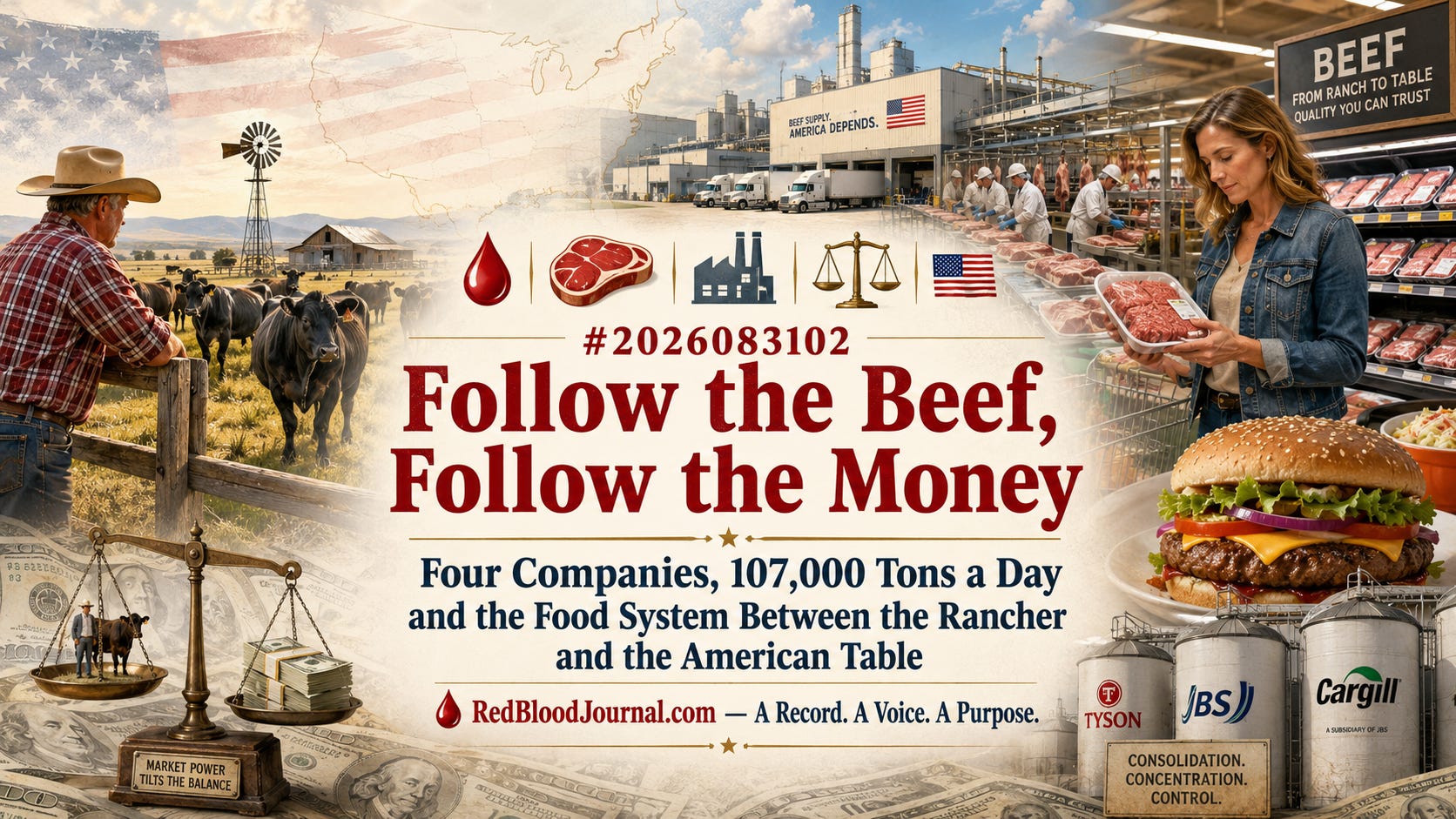
🩸 🥩 🏭 ⚖️ 🇺🇸 #2026083102 — Follow the Beef, Follow the Money: Four Companies, 107,000 Tons a Day and the Food System Between the Rancher and the American Table
When the farmer receives less, the customer pays more, and four companies stand in the middle, the question is no longer simply why beef is expensive. The question is who controls the road from the pasture to the plate.
🩸 RedBloodJournal.com — A Record. A Voice. A Purpose.
Tucker Carlson’s August 31, 2026 interview with farmer and agricultural advocate Joe Maxwell begins with what sounds like a simple question:
Why is the United States importing enormous quantities of beef while American cattle producers themselves are struggling?
It quickly becomes something much larger.
Maxwell describes an American food system in which a handful of multinational meat processors stand between the rancher and the supermarket, enormous retailers stand between the processor and the consumer, regulators move through a revolving door between government and industry, and Americans frequently cannot determine from the package where the beef they are eating actually originated.
Some of the interview’s claims survive examination extremely well.
Others do not.
And several of its most frightening suggestions go considerably beyond what the available evidence establishes.
That distinction matters because the verified story is already extraordinary enough without exaggerating it.
The Number Tucker and Maxwell Got Wrong
One of the first things that must be corrected is the size and structure of President Trump’s latest beef action.
The interview repeatedly discusses 330,000 metric tons of additional beef.
That is not what the August 26, 2026 presidential proclamation says.
The new action temporarily increases the tariff-rate quota for lean beef trimmings by 300,000 metric tons, divided into three tranches of 100,000 metric tons beginning September 1.
Earlier, in February 2026, Trump had separately increased the quota for Argentine lean beef trimmings by 80,000 metric tons.
Those are separate actions.
The August action is therefore:
300,000 metric tons
not:
330,000 metric tons.
And it is important to understand something even more fundamental:
The federal government is not purchasing 300,000 metric tons of beef.
The proclamation increases the quantity of qualifying lean beef trimmings that private importers can bring into the United States at the lower tariff rate.
That is very different from the image created during portions of the interview of Trump somehow locating and purchasing an enormous mysterious pile of inexpensive meat.
The government opened import capacity.
It did not buy a warehouse full of hamburgers.
Then Comes a Tenfold Mathematical Error
At another point Maxwell describes 80,000 metric tons of Argentine beef as roughly 17 million pounds.
That is simply wrong.
The correct conversion is approximately:
80,000 metric tons = 176.4 million pounds
not 17 million.
The statement in the interview is off by approximately a factor of ten.
Likewise, 330,000 metric tons would equal about 727.5 million pounds—not more than 750 million pounds.
But because the newest government action is actually 300,000 metric tons, its proper conversion is approximately:
661 million pounds.
That remains an enormous quantity of beef.
There is no need to inflate it.
But How Enormous Is 661 Million Pounds in America?
This is where the entire discussion needs perspective.
The United States is an extraordinary meat-consuming country.
According to the USDA Economic Research Service’s latest 2026 estimate, approximately 228.8 pounds per person per year of beef, pork, broiler chicken and turkey are available for domestic consumption.
That consists of approximately:
105.6 pounds of chicken
60.0 pounds of beef
49.6 pounds of pork
13.6 pounds of turkey
per person annually.
USDA describes this measure as domestic availability or “disappearance.” It is not a perfect measurement of what physically enters every person’s stomach, because waste occurs along the chain, but USDA uses it as a proxy for consumption.
The U.S. Census Bureau placed the American population at approximately 342.8 million people at the end of August 2026.
Put those two numbers together.
America has approximately:
78.4 billion pounds of beef, pork, chicken and turkey available for consumption every year.
That equals approximately:
39.2 million U.S. tons per year.
Or approximately:
107,000 tons every single day.
Another way of saying it:
America moves through roughly:
215 million pounds of these four major meats every day.
That is the river into which Trump’s new import quota is being poured.
Now Put the 300,000 Tons Into Perspective
The additional 300,000 metric tons equal approximately 661 million pounds.
Against America’s roughly 215-million-pound daily consumption/availability of major meat, the entire three-month quota increase represents roughly:
three days of America’s total beef, pork, chicken and turkey consumption.
That comparison can be misleading too, however, because Trump’s order concerns beef, specifically lean beef trimmings—not all meat.
USDA projects approximately 60 pounds of beef per American in 2026.
With roughly 342.8 million Americans, that represents around:
20.6 billion pounds of beef per year
or approximately:
56 million pounds of beef per day.
Now the scale changes.
The new 661-million-pound quota increase represents roughly:
12 days of total American beef consumption.
And unlike a year’s supply being distributed evenly across twelve months, the White House is allowing this additional quota in only about 90 days.
So Maxwell is correct on the broader point:
This is not a trivial amount of beef entering the market over a short period.
The White House itself describes the program as allowing 100,000 metric tons per month for three months, specifically to increase the supply of lean beef used in ground beef.
Why Does America Need Foreign Lean Beef Anyway?
This is one of the interview’s most useful explanations.
The United States raises excellent cattle.
But highly marbled American beef can produce more fat than processors want when making certain hamburger blends.
Ground beef labeled:
80% lean / 20% fat
or:
90% lean / 10% fat
requires processors to balance lean meat and fat.
The White House itself confirms that imported lean beef trimmings are blended with fattier domestic trimmings to produce ground beef such as hamburgers.
That means importing beef does not necessarily indicate that America has somehow forgotten how to raise cattle.
Part of the trade exists because processors want relatively lean trimmings to combine with domestic beef.
Maxwell describes essentially the same process in the interview.
This is one of the places where the interview is fundamentally correct.
Four Companies Between the Rancher and the Hamburger
The strongest part of Maxwell’s argument is not the speculation about suspicious imported meat.
It is concentration.
Maxwell says approximately four companies control 85% of U.S. beef processing.
The figure is broadly supported.
That means the rancher does not sell cattle into the kind of market many Americans imagine when they hear the words “free market.”
If hundreds of thousands of producers ultimately have to negotiate with a tiny number of dominant buyers, those buyers possess enormous leverage.
Maxwell describes ranchers as price takers.
They pay whatever increasingly concentrated suppliers charge for many inputs.
Then, when their cattle are ready, they ask another highly concentrated industry:
How much will you give me?
Meanwhile the consumer stands at the opposite end wondering:
Why does hamburger cost so much?
The mystery begins to look different.
High supermarket prices do not automatically mean the rancher is becoming rich.
The rancher and consumer can both lose simultaneously.
The entity between them can win.
Capitalism Without Competition
Perhaps the most important sentence in the entire interview comes when Maxwell says:
“Capitalism doesn’t work if it doesn’t have the restraint of competition.”
That is the larger story.
A competitive market requires the realistic possibility that another business can enter, undercut the incumbent, offer farmers a better price or offer consumers a cheaper product.
Maxwell argues that this corrective mechanism has weakened dramatically.
If four processors dominate beef, a similarly concentrated group dominates pork and chicken, and enormous retailers dominate grocery distribution, the theoretical free market becomes increasingly different from the market actually experienced by farmers and consumers.
The result can become:
The farmer does not set the selling price.
The consumer does not set the buying price.
The corporations standing between them possess the leverage to influence both.
The Egg Example Needs Correction Too
Maxwell uses eggs as another example of concentration.
His broader point deserves investigation.
His numbers need greater care.
He describes consumer egg prices rising approximately 300% and Cal-Maine’s profits rising roughly tenfold.
Egg prices unquestionably experienced spectacular increases during the avian-flu crisis, and major egg producers generated extraordinary profits.
But presenting a nationwide 300% increase as a general description of the price change exaggerates the national picture, and the “tenfold” profit claim depends heavily on which periods are selected for comparison.
Avian influenza also killed or required the depopulation of tens of millions of laying hens, meaning the supply shock itself was very real.
The legitimate question is therefore not whether bird flu existed.
It did.
The better question is:
Did concentrated market structure allow companies to turn a genuine supply emergency into pricing power greater than would exist in a competitive market?
That is a much stronger investigation than pretending the disease itself was merely an excuse.
Then There Is JBS
This is where the corporate story becomes harder to dismiss.
JBS is one of the largest meat companies on Earth.
Its corporate family also controls more than 82% of Pilgrim’s Pride, according to the company’s SEC filing.
Pilgrim’s Pride contributed $5 million to Trump’s 2025 inaugural committee.
That fact is documented in SEC materials.
JBS subsequently achieved something it had sought for years:
a listing of its shares in the United States.
The New York Stock Exchange approved the listing on June 5, 2025, and JBS shares were scheduled to begin NYSE trading June 12.
The sequence is real.
The implication requires discipline.
Donation first.
U.S. listing later.
Those facts establish chronology.
They do not, by themselves, establish that the donation purchased the listing.
That is precisely where investigation should begin rather than where a verdict should automatically end.
The Revolving Door Is Also Real
The interview discusses former senior USDA food-safety official Al Almanza later working for JBS.
That transition is not imaginary.
It illustrates a longstanding American governance problem extending far beyond meatpacking:
The regulated become regulators.
Regulators later become employees of the regulated.
Even when every step is perfectly legal, the structure creates an obvious public question:
Who ultimately has greater access to the people writing and enforcing the rules—the ordinary cattle producer or the multinational corporation capable of hiring former regulators?
The answer matters more than party affiliation.
Where the Interview Goes Too Far
The weakest portion arrives when real facts are assembled into an unsupported conclusion about contaminated meat.
There was a real incident involving Argentine beef and prohibited antibiotic residue.
There have been real food-safety controversies involving South American meat.
Those facts justify scrutiny.
But the interview gradually moves toward the possibility that the discounted beef entering under the new American quota might be meat other countries do not want.
Maxwell eventually acknowledges the limitation himself:
“I have no evidence.”
That sentence should govern the conclusion.
There is currently no demonstrated evidence in the transcript that hundreds of millions of pounds entering under the new U.S. quota consist of contaminated meat rejected by China or another country.
And inexpensive beef does not automatically mean contaminated beef.
Currency differences, tariff treatment, cattle type, cuts, lean content, transportation economics, contracts and regional pricing can all affect price.
Question it? Absolutely.
Inspect it? Certainly.
Demand transparency? Yes.
Declare hundreds of millions of pounds contaminated without evidence? No.
The proven story is strong enough.
The Label May Be the Most Important Part
Here Maxwell lands on one of the most tangible issues for the American consumer.
Mandatory country-of-origin labeling for beef and pork was effectively removed after Congress changed the law in December 2015.
USDA formally removed beef and pork from the mandatory COOL regulations in 2016.
Which creates a strange situation.
Americans can examine many products and determine where they were manufactured.
Yet ordinary beef shoppers may not receive the clear country-of-origin information they assume exists.
There has been an improvement.
Beginning with the 2026 compliance requirement, beef voluntarily labeled:
“Product of USA”
or:
“Made in the USA”
must come from animals that were:
born in America,
raised in America,
slaughtered in America,
and:
processed in America.
That is a substantial improvement over the old voluntary standard, under which imported meat subjected to processing here could sometimes carry a U.S.-origin claim that consumers interpreted far more broadly than the rule actually required.
But the key word remains:
Voluntary.
The larger argument over mandatory country-of-origin labeling remains alive.
107,000 Tons Every Day Changes the Perspective
America’s meat system is not a niche agricultural market.
It is an enormous circulatory system.
Approximately:
107,000 tons of beef, pork, chicken and turkey move toward American consumption every day.
Approximately:
39 million tons per year.
At that scale, control of processing is control over something fundamental.
Food is different from smartphones.
A person can postpone buying a television.
A family cannot permanently postpone eating.
That makes concentration in the food supply particularly important.
When several corporations become unavoidable gateways between hundreds of millions of consumers and thousands of producers, market power becomes something more fundamental than a stock-market statistic.
It becomes power over necessity.
The Real Question Isn’t Argentina
Argentina may be today’s headline.
Tomorrow it may be Brazil.
Next year another country.
The deeper question survives every change of administration and every trade agreement:
Who owns the narrowest point in the pipe?
If thousands of ranchers feed cattle into one end...
hundreds of millions of Americans purchase food at the other...
and only a handful of corporations control much of what passes between them...
then the narrowest point is where the power accumulates.
That is where Red Blood should look.
Not merely at Trump.
Not merely at Biden.
Not merely at Argentina.
Not merely at JBS.
Look at the architecture.
Because presidents rotate.
Corporations merge.
Lobbyists change offices.
Regulators become executives.
Executives become advisers.
Political parties exchange control.
And dinner still has to arrive on the table tomorrow night.
🩸 The Red Blood Perspective
The Tucker Carlson interview contains exaggerations, numerical mistakes and speculation that should not be repeated as established fact.
Correcting those errors does not weaken the underlying story.
It strengthens it.
Trump did not purchase a mysterious 330,000 metric tons of meat.
The newest action opens a temporary 300,000-metric-ton tariff quota for lean beef trimmings.
Eighty thousand metric tons is not 17 million pounds.
It is approximately 176 million pounds.
And there is no evidence presently establishing that America’s new import quota consists of contaminated meat rejected elsewhere.
Remove those claims.
What remains?
Four processors dominate roughly 85% of American beef processing.
American ranchers can struggle while supermarket beef remains expensive.
A multinational meat company can possess extraordinary political and economic access.
A corporation controlled by JBS contributed $5 million to a presidential inaugural committee.
JBS subsequently obtained its long-sought American stock listing, although chronology alone does not prove causation.
Government regulators can move into the industries they once regulated.
American consumers still do not have universal mandatory country-of-origin labeling for beef.
And the United States consumes or makes available for consumption approximately 107,000 tons of major meat every day.
That is enough.
The investigation does not require a rumor.
The structure itself deserves examination.
When both the person producing the food and the person buying the food feel squeezed while the corporations between them become larger, asking who owns the middle is not anti-capitalism.
It may be one of the most capitalist questions possible.
A market without meaningful competition eventually stops behaving like a market.
🌊 The Ocean of Love and Positivity Perspective
There is something constructive hidden inside this story.
Every hamburger connects human beings who almost never see one another.
A rancher raises the animal.
Workers process the meat.
Truckers move it.
Stores sell it.
Families prepare it.
Millions of individual lives touch something as ordinary as dinner.
The problem begins when those relationships become invisible.
Once everything becomes anonymous—anonymous meat, anonymous corporations, anonymous producers, anonymous consumers—it becomes easier to stop seeing one another.
The farmer becomes a cost.
The worker becomes a labor unit.
The customer becomes revenue.
The animal becomes inventory.
The food becomes a commodity number moving through an enormous machine.
Perhaps the opening is simply to reverse that process.
Know what is being eaten.
Know where it came from.
Know who produced it.
Ask what something costs—but also ask who received the money.
And beyond food, carry the same awareness inward.
How many things in life are consumed without ever asking where they came from?
Ideas.
Fear.
Anger.
Political identities.
Religious identities.
News.
Beliefs.
Perhaps country-of-origin labeling should exist for thoughts too:
Where did this belief come from?
Who put it here?
Who benefits when it is accepted?
Did it come from personal understanding, or was it simply mixed into the mental hamburger along with everything else?
The greatest independence does not begin at the supermarket.
It begins inside.
See clearly.
Choose consciously.
And wherever possible, reduce the distance between what is consumed and the truth of where it came from.
In an Ocean of Love and Positivity.
🩸🌊✨ Fantastic!
🥩
The Narrowing Pipe: Power and Control in American Beef
Aug 31, 2026
This text evaluates an interview between Tucker Carlson and agricultural advocate Joe Maxwell regarding the current state of the American beef industry. While the source corrects several mathematical errors and unverified claims about contaminated imports, it validates concerns regarding market concentration and the power of multinational processors. The analysis highlights how four dominant companies control the majority of the market, potentially squeezing both struggling ranchers and price-weary consumers. It also examines the influence of corporate lobbying, the “revolving door” between regulators and industry, and the lack of mandatory country-of-origin labeling. Ultimately, the text argues that the true issue lies in a diminished competitive landscape where the middle of the food supply chain holds disproportionate leverage over a national necessity.
#Beef #FoodIndustry #Agriculture #Farmers #Ranchers #CorporatePower #Monopoly #JBS #MeatIndustry #FoodPrices #FoodSafety #CountryOfOrigin #MadeInUSA #AmericanFarmers #Antitrust #BigAgriculture #GroundBeef #FoodSupply #USDA #RedBloodJournal


