


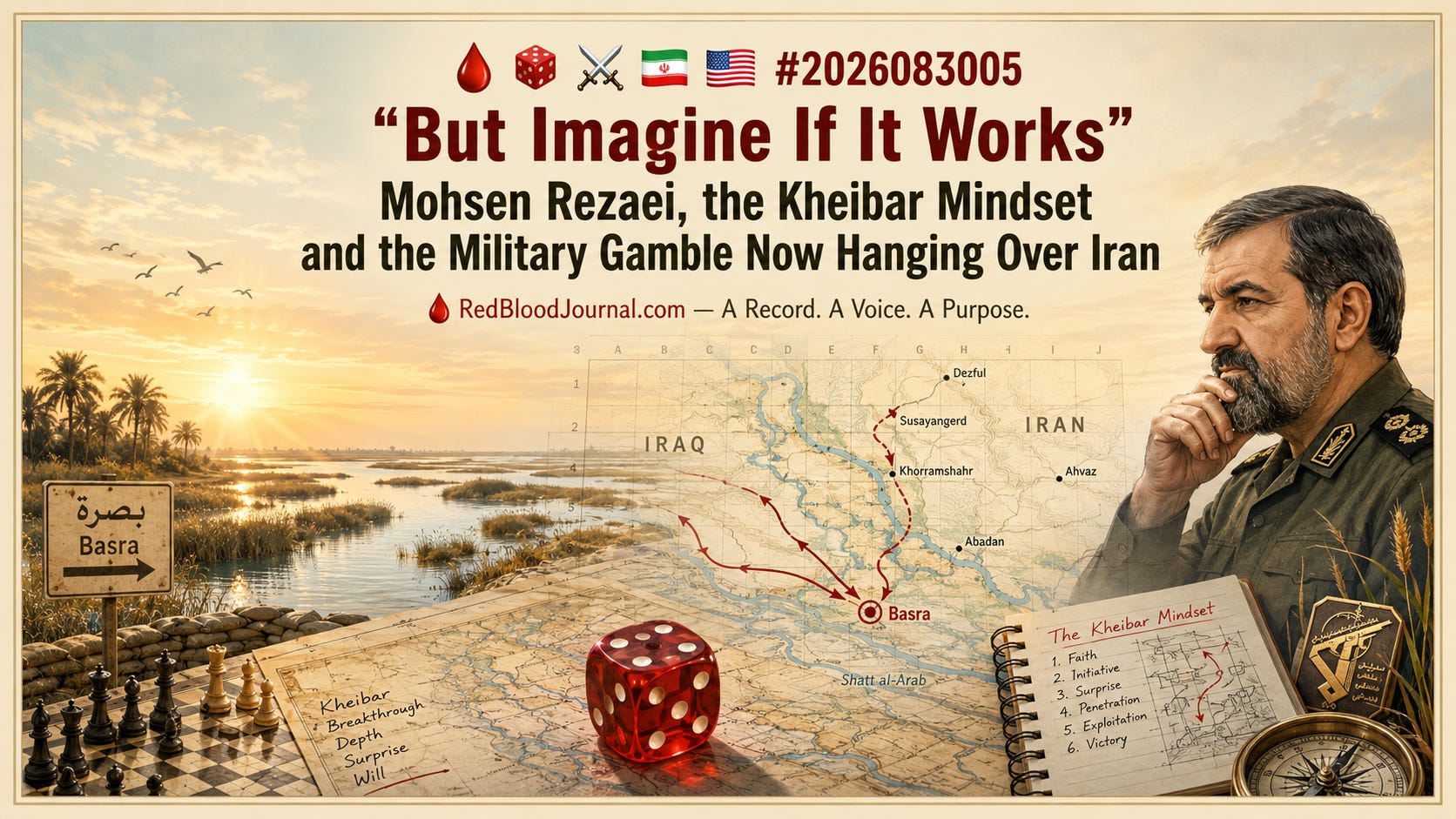
🩸 🎲 ⚔️ 🇮🇷 🇺🇸 #2026083005 — “But Imagine If It Works”: Mohsen Rezaei, the Kheibar Mindset and the Military Gamble Now Hanging Over Iran
🩸 RedBloodJournal.com — A Record. A Voice. A Purpose.
There is a Persian joke about a man sitting beside the sea, spooning yogurt into the water.
Someone asks him what he is doing.
“I’m making doogh.”
They tell him it will never work.
He answers:
“Yes, but imagine how much doogh there would be if it did.”
In the transcript examined for this report, that joke becomes more than a joke.
It becomes a description of a style of military thinking.
And the man placed at the center of that thinking is Mohsen Rezaei.
The argument made in the transcript is not simply that Rezaei was once an important commander during the Iran–Iraq War.
It is much more consequential.
The speaker argues that Rezaei has again moved into a position where decisions involving war, peace, confrontation and national survival may pass through his hands—and that the same strategic instinct visible four decades ago may once again be appearing at exactly the moment Iran can least afford another enormous gamble.
The New Choice Inside Tehran
The transcript describes two increasingly different approaches inside the Islamic Republic.
One side, associated in the speaker’s account with Masoud Pezeshkian and Mohammad Bagher Qalibaf, believes the present economic and military pressure cannot continue indefinitely.
Their answer is negotiation.
End the confrontation.
Reach an agreement.
Restore trade.
Get oil moving again.
Prevent the economic machinery of the state from seizing.
The opposing camp sees almost the same facts and reaches the opposite conclusion.
Negotiations have not worked.
Oil exports are being squeezed.
Ports are under pressure.
The Strait of Hormuz is no longer producing the leverage Tehran expected.
The United States appears content to let economic pressure continue.
Therefore, according to this second line of thinking, waiting is itself defeat.
The rules of the game must somehow be changed.
And the fastest way to change them may be military action.
The transcript places Mohsen Rezaei firmly inside this second camp, saying his path is not the path of agreement or accommodation.
The Gamble
The logic attributed to the confrontation camp is remarkably simple.
If Iran continues under the existing conditions, it loses gradually.
Therefore:
Create a new military situation.
Force Washington to react.
Change the facts on the ground.
Then negotiate from a different position.
Perhaps America will lift the pressure.
Perhaps Iranian oil exports will resume.
Perhaps the blockade or restrictions will loosen.
Perhaps everything changes.
And here the transcript identifies Rezaei as particularly important.
The speaker argues that this is precisely where Mohsen Rezaei may be helping push the Islamic Republic toward a potentially disastrous decision.
The key word is not necessarily war.
It is gamble.
Because the strategy only works if the dramatic action produces the dramatic result imagined beforehand.
If it does not, Iran does not return to where it started.
It may emerge weaker than before.
“What If It Works?”
The transcript’s most important criticism of Mohsen Rezaei concerns his method of thinking.
The speaker says that when Rezaei’s decisions are examined across roughly forty years, a pattern appears.
A very large operation is imagined.
The potential reward is enormous.
The obstacles are known.
The resources may be insufficient.
The logistics may not support the ambition.
The probability may be poor.
Yet the possibility of spectacular success becomes irresistible:
What if it works?
That is why the doogh joke matters.
The criticism is not that Rezaei cannot imagine possibilities.
It is that possibility can become detached from probability.
And in war, the difference between those two words is measured in human beings.
Operation Kheibar
To explain why this matters today, the transcript returns to the Iran–Iraq War.
Its central example is Operation Kheibar.
Iran had repeatedly struggled to find a route toward Basra.
The conventional approaches had not delivered the desired breakthrough.
So another concept emerged.
Instead of attacking through the obvious ground corridors, Iranian forces would move through the marshlands.
They would cross the Hawizeh and Hoor al-Azim areas.
They would reach the Basra–Amarah road.
Then they could approach Basra from another direction, threaten Iraqi positions and potentially transform the entire battlefield.
On a map, the idea had enormous appeal.
If it succeeded, the strategic payoff could have been extraordinary.
There was only one problem.
According to the transcript, trained Army officers warned that the operation was not realistically supportable.
The Warning
The objections were not philosophical.
They were logistical.
How would artillery support forces moving twenty or thirty kilometers through water and marshland?
How would ammunition reach them?
How would food reach them?
How would reinforcements reach them?
How would wounded soldiers be evacuated?
How would a breakthrough be sustained once Iraqi forces counterattacked?
Breaking a line is one thing.
Holding territory after the line has been broken is another.
The transcript says military professionals warned Rezaei that even if Iranian troops succeeded initially, Iraq could counterattack the following morning and push them back because Iran would have difficulty supplying and supporting the advance.
According to the speaker:
That is essentially what happened.
But the Operation Went Forward
The transcript says Rezaei insisted on proceeding, believing surprise could compensate for the weaknesses.
Iranian forces advanced.
They reached important positions.
Some reportedly reached the Basra–Amarah road.
For a moment, the extraordinary possibility seemed reachable.
Then Iraqi forces counterattacked.
Most of the gains were lost.
A limited position remained around the Majnoon Islands.
The transcript calls the result a catastrophe.
The lesson the speaker draws is not merely historical.
It is psychological.
The operation could be defended by saying:
Look how close it came.
The opposing interpretation is:
The operation came close precisely because soldiers accomplished extraordinary things despite a plan that could not sustain them.
Those are completely different conclusions.
The Four Battalions
The transcript then describes an even more disturbing episode connected to Kheibar.
According to the speaker, four Iranian battalions attacked from one direction with the understanding that another force would advance from the Talaiyeh sector and link with them.
The first force moved.
They asked where the other formation was.
They were expecting the two forces to join.
Then, according to the transcript, the response from headquarters was effectively:
Was the operation tonight? We thought it was tomorrow.
The four battalions were isolated.
The speaker estimates that four battalions could represent at least roughly 1,200 men, possibly more.
Whether every detail of that wartime recollection can independently be established is not demonstrated by this transcript.
What matters for this report is why the speaker tells the story.
He is asking:
What happens when the same type of decision-maker is again sitting near the center of decisions about war?
Valfajr Preliminary
Operation Kheibar is not the only example raised.
The transcript also refers to Operation Valfajr Preliminary, describing enormous Iranian losses after the liberation of Khorramshahr and subsequent attempts to carry the war deeper into Iraqi territory.
The speaker alleges that the true casualty count remained unclear even decades later and further alleges that Rezaei did not fully report the number of dead to Ayatollah Khomeini.
The transcript does not independently prove that allegation.
But again, the historical examples are being used to build one larger argument:
Rezaei has previously favored operations in which enormous strategic ambition exceeded the reliable capacity available to achieve it.
And Now America
That brings us back to today.
The confrontation is no longer with Saddam Hussein’s Iraq.
It is with the United States.
The battlefield is no longer one marsh, one road or one front.
It involves:
the Persian Gulf;
the Strait of Hormuz;
Iranian ports;
oil exports;
missiles;
drones;
U.S. bases across the region;
economic sanctions;
maritime enforcement;
regional allies;
global energy markets.
The consequences of miscalculation are therefore much larger.
The transcript argues that the emerging hard-line strategy may be:
Hit hard enough to force America to reconsider the current economic pressure.
The assumption behind the gamble would be that Washington ultimately wants to avoid a major war more than Tehran does.
Therefore Tehran escalates.
America backs away.
Pressure is reduced.
Iran gains breathing room.
It is elegant.
It is simple.
And it works beautifully—
if it works.
The Pentagon Report
One of the strangest pieces of the transcript appears later.
A report is discussed suggesting that American military commanders had expressed concern about ammunition and weapons inventories.
The speaker immediately asks:
Why would information that sensitive become public?
He then offers his own theory.
Perhaps the disclosure was deliberate.
Perhaps Washington wanted its adversaries to see weakness.
Perhaps officials inside Iran would translate the reports, circulate them through intelligence bulletins and conclude:
America is overstretched.
America is short of weapons.
America does not want another war.
America will not respond strongly.
The transcript specifically imagines information like this reaching people such as Mohsen Rezaei.
The speaker clearly identifies this as analysis, not established fact.
But the possibility produces a fascinating strategic danger.
Because misinformation is most effective when it tells the target something he already wants to believe.
If a decision-maker already believes one dramatic operation can change everything, evidence suggesting the enemy is weaker than expected becomes extremely seductive.
The Most Dangerous Intelligence Is the Intelligence We Want to Hear
That may be the deepest lesson in the entire Rezaei discussion.
Every leader receives intelligence.
Every military commander receives warnings.
Every government hears competing interpretations.
The danger begins when information stops being evaluated according to whether it is true and starts being valued according to whether it supports the preferred plan.
Then intelligence becomes permission.
Weak American stockpiles?
Permission to escalate.
America does not want war?
Permission to escalate.
Oil pressure is hurting Iran?
Permission to escalate.
Negotiation has failed?
Permission to escalate.
Every road begins pointing toward the conclusion already chosen.
Then the gamble stops looking like a gamble.
It begins looking inevitable.
The Double-Edged Weapon
The transcript ultimately describes Mohsen Rezaei as something close to a double-edged weapon.
One edge points toward the Islamic Republic itself.
If the speaker’s assessment is correct, unrealistic military decisions could accelerate the regime’s destruction.
A failed confrontation with the United States could further damage military infrastructure, deepen economic isolation and weaken a government already under pressure.
The other edge points toward the Iranian people.
Because governments do not absorb the full cost of their own strategic mistakes.
Citizens do.
If oil exports disappear, ordinary people feel the currency collapse.
If imports stop, ordinary people discover what is missing from shelves.
If livestock feed cannot enter, ordinary people pay for meat and milk.
If wheat becomes scarce, ordinary people stand in line for bread.
If another war begins, ordinary people live beneath the missiles.
The transcript therefore argues that the very decisions that might hasten the collapse of the Islamic Republic could simultaneously increase the suffering imposed on Iranians before that collapse occurs.
That is what makes the situation so dangerous.
🩸 The Red Blood Perspective
Mohsen Rezaei is not important because of what he did forty years ago.
He is important because forty years ago may tell us something about how he thinks today.
That is the argument contained in this transcript.
A government under intense pressure naturally looks for a way out.
One faction sees negotiation.
Another sees confrontation.
And confrontation becomes especially tempting when remaining in place feels like slow defeat.
The danger is that a desperate government does not necessarily choose between victory and defeat.
Sometimes it chooses between slow defeat and a gamble that promises immediate salvation.
That second choice can feel courageous.
It can feel revolutionary.
It can feel unpredictable enough to frighten the enemy.
It can even appear brilliant on the map.
Then someone asks the most intoxicating question in strategy:
What if it works?
History also requires the second question:
What happens if it doesn’t?
Operation Kheibar matters because human beings had to discover the answer.
If Iran is once again approaching a moment in which one enormous military action is imagined as the solution to economic strangulation, lost oil exports, diminished control of Hormuz and failed negotiations, then the lesson of the past should not be whether the gamble almost succeeded.
The lesson should be what was wagered.
Because this time the wager is not four battalions.
It could be an entire country.
🌊 The Ocean of Love and Positivity Perspective
There is still a constructive possibility hidden inside even this history.
A human being is not imprisoned by yesterday’s decisions unless yesterday’s decisions are never examined.
The greatest purpose of remembering failure is not punishment.
It is freedom from repetition.
Every person has a smaller version of Kheibar inside himself.
We have all wanted something badly enough to ignore the warning signs.
We have all imagined the reward before calculating the cost.
We have all occasionally said:
But imagine if it works.
Wisdom begins when excitement is no longer allowed to silence understanding.
There is courage in taking risks.
There is greater courage in recognizing when the ego has transformed risk into fantasy.
The same principle applies to governments, commanders and ordinary people.
The past cannot be changed.
The next decision can.
And perhaps the greatest victory available to anyone—whether an individual or a nation—is reaching the moment where an old pattern presents itself once more and quietly saying:
I recognize you this time.
That is growth.
That is awareness.
That is how a repeated lesson finally becomes a completed lesson.
In an Ocean of Love and Positivity.
🩸🌊✨ Fantastic!
🎲
The Kheibar Mindset: Mohsen Rezaei and Iran’s Strategic Gamble
Aug 31, 2026
This text analyzes the strategic risks currently facing Iran by comparing modern tensions with the United States to the military failures of the Iran–Iraq War. It focuses on Mohsen Rezaei, a high-ranking figure associated with a “confrontation camp” that favors high-stakes military gambles over diplomatic negotiations to end economic isolation. The author uses Operation Kheibar as a historical parallel to illustrate how Rezaei’s tendency to prioritize spectacular possibilities over logistical realities led to past catastrophes. Today, a similar mindset may be driving Tehran toward an escalation strategy based on the hopeful assumption that a dramatic strike will force Washington to retreat. Ultimately, the source warns that such unrealistic strategic thinking risks the survival of the nation and the well-being of the Iranian people. It concludes that true wisdom lies in breaking these historical patterns before a new gamble results in irreversible national ruin.


