


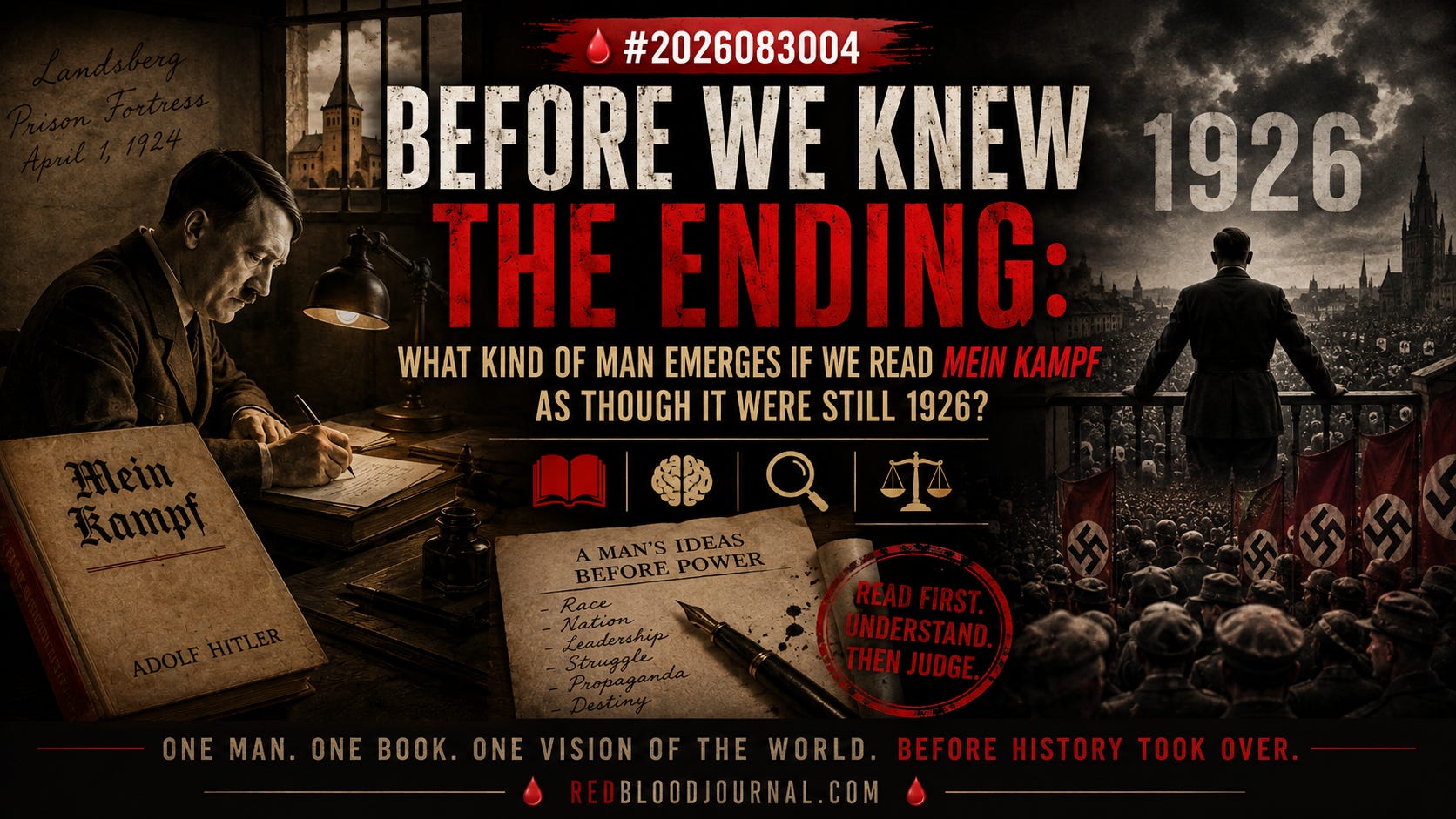
🩸 📖 🧠 🔍 ⚖️ #2026083004 — Before We Knew the Ending: What Kind of Man Emerges If We Read Mein Kampf as Though It Were Still 1926?
Reading Hitler’s Mind from the Horse’s Mouth: A Report on Mein Kampf (Ford Translation)
🩸 RedBloodJournal.com — A Record. A Voice. A Purpose.
Unfiltered primary-source analysis
Adolf Hitler wrote Mein Kampf in Landsberg prison in 1924 after the failed Beer Hall Putsch. He presents it as the foundational stones of the National Socialist movement: part autobiography, part political manifesto. The Ford Translation renders the text in plain modern English without the softening or academic framing common in other editions. What follows is a direct extraction of the author’s stated self-image, experiences, diagnoses, and program—what he claimed was in his mind—without external moral overlay, later historical scoring, or second-hand portraits. The book is the source; later actions are noted only where the text itself invites comparison to consistency of intent.
Formative Vision: Blood, Struggle, and Rejection of Comfort
Hitler opens with deliberate symbolism. Born in Braunau am Inn on the Austrian-German border, he frames his birthplace as fate’s choice for the eventual reunification of all Germans under one Reich. Common blood, not economics, is the decisive principle: “Even if it did not make economic sense, it must still take place because common blood belongs in one common realm.” The German people, he argues, have no moral right to colonies until every German is gathered into the mother state. The plow becomes the sword; future bread is watered by the tears of war.
His childhood is presented as early nationalist formation. He describes himself as a ringleader among rowdy boys, gifted in speaking and drawing, resistant to his father’s plan that he become a civil servant. The father, a self-made customs official who rose from poverty, embodies duty and authority; the son embodies stubborn refusal of “sitting in a government office… a slave.” After the father’s death and the mother’s prolonged illness and death, the orphaned teenager heads to Vienna with a bag of clothes and “an inextinguishable will.” He is rejected by the Academy of Fine Arts (they recommend architecture instead) and spends years in poverty as a day laborer and small-time painter. Hunger is a “faithful sidekick.” Books and architecture (especially the Ringstrasse) become his only remaining pleasures.
Vienna is not romanticized. It is the “saddest period,” a city of glittering wealth and revolting poverty, a “stew of peoples” held together by Hapsburg centralization. Here he claims to have learned the social question from inside, not from above. He watches the cycle of work, strike, unemployment, drinking, family breakdown, and moral collapse among laborers. Housing is “frightful.” He concludes that superficial “social conscience” or welfare schemes are useless; the deeper task is to overcome fundamental weaknesses in economic and cultural organization and to create healthier paths from the start rather than trying to salvage the damaged. Nature, he writes, does not preserve the unfit; it breeds the next generation. Sentimentality cripples resolve.
Two “dangers” crystallize in his mind during these years: Marxism and Jewry. He presents them as interlocking. Marxism is a doctrine of destruction that dissolves national states, elevates the mass over the individual, and turns trade unions into weapons of class war. Jewry is described as a racial group (explicitly not a religion) that lacks creative capacity, lives as a parasite inside host nations, monopolizes trade and finance through shrewdness rather than productive labor, controls the press, and advances internationalism as a tool of domination. He traces a multi-stage historical process by which Jews allegedly enter as traders, become middlemen and money-lenders, form a “state within a state,” gain influence over princes, adopt the host language while preserving blood purity, and finally push democracy and Marxism to dissolve the host’s racial and hierarchical structure. The Protocols of the Elders of Zion is treated as an accurate revelation of method, regardless of authorship. Architecture and music—the “Queens of the Arts”—owe nothing original to Jewry; Jewish cultural output is imitation or corruption.
This is not presented as abstract theory. It is the interpretive lens applied to his own observations: the decline of German character in multi-ethnic Austria, the Hapsburg favoritism toward Slavs, the failure of the German alliance to protect German culture, and the wartime “half-measures” that left Marxist and Jewish agitators free while German soldiers died.
The World-Concept: Race, Personality, and Intolerance
Volume Two shifts from personal accounting to systematic doctrine. The core is a “World-Concept” (Weltanschauung) rooted in race. Human progress, invention, and state-building come from the creative individual of the Aryan race, whose instincts of self-preservation and heroic virtue create culture and states. Economics alone never builds a state; when economic instincts override species-preserving instincts, the result is decline. The Jewish principle is the opposite: the numerical power of the mass, the elimination of personality, and the solvent of national cultures. Marxism is its pure political expression—parliamentary majority rule, trade-union class struggle, and international solidarity that dissolves non-Jewish national states.
The ideal state is therefore race-based and organized on the “personality principle.” From village to Reich, authority and responsibility rest in the individual leader, not majority vote. Councils advise; one man decides. Selection occurs through struggle and proven capacity, not appointment or ballot. Parliaments become advisory bodies, not sovereign. The Prussian army’s hierarchical model (absolute authority downward, absolute responsibility upward) is the template. This is presented as alignment with natural law, the same law that produces invention and culture through gifted individuals rather than the mass.
A true World-Concept is intolerant. It cannot coexist with rival systems; it must destroy the existing order to clear ground for itself. Political parties compromise and feed at the trough; World-Concepts declare infallibility and demand exclusive recognition. Propaganda must therefore be simple, slogan-like, emotionally charged, and aimed at the broad masses (especially the working class) who supply disciplined obedience. Intellectuals alone produce only undisciplined chatter. The movement itself must already embody the future state’s principles—Führer principle, racial priority, organizational discipline—before it seizes power. Half-measures and internal program tinkering are fatal; the core must remain rock-solid while tactics adapt.
War is not aberration but the ultimate expression of the struggle for existence. Hitler describes his 1914 enthusiasm as deliverance from the “anger of my youth.” He petitions to join a Bavarian regiment rather than fight for the multi-ethnic Hapsburg state. The front is the place where nationalistic words are tested by blood. He criticizes wartime restraint of victory celebrations and the failure to crush Marxism at home while soldiers fell. The German army of 1914–18 is mythologized as a monument of iron will.
Character Self-Portrait: Will, Consistency, and Providence
The narrator presents himself as a man formed by rejection, poverty, and reading. He claims a gift for speaking, an early nationalist fanaticism that distinguished true people-nationalism from dynastic patriotism, and a revolutionary temperament in both politics and art. He rejects the civil-service path as slavery, persists through Academy rejection and hunger, and treats obstacles as providential training. “What had then seemed to me to be the unkindness of Fate I accept as the wisdom of Providence.” The Vienna years tear away lower-middle-class blinders and force confrontation with social reality. By the time he leaves for Munich and then the war, the worldview is presented as fixed: German racial preservation first, destruction of Marxism and the Jewish “state within a state,” authoritarian reorganization of the state around personality and race, and intolerant struggle rather than compromise.
He is explicit that writing is secondary to spoken propaganda and organizational force. The book is for “heart-strong supporters” and those needing enlightenment, not strangers. Great movements grow from speakers, not writers; the text merely lays down principles for all time.
Words Versus Later Action: Continuity, Not Reversal
The text itself does not claim to be prophecy of every later policy detail. It does claim to be the unchanging foundation. The racial hierarchy, the identification of Marxism with Jewish internationalism, the Führer principle, the priority of blood over economics, the necessity of destroying the existing order, the instrumental use of propaganda and organization, and the view of struggle as the law of life are stated without ambiguity or later retraction within the book. The practical chapters on party-building (newspaper, office discipline, membership files, business management under Amann), the subordinate role of trade unions (not class struggle but occupational representation under the racial state), and the rejection of pure economic or social-reform focus as insufficient all flow from the same core.
Where later historical outcomes diverged in timing, scale, or method, the book still supplies the stated intention and the diagnostic framework. It does not present itself as hot air or temporary campaign rhetoric. It presents itself as the crystallization of a personal and political vision forged in Vienna, tested in war, and fixed in prison. The author’s self-assessment is that the principles required no revision after 1913–14; only application remained.
This is the mind as the author chose to record it: a fusion of personal grievance, racial biology, authoritarian organizational theory, and millenarian national mission. Whether one judges the content good, evil, or a mixture is external to the text. The text itself is unambiguous about its own hierarchy of values—racial preservation and creative personality above all else—and about the means it considered legitimate to secure them.
🩸 The Red Blood Perspective
The value of Mein Kampf is not that it excuses Hitler, condemns him, or replaces the historical record.
Its value is that it allows the reader to encounter the architecture of his thinking before later history supplies the verdict.
Read this way, Hitler does not emerge as a blank mystery suddenly transformed by power. He presents himself as a man who had already built a coherent internal system around struggle, destiny, race, hierarchy, propaganda, leadership, national survival, and the destruction of competing worldviews.
That does not mean every later act can be mechanically traced to a sentence in the book.
But it does mean the central direction was not hidden.
The deeper lesson is uncomfortable:
People often reveal far more about what they intend than society is willing to believe.
The danger is not only the lie.
Sometimes the danger is the truth stated so openly that listeners assume it cannot possibly be meant literally.
The Red Blood question is therefore larger than Hitler:
When a political figure repeatedly explains how power should work, what kind of society should exist, who the enemies are, what methods are justified, and what must eventually be destroyed—at what point does dismissing those words as rhetoric become its own form of blindness?
The book should neither be worshipped nor feared.
It should be read.
Carefully.
Because understanding a mind does not require agreeing with it.
And refusing to understand a dangerous idea does not make the idea disappear.
🌊 The Ocean of Love and Positivity Perspective
There is another way to look at this book that leaves Hitler behind entirely.
Every human being constructs an explanation of the world.
We experience disappointment.
Rejection.
Poverty.
Loss.
Humiliation.
Fear.
And then the mind begins building a story explaining why those things happened.
That story can move in many directions.
It can produce compassion.
It can produce self-knowledge.
It can produce determination.
Or it can gradually transform pain into blame, blame into certainty, certainty into enemies, and enemies into justification.
The profound lesson is therefore not merely historical.
It is inward.
We cannot always control what happens to us.
But we can observe the meaning we attach to what happens.
We can notice when our explanation becomes absolute.
We can notice when disagreement starts feeling like betrayal.
We can notice when another human being becomes a category rather than a person.
And we can notice when our own suffering begins asking permission to become someone else’s suffering.
That awareness is where personal sovereignty begins.
Perhaps the strongest protection against destructive ideology is not another ideology.
It is the ability to watch our own mind creating one.
To examine our conclusions before becoming their servant.
To understand our wounds without turning them into weapons.
And to discover that strength does not require an enemy.
In an Ocean of Love and Positivity.
🩸🌊✨ Fantastic!
📖
The Architecture of a Dangerous Mind
Aug 30, 2026
This text provides a comprehensive analysis of the Ford translation of Mein Kampf, examining it as a primary historical artifact rather than a post-war interpretation. The author explores how Adolf Hitler meticulously crafted a self-image and a political manifesto based on his early experiences with poverty and rejection in Vienna. The source highlights Hitler’s core ideologies, specifically his focus on racial purity, the rejection of democratic systems, and the elevation of authoritarian leadership. It argues that the book serves as a blueprint for his future actions, suggesting that his radical intentions were stated openly long before he achieved power. Ultimately, the analysis encourages readers to study the development of such dangerous ideologies to understand how personal grievances can be transformed into a destructive global worldview. The piece concludes by reflecting on the psychological process of building an internal narrative and the importance of critical awareness in preventing the weaponization of suffering.
#RedBloodJournal #MeinKampf #AdolfHitler #Hitler #1926 #History #PrimarySource #PoliticalPsychology #PoliticalIdeology #Nazism #NationalSocialism #Propaganda #Authoritarianism #Totalitarianism #MassPsychology #Leadership #Worldview #PoliticalPower #HistoricalAnalysis #WordsAndActions #CharacterStudy #HumanNature #CriticalThinking #FreedomOfThought #ReadingHistory


