


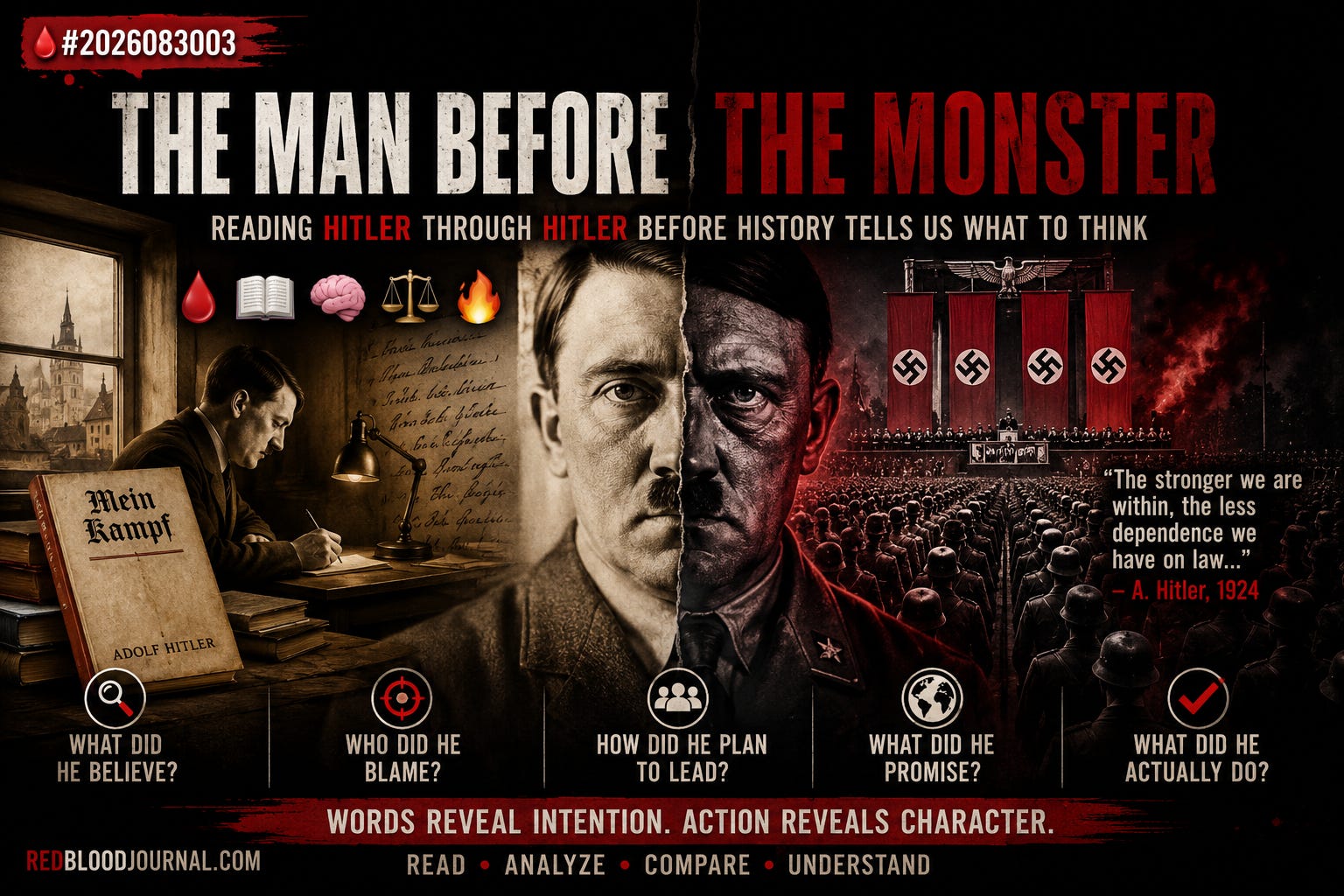
🩸 📖 🧠 ⚖️ 🔥 #2026083003 — The Man Before the Monster: Reading Hitler Through Hitler Before History Tells Us What to Think
What if the most revealing way to understand Adolf Hitler is not to begin with the verdict history handed down, but with the words he wrote before he possessed the power to carry them out?
🩸 RedBloodJournal.com — A Record. A Voice. A Purpose.
There is an unusual advantage in studying Adolf Hitler that does not exist with every political figure.
He left behind a long political autobiography and ideological statement before becoming ruler of Germany.
Mein Kampf is not merely a memoir. Hitler himself explains that he intended the work to describe the development of his movement, establish its principles and provide supporters with a unified doctrine.
That makes the book something more valuable than a collection of quotations.
It is evidence.
The question is not whether history considers Hitler good or evil.
The more interesting question comes first:
Who does Hitler appear to be when Hitler describes Hitler?
And after answering that:
How closely did the Hitler who eventually obtained power resemble the Hitler who had already appeared on the page?
Going to the Horse’s Mouth
Most people encounter Hitler backward.
They first learn Auschwitz.
Then the Second World War.
Then dictatorship.
Then Nazi Germany.
Then eventually, perhaps, they encounter the young Hitler.
By then the conclusion already exists.
Everything he ever said is read through what happened afterward.
There is another method.
Temporarily remove the ending.
Imagine reading Mein Kampf when it first appeared, without knowing what would happen between 1933 and 1945.
What kind of person emerges?
What does he fear?
What does he admire?
What does he believe human beings are?
What does he believe government should be?
What does he believe propaganda should accomplish?
What enemies does he identify?
What future does he imagine?
And perhaps most importantly:
Which things sound like political exaggeration, and which things sound like actual intention?
Only afterward should history be brought back into the room.
The First Character That Appears: The Man Who Refuses to Yield
One personality trait appears very early.
Stubbornness.
Hitler describes his childhood conflict with his father over his future. His father wanted him to become a civil servant. Hitler says he repeatedly refused.
His father said no to becoming an artist.
Hitler responded with his own refusal.
He even describes deliberately neglecting school subjects that did not contribute to the future he imagined for himself.
This matters because the adult Hitler later presents essentially the same personality as a political virtue:
certainty,
persistence,
resistance,
struggle,
and refusal to compromise.
Whether every childhood memory is precisely accurate is another question.
Autobiographies are self-portraits.
But that itself is valuable.
This is the personality Hitler wanted the reader to see:
I decide.
I resist.
I endure.
I do not surrender my conclusion merely because authority disagrees.
Failure Becomes Destiny
Another pattern emerges.
Hitler repeatedly transforms personal disappointment into evidence that destiny has redirected him.
The rejection from the Vienna Academy is not remembered merely as failure.
Poverty is not merely poverty.
Hardship becomes training.
He describes Vienna as a brutal education and says that adversity strengthened his will. He even interprets suffering through the language of Providence and Fate.
This becomes psychologically important.
A person can interpret failure in two very different ways:
Perhaps I was wrong.
Or:
Perhaps this obstacle exists because I am being prepared for something larger.
Hitler repeatedly gravitates toward the second.
That does not automatically create tyranny.
But it creates something politically powerful:
a man increasingly capable of converting personal conviction into historical destiny.
Once that happens, disagreement can stop being disagreement.
It can become resistance to destiny itself.
The Surprising Part: Some of His Social Observations Are Not Absurd
This is where an honest reading becomes uncomfortable.
Hitler observes real suffering.
He describes Vienna as a place of enormous wealth existing beside severe poverty.
He writes about unemployment, insecure work, hunger, alcoholism, inadequate housing, family violence, hopelessness and workers becoming psychologically damaged by economic instability.
He even describes impoverished people as products of destructive circumstances rather than simply morally defective individuals.
This matters.
Because dangerous political movements do not necessarily begin with completely imaginary problems.
Sometimes they begin with a correct observation.
Then comes the dangerous part:
the explanation.
The Turning Point: From Social Diagnosis to Enemy
Hitler gradually moves from examining complex social conditions to identifying specific groups as the cause of national decline.
In describing his Vienna years, he says two forces became central dangers in his worldview:
Marxism and Jewry.
From there, increasingly complicated questions become personalized.
Economic instability.
Political weakness.
Cultural change.
Military defeat.
Social conflict.
Loss of national identity.
Instead of remaining separate problems with separate causes, they begin merging into one explanatory structure.
That is one of the most important psychological transformations in the book.
The world becomes easier to understand once there is one enemy behind many problems.
It also becomes considerably more dangerous.
Because once the enemy is believed responsible for everything, almost anything can eventually be justified as defense.
Hitler’s View of Human Beings May Be More Revealing Than His Politics
One of the clearest windows into Hitler’s mind appears in his discussion of propaganda.
He does not appear to believe the majority of people should independently investigate political questions and arrive at sophisticated conclusions.
Quite the opposite.
He argues that successful propaganda should appeal primarily to emotion, simplify arguments and reduce them to a small number of repeatedly reinforced ideas.
His theory of political organization follows the same architecture.
A movement needs leadership capable of understanding the larger worldview.
The masses need discipline.
He explicitly argues that movements depend upon large numbers of emotionally committed followers obeying superior leadership rather than becoming collections of independent political thinkers.
That gives us a crucial clue.
Hitler’s political system is not simply about policy.
It contains an underlying theory of humanity:
few lead; many follow.
emotion moves people more reliably than reason.
repetition creates conviction.
discipline produces political strength.
That philosophy existed before he controlled a government.
Was It Just Hot Air?
This is where the book becomes historically extraordinary.
Politicians say things.
Candidates exaggerate.
Campaign platforms change.
Promises disappear.
Priorities reverse.
Power exposes the difference between branding and conviction.
Therefore, the fairest way to evaluate Mein Kampf is not to assume every sentence became policy.
Instead:
Put the book beside the government.
Promise → Power → Action
Consider several ideas Hitler states before taking national power.
Territorial expansion
Hitler explicitly says German foreign policy should seek new land and territory while domestic policy should establish a new ideological foundation.
Elsewhere he argues that Germany must escape its constrained territory and obtain new land.
That does not sound like a vague campaign slogan.
It sounds like a geopolitical objective.
The historical question becomes:
Did German foreign policy after 1933 move in that direction?
It clearly did.
The racial state
Hitler describes the state as having a responsibility to preserve and advance what he considered the highest racial elements of the German people.
He describes National Socialism itself as fundamentally racial in doctrine and argues that the movement should organize politically around those ideas.
Again, the question is not whether this was morally acceptable.
The first question is more basic:
Was he serious?
The later racial policies of the Nazi state strongly suggest that this portion was not rhetorical decoration.
The movement becomes the state
Perhaps even more revealing is Hitler’s discussion of what should happen after a revolutionary movement gains power.
He argues that the movement’s original core should retain control over important positions until the movement’s principles become the foundation of government itself and ultimately shape the constitution of the new state.
That is remarkably direct.
He was not simply describing winning elections.
He was describing transformation of the state through the movement.
Force and legality
Hitler also argues that legality is secondary when what he regards as national or racial survival is threatened, and that resistance may move beyond legal methods when opponents use force.
Again, this gives us something measurable.
Not:
What did people later claim Hitler believed?
But:
What did Hitler himself say political struggle permitted?
The SA
He describes the SA as an instrument of strength serving the National Socialist movement and envisages a very large organized force supporting the movement and its racial worldview.
The existence of such language before national power makes it difficult to dismiss the militarization of politics as something that appeared unexpectedly afterward.
The Most Important Discovery May Be This
Hitler appears to have been far less mysterious than history sometimes makes him.
The cartoon version imagines a madman who suddenly acquired power and then revealed himself.
The book raises another possibility.
Much of the architecture was already there.
National struggle.
Territorial expansion.
Racial hierarchy.
Political propaganda based on emotion.
A disciplined mass movement.
Centralized leadership.
Distrust of parliamentary politics.
A state eventually transformed around the ideology of the movement.
Enemies interpreted as existential threats.
Violence justified through survival.
Not every later policy appears fully formed.
Not every statement necessarily represents literal future intent.
And the book is propaganda as well as autobiography.
But enough appears that the comparison becomes unavoidable.
The Book Is Also Hitler Selling Hitler
There is another danger in reading Mein Kampf too literally.
Hitler himself tells us the book serves his movement.
Therefore it cannot simply be treated as a private diary.
It contains at least three Hitlers at once:
Hitler describing what he believes.
Hitler describing what he wants others to believe about him.
Hitler persuading people to join his political project.
Sometimes these may be identical.
Sometimes they may not.
That is why the later historical record becomes indispensable.
Actions become the lie detector.
The Trump Comparison Raises a Useful Question
Modern politics provides an easy way to understand the problem.
Donald Trump has made many strong statements during campaigns.
Some were pursued.
Some changed.
Some were abandoned.
Some collided with institutions, allies, circumstances or political reality.
The same test should be applied to every political leader.
Do not merely catalog promises.
Compare:
Campaign message.
Private worldview where available.
Government policy.
Final action.
Because a politician may genuinely believe something while campaigning and later reverse course.
Or may never have believed it.
Or may discover that the office does not permit what the candidate imagined.
Or may obtain power and reveal that the supposedly extreme campaign language was actually the moderate version.
That is why Mein Kampf is historically valuable.
It gives us the before picture.
Then history gives us the after picture.
The Real Investigation
The strongest way to read this book may therefore be chapter by chapter using five questions:
What problem does Hitler believe he sees?
What does he think caused it?
What solution does he propose?
What does this reveal about his personality and theory of humanity?
What happened when he eventually possessed the power to act?
At the end, every important claim could be placed into five categories:
Carried out.
Partially carried out.
Expanded beyond what was written.
Abandoned or contradicted.
Primarily rhetorical.
Only then would we have something approaching a genuine character study.
The Red Blood Perspective
History normally gives us Hitler already framed.
The murderer.
The dictator.
The warmonger.
The fanatic.
Those descriptions did not appear from nowhere.
But beginning there prevents a different investigation.
What happens when the verdict is temporarily removed and the accused is allowed to speak first?
Not because his words must be trusted.
Because they must be examined.
The most disturbing possibility emerging from the early reading is not that Hitler concealed everything.
It may be almost the opposite.
He appears to have told the world a remarkable amount about the political system he wanted to create.
The larger failure may not have been that nobody could know.
It may have been that too many people assumed rhetoric was merely rhetoric.
🌊 The Ocean of Love and Positivity Perspective
There is a lesson here larger than Hitler.
Human beings often wait until consequences arrive before taking words seriously.
But words reveal patterns long before power reveals consequences.
The lesson is not to become afraid of every radical statement.
It is to become more conscious.
Listen without immediately worshipping.
Listen without immediately condemning.
Listen carefully enough to understand what another person is actually saying.
Then watch whether actions follow.
The same discipline applies inward.
Each person also carries a private manifesto.
Not necessarily written.
It exists in repeated thoughts.
In resentments.
In hopes.
In fears.
In stories about who is responsible for our suffering.
In the excuses we repeatedly tell ourselves.
Eventually those inner words become actions.
And actions become character.
Perhaps the greatest protection against destructive ideology begins before politics:
Learning to observe the story forming inside our own mind before we hand that story the power to govern us.
In an Ocean of Love and Positivity.
🩸🌊✨ Fantastic!
⚖️
The Man Before the Monster
Aug 30, 2026
This source proposes analyzing Adolf Hitler through his early writings to understand his psychological and political development before his rise to power. By examining Mein Kampf as a primary document rather than a historical retrospective, the text explores how Hitler’s stubbornness, personal failures, and observations of social suffering evolved into a dangerous ideological structure. The author argues that Hitler’s theories on emotional propaganda, racial hierarchy, and the necessity of a disciplined mass movement were explicitly detailed long before they became state policy. This perspective suggests that the horrors of the Nazi regime were not sudden aberrations but the fulfillment of a pre-existing blueprint that many contemporaries dismissed as mere rhetoric. Ultimately, the text serves as a warning to take political language seriously by comparing a leader’s early convictions with their eventual actions in power. Through this lens, the source encourages a deeper study of how internal narratives and stated intentions eventually solidify into historical reality.
#RedBloodJournal #MeinKampf #AdolfHitler #Hitler #History #PoliticalPsychology #Propaganda #Totalitarianism #Nazism #NationalSocialism #Dictatorship #PoliticalPower #Ideology #Leadership #MassPsychology #Authoritarianism #HistoricalAnalysis #PrimarySources #WordsVsActions #CampaignPromises #PoliticalRhetoric #HumanNature #CriticalThinking #FreedomOfThought #ReadingHistory


