


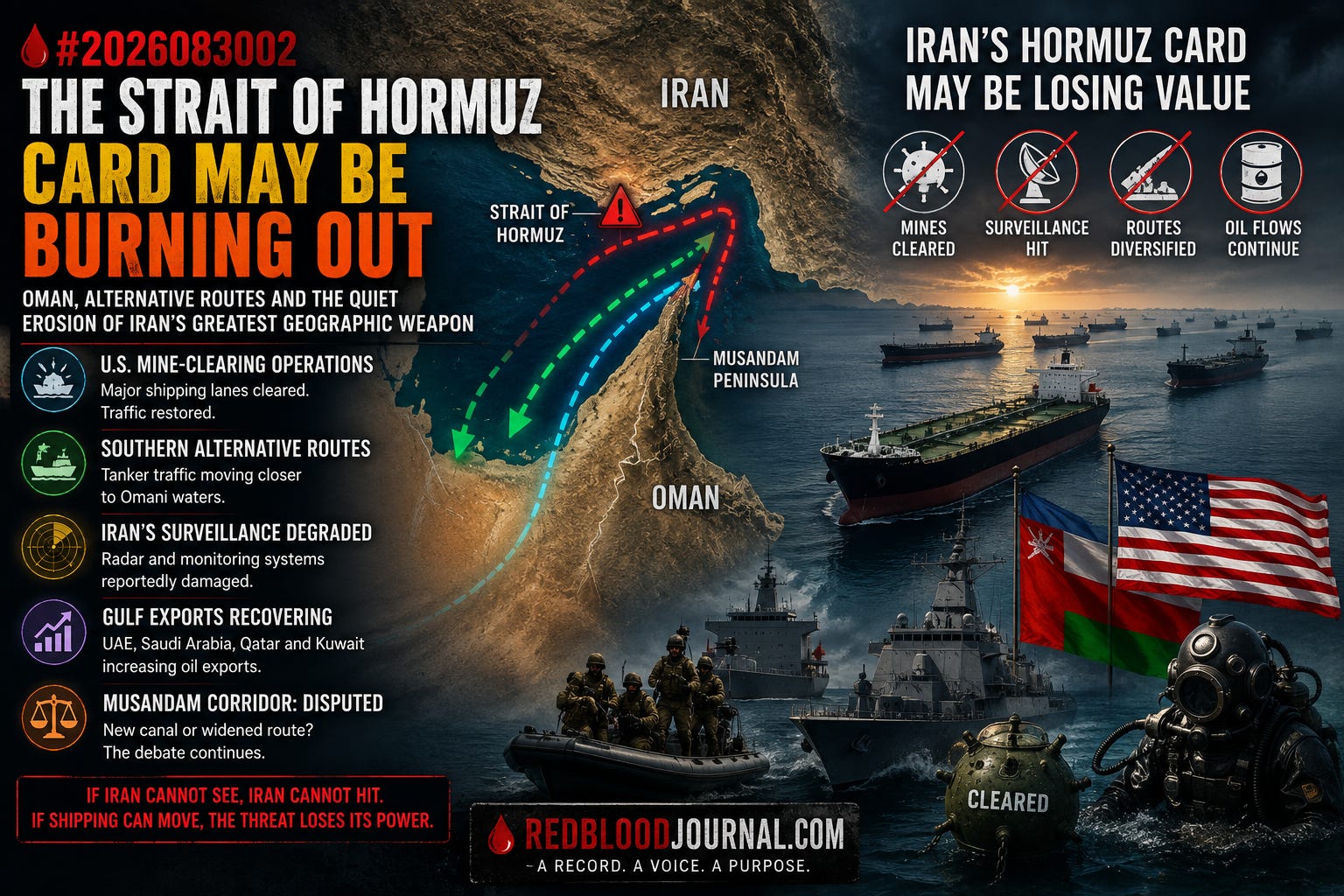
🩸 🌊 🛢️ 🇴🇲 ⚓ #2026083002 — The Strait of Hormuz Card May Be Burning Out: Oman, Alternative Routes and the Quiet Erosion of Iran’s Greatest Geographic Weapon
🩸 RedBloodJournal.com — A Record. A Voice. A Purpose.
For decades, the Strait of Hormuz has been presented as one of Iran’s most powerful strategic cards.
The logic seemed almost unbreakable.
A huge share of the world’s oil passes through a narrow maritime corridor beside Iran. If Tehran were ever pushed too far, it could threaten that passage, disrupt energy markets, send oil prices soaring and force the outside world to reconsider the cost of confronting it.
That was the theory.
But the latest story emerging from the Strait raises a much larger question:
What happens when you finally play your strongest card—and discover that everyone else has spent years designing ways around it?
The transcript examined for this report argues that this may now be happening.
It describes mine-clearing operations, alternative southern shipping routes, damaged Iranian surveillance capabilities, recovering Gulf oil exports and a highly disputed claim that Oman and the United States have widened or developed a navigable corridor through or around the Musandam Peninsula.
Not every part of that story is equally established.
But taken together, they point toward something potentially historic:
Iran’s ability to use Hormuz as a geopolitical veto may be weakening.
The Card Everyone Knew Iran Had
The Strait of Hormuz was never a secret weapon.
Everyone knew where it was.
Everyone knew why it mattered.
Everyone knew Iran might someday threaten to close it.
That is precisely why the surrounding states and the United States had every incentive to prepare for that possibility long before the threat became real.
The transcript describes regime supporters who believed closing or threatening the Strait could force the world into dependence on Tehran and drive oil prices dramatically higher. Instead, the report portrays growing anger among those same circles as shipping continues and oil exports from neighboring Gulf states recover.
The deeper strategic problem is simple:
A weapon becomes less valuable when your opponent has decades to study it.
Hormuz may have been Iran’s strongest geographic advantage.
It was also its most obvious one.
The Mine-Clearing Operation
One of the more concrete claims in the transcript concerns U.S. mine-clearing operations.
The source says CENTCOM announced that U.S. naval divers, special forces and supporting aviation assets had completed operations clearing Iranian mines from important shipping routes.
According to the transcript, the result was the reopening of major maritime lanes and the restoration of oil traffic.
If accurate as described, this matters enormously.
Closing a maritime chokepoint is one thing.
Keeping it closed against the combined naval, technological and logistical capacity of the United States and multiple Gulf states is something entirely different.
A mine can obstruct a route.
But a minefield that can be mapped, cleared and bypassed becomes a temporary obstacle rather than permanent leverage.
The Southern Highway
The most important part of the story may not be the sensational claim about a secret canal.
It may be the less dramatic development underneath it.
The transcript cites Iranian political geographer Yadollah Karimipour as saying that shipping routes farther south, closer to Omani waters, have already been used as alternatives to the normal traffic pattern.
The source describes these routes as part of a broader effort to make shipping less vulnerable to areas Iran can easily threaten. It also says very large tankers have already traveled through some of these southern routes.
That distinction is critical.
Whether someone literally carved an entirely new canal through Musandam may remain disputed.
But efforts to reroute maritime traffic farther toward Oman are a different question.
And according to the material in the transcript, those efforts have been underway for months.
This is where the real strategic shift may lie.
The objective does not necessarily have to be:
Make Hormuz irrelevant.
It only has to be:
Make Iran less capable of controlling what passes through it.
The Musandam Mystery
Then comes the extraordinary claim.
The transcript discusses reports and social-media analysis alleging that the United States and Oman widened, dredged or otherwise developed a maritime corridor in or near Oman’s Musandam Peninsula.
Some versions cited in the transcript claim a route roughly 488 to 490 meters wide and around 28 to 30 meters deep.
Supporters of the claim argue that rock was removed, dredging occurred and a passage was prepared that would allow significant tanker traffic to operate farther from Iranian reach.
But the transcript itself also acknowledges substantial disagreement.
Some commentators say the supposed “secret American corridor” is not new at all and that a navigable route existed there previously.
Others argue that geography makes the dramatic canal story implausible.
The opposing side responds that the existing passage may simply have been expanded or improved.
That dispute should not be erased.
The existence, scale and engineering history of the alleged new Musandam corridor are not established by the transcript alone.
But there is a larger point that does not depend entirely on proving the most dramatic version.
Something does not have to be a secret canal to change the strategic equation.
Improved routes, dredging, traffic separation, mine clearing and the deliberate movement of tankers toward Omani waters can collectively reduce Iran’s ability to hold maritime traffic hostage.
Oman: Mediator in Front, Strategist Behind?
The transcript presents an even more provocative interpretation.
While Oman was publicly involved in diplomacy and negotiations surrounding the Strait, some commentators cited in the source believe Muscat was simultaneously working with Washington to develop alternatives to Iranian-controlled shipping routes.
In that interpretation, diplomacy and engineering were taking place at the same time.
Iran was negotiating over the value of the Strait while others were quietly working to reduce that value.
Whether this constituted a deliberate deception operation is not established by the source.
But strategically, the possibility is fascinating.
A negotiator does not need to deceive you if your assumptions deceive you first.
If Tehran assumed geography guaranteed permanent leverage, then every kilometer of alternative routing, every cleared mine and every upgraded maritime corridor was quietly changing the negotiation before anyone sat at the table.
Iran May No Longer See What It Once Controlled
Perhaps the most damaging claim in the transcript concerns Iranian surveillance.
Iranian state-media discussions quoted in the source raise the possibility that previous attacks badly degraded Iran’s radar, observation and targeting abilities around Hormuz.
One speaker summarizes the problem brutally:
Iran may no longer be able to see enough of the maritime picture to reliably strike what is passing through.
The transcript reduces the dilemma to a devastating sentence:
If Iran cannot see, Iran cannot hit.
That would change everything.
Control of a chokepoint is not created by geography alone.
It requires sensors.
Radar.
Reconnaissance.
Target identification.
Communications.
Command systems.
Weapons.
And enough survivability to continue operating after the enemy begins destroying those systems.
Without the eyes, the fist becomes dramatically less useful.
The Oil Price Is Asking Its Own Question
There is another indicator running quietly through the transcript:
The oil price.
If Hormuz had truly been rendered unusable for a sustained period, one would expect extraordinary pressure on global energy markets.
Yet the source repeatedly points to oil remaining below the extreme levels regime supporters had predicted.
Commentators quoted in the transcript ask a simple question:
If the Strait is really closed, why is oil not exploding upward?
Price alone does not prove the condition of the Strait.
Global oil pricing depends on many factors.
But it can reveal something important about market expectations.
Markets appear to care less about declarations than about whether tankers actually keep moving.
And according to the picture painted by this transcript, many of them are.
Everyone Is Exporting—Except Iran
The source describes another painful irony.
Saudi Arabia and the UAE were already positioned to move significant quantities of oil through alternative infrastructure.
The transcript then cites reports suggesting Qatar and Kuwait were also increasing exports while maritime traffic was recovering toward a substantial portion of prewar levels.
Meanwhile, Iran itself remained heavily constrained.
Think about the reversal.
The Strait was supposed to be Iran’s hostage.
Instead, Iran risks becoming the hostage of the disruption.
The surrounding countries diversify.
Shipping adapts.
Navies clear routes.
New corridors are tested.
Exporters gradually reconnect themselves to global markets.
And Iran—the country that supposedly possessed the ultimate Hormuz card—finds its own exports trapped.
That is not strategic leverage.
That is strategic inversion.
Who Ordered the Attacks?
This is why the transcript spends so much time on a question emerging from within regime-supporting circles:
Who ordered the attacks on the ships?
The anger is understandable.
If the purpose of controlling Hormuz was to extract concessions, then using the threat too quickly may have destroyed the very value that made it useful.
The transcript describes supporters asking whether attacks on three vessels triggered the sequence that ultimately accelerated mine clearing, alternative routing and greater Western involvement.
It is the ancient danger of leverage.
A threat can be more valuable before it is used.
Once used, the opponent adapts.
And once the opponent adapts, the weapon may never regain its former psychological power.
The Geography Has Not Changed. The Meaning of the Geography May Have.
Iran still sits beside the Strait of Hormuz.
No engineering project can move Iran away from it.
No alternative corridor makes the Persian Gulf disappear.
No mine-clearing operation permanently eliminates the danger of renewed disruption.
Iran retains geographic proximity, missiles, naval assets and the ability to impose serious costs.
But geopolitics is not simply about where mountains and water are located.
It is about what people can do with them.
A mountain that once blocked an army becomes less important after a tunnel is built.
A river that once protected a city becomes less important after bridges proliferate.
A chokepoint that once gave one country enormous leverage becomes less powerful when shipping can be rerouted, mines cleared, surveillance destroyed and alternative infrastructure developed.
The map may remain the same while the strategic meaning of the map changes completely.
🩸 The Red Blood Perspective
The most important story is not whether someone secretly dug one spectacular canal through Musandam.
That claim deserves verification.
The larger story is more consequential.
For decades, the Islamic Republic spoke about Hormuz as though geography itself guaranteed permanent power.
But permanent power rarely exists.
The moment a government announces repeatedly that one chokepoint is its ultimate weapon, every threatened country begins spending money, technology and imagination finding ways to weaken that weapon.
The threat itself creates the solution.
Iran may now be discovering that possessing a strategic card and preserving the value of that card are two different things.
If the transcript’s broader picture is correct, the Islamic Republic did not lose Hormuz because Oman moved.
It did not lose it because the mountains disappeared.
It may be losing it because everyone else adapted.
The great irony is that repeatedly threatening to close the Strait may have accelerated the international effort to make closing it less consequential.
The strongest weapon was shown so many times that everyone learned how it worked.
And once everyone understands the trick, the magician has a problem.
🌊 The Ocean of Love and Positivity Perspective
There is also a lesson here far beyond governments and shipping lanes.
Human beings often believe their greatest strength is something outside themselves.
A position.
A title.
Money.
A relationship.
A reputation.
A strategic advantage.
Something we believe others cannot take away.
Then life changes.
The road moves.
The market adapts.
The people around us learn.
The advantage that once seemed permanent becomes ordinary.
And suddenly we are forced to ask:
Who am I without the card I thought made me powerful?
That question can feel like defeat.
But it can also become freedom.
Because perhaps real strength was never the ability to block the Strait.
Perhaps it was never the ability to frighten someone into needing us.
Perhaps real power begins when we no longer need someone else to be trapped in order for us to feel secure.
The strongest position is not the chokepoint everyone must pass through.
It is becoming the person who does not need a chokepoint at all.
When the outside leverage disappears, the inside becomes visible.
And sometimes losing the card is exactly what forces us to finally discover the player.
In an Ocean of Love and Positivity.
🩸🌊✨ Fantastic!
⚓
Neutralizing the Strait: The Erosion of Iran’s Geographic Leverage
Aug 30, 2026
This analysis examines how Iran’s longstanding strategic control over the Strait of Hormuz is being systematically undermined by international countermeasures and geographic adaptations. The text details how U.S.-led mine-clearing operations, the degradation of Iranian surveillance capabilities, and the development of alternative shipping routes near Oman have diminished Tehran’s maritime leverage. There is a specific focus on the disputed claim that a new navigable corridor has been established through the Musandam Peninsula to bypass Iranian reach. These developments suggest that global oil markets and neighboring Gulf states are successfully diversifying their logistics, leaving Iran’s “geographic weapon” increasingly obsolete. Ultimately, the source argues that by repeatedly threatening to close the waterway, Iran inadvertently incentivized the world to engineer permanent strategic workarounds.
#RedBloodJournal #Iran #StraitOfHormuz #Hormuz #Oman #Musandam #PersianGulf #Oil #OilExports #Geopolitics #MiddleEast #USNavy #CENTCOM #MaritimeSecurity #IranEconomy #EnergySecurity #Shipping #Sanctions #IRGC #RedBlood
#Iran
#StraitOfHormuz
#Geopolitics
#MiddleEast
#Oil


