


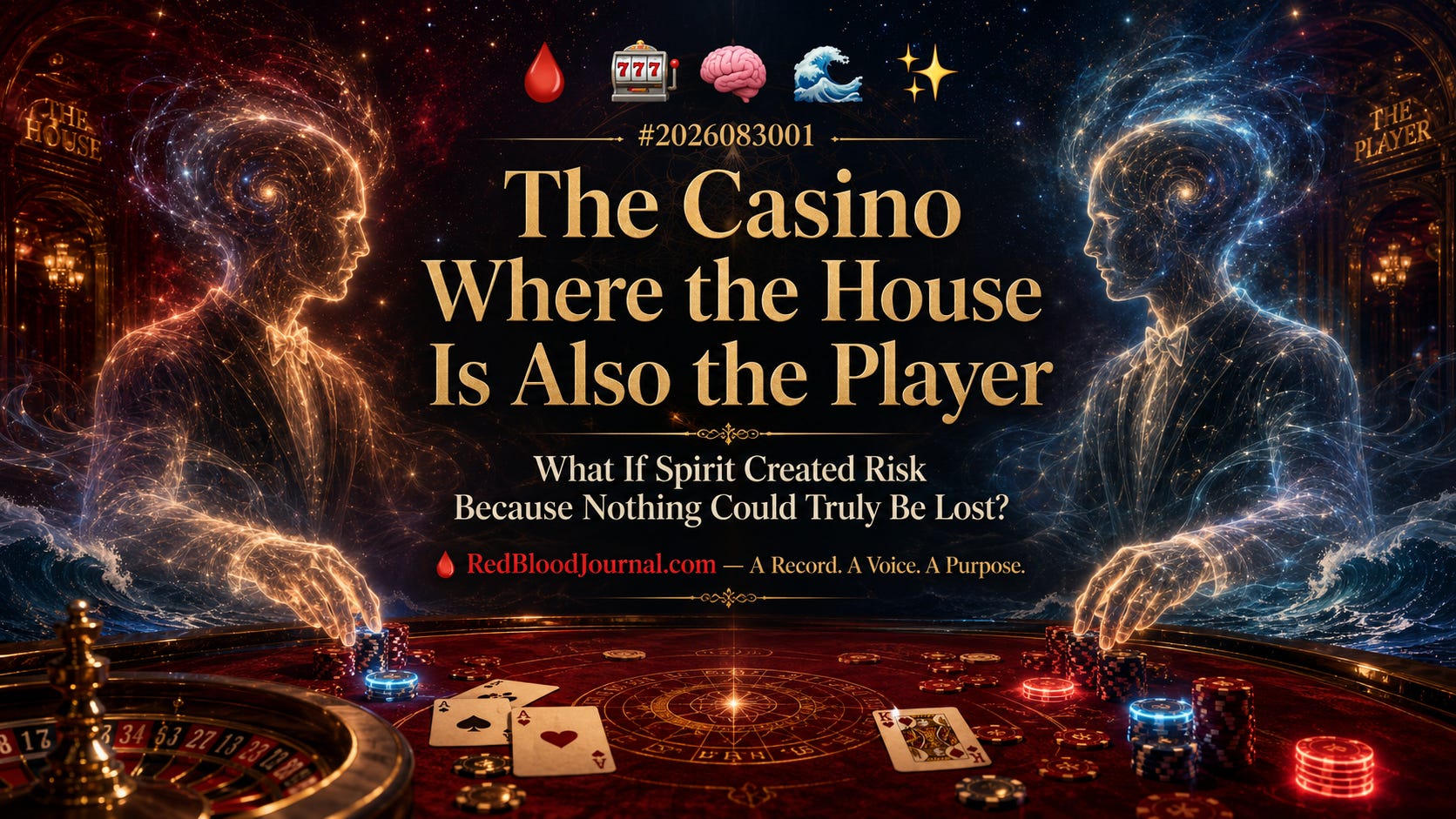
🩸 🎰 🧠 🌊 ✨ #2026083001 — The Casino Where the House Is Also the Player: What If Spirit Created Risk Because Nothing Could Truly Be Lost?
🩸 RedBloodJournal.com — A Record. A Voice. A Purpose.
Imagine entering a casino where every table belongs to you.
The chips are yours.
The building is yours.
The dealer works for you.
The money in the vault is yours.
Even the player sitting nervously at the table is you.
At first, such a casino would seem pointless.
How could there be excitement if nothing could truly be lost?
How could winning matter if the winnings were already yours?
How could risk feel real if the house and the gambler were ultimately the same being?
Perhaps that is exactly the problem Spirit had to solve.
The Problem With Having Everything
Suppose consciousness existed without limitation.
No hunger.
No death.
No uncertainty.
No separation.
No fear.
No unanswered questions.
No possibility of permanent loss.
At first glance, that sounds like perfection.
But perfection has an unusual problem.
Nothing surprises it.
Nothing threatens it.
Nothing needs to be discovered.
If everything is already known, discovery disappears.
If everything is already possessed, achievement disappears.
If nothing can be lost, courage disappears.
If there is no separation, reunion disappears.
If there is no uncertainty, hope disappears.
If there is no darkness, even light becomes impossible to recognize.
Perhaps Spirit did not create the human experience because something was missing from existence.
Perhaps Spirit created it because experience itself requires limitation.
The Chips Had to Feel Real
A gambler cannot experience risk while constantly remembering that the casino belongs to him.
The game only becomes exciting when the chips begin to feel important.
So imagine Spirit entering matter and temporarily accepting limitations.
A body.
A name.
A family.
A country.
A language.
A history.
A limited memory.
A limited lifespan.
Suddenly the chips matter.
Health matters.
Money matters.
Love matters.
Reputation matters.
Loss matters.
The game becomes convincing.
That does not mean those experiences are meaningless.
Quite the opposite.
Their temporary nature may be exactly what gives them intensity.
A sunset matters partly because it ends.
A childhood matters because it cannot be repeated exactly.
A person matters because the time available with that person appears limited.
Mortality may be one of the mechanisms that makes existence precious.
The House Has to Forget It Is the House
There is one requirement for this strange casino to work.
The player cannot constantly remember that he owns it.
If every frightened person immediately remembered,
None of this can ultimately threaten what I really am,
then much of the drama would disappear.
So perhaps forgetting is not a defect.
Perhaps it is part of the design.
The player enters deeply enough into the role that the role temporarily becomes reality.
The billionaire plays the beggar.
The immortal plays the mortal.
The whole plays the separate individual.
The one consciousness experiences itself as billions of competing perspectives.
For a while, the house genuinely believes it is only another gambler sitting beneath the lights.
And then the game begins.
Why Would Spirit Choose Pain?
This is where the metaphor becomes difficult.
Excitement is easy to understand.
Curiosity is easy to understand.
Adventure is easy to understand.
But suffering?
Why would consciousness voluntarily enter a reality containing grief, disease, betrayal, fear, violence, loneliness and death?
One possibility is that experience cannot be divided neatly.
A world capable of profound love must also permit profound loss.
A world containing genuine choice must permit destructive choices.
A world where courage exists must contain something frightening enough to require courage.
Compassion requires vulnerability.
Forgiveness requires injury.
Patience requires frustration.
Sacrifice requires something valuable enough to surrender.
The casino cannot offer only winning hands.
A game where every card is an ace soon stops being a game.
The Strange Value of Not Knowing
Think about watching a movie whose ending you already know.
It can still be enjoyable.
But the uncertainty is gone.
Now imagine forgetting the ending completely.
Suddenly every scene matters again.
Perhaps human life works similarly.
We ask:
Will I succeed?
Will I recover?
Will this person love me?
Will I survive?
What happens after death?
Why am I here?
What am I?
The questions themselves create the experience.
Maybe Spirit already possesses the answers at a deeper level.
But the human participant does not.
And that difference between knowing and not knowing creates the adventure.
Winning May Not Mean What We Think
If this metaphor has any truth to it, perhaps the objective is not accumulating the most chips.
The richest gambler still leaves the table.
The poorest gambler leaves too.
Titles remain behind.
Possessions remain behind.
Bodies remain behind.
Even reputations eventually fade.
Maybe the important question is not:
How much did I win?
Maybe it is:
What did I become while I believed the chips were real?
Did fear control the player?
Did greed?
Did anger?
Did the player learn compassion?
Did separation eventually reveal connection?
Did the player recognize something familiar behind the eyes of another person?
Did the gambler ever realize that the opponent across the table might be another expression of the same house?
That changes the entire game.
The House Fighting Itself
One of the strangest possibilities follows naturally.
If Spirit is within everyone, then much human conflict becomes consciousness fighting different versions of itself.
Nation against nation.
Religion against religion.
Race against race.
Neighbor against neighbor.
Brother against brother.
Each player protects his pile of chips while forgetting that every chip came from the same vault.
Perhaps this is the deepest joke in the casino.
The house divides itself into players.
The players fight over the house’s property.
Then they eventually return everything to the house.
Nothing ever actually left.
Death as Leaving the Table
The human perspective naturally treats death as the ultimate loss.
From inside the game, that makes sense.
The body disappears.
Relationships change.
Possessions are surrendered.
The familiar identity ends.
But imagine again that the gambler is secretly the owner.
Leaving the table would look catastrophic to the character being played.
It might look completely different to the consciousness playing the character.
Perhaps death is not the casino burning down.
Perhaps it is simply standing up from one table.
The game ends.
The chips remain behind.
And the player remembers something that could not be fully remembered while the game was underway.
I was never only the gambler.
And Then Perhaps We Play Again
Why would anyone return?
For the same reason people ride the roller coaster again.
For the same reason someone begins another book.
For the same reason an athlete seeks a harder opponent after mastering the easier one.
For the same reason people play another hand even after saying they are finished.
Experience is compelling precisely because it contains uncertainty.
Perhaps consciousness continually seeks new perspectives through which to encounter itself.
Another century.
Another body.
Another family.
Another culture.
Another combination of strengths and weaknesses.
Another table.
Another hand.
Another opportunity to forget.
Another opportunity to remember.
The Red Blood Perspective
The casino metaphor turns the traditional spiritual question upside down.
Instead of asking why an outside God placed humanity inside a dangerous world, ask whether the consciousness experiencing the danger participated in creating the conditions for the experience.
The possibility is startling:
The house and the player may not be separate.
Spirit may not be somewhere above us watching the table.
Spirit may be the awareness looking through our eyes right now.
The risk feels real because the game must feel real.
The losses hurt because the chips must matter while we hold them.
The uncertainty exists because without uncertainty there can be no discovery.
And perhaps beneath every apparent loss is something that cannot actually be taken away.
The player can lose the hand.
The character can lose everything.
But the house remains.
🌊 The Ocean of Love and Positivity Perspective
There is a peaceful possibility hidden inside this metaphor.
If the deepest part of us cannot ultimately be diminished by the changing fortunes of the table, then life does not have to be approached entirely through fear.
That does not make pain imaginary.
It does not make love disposable.
It makes each experience more precious because it can be entered fully without needing to possess it forever.
Perhaps the invitation is not to escape the casino.
Perhaps it is to play consciously.
Love deeply.
Lose gracefully.
Win without becoming owned by the winnings.
Recognize the frightened player across the table.
Remember that everyone is holding temporary chips.
And occasionally, beneath all the noise of the spinning wheels and falling cards, recognize something astonishing:
The house was never against us.
The house was us.
We created the possibility of losing so that courage could exist.
We created distance so reunion could mean something.
We created uncertainty so discovery could still surprise us.
And perhaps we entered the game for the simplest reason imaginable.
Eternity had become predictable.
So we dealt ourselves a hand we could not see.
In an Ocean of Love and Positivity.
🩸🌊✨ Fantastic!
🎰
The House Playing Itself
Aug 30, 2026
The provided text explores the philosophical concept that human existence is a simulated game designed by universal consciousness to escape the predictability of perfection. By using the metaphor of a casino, the author suggests that Spirit intentionally accepts limitations like mortality and suffering to make life’s risks and rewards feel authentic. This perspective posits that forgetting our divine nature is a necessary component of the experience, allowing for genuine courage, discovery, and connection. Ultimately, the source argues that individual identity is an illusion, as the player and the house are one and the same. Life is presented not as a struggle to be won, but as a temporary adventure where loss is impossible because everything already belongs to the creator.
#RedBloodJournal #Spirit #Consciousness #Spirituality #Philosophy #OceanOfLove #HumanExperience #MeaningOfLife #LifeAfterDeath #InnerSelf #SelfDiscovery #Awareness #Soul #Existence #Reality #Risk #FreeWill #Mortality #Love #PersonalSovereignty


