


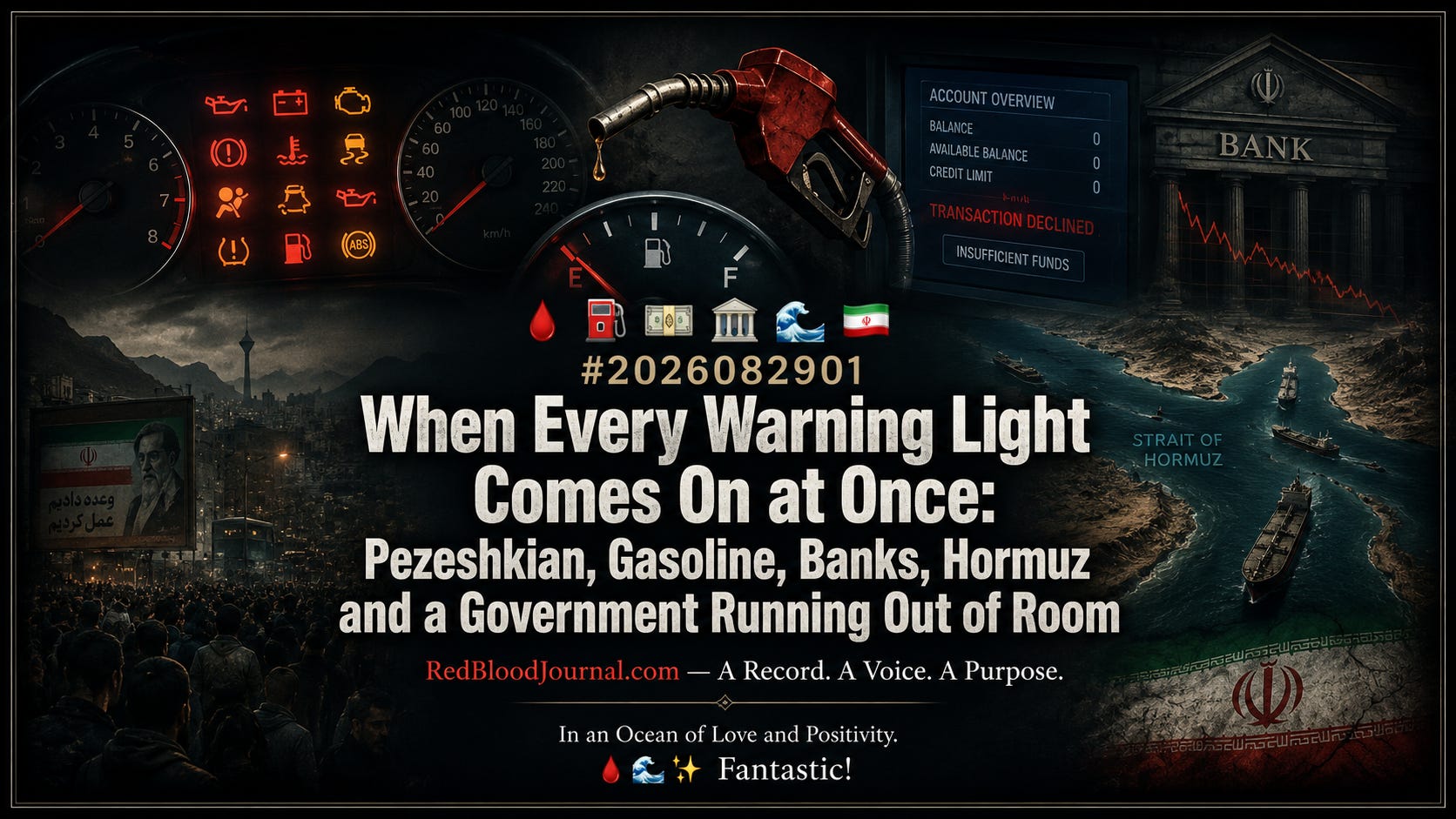
🩸 ⛽ 💵 🏦 🌊 🇮🇷 #2026082901 — When Every Warning Light Comes On at Once: Pezeshkian, Gasoline, Banks, Hormuz and a Government Running Out of Room
🩸 RedBloodJournal.com — A Record. A Voice. A Purpose.
There are moments when a government faces one crisis.
There are other moments when seemingly unrelated problems begin appearing everywhere at once.
A shortage here.
A banking failure there.
A frustrated police officer somewhere else.
A president admitting that revenue has fallen.
A government discussing closing offices.
Gasoline lines.
Electricity problems.
Foreign banks being warned to stop processing Iranian transactions.
And the weapon that was supposed to frighten the world—the Strait of Hormuz—appearing less decisive than advertised.
The importance of Masoud Pezeshkian’s televised remarks is therefore not any single sentence.
It is the picture created when all the sentences are placed beside one another.
And that picture is of a government whose room for maneuver appears to be rapidly narrowing.
Pezeshkian Said the Quiet Part Out Loud
The most important part of Pezeshkian’s appearance may have been its simplicity.
Government revenue has fallen.
Problems have increased.
Iran does not have unlimited gasoline.
It does not have unlimited gas.
It does not have unlimited electricity.
Some government departments may have to be reduced or closed.
Consumption has to be cut.
And Iran is being forced to think about how to manage gasoline because domestic production alone is not enough.
The transcript quotes Pezeshkian explaining that Iran must purchase gasoline in addition to what it produces—and that even when import routes are open, the government must possess the money to buy it.
This is very different from the language of a government claiming that sanctions have failed.
Pezeshkian goes even further.
He openly rejects the idea that sanctions have no effect, pointing to falling imports and exports and ridiculing the suggestion that economic isolation somehow produces no consequences.
That admission matters.
Because once the president acknowledges that the pressure is real, the political argument changes.
The question is no longer:
Are sanctions hurting the system?
The question becomes:
How much pressure can the system absorb?
The Government Is Beginning to Consume Itself
Pezeshkian discusses reducing government operations while continuing to pay employees.
On paper, that sounds like efficiency.
But the surrounding evidence in the transcript makes the situation more serious.
A police officer is shown complaining that after years of service his take-home income has fallen to a level at which even feeding his family becomes difficult.
That is an important warning.
Authoritarian governments can survive widespread public dissatisfaction for surprisingly long periods when the institutions responsible for enforcing order remain financially protected.
Police.
Military personnel.
Security services.
Government employees.
They form part of the machinery that keeps the state functioning.
When the people operating that machinery begin experiencing the same economic desperation as everyone else, the distinction between the state and the society suffering beneath it begins to narrow.
The transcript even notes the strange language of these complaints: officers emphasize that they are not against the system while simultaneously describing conditions that have become intolerable.
That may be one of the most revealing contradictions in the entire report.
People still declaring loyalty while explaining why loyalty is becoming harder to afford.
Then Comes the Gasoline
Gasoline is not merely another commodity.
It is movement.
Food distribution.
Work.
Transportation.
Police operations.
Government vehicles.
Commerce.
Daily life.
And in Iran, gasoline has also become deeply political.
The transcript describes increasingly severe shortages, long lines, reduced monthly allocations and reports of stations running completely dry. It cites estimates of approximately 120 million liters of daily gasoline production against consumption exceeding 135 million liters, leaving an estimated deficit of roughly 15 million liters every day.
Whether every numerical estimate in the source ultimately proves exact is less important than the underlying structural problem the discussion identifies:
Iran consumes more gasoline than the domestic system can comfortably supply under present conditions.
Previously, imports could help fill the gap.
But the transcript argues that wartime disruption, maritime pressure and difficulties obtaining outside fuel are making that increasingly difficult.
That turns gasoline from an economic problem into a political countdown.
A government can ask people to tolerate ideological confrontation.
It can ask them to tolerate sanctions.
It can ask them to tolerate inflation.
But eventually ideology must meet the gas pump.
And the gas pump does not respond to speeches.
The Soviet Comparison Is Becoming Harder to Ignore
One of the most striking comparisons in the transcript is with the final period of the Soviet Union.
The analogy is not that Iran and the Soviet Union are identical.
They are not.
The analogy is much simpler.
A state may possess missiles.
It may possess military forces.
It may possess intelligence agencies.
It may possess nuclear knowledge.
It may produce enormous propaganda about its strategic power.
And yet ordinary people may still discover that the country cannot reliably provide gasoline.
That contrast is devastating because it exposes the difference between state power and state competence.
A government capable of threatening enemies thousands of kilometers away but unable to guarantee ordinary domestic necessities eventually confronts a basic question from its own citizens:
What exactly was all that power for?
The transcript explicitly describes the emerging crisis in terms reminiscent of late Soviet collapse: military capability remains while essential civilian systems deteriorate.
The Financial War Is Moving Outside Iran
The second major development is potentially even more consequential.
The pressure campaign described in the transcript is no longer limited to sanctioning Iranian institutions.
The United States is increasingly targeting the foreign organizations that allegedly help Iran move money.
The transcript describes action involving Egyptian banking operations in the UAE and cites approximately $1.8 billion in transactions involving 103 companies suspected of participating in Iran’s shadow-banking system, including entities allegedly connected with the Defense Ministry and Islamic Revolutionary Guard Corps.
The strategic message is straightforward:
A foreign bank may have to choose.
Do business with the Islamic Republic.
Or maintain access to the American dollar and the international financial system.
The transcript explicitly extends that warning beyond one Egyptian bank to institutions in the UAE, Iraq, Turkey, Qatar, Oman, China and elsewhere.
That changes the nature of sanctions.
Traditional sanctions attempt to prohibit transactions.
Secondary pressure attempts to make Iran financially radioactive.
The objective is not merely to tell Tehran:
You cannot use this bank.
It is to make banks around the world conclude independently:
Iran is no longer worth the risk.
If that happens broadly enough, financial isolation begins enforcing itself.
The Real Weapon Is Fear
This may be the most powerful element of the strategy.
Washington does not have to discover and sanction every transaction individually.
It only has to demonstrate convincingly that it can find enough of them.
One bank is punished.
Another bank watches.
A third bank closes suspicious accounts before receiving any warning.
A fourth refuses an Iranian-linked customer.
A fifth demands additional documentation.
A sixth decides the profit is not worth the possibility of losing dollar access.
Soon, the fear of sanctions begins doing work that sanctions themselves could never accomplish alone.
The transcript argues that this could make foreign revenue collection, currency conversion, import payments and financing for the IRGC and Defense Ministry increasingly expensive and difficult.
That is why this financial front may eventually matter more than another missile strike.
Buildings can be repaired.
Financial trust is much harder to rebuild.
And Then There Is Hormuz
For decades, the Strait of Hormuz has occupied a nearly mythical position in Iranian strategic thinking.
The message was understood everywhere:
Push Iran too far and Iran can choke one of the world’s most important energy corridors.
But the transcript describes a very different picture emerging from the current confrontation.
It cites an Axios report saying that more than 200 mine-like objects had been encountered, but that only eleven were actual mines and relatively few had been properly deployed.
The report also says tanker traffic has begun recovering, reaching approximately 20–30 tankers per night carrying roughly 9–10 million barrels, with the United States seeking to restore an even larger portion of prewar traffic.
If those developments continue, something strategically important happens.
Hormuz does not become irrelevant.
But its value as an ultimate threat declines.
And Iran may discover that the weapon it spent decades convincing the world to fear cannot produce the political result expected from it.
That would represent more than a military setback.
It would be a psychological one.
The Crisis Is Now Appearing Inside the Banking System
The transcript also contains another warning sign that deserves attention.
Ordinary Iranians describe banks closing, applications malfunctioning and customers struggling to obtain access to their own money.
The cause remains uncertain in the source.
Cyberattack?
Infrastructure failure?
Liquidity problems?
Something else?
The transcript itself does not establish the answer.
But that uncertainty is part of the danger.
A gasoline shortage creates anger.
A banking interruption creates fear.
Because when people begin wondering whether their money will still be accessible tomorrow, they do not wait for an official economic report.
They react.
They withdraw.
They convert.
They buy.
They protect themselves.
And collective fear can become its own economic event.
The transcript records customers describing repeated banking disruptions and difficulty accessing funds needed for ordinary obligations such as rent.
Even the Argument Inside the System Is Changing
Perhaps equally significant is the political language appearing inside government-aligned media.
A young supporter of the system is shown openly attacking officials over inflation, corruption, social conditions and enormous expenditures associated with the IRGC.
Elsewhere, Pezeshkian and Mohsen Rezaei are described as signaling interest in reaching some form of accommodation with the United States.
Then comes the uncomfortable argument:
If Iran does not want another war, can it avoid reaching an agreement?
And if Washington dictates the conditions of that agreement, when does negotiation begin to resemble surrender?
That is the political trap.
Continue confrontation and economic pressure intensifies.
Compromise and the ideological mythology of resistance begins collapsing.
Escalate militarily and risk greater destruction.
Do nothing and shortages continue spreading.
Every door appears increasingly expensive.
This Is Why Pezeshkian’s Interview Matters
His interview should not be read merely as another Iranian president discussing another difficult budget.
It should be placed beside everything else.
Revenue falling.
Imports constrained.
Gasoline scarce.
Government offices potentially reduced.
Employees struggling.
Police officers complaining.
Banks malfunctioning.
Foreign intermediaries being sanctioned.
Iranian financial networks being hunted abroad.
Hormuz functioning again despite Tehran’s attempts to disrupt it.
Inflation rising.
Regime supporters criticizing the regime on its own television.
And senior officials again talking about agreement with Washington.
None of these individually proves imminent collapse.
Together, however, they describe something much more significant:
the simultaneous contraction of the government’s available choices.
That is the real danger for any political system.
Collapse does not necessarily begin when the population becomes angry.
Populations can remain angry for decades.
Collapse becomes possible when the government repeatedly asks:
What can we do?
And every available answer requires sacrificing something else it cannot afford to lose.
🩸 The Red Blood Perspective
The question is no longer whether the Islamic Republic has problems.
The government itself is describing them.
The deeper question is whether these crises are still separate problems—or whether they have begun connecting into one larger systemic crisis.
Gasoline affects transportation.
Transportation affects commerce.
Commerce affects prices.
Prices affect salaries.
Salaries affect security personnel.
Foreign sanctions affect imports.
Import shortages affect gasoline.
Currency shortages affect government budgets.
Banking fear affects capital flight.
Military setbacks affect political confidence.
Political weakness encourages internal criticism.
Each problem begins feeding another.
That is how warning lights become something more dangerous than warning lights.
Eventually they may indicate that the engine itself is failing.
And perhaps that is what made Pezeshkian’s television appearance so remarkable.
He did not announce the collapse of the Islamic Republic.
He did something potentially more important.
He described many of the ingredients from which one could occur.
🌊 The Ocean of Love and Positivity Perspective
But the end of one system does not automatically create a better one.
That lesson belongs not only to governments.
It belongs to every human being.
A person can spend a lifetime blaming the driver who came before and still drive into the same wall.
A society can overthrow rulers while carrying the ruler’s anger, revenge, fear and hunger for control inside itself.
Then only the faces change.
The deeper revolution begins before political victory.
It begins when individuals ask:
What kind of Iran would we create if nobody were forcing us to behave?
Would disagreement still be allowed?
Would minorities still belong?
Would opponents still possess dignity?
Would power still be limited when our own side controlled it?
Would revenge be rejected when revenge suddenly became possible?
That is where freedom becomes real.
Not merely when the old jailer disappears.
But when the prisoner refuses to become the next jailer.
Iran’s present suffering can therefore carry one extraordinary possibility:
A generation has been given an intimate education in what centralized power, ideological certainty, corruption, fear and political exclusion can ultimately produce.
If that lesson is truly understood—not merely remembered—then something much better can grow from it.
A country where government serves citizens rather than citizens serving government.
A country strong enough to tolerate disagreement.
A country confident enough that it does not need enemies to explain every failure.
And individuals who understand that sovereignty begins inside themselves long before it appears inside a constitution.
The greatest victory would not simply be the end of an old system.
It would be refusing to rebuild it under another name.
In an Ocean of Love and Positivity.
🩸🌊✨ Fantastic!
⚠️
The Shrinking Room for Maneuver
Aug 29, 2026
The provided text analyzes a multifaceted systemic crisis currently facing the Iranian government, as highlighted by President Masoud Pezeshkian’s recent public admissions. The administration is struggling with severe resource shortages, including critical deficits in gasoline and electricity, alongside a failing banking infrastructure and declining state revenues. This domestic instability is exacerbated by aggressive international financial sanctions that isolate Iran’s shadow-banking networks and diminish its strategic leverage over the Strait of Hormuz. Consequently, the state’s narrowing room for maneuver creates a dangerous feedback loop where economic desperation begins to alienate even the security forces responsible for maintaining order. Ultimately, the source suggests that the government is confronting a structural exhaustion reminiscent of the late Soviet Union, where military power can no longer mask the collapse of essential civilian functions.
#RedBloodJournal #Iran #Pezeshkian #IranEconomy #GasolineCrisis #FuelShortage #IranBanks #BankingCrisis #StraitOfHormuz #Hormuz #IranSanctions #EconomicWar #ScottBessent #ShadowBanking #IRGC #IranInflation #IranCrisis #RegimeCrisis #SystemicCrisis #IranProtests #EnergyCrisis #FinancialCrisis #IranCollapse #IslamicRepublic #MiddleEast #Geopolitics #EconomicPressure #IranNews #RedBloodPerspective #OceanOfLoveAndPositivity


