


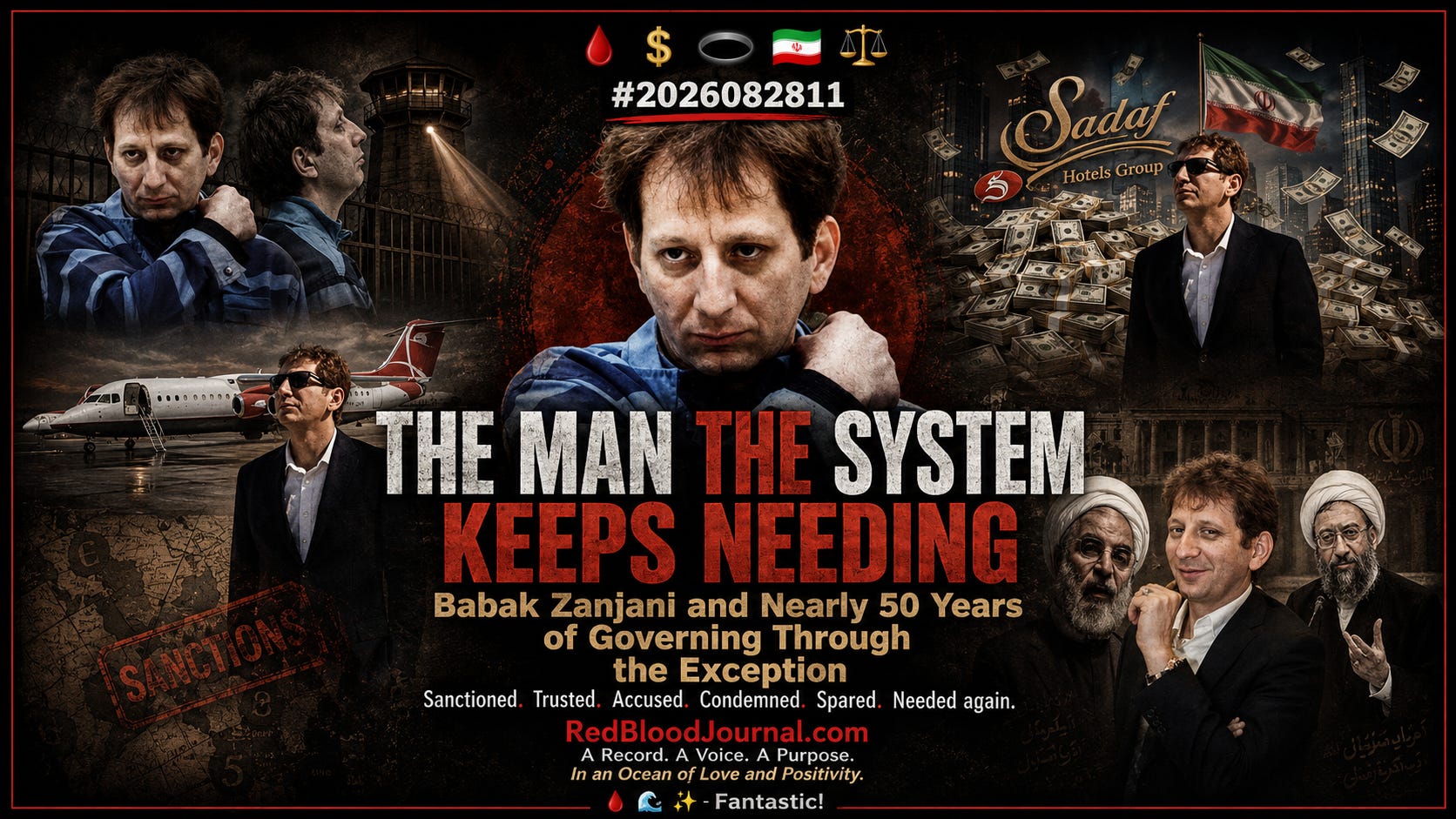
🩸 💰 🕳️ 🇮🇷 ⚖️ #2026082811 — The Man the System Keeps Needing: Babak Zanjani and Nearly 50 Years of Governing Through the Exception
Sanctioned. Trusted. Accused. Condemned to death. Spared. Rehabilitated. Needed again.
🩸 RedBloodJournal.com
A Record. A Voice. A Purpose.
Babak Zanjani is not simply the story of one businessman.
He is not simply the story of corruption.
He is not simply the story of sanctions.
He may be one of the clearest living examples of how the Islamic Republic learned to function when normal institutions could no longer perform the jobs the state required.
That is why his biography matters.
Because when the complete story is placed in sequence, something much larger appears.
A government becomes isolated.
Normal banking channels close.
Oil still has to be sold.
Money still has to move.
Foreign currency still has to return.
Official institutions become constrained.
So unofficial people become indispensable.
The state needs someone who can operate in places where the state officially cannot.
Someone who knows the banks.
The companies.
The intermediaries.
The loopholes.
The front organizations.
The offshore routes.
The people who know other people.
That is the environment that created Babak Zanjani.
And nearly fifty years into the Islamic Republic, the larger lesson is difficult to miss:
the individual changes, but the method survives.
Before He Was a Criminal, He Was Useful
By the early 2010s, Babak Zanjani had become associated with a sprawling international business network spanning oil, finance, banking, transportation and other industries.
His importance grew during a period when sanctions were making it increasingly difficult for Iran to conduct ordinary international commerce.
In April 2013, the U.S. Treasury sanctioned Zanjani and companies linked to his Sorinet Group, alleging that his network was helping the National Iranian Oil Company and related entities sell Iranian oil and move the proceeds internationally. Treasury described Sorinet companies and financial institutions as being used to finance Iranian oil sales around the world.
That allegation reveals the core of the Zanjani story.
He was valuable precisely because the ordinary financial system had become inaccessible.
He could reportedly help move money where official Iranian institutions could not.
That is not a minor detail.
That is the foundation.
Sanctions Created the Need
Imagine the structure.
Iran sells oil.
But major banks refuse the transaction.
Iran receives money.
But transferring it back becomes difficult.
Companies fear secondary sanctions.
International financial institutions refuse exposure.
Governments scrutinize transactions.
The state still needs revenue.
What happens?
A second financial architecture begins growing around the first.
Intermediaries become more important than institutions.
Private companies become more useful than ministries.
Personal trust can become more valuable than formal procedure.
Secrecy becomes an economic asset.
And the people capable of functioning inside that darkness become extremely powerful.
Zanjani did not invent that environment.
He flourished inside it.
The Shadow Economy Has Its Own Logic
Once a government becomes dependent on sanctions-evasion networks, ordinary accountability becomes difficult.
A conventional oil sale is relatively straightforward.
There is a seller.
A buyer.
A bank.
An invoice.
A payment.
An account.
An audit trail.
But a sanctions-era transaction may involve layers of companies, currencies, intermediaries, jurisdictions, banks and private arrangements designed specifically to conceal the origin or destination of the transaction.
The secrecy has an obvious purpose:
hide the transaction from those enforcing sanctions.
But the same secrecy creates another possibility:
hide the transaction from the public.
The darkness works in both directions.
The structure that prevents Washington from seeing the money can also prevent Iranian citizens from seeing the money.
And that is where sanctions evasion and corruption begin occupying the same room.
Then Billions Went Missing
Zanjani’s usefulness eventually became his danger.
Iranian authorities accused him of failing to return billions of dollars connected to oil sales.
He was arrested in 2013.
In 2016, an Iranian court convicted him in one of the country’s largest corruption cases and sentenced him to death.
The case centered on billions in oil revenue that Iranian authorities said had not been returned to the state.
The sentence was eventually upheld.
For years, Zanjani appeared to have reached the end of the familiar political journey.
Useful insider becomes accused insider.
Accused insider becomes convicted criminal.
Convicted criminal becomes expendable.
The state demonstrates that corruption will be punished.
Case closed.
Except it wasn’t.
The Condemned Man Returns
In 2024, Zanjani’s death sentence was commuted.
Then something even more remarkable happened.
He began returning to major economic activity.
By 2025, according to the U.S. Treasury and Reuters, Zanjani had re-emerged as a financial backer of important Iranian infrastructure and transportation projects. Treasury cites an approximately $800 million railway contract associated with his Dot One business network.
The man once sentenced to death for one of Iran’s biggest financial scandals was again participating in major projects connected to the Iranian economy.
That is the moment when the Zanjani story stops being merely a biography.
It becomes a political diagram.
Useful — Criminal — Useful Again
The sequence is extraordinary:
The state is isolated.
Zanjani becomes useful.
Money moves through opaque networks.
Zanjani becomes powerful.
Billions become disputed.
Zanjani becomes a criminal.
He is sentenced to death.
Zanjani becomes expendable.
The economic crisis deepens again.
Zanjani becomes useful again.
This is why he deserves an entire report.
Because very few biographies reveal the structure so clearly.
The State Did Not Eliminate the Method
It punished the man.
But the underlying need remained.
Iran still faced sanctions.
Iran still needed foreign currency.
Iran still needed unconventional payment systems.
Iran still needed infrastructure investment.
Iran still needed ways around restricted banking channels.
The problem that created the middleman never disappeared.
And when the problem survived, the middleman’s skill set regained value.
That is a crucial distinction.
If the government genuinely wanted to eliminate the conditions that produced Zanjani, it would have to eliminate dependence on opaque financial networks.
But that would require either normalization with the global financial system or the creation of transparent domestic alternatives.
Instead, the shadow system continued.
And eventually the shadow financier returned.
From Oil to Crypto
The method also evolved.
The old sanctions economy involved oil tankers, banks, shell companies and offshore financial arrangements.
The newer version increasingly includes digital assets.
On January 30, 2026, the U.S. Treasury again sanctioned Zanjani, along with the digital asset exchanges Zedcex and Zedxion.
Treasury alleged that the exchanges processed funds linked to the IRGC and described Zanjani as having returned to major regime-linked projects after his sentence was commuted.
Then on July 24, 2026, Treasury sanctioned additional individuals and companies connected to his broader network.
The action targeted businesses associated with the Dot One conglomerate across transportation, infrastructure, gold, financial services and digital assets. Treasury alleged that these structures were being used in part to move funds covertly and facilitate sanctions evasion.
The technology changed.
The principle did not.
The Sanctions Middleman Became the Crypto Middleman
This may be one of the most important details in the entire biography.
In 2013, Zanjani was accused of helping Iran navigate restrictions on conventional oil and banking transactions.
In 2026, the U.S. government was again accusing networks tied to him of helping Iran navigate financial restrictions — this time increasingly through digital assets.
Thirteen years separate the two sanctions actions.
But structurally, they tell the same story.
A closed door appears.
An intermediary finds another door.
That intermediary becomes valuable.
The government becomes dependent on the alternative route.
The route becomes increasingly opaque.
And enormous financial power concentrates in the hands of people operating between the formal system and the shadow system.
The Problem Is Bigger Than Zanjani
This is where the reader must resist the easiest conclusion.
The easy conclusion is:
Babak Zanjani is corrupt.
That may be part of the story.
But it is not the whole story.
The more important question is:
Why does the political system keep producing the need for people like Babak Zanjani?
Why does a country with ministries, banks, an oil company, a central bank, courts and regulatory agencies repeatedly require private intermediaries operating in opaque spaces?
Why are individuals able to become so powerful that the state appears unable to function without them?
Why does national economic survival repeatedly depend on transactions the public cannot fully examine?
Those questions point beyond one man.
They point toward the architecture.
Nearly 50 Years of Governing Through Exceptions
Babak Zanjani himself has obviously not been running the Islamic Republic for nearly fifty years.
But the political method that made someone like him possible stretches much further back.
The Islamic Republic has spent much of its existence operating under some form of permanent emergency.
Revolution.
War.
Sanctions.
Regional confrontation.
Nuclear pressure.
Banking restrictions.
Oil restrictions.
International isolation.
Security crises.
Every emergency provides another reason to bypass normal procedure.
The explanation is always understandable in the moment:
This situation is exceptional.
Therefore normal rules cannot apply.
But when exceptional conditions last decades, something changes.
The exception becomes the system.
Temporary Measures Become Permanent Government
During wartime, secrecy may be justified as temporary.
During sanctions, financial workarounds may be described as temporary.
During diplomatic confrontation, centralized decision-making may be described as temporary.
But the Islamic Republic has lived from emergency to emergency.
One temporary structure survives into the next crisis.
Then another layer is added.
Then another.
Eventually the state no longer governs despite the exception.
It governs through the exception.
That is the environment where informal power grows.
When Institutions Cannot Do the Job, Personal Networks Do It
A functioning institution is intentionally boring.
It has procedures.
Audits.
Rules.
Documentation.
Oversight.
Responsibility.
The identity of the individual should matter less than the system.
Shadow governance works differently.
Who do you know?
Who trusts you?
Which minister will take your call?
Which commander approves the transaction?
Which company can hide the origin?
Which bank will process it?
Which foreign partner is willing to take the risk?
Who can make the problem disappear?
The individual becomes the institution.
That is dangerous because when the individual controls the route, the state becomes dependent upon the individual.
Then Accountability Becomes Almost Impossible
Suppose billions disappear inside a normal system.
There are records.
Auditors.
Bank transfers.
Account numbers.
Approvals.
Institutional responsibility.
Now suppose the same transaction was intentionally hidden because it was designed to evade international surveillance.
The same features that made the transaction effective make accountability harder.
Who knew?
Who authorized it?
What was the real commission?
Which companies were fronts?
Which accounts belonged to whom?
How much money actually returned?
How much was legitimately spent?
How much disappeared?
At that point the state faces a paradox of its own creation.
To investigate the corruption completely, it may have to expose the sanctions-evasion machinery it wanted hidden.
So secrecy protects the system.
And potentially the people operating inside it.
Corruption and National Security Become Entangled
This is one of the most dangerous stages.
An intermediary accused of misconduct can always argue:
I was serving the country.
The government can respond:
You stole from the country.
But neither side may want the complete financial architecture exposed.
The line between national-security secrecy and financial secrecy becomes blurred.
And once that happens, the public cannot easily know which explanation is true.
The citizen is simply told:
Trust us.
That is precisely where legitimacy begins eroding.
The Zanjani Rehabilitation Is the Revelation
The most revealing part of his story is not that he was convicted.
It is that he came back.
A corrupt businessman being punished would support the argument that the institution corrected itself.
But a condemned businessman returning to major economic activity suggests something else.
It suggests his capabilities remained valuable.
The machine still needed the mechanic.
Perhaps it disliked him.
Perhaps it distrusted him.
Perhaps factions fought over him.
But the economic structure still produced demand for what he knew how to do.
And that tells the reader more about the system than the death sentence ever did.
The Man Who Was Too Corrupt to Live Became Too Useful to Lose
That may be the entire story in one sentence.
The system once decided Babak Zanjani deserved death.
Then it decided he could live.
Then he reappeared in major economic projects.
Then Washington again sanctioned him and companies connected to his network.
The same man crossed from financier to prisoner to condemned criminal to financier again.
The labels changed.
The need did not.
Washington Sees the Same Pattern
The U.S. Treasury’s July 2026 action described a Zanjani-linked network extending through financial services, gold and precious metals, digital assets, transportation and infrastructure.
Whether every U.S. allegation is ultimately established in an independent judicial proceeding should always be distinguished from the allegation itself.
But the broader chronology is not merely an American narrative.
Zanjani’s conviction occurred inside Iran.
His death sentence came from Iran.
His commutation came from Iran.
His re-emergence occurred inside Iran.
His major economic projects occurred inside Iran.
Those facts make his political significance impossible to dismiss simply as foreign propaganda.
The central contradiction belongs to Tehran.
The Citizen Pays for the Darkness
There is another side to the shadow economy.
Every layer costs money.
Intermediaries charge fees.
Sanctions discounts reduce oil revenue.
Risk increases borrowing costs.
Complex transactions create opportunities for theft.
Currency conversions consume value.
Front companies take commissions.
Smuggling networks need compensation.
And eventually those costs are absorbed somewhere.
Usually by the population.
The person paying more for food.
The pensioner waiting for money.
The worker whose salary loses value.
The parent buying diapers.
The family paying an electricity bill.
The state may successfully move one billion dollars around sanctions.
But if moving that billion requires a structure that removes hundreds of millions in discounts, commissions, corruption and inefficiency, ordinary citizens ultimately finance the workaround.
The Shadow Economy Does Not Remain in the Shadows
Eventually it changes the entire political economy.
People who control sanctions routes become wealthy.
People with political access receive opportunities unavailable to ordinary businesses.
Transparent companies cannot compete with privileged networks.
Entrepreneurs learn that political connections matter more than innovation.
Institutions weaken.
Personal relationships strengthen.
Wealth concentrates.
Public trust collapses.
And the government becomes increasingly dependent on exactly the people whose existence proves that ordinary governance has failed.
That is how an emergency mechanism becomes an economic class.
Zanjani Is Not the Disease
He is a symptom.
Remove one Zanjani and another intermediary appears if the underlying structure remains unchanged.
Another oil trader.
Another currency broker.
Another shipping intermediary.
Another cryptocurrency network.
Another politically connected conglomerate.
Another person nobody had heard of who suddenly controls billions.
Because the system continues asking the same question:
Who can move the money?
Not:
Which transparent institution should move the money?
That difference explains almost everything.
The Structure Protects Its Own Necessity
This does not mean every intermediary is corrupt.
It does not mean every sanctions-evasion transaction is theft.
It means the architecture itself makes accountability extraordinarily difficult.
And systems tend to preserve structures they depend upon.
The Islamic Republic may publicly denounce corruption while simultaneously maintaining the conditions that continuously regenerate it.
Because eliminating the shadow system would require changing the strategic decisions that made the shadow system necessary.
That is a much larger political decision.
The Real Biography Is the Biography of the Islamic Republic
Read Zanjani’s story again.
Not as a businessman.
As a timeline.
Sanctions tighten.
A middleman rises.
Oil moves.
Billions move.
Money becomes disputed.
The middleman falls.
The courts condemn him.
The economy remains isolated.
The system still needs alternative financial channels.
The middleman survives.
The middleman returns.
The technology evolves.
Crypto replaces some of the banking workarounds.
The United States sanctions him again.
And the cycle continues.
That is not merely Babak Zanjani’s biography.
It is a biography of governing under permanent exception.
🩸 The Red Blood Perspective
Babak Zanjani is valuable to the reader because he makes something invisible visible.
Political systems are often easiest to understand through the people they repeatedly need.
A government tells us what it values by whom it rewards.
It tells us what it fears by whom it punishes.
But perhaps most importantly, it tells us how it actually works by whom it cannot function without.
Zanjani was once useful.
Then dangerous.
Then condemned.
Then spared.
Then economically useful again.
That sequence should make us ask a question larger than whether one businessman stole money.
What kind of system repeatedly creates billion-dollar intermediaries operating between government power and financial darkness?
Almost fifty years of confrontation, sanctions, emergency governance and institutional bypassing have created an economy where the exception increasingly looks ordinary.
And that may be the larger scandal.
Not that the Islamic Republic produced Babak Zanjani.
But that after everything that happened, it could still need him.
The face may change.
The company name may change.
The currency may change.
The technology may change.
Oil yesterday.
Crypto today.
Something else tomorrow.
But as long as the political structure continues requiring invisible routes around visible institutions, another Zanjani will always be waiting.
🌊 The Ocean of Love and Positivity Perspective
There is an inward lesson here too.
Human beings also learn to live through exceptions.
We tell ourselves:
Just this once.
Just this one shortcut.
Just this one compromise.
Just this one lie.
Just this one decision against conscience because circumstances are difficult.
And sometimes the exception really is necessary.
But repetition changes its nature.
What we repeatedly excuse eventually becomes what we repeatedly do.
What we repeatedly do becomes habit.
Habit becomes character.
And character becomes the system through which our life operates.
That is why the deepest question is not whether we have ever taken a shortcut.
Everyone has.
The question is whether the shortcut has quietly become the road.
A society can reach that point.
So can a person.
The opportunity is always the same:
see the pattern.
Name it.
Understand why it began.
Then decide whether it still deserves to govern us.
Because awareness creates the possibility that institutions often resist:
change.
We do not have to remain prisoners of the mechanisms we once created to survive.
We can thank an old strategy for carrying us through one difficult chapter and still recognize when it has become destructive.
We can return to transparency.
To responsibility.
To self-respect.
To conscious choice.
And when we do, the exception no longer needs to govern the whole life.
The driver returns to the wheel.
In an Ocean of Love and Positivity.
🩸🌊✨ Fantastic!
🔗
The Shadow Architect: Babak Zanjani and the Governance of Exception
Aug 29, 2026
The provided text explores the life of Babak Zanjani as a symbol of the Islamic Republic of Iran’s reliance on shadow economies and informal power structures. While Zanjani rose to prominence as a sanctions-evasion specialist, his journey from a state-sanctioned billionaire to a condemned criminal—and his subsequent rehabilitation and return to business—illustrates a governing method defined by permanent exceptions. The narrative argues that international isolation forced the state to bypass official institutions, creating a necessity for opaque intermediaries who operate where the government cannot. Ultimately, the source suggests that Zanjani is a symptom of a deeper institutional failure where secrecy and personal networks have replaced transparent governance. This cycle of economic necessity and corruption persists because the underlying political conditions that created the need for such middlemen remain unchanged.
#RedBloodJournal #BabakZanjani #Iran #IranEconomy #Corruption #Sanctions #SanctionsEvasion #ShadowEconomy #IRGC #PoliticalEconomy #IranPolitics #MoneyNetworks #StateCorruption #EconomicCrisis #IslamicRepublic


