


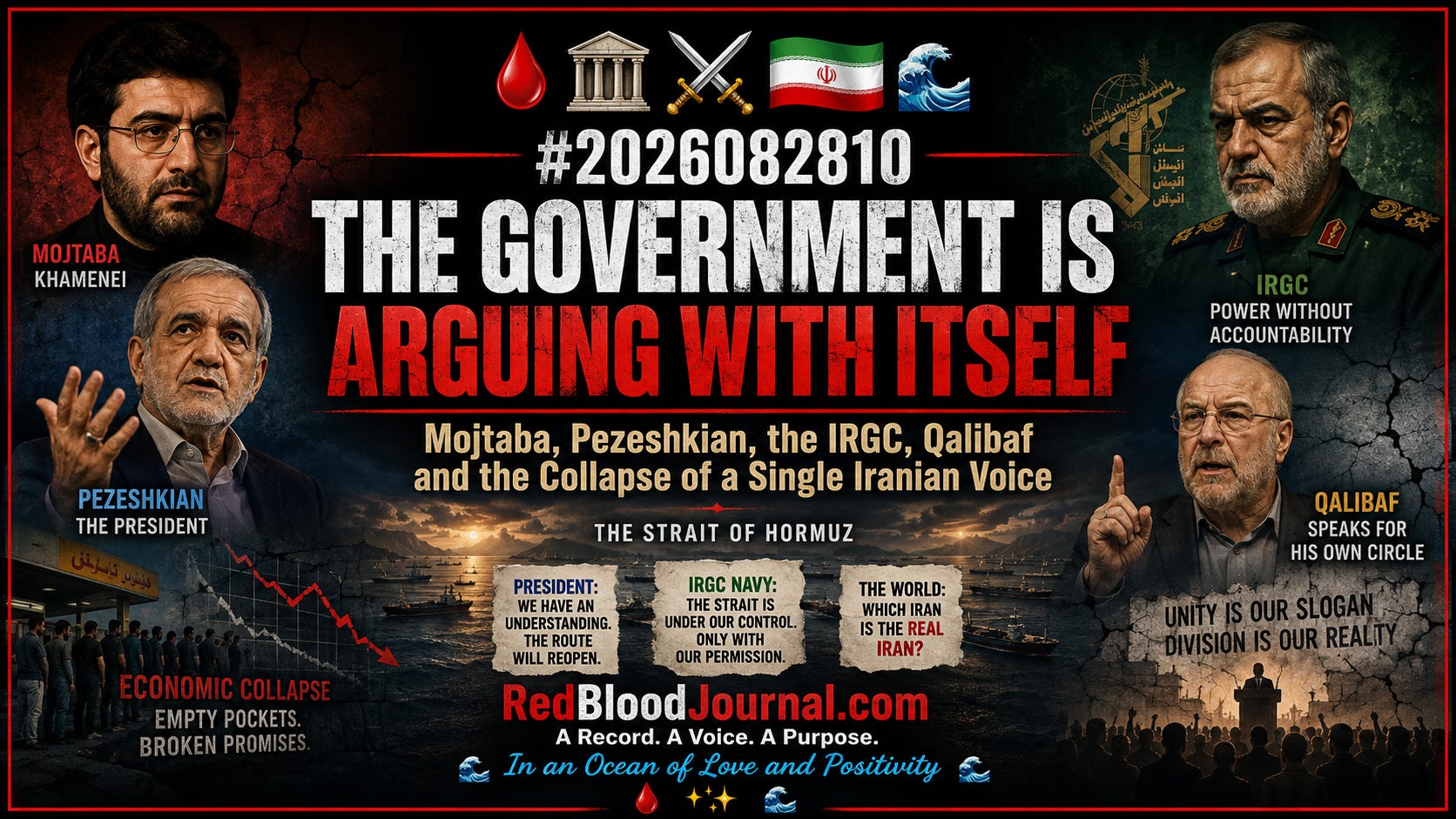
🩸 🏛️ ⚔️ 🇮🇷 🌊 #2026082810 — The Government Is Arguing With Itself: Mojtaba, Pezeshkian, the IRGC, Qalibaf and the Collapse of a Single Iranian Voice
When every institution says “unity” while publicly contradicting the others
🩸 RedBloodJournal.com
A Record. A Voice. A Purpose.
A government can survive disagreement.
What becomes much harder to survive is contradiction at the top when every major institution begins speaking as though it represents a different state.
That is the picture emerging from the transcript.
A message attributed to Mojtaba Khamenei calls for unity.
Pezeshkian publicly describes a country in deep crisis.
Qalibaf’s political orbit produces its own controversies.
The IRGC contradicts the president on one of Iran’s most strategically important issues.
And the Strait of Hormuz — long presented as one of Tehran’s most powerful bargaining instruments — becomes another stage for internal disagreement.
The contradiction is becoming difficult to hide:
everyone is calling for unity while demonstrating disunity.
The Message From Mojtaba
The first fracture appears in the new written message attributed to Mojtaba Khamenei.
Even the existence and authenticity of these messages are treated cautiously in the transcript.
The speaker notes that the messages being circulated are written rather than accompanied by clear public appearances, audio or video that would definitively establish Mojtaba’s condition and role.
Until he is visibly presented, uncertainty remains.
Yet the message attributed to him is politically revealing.
It reportedly calls for:
unity and cohesion.
It warns against emphasizing weaknesses.
It speaks about moving toward a stronger Iran.
And it proposes reducing the role of the dollar in Iran’s economy.
The problem is timing.
Almost immediately afterward, Pezeshkian appears on television and does nearly the opposite.
Rather than conceal weakness, he begins describing it.
Do Not Highlight Weakness — Then the President Lists the Weaknesses
This may be the most revealing contradiction in the entire episode.
According to the transcript, Mojtaba’s message tells officials not to highlight weaknesses.
Then Pezeshkian appears and effectively gives what the speaker describes as a bankruptcy report.
The president discusses economic difficulty, shortages, insufficient foreign currency, reduced trade, pressure on imports and exports and a difficult winter ahead.
The transcript explicitly notices the contradiction:
one side says do not emphasize weakness;
the president then publicly describes weakness in nearly every major area.
This is more than poor coordination.
It suggests that different power centers are no longer even controlling the same narrative.
Unity Becomes the Word Everyone Uses Because Unity Is Missing
After the message, officials from competing centers reportedly begin repeating the language of unity.
Pezeshkian.
Qalibaf.
The IRGC.
Other senior figures.
The transcript points out the irony:
many of the same officials repeating the call for unity are simultaneously engaged in public disputes with one another.
That produces a strange political scene.
Everyone agrees that unity is necessary.
Nobody appears capable of producing it.
The repetition of the word itself may be evidence of the problem.
Governments rarely need to insist constantly that they are united when unity is obvious.
The slogan becomes necessary when reality is beginning to show the opposite.
Pezeshkian Is Speaking Like a Crisis Manager
Pezeshkian’s role in this fracture is unusual.
He is still president.
But much of the transcript portrays him less as a leader setting policy and more as a man announcing constraints.
There is not enough money.
Foreign currency is limited.
Imports are difficult.
Exports have fallen.
Gasoline is becoming more expensive.
Winter will be hard.
The public must conserve.
Government offices may close.
Employees may have to change routines.
The effect is politically important.
A president traditionally communicates control.
Pezeshkian increasingly communicates limits.
He is not telling the country what the government will do.
He is often telling the country what the government cannot do.
That is a major change in tone.
The IRGC Is Speaking Like a Separate Government
Then comes the Strait of Hormuz.
Pezeshkian reportedly announces that an understanding with Oman has been reached and that a route through the strait will reopen.
Shortly afterward, according to the transcript, the IRGC Navy issues a contradictory statement.
Its position is essentially that the strait remains under its control and that only vessels receiving permission can pass.
The political meaning is larger than the technical question of whether one shipping lane is open.
Who speaks for Iran?
The president?
The IRGC?
The foreign-policy establishment?
The military?
The supreme-leadership structure?
When the president makes a strategic announcement and the military publicly rejects it, the problem is no longer messaging.
It is authority.
Hormuz Exposes the Real Structure
For years, the Strait of Hormuz has been one of the Islamic Republic’s most important symbols of leverage.
Iran repeatedly signaled that if pushed too far, it possessed the ability to threaten or restrict one of the most important energy corridors in the world.
The threat had psychological value even when it was not fully exercised.
But a bargaining weapon requires clarity.
If Tehran says the strait is closed, the outside world must believe Tehran can close it.
If Tehran says passage requires permission, the outside world must believe that permission can actually be enforced.
If the president says one thing while the IRGC says another, uncertainty begins moving inward.
The question becomes not:
What is Iran’s position?
But:
Does Iran still have one position?
A Strategic Card Weakens When Nobody Knows Who Holds It
The transcript argues that the Hormuz card is becoming harder for the Islamic Republic to use.
Pezeshkian presents reopening as a negotiated development.
The IRGC presents continued control.
The United States, according to the discussion, treats passage as effectively open.
Each side describes a different reality.
That weakens deterrence.
A threat works best when it is simple.
A red line works best when everyone knows where it is.
But when different institutions announce different red lines, adversaries begin testing the gaps between them.
Internal disagreement becomes external vulnerability.
Qalibaf’s Orbit Adds Another Fracture
The Qalibaf camp appears in another revealing controversy.
One of his advisers, Ebrahim Rasouli, reportedly tried to discuss both revenge for Khamenei and the deteriorating economy.
His example was the rising cost of baby diapers, which he said had increased sharply.
The comparison triggered outrage among regime loyalists, who objected to placing the cost of diapers beside the blood of Khamenei.
Rasouli later apologized.
On the surface, this looks like a small controversy.
Politically, it is more revealing.
The economic crisis is becoming so strong that even insiders are struggling to keep ideological priorities separate from household realities.
The cost of ordinary life is invading the language of revolutionary sacrifice.
That itself is a fracture.
The State Has Too Many Centers of Truth
A coherent government normally requires one of two things:
either genuine consensus,
or a clear hierarchy capable of settling disagreement.
The transcript suggests Iran increasingly has neither.
Mojtaba’s message presents one reality.
Pezeshkian presents another.
The IRGC presents another.
Qalibaf’s political circle produces its own framing.
Economic officials contradict ideological officials.
Military officials contradict civilian officials.
The state still exists.
But its voice is fragmenting.
That matters because political power depends not only on institutions.
It depends on the public understanding who is actually in charge.
The Dollar Reveals Another Contradiction
The message attributed to Mojtaba reportedly calls for removing or reducing the dollar’s role in Iran’s economy.
But the transcript immediately argues that Iran is more dependent on dollar conditions than ever.
Foreign-exchange scarcity is central to the crisis.
The government itself says it lacks enough currency to stabilize the market.
The rial’s value is increasingly measured against the very dollar the leadership says should become less important.
So the political message is aspirational.
The economic reality is immediate.
That gap between ideological language and material reality is becoming harder to bridge.
The Strong Iran Versus the Weakening Iran
The attributed message speaks about moving toward a stronger Iran.
The transcript answers with the opposite assessment:
Iran is becoming weaker economically, institutionally and strategically.
That disagreement reveals two completely different political languages.
One language is declarative:
Iran must be strong.
The other is diagnostic:
Iran is weakening.
A political system can survive bad conditions.
What it cannot easily survive is refusing to agree internally on what the conditions are.
If one faction believes the problem is insufficient ideological discipline while another believes the problem is economic collapse, they will propose entirely different remedies.
One will demand unity.
Another will demand concessions.
Another will demand military escalation.
Another will demand economic opening.
That is how policy paralysis begins.
The Enrichment Statement Deepens the Divide
The transcript also discusses remarks from a senior Pezeshkian official suggesting that if the leadership had known Khamenei would be killed, Iran might have reconsidered enrichment.
The remark triggered intense criticism.
Critics argued that the nuclear program and the sacrifices surrounding it should not be spoken about that way.
But the statement reveals a deeper divide.
Some officials are beginning to ask whether previous strategic choices were worth their cost.
That is one of the most dangerous questions a revolutionary system can face.
Because once insiders begin questioning the price of the original strategy, the disagreement is no longer tactical.
It becomes historical.
Was the Strategy Worth It?
This may eventually become the central question inside the system.
Was enrichment worth the sanctions?
Was confrontation worth the economic isolation?
Was Hormuz worth the military risk?
Was regional expansion worth the financial burden?
Was ideological rigidity worth domestic alienation?
The transcript does not present these as abstract academic questions.
They are increasingly appearing through statements made by officials themselves.
Once that begins, political fracture moves from personality conflict toward strategic conflict.
And strategic conflict is much harder to repair.
The IRGC and the President Are Not Merely Disagreeing
There is an important distinction.
Governments everywhere contain disagreements.
Presidents argue with generals.
Ministers argue with parliament.
Political factions fight.
None of that automatically signals collapse.
The serious issue appears when institutions begin publicly contradicting one another over fundamental questions of sovereignty.
Who controls the Strait of Hormuz?
Who determines nuclear strategy?
Who defines the economic narrative?
Who determines whether weakness should be discussed or hidden?
Who speaks for the state?
Those are not small administrative differences.
They concern the architecture of authority itself.
The Problem With Multiple Governments Inside One Government
The Islamic Republic has always contained overlapping centers of power.
That is not new.
But overlapping power structures function only while everyone accepts a final referee.
If the supreme-leadership structure weakens, ambiguity spreads rapidly.
The president gains room.
The IRGC protects its authority.
Parliamentary power centers maneuver.
Economic networks protect themselves.
Ideological institutions insist on continuity.
Everyone begins interpreting national interest differently.
The result can look like one government from the outside while operating like several governments internally.
That is the fracture now becoming visible.
Hormuz May Be the Preview
The disagreement over Hormuz may eventually be remembered as more than a shipping dispute.
It may be an early demonstration of what happens when the chain of command becomes uncertain.
The president announces.
The IRGC corrects.
Foreign governments decide which statement matters.
Markets decide which statement they believe.
Citizens watch the contradiction.
And the government’s authority is weakened without a single opposition figure needing to say anything.
The institutions do the damage themselves.
The Outside World Notices Internal Contradictions
Adversaries study political division carefully.
They look for:
conflicting statements,
unclear red lines,
economic desperation,
institutional rivalry,
weakening command structures,
and officials willing to contradict one another publicly.
Every visible fracture creates negotiating leverage for the other side.
A unified government can say no.
A divided government can often be pressured by offering one faction something another faction opposes.
That is why political cohesion is not just a domestic issue.
It is a strategic asset.
And losing it has foreign-policy consequences.
The Most Important Question Is Becoming: Who Can Make a Decision?
Iran still has officials.
It still has ministries.
It still has commanders.
It still has political institutions.
But the deeper question is whether any single authority can make a decision and have every major institution follow it.
Hormuz suggests uncertainty.
The economic crisis suggests uncertainty.
The nuclear debate suggests uncertainty.
The competing narratives surrounding unity suggest uncertainty.
When that happens, government begins moving from hierarchy toward negotiation among internal power centers.
And that process can become increasingly unstable.
🩸 The Red Blood Perspective
The headline is not that Pezeshkian and the IRGC disagree.
The headline is that the disagreement is becoming public enough that the world can see it.
Mojtaba says unity.
Pezeshkian describes collapse.
The IRGC contradicts the president.
Qalibaf’s political orbit is forced to navigate between ideological loyalty and household economic reality.
The nuclear program itself is beginning to be discussed in terms of whether the sacrifice was worth it.
And Hormuz — once one of Tehran’s clearest symbols of strategic leverage — now produces contradictory statements from the same government.
The state still has institutions.
What it increasingly appears to lack is one uncontested center of decision.
That distinction may determine everything that follows.
Because political systems rarely collapse simply because opponents become stronger.
They become most vulnerable when the people inside the system stop agreeing on what the system should do.
And perhaps even more importantly:
when they stop agreeing on who has the authority to decide.
🌊 The Ocean of Love and Positivity Perspective
Political fracture has an inward mirror.
A human being can also become divided.
One part says:
Be strong.
Another part knows:
I am exhausted.
One part demands discipline.
Another recognizes that the old strategy is failing.
One part wants to preserve pride.
Another knows a change is necessary.
There is nothing unusual about internal disagreement.
The danger comes when the voices inside us stop listening to one another.
Then we become like a government with several competing centers of power.
The body wants one thing.
The ego wants another.
Fear demands something else.
Conscience quietly points somewhere different.
And eventually the driver loses control of the vehicle because no single principle is leading.
The answer is not suppression.
It is alignment.
Not pretending there is no conflict.
But understanding it completely enough that a clear direction can emerge.
A strong person is not someone who never contains contradiction.
A strong person is someone capable of seeing every contradiction clearly and still choosing consciously.
That may also be the lesson hidden inside Iran’s political fracture.
A system that cannot reconcile its competing voices eventually becomes governed by the loudest one.
A person who cannot reconcile his competing voices can suffer the same fate.
The path back begins with one question:
Who is really driving?
When that answer becomes clear, unity no longer has to be demanded.
It happens naturally.
In an Ocean of Love and Positivity.
🩸🌊✨ Fantastic!
🧩
Fractured Authority: The Struggle for a Unified Iranian Voice
Aug 29, 2026
The provided text analyzes a widely fractured Iranian leadership where major state institutions are publicly undermining one another despite official calls for national cohesion. While Mojtaba Khamenei reportedly advocates for a facade of strength, President Pezeshkian contradicts this by openly detailing the country’s dire economic insolvency. This internal friction extends to strategic military matters, evidenced by the IRGC issuing statements that directly challenge the President’s authority regarding the Strait of Hormuz. Such institutional discord suggests that Iran’s centralized power structure is fragmenting into competing factions with no clear decision-making head. Ultimately, the source argues that this loss of a unified voice erodes the regime’s international leverage and domestic stability. These political divisions are also mirrored as a metaphor for the internal psychological conflicts individuals face when navigating exhaustion and discipline.
#RedBloodJournal #Iran #IranPolitics #PoliticalFracture #MojtabaKhamenei #Pezeshkian #IRGC #Qalibaf #StraitOfHormuz #IranCrisis #PowerStruggle #NuclearIran #IranEconomy #RegimeDivision #TehranPolitics


