


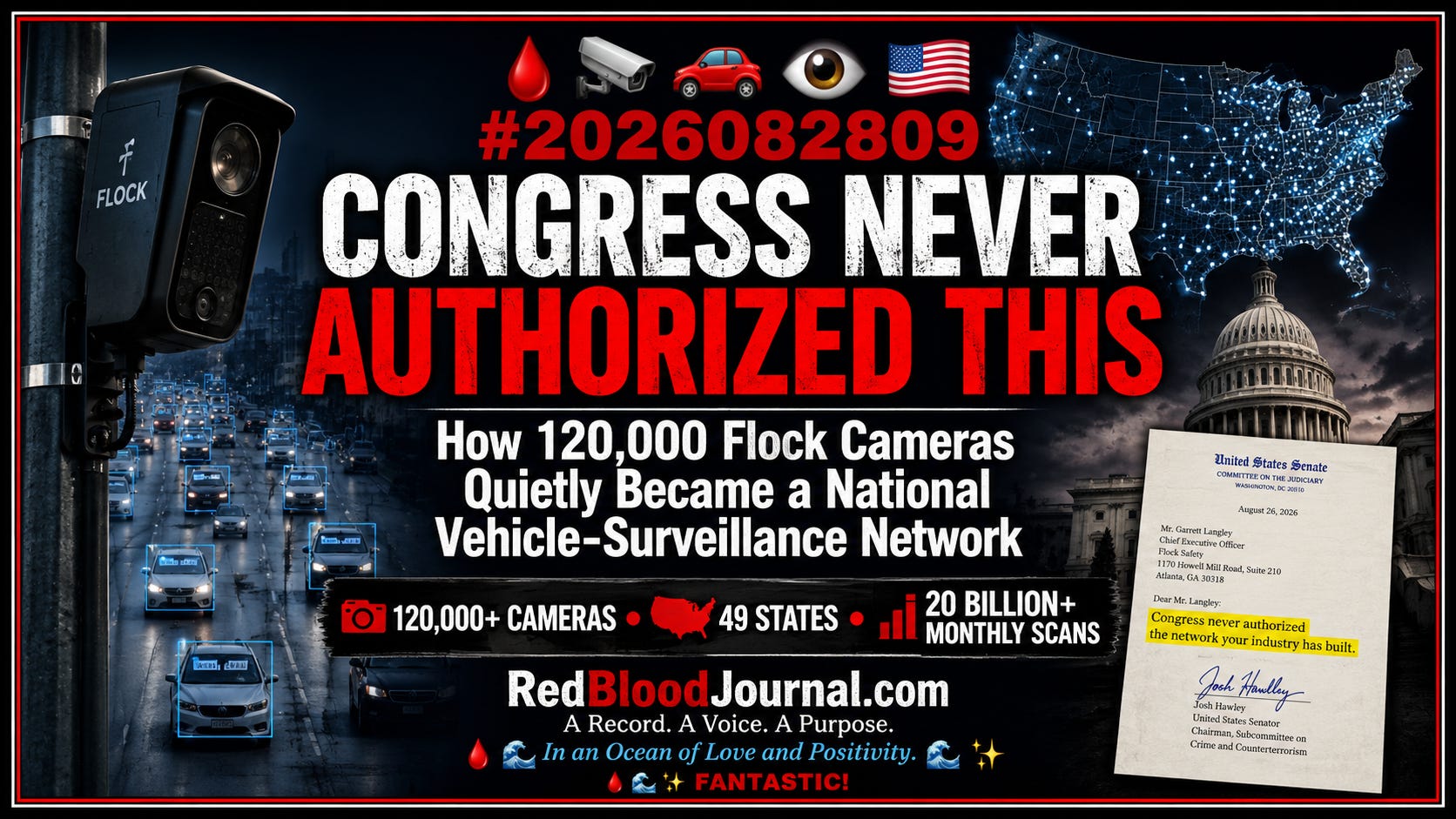
🩸 📷 🚗 👁️ 🇺🇸 #2026082809 — Congress Never Authorized This: How 120,000 Flock Cameras Quietly Became a National Vehicle-Surveillance Network
The cameras were introduced one town at a time. The network they created is national. Now Congress is asking who authorized it.
🩸 RedBloodJournal.com — A Record. A Voice. A Purpose.
A camera at an intersection does not look like a surveillance state.
Neither does another camera outside a shopping center.
Nor another beside a highway.
Nor ten more installed by a neighboring police department.
Each one can be explained individually.
Crime prevention.
Stolen vehicles.
Missing children.
Wanted suspects.
Public safety.
But eventually, the question changes.
The question is no longer:
What does this camera do?
It becomes:
What do all of these cameras become when they can talk to one another?
That question has now reached Congress.
On August 26, 2026, Senator Josh Hawley, chairman of the Senate Judiciary Subcommittee on Crime and Counterterrorism, opened an investigation into Flock Safety and its rapidly expanding automated license-plate-reader network.
According to Hawley’s letter to Flock CEO Garrett Langley, the company operates more than 120,000 cameras across 49 states, generating more than 20 billion vehicle scans every month.
Hawley’s central accusation was extraordinary because of how simple it was:
Congress never authorized the network that now exists.
That may become the defining question surrounding Flock Safety.
Not whether a particular camera is useful.
Not whether a particular police officer caught a criminal with it.
Not even whether license-plate readers should exist.
The larger issue is whether thousands of individually approved surveillance points have quietly become something that no individual town, sheriff, police chief, city council—or perhaps even Congress—ever explicitly approved:
A searchable national record of where Americans drive.
The Camera Is Not the Story
Flock Safety cameras photograph passing vehicles and record information that can include license plates, vehicle characteristics, locations and timestamps.
That information becomes searchable.
At the local level, the argument for the technology is easy to understand.
A car is stolen.
Police enter the plate.
A camera sees the vehicle.
Officers receive an alert.
A kidnapping occurs.
A suspect’s vehicle is identified.
The cameras may help investigators locate it.
Technology can unquestionably make legitimate police work faster.
But the Red Blood question begins where the sales presentation usually ends:
What else can the system do?
And more importantly:
What happens once every local camera becomes part of something much larger?
From Three Cameras to the Entire Country
The uploaded investigation provides a remarkable example from North Manchester, Indiana.
Bob Sklar believed that local police were following him.
He was not describing occasional patrol cars.
He said officers appeared to know where he had traveled and seemed to appear repeatedly after he entered town.
Sklar was also a regular critic of local government and police, speaking publicly at town council meetings.
Eventually, he learned about Flock cameras.
He filed records requests seeking audit information about searches involving his vehicle.
According to the transcript, he discovered that an alert had been placed on his vehicle.
The investigation later reported that public records from outside departments showed North Manchester officers and Wabash County sheriff’s deputies repeatedly searching his license plate for at least a year.
Some recorded search explanations were reportedly little more than:
“Locate.”
A word that describes an action.
Not necessarily a crime.
The reporter asked:
“Locate isn’t a crime.”
Sklar answered:
“Nope.”
That small exchange exposes the enormous philosophical problem at the center of modern surveillance.
Technology originally justified by the need to investigate wrongdoing can also provide the ability simply to locate a person.
The machine does not know why someone is being searched.
It merely answers the question:
Where is the vehicle?
A Local Officer With National Eyes
North Manchester reportedly had only three Flock cameras.
But Sklar did not necessarily have to remain within range of those three cameras to be visible.
According to the investigation, the police department’s access connected into a network involving more than 6,000 agencies across 49 states at the time of the reporting.
Sklar recalled an officer once asking him:
“How was your trip to Philly?”
His immediate reaction was obvious:
How did the officer know he had been in Philadelphia?
That is the moment the story stops being about cameras.
A police department in a small Indiana town does not need cameras in Philadelphia if it can query cameras belonging to someone else.
And Philadelphia does not need cameras in Indiana if the network itself bridges the distance.
This is the transformation.
Local surveillance becomes national surveillance through connectivity.
The camera remains physically local.
The database does not.
120,000 Cameras
The system has expanded considerably.
Hawley now says Flock boasts more than 120,000 cameras across 49 states and processes more than 20 billion vehicle scans every month.
Think about the scale of that number.
Twenty billion scans every month means the overwhelming majority cannot possibly involve people suspected of crimes.
They are ordinary people.
Going to work.
Driving home.
Visiting parents.
Going to restaurants.
Taking children to school.
Visiting doctors.
Attending churches, synagogues, mosques or political meetings.
Meeting friends.
Driving across state lines.
Living normal lives.
The individual photograph may appear trivial.
A car existed at a particular place at a particular moment.
But millions of those observations assembled over time become something different.
They can become a movement history.
And movement history can reveal far more than movement.
It can reveal relationships.
Habits.
Associations.
Religious activity.
Political participation.
Medical visits.
Employment.
Travel.
Routine.
The individual observation may be public.
The comprehensive reconstruction of someone’s life may be something else entirely.
That distinction is central to Hawley’s congressional inquiry. He specifically cited Supreme Court recognition that comprehensive retrospective tracking of someone’s movements can be fundamentally different from ordinary visual observation in public.
The Search Box Changes Everything
There has always been surveillance in public.
A police officer standing at an intersection can see cars drive past.
A store camera can record a parking lot.
A witness can remember seeing someone’s vehicle.
But those forms of observation have natural limitations.
The officer cannot stand at every intersection in America.
The witness cannot remember every license plate.
The investigator cannot simultaneously examine millions of cameras across thousands of jurisdictions.
The human limitation once acted as an accidental privacy safeguard.
Technology removes that limitation.
The difference is not necessarily the camera.
The difference is the search box.
Once observations scattered across thousands of locations become electronically searchable, surveillance acquires a new characteristic:
memory.
And when searchable memory becomes interconnected nationally, geographical distance ceases to provide the same protection it once did.
The Abuse Is No Longer Hypothetical
Supporters of surveillance technology often respond to privacy concerns with a familiar argument:
Responsible authorities will use the system responsibly.
But the uploaded investigation documents numerous allegations of misuse.
The report said it was tracking more than 70 cases nationwide involving unauthorized use of Flock cameras, including officers who had been investigated, disciplined, fired or arrested.
Reported misuse included searches involving former romantic partners, acquaintances and family members.
Hawley’s letter contains additional examples.
He cited St. Charles County, Missouri, where a civilian police employee allegedly conducted Flock searches for personal purposes.
He also cited Milwaukee, where prosecutors charged an officer who allegedly searched his girlfriend’s plate 124 times and her former boyfriend’s plate 55 times.
These cases matter because they change the debate.
The question is no longer:
Could someone misuse this system?
The answer is already yes.
The remaining questions are:
How frequently does misuse occur?
How easily can it be detected?
Who has access?
Who audits the searches?
What penalties exist?
How long is information retained?
Which agencies can see information collected by other agencies?
And perhaps most importantly:
Who watches the people doing the watching?
The Audit Trail Begins Disappearing
The uploaded investigation identified another troubling development.
The reporters said that outside-agency audit logs had helped reveal searches involving Sklar’s vehicle.
Those logs could show that another department had queried information collected by a particular agency.
But according to the transcript, Flock subsequently changed those records so officer names and searched license plates were withheld, saying law-enforcement officers had asked that their identities not appear in public records.
Consider the imbalance this creates.
The authority may be able to determine where the citizen traveled.
The citizen may be unable to determine which authority searched him.
The cameras create transparency in one direction.
Opacity can remain in the other.
The transcript summarizes the fear dramatically:
Police may be able to search movement information without a warrant, reasonable suspicion or probable cause in jurisdictions permitting such access, while an individual may have great difficulty discovering who searched for him.
That is where surveillance becomes more than a crime-fighting question.
It becomes a power question.
The Atlanta Example
Another development reported August 28 illustrates how quickly these supposedly local systems can become enormous networks.
WIRED reported that the police department in Alpharetta, Georgia, was sharing Flock information with more than 2,000 organizations nationwide, while receiving access from more than 1,300 organizations.
That is the architecture in miniature.
One city.
Thousands of connections.
No enormous federal command center required.
No giant building labeled:
National Vehicle Surveillance Headquarters.
The network emerges through sharing agreements.
One department connects to another.
That department connects to hundreds more.
Those connect elsewhere.
Eventually, what was sold as a local tool begins behaving like national infrastructure.
This may be one of the defining characteristics of twenty-first-century government power:
Centralization without an obvious center.
No One Had to Build the Whole Thing
Imagine Congress proposed the following law:
The federal government shall create a database capable of recording billions of vehicle movements every month across nearly every American state, and thousands of government agencies shall be able to query portions of that information.
The debate would be enormous.
Fourth Amendment questions would immediately arise.
Civil-liberties groups would mobilize.
Americans would demand retention limits.
Warrant requirements would be debated.
Congress would argue about oversight.
Courts would eventually become involved.
But what if nobody proposed such a system?
What if cities merely purchased cameras?
Police departments signed contracts.
Sheriffs connected databases.
Businesses installed units.
Homeowners associations participated.
Software enabled cross-jurisdiction searches.
And one day everyone looked up and realized:
The national network already existed.
That is the significance of Hawley’s statement.
Congress did not necessarily reject this network.
Congress never had the opportunity to approve it in the first place.
The Privatization of Constitutional Boundaries
There is another unusual element.
The infrastructure is privately built.
Flock Safety is not Congress.
It is not the Supreme Court.
It is not a constitutional convention.
It is a technology company.
Yet when legislation has not kept pace with technology, corporate policies can effectively determine critical questions involving public surveillance.
How long is information stored?
Who can search it?
What must officers enter as justification?
Which departments can share information?
What appears in audit logs?
When is access suspended?
How much transparency exists?
Hawley’s letter makes precisely this point, arguing that Flock’s internal policies effectively function as safeguards over movement information affecting enormous numbers of Americans.
This should concern people regardless of political ideology.
Rights should not depend entirely upon a company’s terms-of-service update.
Nor should constitutional boundaries emerge accidentally from software settings.
Flock’s Defense Matters Too
None of this means the technology has no legitimate purpose.
Flock says its system helps law enforcement solve crimes and locate missing people.
The company has said it intends to cooperate with Hawley’s investigation and explain how the platform works, what safeguards exist and how agencies use it.
That defense deserves consideration.
The real question is not whether catching criminals is good.
Of course it is.
The real question is whether creating a mechanism capable of monitoring enormous numbers of innocent people is necessary—or constitutionally acceptable—to accomplish that objective.
Those are different questions.
A technology can simultaneously be useful and dangerous.
Indeed, the most consequential surveillance systems almost always are.
If the technology had no useful purpose, nobody would buy it.
The danger comes precisely because useful tools create powerful incentives to expand them.
The Database Does Not Know Who Will Be in Power Tomorrow
Every surveillance system is initially defended according to the intentions of the people controlling it today.
But durable infrastructure must be judged differently.
The question is not:
Do we trust today’s police chief?
The question is:
Would we trust every future police chief?
Not:
Do we trust this administration?
But:
Would we trust every administration that follows it?
Not:
Will today’s employees misuse the system?
But:
Could tomorrow’s?
Technology survives elections.
Databases survive administrations.
Infrastructure survives personalities.
Power created for one purpose can eventually be used for another.
That is why free societies traditionally place limits on government capability rather than depending solely upon good intentions.
🩸 The Red Blood Perspective
The Flock debate is not fundamentally about license plates.
It is about something much older:
The relationship between the citizen and power.
America has always possessed law enforcement.
America has always possessed criminals.
America has always possessed governments claiming that additional power would produce additional safety.
Technology changes the scale.
A patrol officer once had two eyes.
Now an officer may potentially have access to thousands of electronic eyes.
A detective once had memory.
Now databases remember.
A local department once ended at the county line.
Networks do not.
That transformation deserves explicit democratic consent.
If Americans decide that nationwide automated vehicle tracking is an acceptable price for additional law-enforcement capability, that decision should be made openly.
If Americans decide warrant requirements are necessary, those rules should be written openly.
If data must disappear after a certain period, the public should determine the standard.
If cross-state sharing requires judicial supervision, elected lawmakers should debate it.
What should not happen is perhaps the most important lesson of this entire story:
A society should not accidentally wake up inside a surveillance system nobody remembers choosing.
Technology moves quickly.
Liberty disappears quietly.
And often the most consequential moment is not when someone takes freedom away.
It is when everyone assumes somebody else already approved what happened.
🌊 The Ocean of Love and Positivity Perspective
There is something positive hidden inside this story.
People noticed.
Journalists investigated.
Citizens requested records.
Communities began asking questions.
Local governments reconsidered contracts.
And now Congress is looking at something that until recently was largely invisible to most Americans.
That is how consciousness works.
First something exists unnoticed.
Then someone sees it.
Then someone questions it.
Then everyone has an opportunity to choose differently.
But the deepest lesson does not live inside Flock Safety.
It lives inside us.
Technology constantly offers the temptation to surrender responsibility in exchange for convenience.
More cameras will protect us.
More algorithms will decide for us.
More databases will remember for us.
More institutions will watch for us.
Eventually we can forget that a free human being must remain awake.
The machine itself is not the final danger.
Unconscious surrender is.
When we understand that, surveillance becomes another lesson from the University of Life.
The outer camera reminds us to strengthen the inner observer.
The outer database reminds us to remember who we are.
The outer system reminds us that sovereignty begins within.
Fear says:
Someone is watching me.
Awareness asks:
Am I watching myself?
Am I conscious of my choices?
Am I surrendering freedom merely because surrender is convenient?
Am I handing responsibility to systems because thinking for myself requires effort?
That is where this story can become constructive.
The awakening does not begin by destroying every camera.
It begins when human beings stop living unconsciously beneath them.
A conscious population requires fewer masters.
A self-aware person requires less external control.
And a society filled with people who understand the value of their own sovereignty becomes much harder to quietly place inside any cage.
The cameras may be watching the roads.
But the most important journey remains invisible to every one of them.
The journey inward.
Where there is no database.
No license plate.
No search history.
No government.
No corporation.
Only the observer discovering that the deepest freedom was never located on the road outside.
It was always inside the driver.
In an Ocean of Love and Positivity.
🩸🌊✨ Fantastic!
👁️
The Unseen National Net: Congress Probes Flock Camera Surveillance
Aug 29, 2026
This text examines the rapid proliferation of Flock Safety’s automated license-plate-reader network, which has quietly connected over 120,000 cameras into a vast, national surveillance system. While marketed as a local tool for solving crimes, the report highlights how these interconnected databases allow police to track individual movement history across state lines without explicit congressional authorization. Senator Josh Hawley has launched a formal investigation into the company following allegations of unauthorized misuse by officers and concerns over the lack of transparency in audit logs. The source argues that this private infrastructure effectively redraws constitutional boundaries, potentially compromising the privacy of innocent citizens through comprehensive data collection. Ultimately, the narrative warns of a centralized surveillance state emerging from decentralized agreements, urging the public to demand democratic oversight of these powerful technologies.
#RedBloodJournal #FlockSafety #Surveillance #LicensePlateReaders #ALPR #Privacy #CivilLiberties #FourthAmendment #PoliceSurveillance #MassSurveillance #DigitalPrivacy #GovernmentOversight #JoshHawley #Congress #LawEnforcement #VehicleTracking #FacialRecognitionDebate #SurveillanceState #TechnologyAndFreedom #CitizenRights #America #RedBloodPerspective #OceanOfLove #Fantastic


