


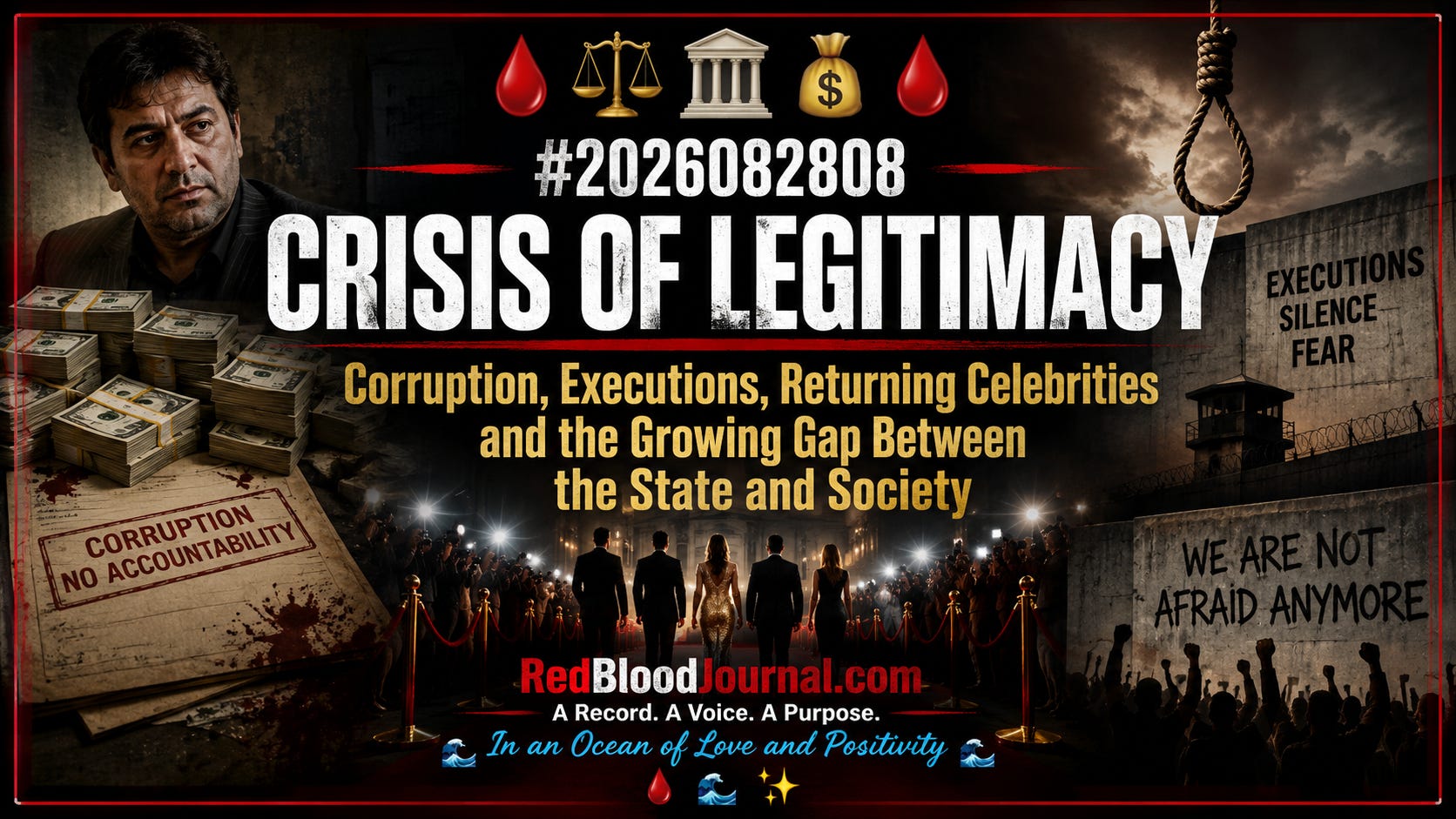
🩸 ⚖️ 🏛️ 💰 🩸 #2026082808 — Crisis of Legitimacy: Corruption, Executions, Returning Celebrities and the Growing Gap Between the State and Society
When a government can still command institutions but can no longer command belief
🩸 RedBloodJournal.com
A Record. A Voice. A Purpose.
A government does not lose legitimacy in a single moment.
There is rarely one speech, one execution, one scandal or one economic failure that suddenly causes an entire population to declare that the relationship between citizen and state has ended.
Legitimacy usually erodes more quietly.
It disappears through accumulation.
One contradiction at a time.
One unpaid pension.
One politically connected businessman.
One execution.
One order telling people how to live while powerful insiders operate under a different set of rules.
One attempt to manufacture normality while the memory of blood remains fresh.
And eventually, the question facing society changes.
It is no longer:
Is the government governing well?
It becomes:
By what moral authority is this government governing at all?
That is the deeper thread running through several seemingly unrelated developments discussed in the August 28 transcript.
They are not really separate stories.
They are pieces of the same crisis.
The State Still Has Power
The Islamic Republic still possesses the traditional instruments of government.
It has ministries.
Police.
Courts.
Security forces.
Prisons.
Broadcasting organizations.
Taxing authority.
Military forces.
Regulatory agencies.
And the machinery necessary to issue orders.
But power and legitimacy are not the same thing.
A government may retain the ability to compel behavior long after it has lost the ability to persuade the population that its authority is just.
That distinction matters.
Because coercive capacity can remain powerful even while political legitimacy is collapsing underneath it.
The transcript repeatedly returns to this widening gap.
The Babak Zanjani Problem
One of the clearest symbols is Babak Zanjani.
The transcript describes a government facing such severe economic difficulty that it increasingly turns toward people previously associated with enormous corruption scandals.
Zanjani had once faced a death sentence over corruption allegations before his sentence was reduced.
The Central Bank had publicly disputed whether money owed to it had actually been returned.
Yet the transcript portrays him as once again becoming an important economic figure because the state needs people capable of navigating sanctions, financing and international restrictions.
This produces an extraordinary political contradiction.
The system spent years presenting itself as guardian of morality, revolutionary purity and Islamic discipline.
Yet when economic survival becomes difficult enough, ideological purity suddenly becomes negotiable.
The transcript describes the controversy surrounding a café associated with Zanjani where women without mandatory hijab reportedly appeared.
The government now faces competing imperatives:
Enforce ideological conformity.
Or tolerate the politically useful businessman who may help keep money moving.
That contradiction tells citizens something important.
Rules that are presented as sacred may become flexible when powerful people become useful.
And once citizens see that, legitimacy suffers.
Corruption Stops Looking Like a Defect
There is another threshold a political system can cross.
At first corruption is described as an abuse of the system.
Then corruption becomes part of the system.
The transcript recalls earlier episodes in which politically connected intermediaries allegedly handled enormous financial transactions through informal arrangements rather than conventional state institutions.
One account describes oil revenues potentially being routed through a personal contact abroad.
Another describes an individual arriving at the Central Bank with authorization connected to the president’s office and requesting approximately one billion dollars.
The speaker uses those examples to argue that informal political connections had begun replacing institutional financial procedures.
Whether every anecdotal detail can ultimately be independently established is a separate question.
The importance inside the transcript is the political perception being expressed:
citizens no longer necessarily see corruption as an occasional violation of the government’s rules.
They increasingly see corruption as one of the ways the system functions.
That perception is devastating to legitimacy.
The Citizen Sees Two Governments
There is the government described in speeches.
And there is the government citizens experience.
The first talks about sacrifice.
The second protects insiders.
The first talks about national unity.
The second contains institutions publicly contradicting one another.
The first asks citizens to conserve electricity, gasoline and gas.
The second struggles to explain why ordinary people must absorb the consequences of decisions they did not make.
The first invokes morality.
The second appears willing to bend morality for useful insiders.
Eventually, people begin judging government not by what it says but by what it repeatedly does.
That is when legitimacy moves from damaged to endangered.
Then Come the Executions
The contrast becomes much more severe when the state simultaneously attempts to project tolerance while continuing punitive actions against political opponents and protesters.
The transcript refers to the execution of Reza Zanganeh and discusses the punishment of Milad Hashempour, including prison and flogging.
These developments appear in the same discussion as another campaign:
the effort to encourage prominent Iranians and celebrities to return to the country.
That juxtaposition creates the central contradiction of this report.
The government wants the image of reconciliation.
But reconciliation cannot simply be announced.
It must be believed.
And belief becomes difficult when punishment continues.
The Red Carpet
The transcript gives this contradiction a powerful image:
A red carpet dripping with blood.
The government may invite celebrities back.
It may loosen certain visible restrictions.
It may allow images suggesting normal social life.
It may attempt to communicate:
The country is stabilizing.
Things are becoming normal again.
People can return.
But the transcript argues that these gestures cannot be separated from the killings, executions and repression that preceded them.
The symbolism becomes unavoidable.
The carpet may be red.
But why is it red?
That is the question the state cannot answer merely by opening airports, welcoming entertainers or allowing selected displays of tolerance.
Normality Cannot Be Manufactured
Governments in crisis frequently attempt to manufacture normality.
Stores remain open.
Television continues broadcasting.
Celebrities appear.
Traffic moves.
Restaurants operate.
Football is played.
People go to work.
Official ceremonies continue.
And from the outside, the machinery of daily life can create the appearance that the political crisis has passed.
But normal activity is not the same thing as political legitimacy.
People can live normal lives while privately withdrawing consent from the government governing them.
They can go to work without believing.
They can pay bills without believing.
They can obey laws without believing.
They can remain silent without believing.
Silence is not necessarily consent.
Compliance is not necessarily legitimacy.
The Return of Celebrities Becomes Political
The transcript also wrestles with an uncomfortable question.
Does an Iranian citizen have the right to return home?
Of course the general principle of belonging to one’s homeland remains powerful.
But the transcript argues that the political meaning of a high-profile return depends on context.
A celebrity returning quietly to see family is one thing.
A government publicly showcasing returning celebrities as evidence that political conditions have normalized is another.
At that point the returning individual may become part of a political narrative whether they intended to or not.
The state obtains an image:
Look. They are coming back.
And critics answer:
Yes — while others remain imprisoned, punished or dead.
That is where the red carpet metaphor acquires its force.
The Gray Zone Begins to Shrink
The transcript argues that Iranian society is becoming increasingly polarized.
The political middle becomes harder to occupy.
Individuals are judged more aggressively according to whether their actions appear to strengthen the Islamic Republic or oppose it.
The speaker describes a society increasingly moving toward a binary interpretation:
with the government or against it.
That development carries its own dangers.
But it is also a recognizable symptom of a legitimacy crisis.
When institutions are widely trusted, society can tolerate ambiguity.
When legitimacy collapses, ambiguity begins to look like collaboration.
Political neutrality becomes difficult because every public action acquires symbolic meaning.
Even Pets Become Political
One of the strangest examples in the transcript involves Mashhad.
Authorities reportedly installed numerous signs restricting dog walking while citizens were experiencing major economic hardship.
The speaker contrasts public affection for animals with growing hostility toward institutions such as the police, Basij and IRGC.
At first this seems like a minor cultural controversy.
It is not.
The deeper issue is priorities.
When citizens are worried about food, housing, inflation, salaries and electricity, a government campaign against people walking dogs may communicate something unintended:
The state still has energy to regulate private life even when it cannot solve basic public problems.
That perception can damage legitimacy more than the regulation itself.
A State Can Be Strong and Weak at the Same Time
This is one of the great paradoxes of political decline.
A government can be extremely strong institutionally while becoming extremely weak socially.
It may have more weapons than its opponents.
More police.
More money.
More surveillance.
More prisons.
More broadcasting power.
Yet it may possess less trust.
Less voluntary cooperation.
Less moral authority.
Less emotional allegiance.
And eventually those deficits matter.
Pezeshkian himself reportedly invoked the Soviet Union, noting that missiles and bombs cannot save a political system when internal cohesion collapses.
That comparison is significant.
The Soviet Union did not disappear because it lacked military power.
It disappeared while possessing one of the most powerful militaries ever created.
Weapons can protect borders.
They cannot manufacture belief.
Legitimacy Is an Invisible Currency
Governments spend legitimacy every day.
When citizens accept inconvenience because they trust leadership, legitimacy is being spent.
When people tolerate taxation because they believe institutions broadly serve the public, legitimacy is being spent.
When families send children into military service because they believe the nation is worth defending, legitimacy is being spent.
But legitimacy must also be replenished.
Justice replenishes it.
Competence replenishes it.
Consistency replenishes it.
Accountability replenishes it.
Shared sacrifice replenishes it.
When powerful people are protected while ordinary citizens suffer, legitimacy is depleted.
When rules are selectively enforced, legitimacy is depleted.
When corruption appears rewarded, legitimacy is depleted.
When the government invites celebrities onto a red carpet while protesters face prisons and executions, legitimacy is depleted.
Eventually the account can approach zero.
The Regime’s Greatest Problem May No Longer Be the Dollar
Iran faces an extraordinary collection of economic problems.
Inflation.
Energy shortages.
Sanctions.
Oil restrictions.
Currency weakness.
Unpaid obligations.
Possible food shortages.
The transcript describes all of them.
But money may not be the deepest crisis.
Money can return.
Oil exports can recover.
Sanctions can be lifted.
Currencies can stabilize.
Infrastructure can eventually be rebuilt.
Legitimacy is harder.
Because once citizens conclude that a political system does not represent them, every new crisis is interpreted through that conclusion.
A blackout becomes evidence of incompetence.
A corruption scandal becomes evidence of systemic theft.
An execution becomes evidence of political fear.
A celebrity return becomes propaganda.
A speech about unity becomes evidence that the leadership itself is divided.
That is how legitimacy crises become self-reinforcing.
The Government May Still Be Governing
But the deeper question is whether society still recognizes the relationship.
That is the dividing line.
A government can issue commands.
A population can obey them.
And still something fundamental may already have broken.
The state may remain physically present while becoming emotionally absent from the population it rules.
Once that separation becomes large enough, every additional contradiction widens it.
Babak Zanjani.
Executions.
Mandatory hijab.
Returning celebrities.
Economic hardship.
Selective morality.
Unpaid citizens.
Protected insiders.
Each story becomes another strand of the same argument.
Not merely that the government is struggling.
But that growing numbers of citizens may no longer believe the government possesses the moral authority to demand their loyalty.
🩸 The Red Blood Perspective
The most important story here is not Babak Zanjani.
It is not celebrity returns.
It is not one execution.
It is not dog walking.
It is not even corruption by itself.
The story is the relationship between the citizen and the state.
That relationship depends on something governments cannot print, import or seize.
Consent.
Force can compel behavior.
Fear can produce silence.
Money can purchase cooperation.
Propaganda can manufacture appearances.
But none of them permanently substitute for legitimacy.
The dangerous moment for any government arrives when citizens begin seeing every institution through the same lens:
These people are governing themselves, not us.
Once that thought takes hold widely enough, corruption becomes more than theft.
Execution becomes more than punishment.
Propaganda becomes more than messaging.
They become confirmation.
And a government facing that condition is no longer simply managing an economic crisis.
It is trying to preserve the belief that it still has the right to govern.
🌊 The Ocean of Love and Positivity Perspective
There is a deeper lesson beyond Iran and beyond government.
Authority exists in every human life.
Parents exercise it.
Employers exercise it.
Teachers exercise it.
Governments exercise it.
And each of us exercises authority over ourselves.
The same rule applies everywhere:
authority without integrity eventually loses legitimacy.
A person cannot continuously betray his own conscience and still expect inner peace.
We cannot demand discipline from others while excusing ourselves.
We cannot ask for honesty while practicing deception.
We cannot ask for sacrifice while protecting only our own comfort.
The political crisis outside becomes a mirror for the private world inside.
Before judging the legitimacy of institutions, there is another question worth asking:
Does the person governing my own life still have my respect?
The driver inside us earns authority the same way any legitimate government does:
through consistency.
Through truth.
Through responsibility.
Through courage.
Through love.
And perhaps that is the opening hidden inside every collapsing structure.
When false authority weakens, there is space for genuine authority to emerge.
Not domination.
Not obedience.
Not fear.
But self-government.
A human being who can govern himself with compassion, discipline and clarity becomes much harder for any external system to govern through fear.
That is where sovereignty begins.
Not in a palace.
Not in a parliament.
Not in a prison.
Inside.
In an Ocean of Love and Positivity.
🩸🌊✨ Fantastic!
⚖️
The Red Carpet and the Crisis of Legitimacy
Aug 28, 2026
This text explores the profound crisis of legitimacy facing the Iranian government as it struggles to maintain moral authority over its citizens. While the state retains its institutional power and coercive tools, the source argues that its credibility is eroding due to systemic corruption, economic hardship, and a widening gap between official rhetoric and the lived reality of the people. The narrative highlights sharp contradictions, such as the state’s reliance on corrupt intermediaries for economic survival while simultaneously enforcing strict ideological rules and carrying out political executions. Attempts by the regime to manufacture a sense of social normalcy or reconciliation are depicted as superficial gestures that fail to mask underlying repression. Ultimately, the source suggests that once a population views its leaders as self-serving insiders, the fundamental bond of consent is broken, rendering military and police force an insufficient substitute for genuine trust.
#RedBloodJournal #Iran #IranCrisis #IslamicRepublic #LegitimacyCrisis #Corruption #Executions #IranProtests #BabakZanjani #IranEconomy #PoliticalRepression #IranianSociety #HumanRights #StateVsSociety #IranPolitics


