


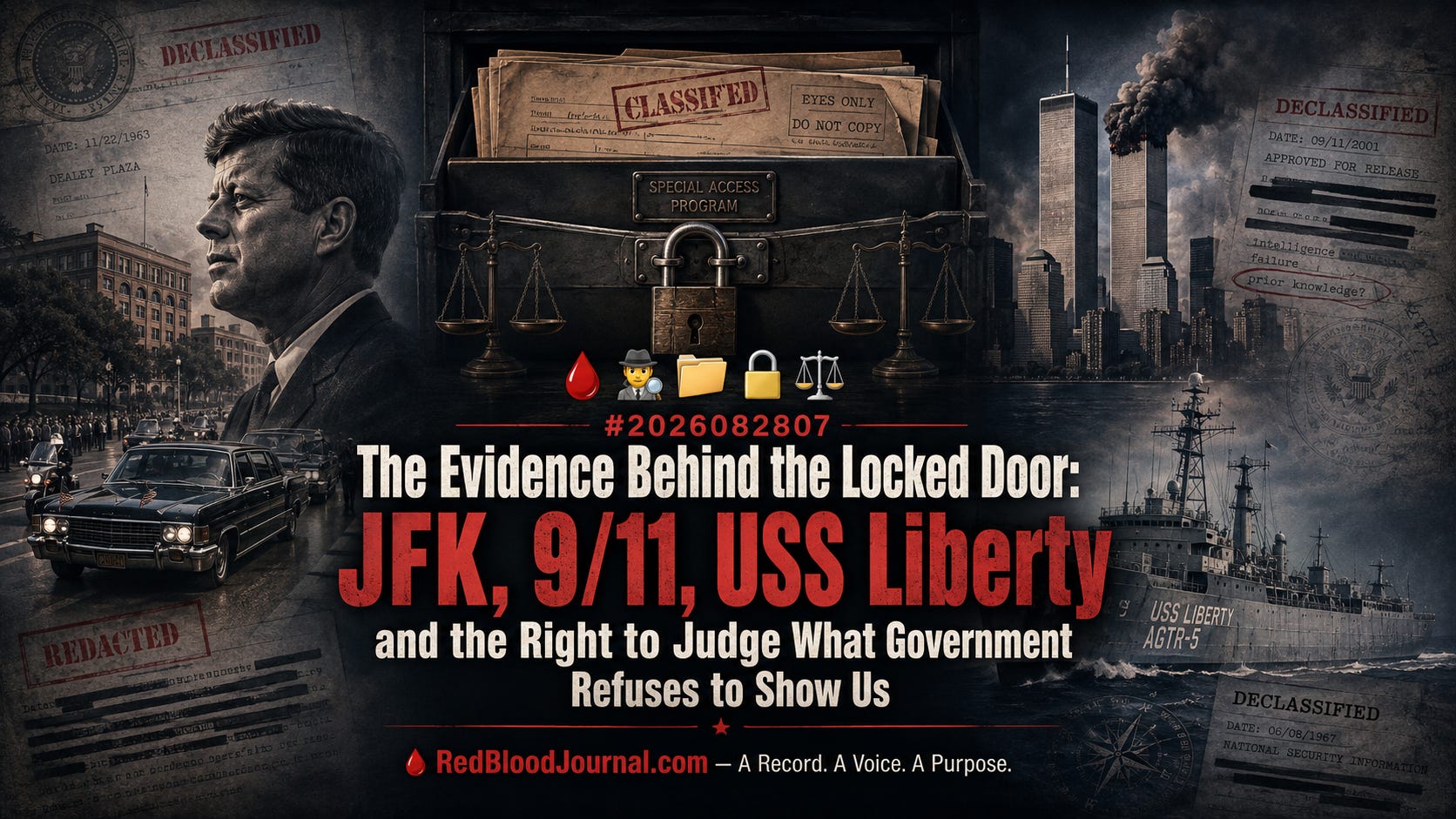
🩸 🕵️ 📁 🔒 ⚖️ #2026082807 — The Evidence Behind the Locked Door: JFK, 9/11, USS Liberty and the Right to Judge What Government Refuses to Show Us
🩸 RedBloodJournal.com — A Record. A Voice. A Purpose.
There comes a point when secrecy stops protecting credibility.
It begins destroying it.
Governments have repeatedly asked citizens to accept a remarkable arrangement:
Believe our conclusion.
Do not see all of the evidence.
Do not hear every recording.
Do not read every intelligence report.
Do not know every source.
Do not examine every internal communication.
Do not ask why some records disappeared.
Do not ask why others remained classified for decades.
Just believe the conclusion.
And when citizens refuse?
They are often told that their skepticism itself is the problem.
Red Blood Journal rejects that arrangement.
Freedom of thought does not require government permission.
If the government possesses information capable of answering a major historical question and keeps that information away from the public, citizens remain completely free to consider the withholding itself when forming their conclusions.
The locked door is part of the evidence.
🩸 Freedom of Thought Means Exactly That
There is no freedom of speech without freedom of thought.
And freedom of thought means no government agency owns the final interpretation of history.
The CIA may publish its explanation.
The FBI may publish its explanation.
The Pentagon may publish its explanation.
A congressional commission may publish its explanation.
A president may repeat that explanation.
Television networks may repeat it for fifty years.
Textbooks may print it.
None of that transfers ownership of the human mind to the institution making the claim.
A citizen remains free to say:
I do not believe you.
A citizen remains free to ask:
Show me the evidence.
And when the answer for generation after generation remains:
You cannot see it,
the citizen remains free to draw a conclusion from that too.
🔒 The Red Blood Presumption of Concealment
From this report forward, Red Blood Journal adopts a simple principle.
When a government institution possesses records that could materially clear that institution—or clarify its knowledge, conduct, foreknowledge, failures, relationships or responsibility—and continues withholding those records for an extraordinary period of time:
The withholding itself becomes evidence.
The public will not automatically assume that unseen evidence favors the institution hiding it.
The longer the secrecy continues, the greater the adverse inference becomes.
Ten years matters.
Twenty years matters more.
Fifty years changes the entire credibility equation.
Seventy years demands an extraordinary explanation.
A century of secrecy should not somehow strengthen the government’s presumption of innocence.
It should weaken it.
🇺🇸 JFK: More Than Sixty Years to Open the Cabinet
President John F. Kennedy was assassinated on November 22, 1963.
More than six decades later, Americans were still waiting for records associated with the assassination to be fully disclosed.
That fact alone deserves contemplation.
In March 2025, the National Archives announced that records previously withheld because of classification within the JFK Assassination Records Collection were finally being released pursuant to a presidential directive.
The Archives also disclosed something extraordinary: additional JFK-related FBI records had been located during a later inventory process and transferred to the National Archives in 2025.
Think about the timeline.
Then more releases.
Whatever anyone believes about Lee Harvey Oswald, the CIA, organized crime, Cuba, the Soviet Union or any alternative theory is secondary to the larger issue.
Why did material relevant to an event of enormous historical importance remain beyond complete public examination for generations?
The government cannot create decades of secrecy and then act surprised that decades of suspicion followed.
✈️ 9/11: Twenty-Five Years Later, Questions Still Belong to the Public
September 11, 2001 fundamentally transformed the United States.
Nearly 3,000 people were killed.
Wars followed.
The Department of Homeland Security followed.
The PATRIOT Act followed.
Mass surveillance expanded.
Airport security changed permanently.
American foreign policy changed.
Government power changed.
Entire regions of the world changed.
Yet citizens examining 9/11 have repeatedly encountered classified intelligence, redacted records, intelligence failures, disputed warnings and information released only years after the attacks.
The fundamental Red Blood question is therefore not:
Which theory must everyone believe?
It is:
Why should any citizen be forbidden—socially, intellectually or institutionally—from questioning an event whose underlying intelligence history was never completely available to that citizen in real time?
If the CIA possessed information before September 11 concerning al-Qaeda, hijackers, foreign intelligence contacts, threat reporting or operational warnings, then the public has every right to know the fullest possible history of what was known, when it was known and what was done with it.
If those records clear agencies of darker suspicions, release strengthens their case.
If they reveal incompetence, expose it.
If they reveal bureaucratic failure, admit it.
If they reveal something worse, history deserves that too.
The American people lived with the consequences.
They therefore deserve the record.
And Red Blood Journal will never tell a citizen that freedom of thought stops at the edge of an intelligence agency’s filing cabinet.
🚢 USS Liberty: An American Ship, American Dead and Questions That Refused to Sink
On June 8, 1967, during the Six-Day War, Israeli aircraft and torpedo boats attacked the American intelligence ship USS Liberty.
Thirty-four Americans were killed.
More than 170 were wounded.
Israel maintained that the attack resulted from mistaken identification.
Many surviving crew members and critics have disputed aspects of that explanation for decades.
What makes the episode especially relevant here is the documentary history surrounding it.
The NSA today maintains an extensive historical archive of previously classified USS Liberty records, including attack reports, communications material, intelligence documents, interviews, operational records and records concerning the subsequent inquiry.
Its own archive includes records concerning the Israeli Defense Forces’ admission that their forces torpedoed the ship, as well as U.S. fact-finding activity after the attack.
That raises the same philosophical question.
Why should an American citizen be required to inherit an official conclusion without independently examining everything that can still be examined?
The sailors were Americans.
The dead were Americans.
The ship flew the American flag.
The documents belong to American history.
No diplomatic relationship should own the citizen’s conclusion.
No alliance should require intellectual obedience.
And no passage of time should turn unanswered questions into forbidden questions.
🧠 MKULTRA: Yesterday’s “Conspiracy” Became Tomorrow’s Document
History gives us another reason not to treat institutional assurances as sacred.
MKULTRA existed.
The CIA conducted secret experiments involving behavioral modification and psychoactive drugs.
For years, the public did not know the scope of what had happened.
Records were destroyed.
Investigations came later.
Disclosure came later.
What would have sounded outrageous to many Americans before exposure eventually became part of the historical record.
This is precisely why freedom of thought matters.
Yesterday’s impossible accusation can become tomorrow’s declassified document.
That does not make every allegation true.
It means citizens should never surrender their ability to investigate simply because an institution tells them something is unthinkable.
🕵️ COINTELPRO: Surveillance That Wasn’t Supposed to Be Seen
The FBI’s COINTELPRO operations provide another example.
Political organizations, activists and Americans exercising constitutional rights were secretly monitored, infiltrated and disrupted.
The program did not become respectable because it was hidden.
The secrecy merely delayed public judgment.
Once documents emerged, citizens could finally judge actions that had already been taken in their name.
This pattern appears repeatedly:
First comes secrecy.
Then denial or silence.
Then discovery.
Then partial disclosure.
Then the explanation.
Then, many years later, history calmly acknowledges something that citizens once could have been ridiculed for suspecting.
🧪 The Tuskegee Study
For decades, African-American men suffering from syphilis were observed in a federal study while effective treatment was withheld from participants.
The study lasted from 1932 until 1972.
Imagine telling someone during those decades:
The government would never do something like that.
History eventually answered.
It did.
That does not mean governments always lie.
It means “the government would never do that” is not evidence.
History has permanently removed that argument from serious reasoning.
📄 The Pentagon Papers
The Pentagon Papers exposed a gap between what successive administrations publicly said about Vietnam and what officials privately understood.
Again, secrecy protected the narrative longer than it protected the truth.
Citizens could not evaluate information they were not permitted to see.
Once the documents emerged, the history changed.
Not because reality suddenly changed.
Because the public finally gained access to more of the reality that had existed all along.
🌊 Gulf of Tonkin
The Gulf of Tonkin episode became the basis for an extraordinary expansion of American involvement in Vietnam.
Later historical evidence complicated the original public understanding of what occurred, particularly concerning the reported second attack of August 4, 1964.
Here again stands the same lesson:
Governments make enormous decisions using information citizens cannot independently verify.
The consequences belong to the people immediately.
The evidence frequently arrives decades later.
☢️ Secret Radiation and Human Experiments
The United States also eventually acknowledged numerous Cold War-era radiation experiments involving human subjects.
Some participants had inadequate knowledge of what was being done.
Some records emerged only through later investigations.
Once again:
The unimaginable became documented history.
The lesson is not that every suspicion deserves belief.
The lesson is that authority does not deserve immunity from suspicion simply because authority possesses the documents.
🗂️ Operation Northwoods
Then there is Operation Northwoods.
Official documents revealed that senior U.S. military officials considered proposals in the early 1960s involving staged or fabricated incidents that could provide justification for military action against Cuba.
The proposals were never implemented.
That distinction matters historically.
The deeper lesson matters philosophically.
Ideas that ordinary citizens might once have dismissed as impossible were actually written inside government planning documents.
The file existed before the public knew it existed.
Reality did not begin when the document was declassified.
Public knowledge did.
🩸 This Is Why the Locked Door Matters
Consider the pattern:
JFK.
Decades of withheld assassination records.
9/11.
Intelligence questions and classified material surrounding an event that reshaped the world.
USS Liberty.
An attack killing American servicemen followed by decades of dispute and later declassification of extensive intelligence records.
MKULTRA.
Secret experimentation later acknowledged.
COINTELPRO.
Domestic surveillance and disruption eventually exposed.
Tuskegee.
Human beings harmed under government authority for decades.
The Pentagon Papers.
Private knowledge dramatically different from public assurances.
Gulf of Tonkin.
An event used to expand a war whose historical interpretation later became considerably more complicated.
Human radiation experiments.
Activities once hidden and later officially investigated.
Operation Northwoods.
Extraordinary proposals preserved inside government documents.
History teaches a very simple lesson:
Secrecy is not proof of innocence.
Sometimes secrecy protects legitimate intelligence.
Sometimes it protects living sources.
Sometimes it protects military capabilities.
Sometimes it protects diplomacy.
And sometimes history shows that secrecy protected institutions from accountability, embarrassment or public outrage.
Citizens therefore have every right to determine which explanation they believe.
⚖️ Who Has the Burden After Fifty Years?
This is where the traditional arrangement must be reversed.
Suppose the government holds a document concerning its own behavior.
The citizen asks for it.
The government refuses.
Twenty years pass.
The citizen asks again.
The government refuses.
Forty years pass.
Still classified.
Sixty years pass.
Still redacted.
Then someone tells the citizen:
You have no evidence.
Of course the citizen does not have the evidence.
The government has it.
That is precisely the problem.
The party controlling the locked room cannot demand that outsiders produce what is inside the room before they are permitted to question why the room is locked.
🚪 Open the Door
There is one remarkably effective solution to conspiracy theories.
It is not censorship.
It is not ridicule.
It is not algorithmic suppression.
It is not television experts.
It is not changing vocabulary.
It is not labeling people.
It is not telling citizens which questions respectable people are permitted to ask.
It is this:
OPEN THE FILES.
Release the documents.
Release the recordings.
Release the cables.
Release the photographs.
Release the intelligence assessments.
Release the internal correspondence.
Release everything whose disclosure can no longer reasonably endanger living people or active operations.
If the records clear the CIA:
Let them clear the CIA.
If they clear the FBI:
Let them clear the FBI.
If they clear the Pentagon:
Let them clear the Pentagon.
If they support the official account of JFK:
Release them.
If they strengthen the conventional history of 9/11:
Release them.
If they resolve the remaining controversies surrounding USS Liberty:
Release them.
Truth does not become weaker by being examined.
Only a story requiring protection fears examination.
🩸 The Red Blood Perspective
Red Blood Journal begins with the citizen.
Not the institution.
Not the intelligence agency.
Not the television network.
Not the political party.
Not the historian selected by government.
The citizen.
The citizen does not owe permanent intellectual obedience to institutions that maintain permanent secrecy.
From this point forward, when an institution possesses evidence capable of materially resolving allegations concerning its own conduct and keeps that evidence hidden beyond any reasonable period, Red Blood Journal will treat that continued concealment as part of the evidentiary record.
We will ask:
Who has the document?
Who classified it?
Who renewed the secrecy?
Who benefits from the public not seeing it?
What justification remains after the people involved are dead?
Could the record clear the institution?
And if so:
WHY IS IT STILL SECRET?
JFK does not belong to the CIA.
9/11 does not belong to the CIA.
USS Liberty does not belong to Israel, the Pentagon, the NSA or any administration.
Vietnam does not belong to the Pentagon.
MKULTRA does not belong to the intelligence community.
These events belong to history.
And history belongs to humanity.
No government owns the citizen’s conclusion.
No classification stamp owns the human mind.
🌊 The Ocean of Love and Positivity Perspective
And now the strangest thing happens.
After examining all these locked government doors, perhaps we discover that the most important door was never in Washington.
It was inside ourselves.
Governments hide records.
Human beings hide memories.
Institutions protect narratives.
Human beings protect identities.
Agencies redact embarrassing passages.
We redact parts of ourselves.
A government can spend sixty years defending a version of history because admitting something different would threaten its legitimacy.
A person can spend sixty years doing exactly the same thing.
We tell ourselves:
That wasn’t why I did it.
I wasn’t afraid.
I wasn’t jealous.
I didn’t know better.
I had no choice.
It was everyone else’s fault.
And somewhere deep inside sits the unredacted document.
We already know.
That is where freedom of thought reaches its highest form.
Not when we gain the courage to question the CIA.
Not when we question the FBI.
Not when we question presidents, generals, intelligence agencies, historians or television networks.
Those are comparatively easy.
The greatest act of intellectual freedom occurs when the observer turns around and questions himself.
What story have I been protecting?
What evidence have I refused to examine?
What memory remains classified?
What truth would change the story I tell about who I am?
What part of my life have I spent blaming on someone else because opening my own archive would hurt?
That is the archive no Freedom of Information Act can reach.
No president can declassify it.
No congressional committee can subpoena it.
No journalist can leak it.
Only the person carrying it possesses the key.
And here is the beautiful part.
Unlike governments, we do not have to wait seventy years.
We can open it today.
Maybe we discover that we were wrong.
Fantastic.
We learned.
Maybe we discover that someone hurt us and we carried the wound much longer than the event itself.
Fantastic.
Now we can put it down.
Maybe we discover that the enemy we fought for twenty years existed mostly inside our own fear.
Fantastic.
The war can end.
Maybe we discover that underneath all the explanations, defenses, identities and stories there remains something extraordinarily simple:
The observer.
The quiet consciousness watching all of it.
The driver who was there before the argument began.
The part that does not need to win history.
The part that only needs to understand it.
And suddenly the lesson becomes larger than JFK.
Larger than 9/11.
Larger than USS Liberty.
Larger than the CIA.
Larger than America.
Every locked door eventually asks the same question:
Are we brave enough to know what is behind it?
For governments, that answer may take generations.
For us, it can happen now.
Open the inner archive.
Remove the redactions.
Stop defending yesterday’s story.
Look directly at what is there.
Understand it.
Accept it.
Learn from it.
And then let it go.
Because the ultimate freedom is not merely possessing the right to question everyone else.
It is becoming so completely free inside yourself that no hidden file, government narrative, old wound, fear, institution or ideology can own your mind again.
That is freedom of thought.
That is personal sovereignty.
That is graduation.
And perhaps when enough people become unafraid of truth inside themselves, humanity will finally stop being so afraid of truth outside itself.
In an Ocean of Love and Positivity.
🩸🌊✨ Fantastic!
🔓
The Locked Door: Secrecy, History, and the Freedom of Thought
Aug 28, 2026
The provided text from Red Blood Journal serves as a manifesto against government secrecy, arguing that the prolonged withholding of evidence regarding major historical events undermines official credibility. By examining cases like the JFK assassination, 9/11, and the USS Liberty, the author asserts that the act of concealment itself should be viewed as an adverse inference against state institutions. The source demands the full declassification of records to restore freedom of thought and allow citizens to judge history independently. Ultimately, the narrative shifts toward a philosophical reflection, suggesting that true intellectual sovereignty requires individuals to confront their own internal archives with the same transparency they demand from the state. This dual perspective bridges the gap between institutional accountability and the personal pursuit of unfiltered truth.
JFK, 9/11, USS Liberty, CIA, Government Secrecy, Classified Records, Declassification, Intelligence Agencies, Freedom of Thought, Government Accountability, Historical Records, National Security


