


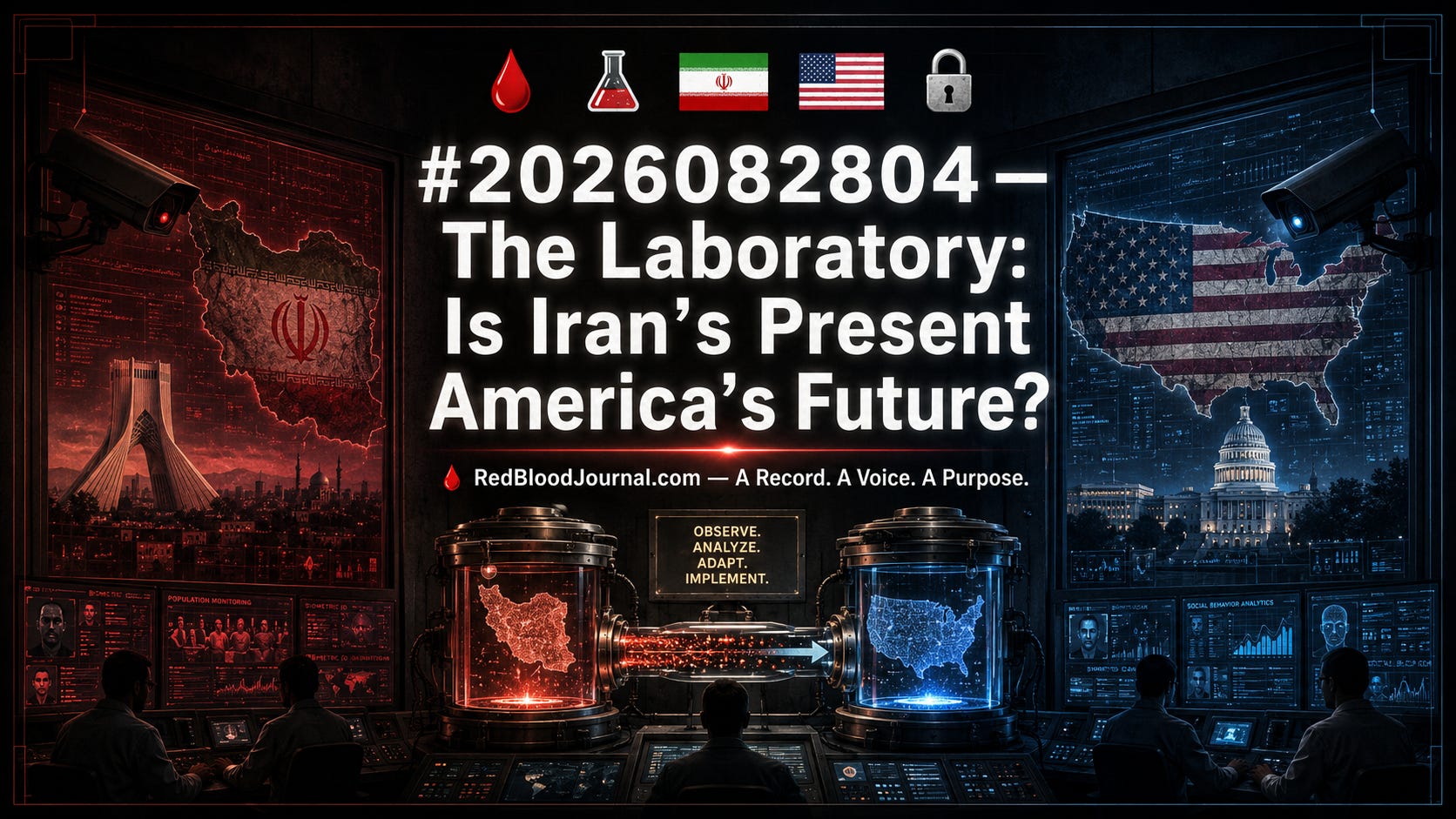
🩸 🧪 🇮🇷 🇺🇸 🔒 #2026082804 — The Laboratory: Is Iran’s Present America’s Future?
The governing thesis
🩸 RedBloodJournal.com — A Record. A Voice. A Purpose.
What if Iran is not merely America’s enemy?
What if Iran is also a laboratory?
Not necessarily a laboratory controlled by one government, one intelligence agency, one billionaire, or one secret room. That claim would require evidence we do not have.
The larger and more defensible question is more disturbing:
Are modern societies collectively discovering which methods of population management actually work—and then borrowing the successful ones from one another?
Iran represents an advanced example of what happens when enough mechanisms accumulate:
identity → permission → surveillance → economic dependence → information control → fear → self-censorship.
And the United States increasingly possesses technological versions of many of the same capabilities, even though its political and constitutional system remains substantially different.
That distinction is important.
Because the argument should not be:
America is Iran.
It should be:
Iran may be showing America what America could become.
Iran today provides an extreme case study in centralized control over information. Just this week, proposed Iranian legislation was reported that could criminalize unauthorized communication with foreign media, potentially bringing prison sentences for citizens simply for communicating outside approved channels.
Now move across the ocean.
America has not reached that point.
But something different is being built.
Federal agencies already employ facial-recognition technology, while the U.S. Commission on Civil Rights has warned that federal regulation and oversight have lagged behind its deployment.
Private automated license-plate-reader networks have become extensive enough that Senator Josh Hawley opened an investigation this week into Flock Safety, questioning the collection, retention and distribution of Americans’ movement data.
Age verification is expanding as another infrastructure layer. The FTC has explicitly encouraged certain age-verification technologies for online child protection, while Meta is introducing automated age-assurance systems and broader restrictions on teenage accounts.
Every individual measure can have a reasonable explanation.
Protect the child.
Find the criminal.
Stop terrorism.
Prevent fraud.
Verify identity.
Maintain public order.
And that may be precisely where the comparison becomes interesting.
Control rarely arrives labeled “control.”
Iran did not wake up one morning with every mechanism of the present system fully constructed.
Institutions accumulate.
Databases accumulate.
Authorities accumulate.
Exceptions accumulate.
Emergencies accumulate.
And citizens gradually adjust their behavior around them.
The most sophisticated control system is not necessarily the one with police standing on every corner.
It is the one in which people know the cameras exist, know their communications can be examined, know their livelihood depends upon compliance, and eventually modify themselves without anyone giving an order.
That is the transition from external control to self-policing.
And technologically, America could build something vastly more capable than Iran ever could.
Iran has the primitive version. America can build the digital version.
Iran’s model historically depends heavily upon visible state power.
Police.
Courts.
Government-controlled institutions.
Filtering.
Licensing.
Physical enforcement.
The American version would not necessarily resemble that at all.
It could be distributed among:
government agencies,
banks,
employers,
insurance companies,
technology platforms,
data brokers,
AI systems,
identity providers,
payment networks,
telecommunications companies,
and automated risk-scoring systems.
No Ministry of Information would be required.
No single dictator would even be required.
The citizen could simply encounter:
ACCESS DENIED.
Account suspended.
Payment rejected.
Insurance unavailable.
Content removed.
Identity verification required.
Travel flagged.
Application declined.
Visibility reduced.
And nobody behind the counter would necessarily have made the decision.
The system made it.
That could be considerably more powerful than Iran’s present model.
The experiment may not even require experimenters
This is where the “owners” idea becomes philosophically stronger if Red Blood does not insist upon a literal secret committee.
Systems learn.
Governments observe governments.
Corporations observe governments.
Technology companies observe populations.
Military organizations study adversaries.
Police departments study other police departments.
Authoritarian governments learn from democracies.
Democracies learn techniques developed under authoritarian conditions.
Successful mechanisms travel.
The question therefore becomes less:
“Who owns the laboratory?”
and more:
“Who is studying the results?”
Iran demonstrates how much economic pressure a population can absorb.
It demonstrates how populations behave under currency destruction.
It demonstrates the effects of information restrictions.
It demonstrates the relationship between surveillance and dissent.
It demonstrates how institutions preserve themselves despite widespread dissatisfaction.
It demonstrates how citizens develop parallel economies and communications systems.
It even demonstrates the limits of control.
Iran is therefore useful not merely as a geopolitical opponent.
It is a case study in human behavior under sustained institutional pressure.
And America is simultaneously constructing technologies Iran’s rulers could only dream of.
But there is one enormous difference
America still possesses mechanisms that Iran severely restricts:
competitive political organization,
independent civil society,
constitutional litigation,
a largely open Internet,
multiple competing media organizations,
federalism,
and extensive protections for speech and association.
Today’s disputes over surveillance themselves demonstrate that difference. American lawmakers, courts, journalists and civil-liberties groups can openly challenge these systems.
Those protections make the statement
“America has become Iran”
wrong.
But they do not make the warning meaningless.
Because institutions survive only while people defend the principles beneath them.
And that leads to the Red Blood conclusion
Perhaps America’s future is not today’s Iran.
Perhaps it is something far more sophisticated.
Iran may be the analog prototype.
America has the technology to produce the digital edition.
Iran requires censorship.
Algorithms can produce invisibility.
Iran requires police checkpoints.
Databases can produce continuous location histories.
Iran requires government files.
Modern societies voluntarily generate their own files every hour.
Iran must watch its citizens.
We carry the watching devices ourselves.
That is why the comparison should not end with Iran.
It should end with the mirror.
The frightening possibility is not that somebody will suddenly announce:
“America will now become Iran.”
Nothing so dramatic is necessary.
Each new mechanism can arrive separately.
Each can solve a legitimate problem.
Each can appear temporary.
Each can seem harmless alone.
Until one generation finally looks around at the combined architecture and asks:
When did permission replace freedom?
And nobody can identify the day.
Because there wasn’t one.
There were thousands.
🩸 The Red Blood Perspective
The greatest danger may therefore be misunderstanding what a laboratory looks like.
Perhaps there is no scientist standing behind the glass.
Perhaps civilization itself is conducting the experiment.
Every country is showing every other country what populations will tolerate, what technologies work, what enforcement fails, what propaganda persuades, what economic pressure breaks people, and what mechanisms quietly produce obedience.
Iran’s tragedy then becomes larger than Iran.
It becomes data.
And America possesses the money, technology and institutional reach to transform lessons learned elsewhere into systems far more efficient than the originals.
The warning is not that the United States will someday look exactly like Iran.
It won’t.
The warning is that someday Americans may experience many of the same relationships between citizen and power—
while everything still looks unmistakably American.
And that may be the most important sentence in the entire report:
The United States does not have to look like Iran for the American future to become the Iranian present.
🌊 The Ocean of Love and Positivity Perspective
And yet the laboratory contains another result that power repeatedly overlooks.
Human beings keep searching for freedom.
Iran proves that too.
Pressure can regulate behavior.
Technology can observe movement.
Institutions can restrict choices.
Fear can silence a voice temporarily.
But none of those instruments can enter the deepest place where a human being decides who is driving.
That is where sovereignty begins.
Before demanding freedom from the enormous systems outside, the individual can examine the smaller government operating inside:
What controls my fear?
What controls my anger?
What controls my desires?
What makes my decisions for me?
What information do I accept without examination?
What authority have I surrendered voluntarily?
A person who cannot govern the self will always be vulnerable to someone offering to do the governing for them.
And a society composed of people who recover that inner responsibility becomes extraordinarily difficult to control from the outside.
Perhaps that is the experiment neither Iran nor America can complete for us.
That experiment belongs to each individual.
Life is still a school, not a courtroom.
And perhaps Iran’s present does not have to become America’s future at all.
Perhaps Iran’s present can become the warning that prevents it.
In an Ocean of Love and Positivity.
🩸🌊✨ Fantastic!
👁️
The Laboratory: Iran’s Present as America’s Future
Aug 28, 2026
This text explores the concerning hypothesis that Iran functions as a sociological laboratory for methods of population control that may eventually be adopted by Western nations like the United States. While the two countries possess vastly different legal systems, the author argues that advanced digital infrastructure—such as facial recognition, data brokerage, and automated financial restrictions—could allow America to implement a more invisible and efficient form of centralized management. Rather than relying on overt state violence, this potential American model would utilize a distributed network of private and public institutions to enforce compliance through “access denied” moments. The narrative suggests that global governing bodies observe one another to see what modern populations will tolerate, leading to a gradual accumulation of surveillance that eventually replaces genuine freedom with a system of self-censorship. Ultimately, the source serves as a warning that a society does not need to look like a traditional dictatorship to exert the same suffocating levels of institutional pressure on its citizens. To counter this trend, the author emphasizes the importance of individual sovereignty and self-governance as the final defenses against external control.
#RedBloodJournal #TheLaboratory #Iran #UnitedStates #America #Surveillance #GovernmentControl #DigitalControl #CivilLiberties #Freedom #Privacy #Censorship #FacialRecognition #DigitalIdentity #PopulationControl #Authoritarianism #Technology #Governance #IranPresentAmericaFuture #OceanOfLove


