


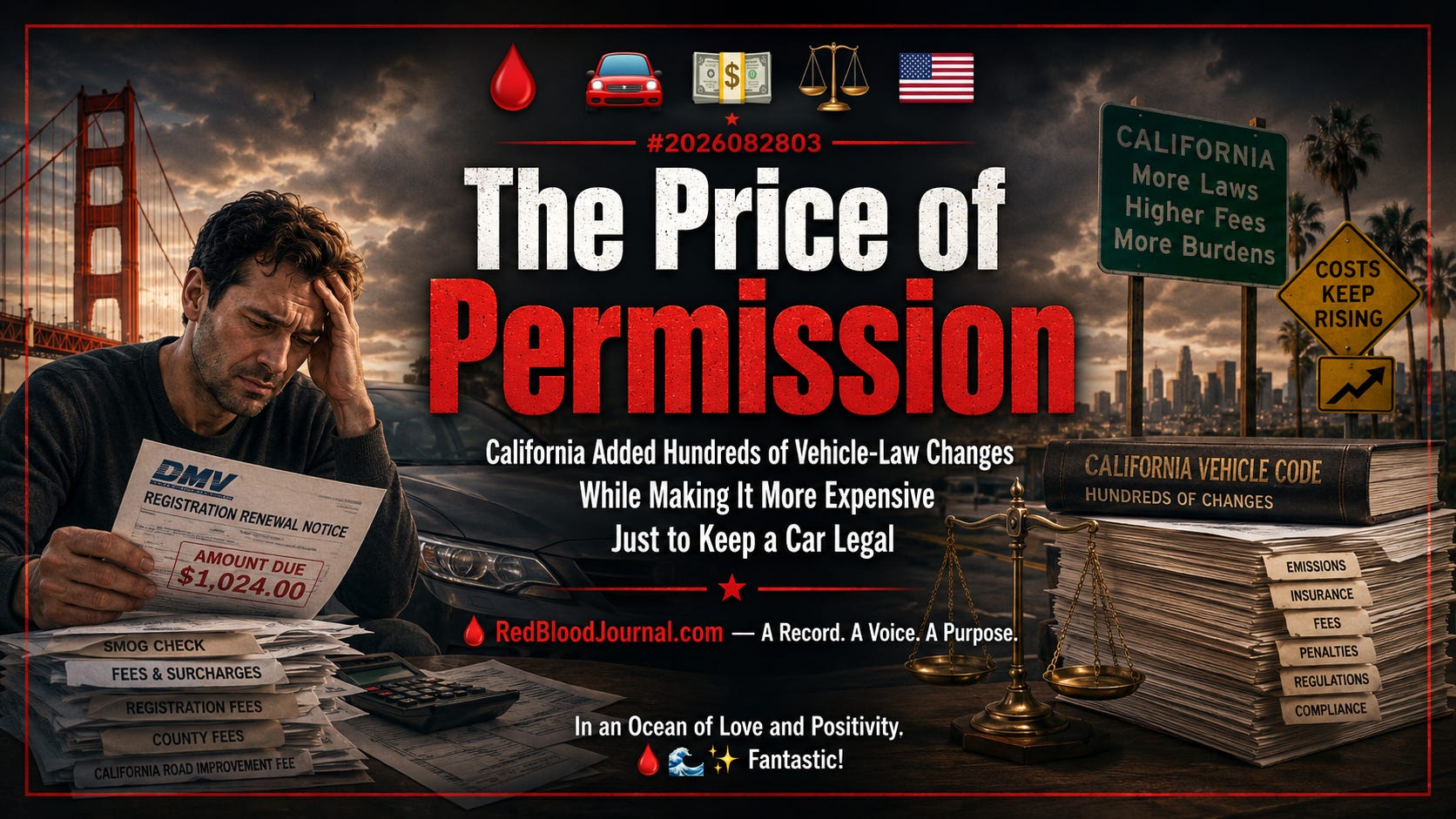
🩸 🚗 💵 ⚖️ 🇺🇸 #2026082803 — The Price of Permission: California Added Hundreds of Vehicle-Law Changes While Making It More Expensive Just to Keep a Car Legal
The automobile did not simply become more expensive. The permission to own, register, insure and legally operate one became more expensive too.
🩸 RedBloodJournal.com — A Record. A Voice. A Purpose.
For millions of Californians, a car is not a luxury.
It is how they get to work.
It is how they take their children to school.
It is how they buy groceries, visit family, see a doctor, reach a second job and survive in communities built around distances that cannot realistically be walked.
Yet during roughly the last decade, something has happened almost quietly.
The driver has been surrounded by more rules.
The vehicle has been surrounded by more fees.
The cost of ownership has climbed.
The cost of compliance has climbed.
And the legal book governing the entire relationship between the citizen, the automobile and the road has continued growing and changing.
The question is no longer merely:
Why are cars so expensive?
The deeper question is:
How expensive has California made the permission to drive?
Hundreds of Changes in One Decade
California does not publish one convenient number labeled:
“Number of new driving laws added during the last ten years.”
That makes the question surprisingly difficult to answer.
The California Senate Transportation Committee publishes legislative summaries covering the enormous range of transportation legislation considered by the state: rules of the road, driver’s licenses, vehicle registration, enforcement, automobiles, commercial vehicles, autonomous vehicles, parking, towing and much more.
Looking across the decade, a reasonable working estimate is that California enacted around 300 separate motor-vehicle-related legislative measures or substantial changes affecting drivers, vehicles, licensing, registration, enforcement and road use.
If every individual Vehicle Code section and subsection amended by those bills were counted separately, the number would be considerably higher — well into the hundreds.
That distinction matters.
One bill may be described publicly as one new law while changing numerous provisions of the legal code.
So saying California created “300 new driving laws” would be too simplistic.
A more accurate statement is:
During roughly the last decade, California has enacted around 300 legislative measures or substantial statutory changes affecting motorists and vehicles, collectively touching hundreds of individual legal provisions.
And 2026 is not finished yet.
The Driver Does Not Get a New Test Every January
This creates an unusual situation.
A person may have taken California’s written driving examination years — perhaps decades — ago.
That examination tested the rules existing at that moment.
The driver receives a license.
Then the Legislature continues changing the rules.
Year after year.
The driver does not normally return to DMV every January to demonstrate knowledge of everything that changed.
Yet ignorance of a new law generally does not erase responsibility for violating it.
Consider just some of the rules taking effect in 2026.
California expanded its Slow Down, Move Over requirement to additional stationary vehicles.
It changed provisions involving DUI offenders.
It established new automated traffic-enforcement authority.
It created a $1,000 infraction involving manufacture of devices intended to obscure license plates.
It made additional changes involving autonomous vehicles, motorcycles, parking and driver licensing.
That is one year.
Then comes another.
And another.
And another.
But Regulation Is Only Half the Story
While the legal environment has expanded, the financial environment surrounding the automobile has changed too.
AAA calculated the average cost of owning and operating a new vehicle in 2025 at:
$11,577 per year
or approximately:
$965 every month.
AAA’s calculation includes depreciation, financing, fuel, insurance, maintenance, repairs, tires, registration, licensing and taxes, assuming 15,000 miles of annual driving.
In 2016, AAA’s comparable national ownership estimate was approximately $8,558 per year.
That puts the increase at roughly:
$3,019 more per year
or:
about 35% higher.
And that is a national calculation.
California drivers live inside an additional layer of state-specific costs.
Then Came the Transportation Improvement Fee
One of the clearest examples is California’s Transportation Improvement Fee.
It did not exist as part of ordinary vehicle registration before 2018.
Today DMV lists the annual TIF according to vehicle value:
Vehicle valueTransportation Improvement Fee$0–$4,999$33$5,000–$24,999$66$25,000–$34,999$132$35,000–$59,999$198$60,000+$231
That is not the entire registration bill.
It is one component.
California DMV says an on-road vehicle may also be subject to:
registration fees,
California Highway Patrol fees,
Vehicle License Fees,
Transportation Improvement Fees,
county or district fees,
and other applicable charges.
The basic registration/renewal fee itself is currently $76.
The Vehicle License Fee is generally 0.65% of the vehicle’s value.
And depending upon the automobile and location, additional charges can apply.
Electric Cars Did Not Escape the System Either
California encouraged motorists to move toward zero-emission vehicles.
But as gasoline-tax revenue became an issue, the state also created a separate Road Improvement Fee for qualifying zero-emission vehicles.
For model-year 2020 and newer zero-emission vehicles subject to the charge, DMV currently lists the Road Improvement Fee at:
$121 per year.
The message becomes interesting.
Use gasoline?
Pay taxes through gasoline.
Move away from gasoline?
Another mechanism emerges to capture road revenue.
The technology changes.
The collection mechanism adapts.
Fees That Can Increase Without a Political Headline
There is another important development that receives far less attention than a major tax increase.
Many DMV fees are subject to periodic adjustments.
DMV’s own current rulemaking page lists an Annual Fee Adjustment, effective January 1, 2026.
That means the financial burden does not necessarily require a dramatic new political battle every time the dollar amount changes.
Once an adjustment mechanism exists, the number itself can continue moving.
A $25 fee becomes something larger.
A $175 maximum becomes something larger.
A collection system becomes normalized.
Eventually the driver stops asking why the charge exists.
The driver simply pays the renewal notice.
The Cost of Breaking the Rules Rises Too
There is another category that ordinary ownership calculations do not fully capture:
the cost of being wrong.
A traffic violation can bring:
a fine,
court assessments,
insurance consequences,
points,
traffic school,
lost working time,
towing,
impoundment,
or increased insurance premiums.
And as the number and complexity of rules increases, the citizen is expected to remain current.
This creates an asymmetry.
The government has professional legislative staffs, attorneys, committees, regulators and agencies dedicated to writing, interpreting and enforcing the rules.
The ordinary driver has:
a glove compartment.
Perhaps a driver’s handbook.
Perhaps a DMV email.
Perhaps a news story announcing that several laws changed on January 1.
Then Monday morning arrives and the driver goes to work.
What Exactly Are We Paying For?
This report is not an argument that traffic laws should disappear.
Some laws clearly save lives.
Child-restraint requirements save children.
Drunk-driving laws protect everyone.
Move Over laws protect emergency and roadside workers.
Vehicle-safety standards prevent injuries.
Rules are necessary whenever millions of independent vehicles share the same roads.
The question is not:
Should there be rules?
The question is:
At what point does necessary regulation become an accumulating financial and legal burden that ordinary citizens can no longer realistically track?
Those are very different questions.
The Hidden Cost Is Compliance
When people discuss the increasing cost of automobiles, the conversation usually centers on:
the purchase price,
gasoline,
interest rates,
insurance,
repairs,
and depreciation.
But there is another category.
Compliance.
Registration.
Inspection.
Smog requirements.
License requirements.
Taxes.
Fees.
Equipment requirements.
Insurance requirements.
Parking regulation.
Toll rules.
New technology mandates.
Changing traffic rules.
Penalties for failing to understand them.
The cost of the vehicle is one thing.
The cost of keeping the vehicle legally acceptable to the state is another.
That distinction deserves far more attention.
A Car Is Becoming a Subscription to the Road
There was a time when automobile ownership was conceptually simple.
Buy the vehicle.
Register it.
Insure it.
Maintain it.
Drive it.
Today ownership increasingly resembles a continuing subscription.
Registration expires.
Insurance renews.
Fees recur.
Rules change.
Technology requirements evolve.
Road charges change.
Taxes change.
Enforcement technology expands.
Automated cameras appear.
Electronic tolling expands.
The physical automobile may belong to the citizen.
But access to the public road remains conditional.
And maintaining that permission costs money every year.
The Most Important Number May Not Be 300
We began by asking:
How many driving-related laws changed?
Approximately 300 legislative measures or substantial changes over the decade is a useful working estimate.
But perhaps that is not the most important number.
The more revealing number may be:
365.
Because every single day, millions of Californians wake up needing transportation.
The warehouse worker.
The nurse.
The gardener.
The rideshare driver.
The construction worker.
The hotel employee.
The parent taking children to school.
The person working two jobs.
The small-business owner.
For them, an automobile is not primarily an environmental debate, transportation-policy theory or legislative abstraction.
It is:
How do I get there tomorrow morning?
That is where policy eventually meets reality.
The Red Blood Perspective
🩸 Red Blood is all about citizens.
A society has every right to demand responsible behavior on shared roads.
But responsibility must work in both directions.
If citizens are expected to know the law, government has a responsibility to make that law reasonably understandable and accessible.
If citizens are required to maintain vehicles to legal standards, government should remain conscious of how much cumulative compliance costs.
And if hundreds of legal provisions are changed over a decade, perhaps the question should not only be:
Did Sacramento properly publish the change?
Perhaps it should also be:
Did the ordinary person have any realistic chance of knowing it changed?
There is a difference between publication and communication.
There is a difference between legality and comprehensibility.
And there is a difference between regulating something and slowly making participation unaffordable.
Transportation freedom matters because economic freedom often begins with physical movement.
When someone cannot afford to move, their choices shrink.
Where they can work shrinks.
Where they can live shrinks.
Who they can visit shrinks.
Their world becomes smaller.
That deserves consideration whenever another seemingly small fee, rule or penalty is added.
Because governments rarely make an activity unaffordable with one giant decision.
It often happens through hundreds of little ones.
The Ocean of Love and Positivity Perspective
And then the external argument can be left behind.
Because there is something useful hidden inside even this subject.
The growing rulebook asks a larger personal question:
How much of life is being lived automatically?
A renewal arrives.
Pay it.
A new rule arrives.
Accept it.
Insurance rises.
Pay it.
Gas rises.
Pay it.
Another fee appears.
Pay it.
Another regulation arrives.
Adjust.
Eventually a human being can spend an entire life reacting without ever stopping to examine the system around them — or the system inside them.
The automobile becomes another teacher.
It asks:
Who is driving?
Not merely who holds the steering wheel.
Who is driving the life?
The world will always produce rules, prices, expectations, pressures and obstacles.
Some will be reasonable.
Some will be excessive.
Some can be changed.
Some cannot.
But none of them has to take possession of the inner driver.
Know what is happening.
Understand what is being asked.
Question what deserves questioning.
Accept what cannot presently be changed without surrendering the mind to it.
Change what can be changed.
And never confuse the cost of permission in the outside world with the value of the person inside the vehicle.
The registration belongs to the car.
The rules belong to the road.
The fees belong to the system.
But the driver within still belongs to itself.
That realization costs nothing.
No Legislature can increase its fee.
No DMV can suspend it.
No camera can photograph it.
No renewal notice can expire it.
And perhaps that is why even a discussion about hundreds of laws and thousands of dollars can eventually lead back to the same place.
Not Sacramento.
Not the DMV.
Not the highway.
Inside.
Where the real driver has been sitting all along.
In an Ocean of Love and Positivity.
🩸🌊✨ Fantastic!
⚖️
The Price of Permission: California’s Rising Cost of Compliance
Aug 28, 2026
This report examines the escalating financial and regulatory burdens placed on California motorists over the last decade. The state has implemented roughly 300 legislative measures affecting vehicle ownership, creating a complex legal landscape that is increasingly difficult for the average citizen to navigate. Beyond the rising purchase price of cars, drivers face a surge in compliance costs, including new registration fees, zero-emission vehicle charges, and automated inflation-based adjustments. These cumulative changes transform vehicle ownership into a costly subscription model, disproportionately impacting those who rely on cars for essential daily needs. Ultimately, the source argues that while road safety is vital, the sheer volume of rules and fees risks making transportation freedom unaffordable. The text concludes by encouraging individuals to remain aware of these systemic pressures without losing their personal sense of autonomy and inner peace.
#RedBloodJournal #California #CaliforniaDMV #DrivingLaws #VehicleLaws #CostOfDriving #CarOwnership #DMVFees #RegistrationFees #CaliforniaDrivers #CostOfLiving #Transportation #GovernmentRegulation #Driving #PriceOfPermission #CitizensFirst #OceanOfLove


