


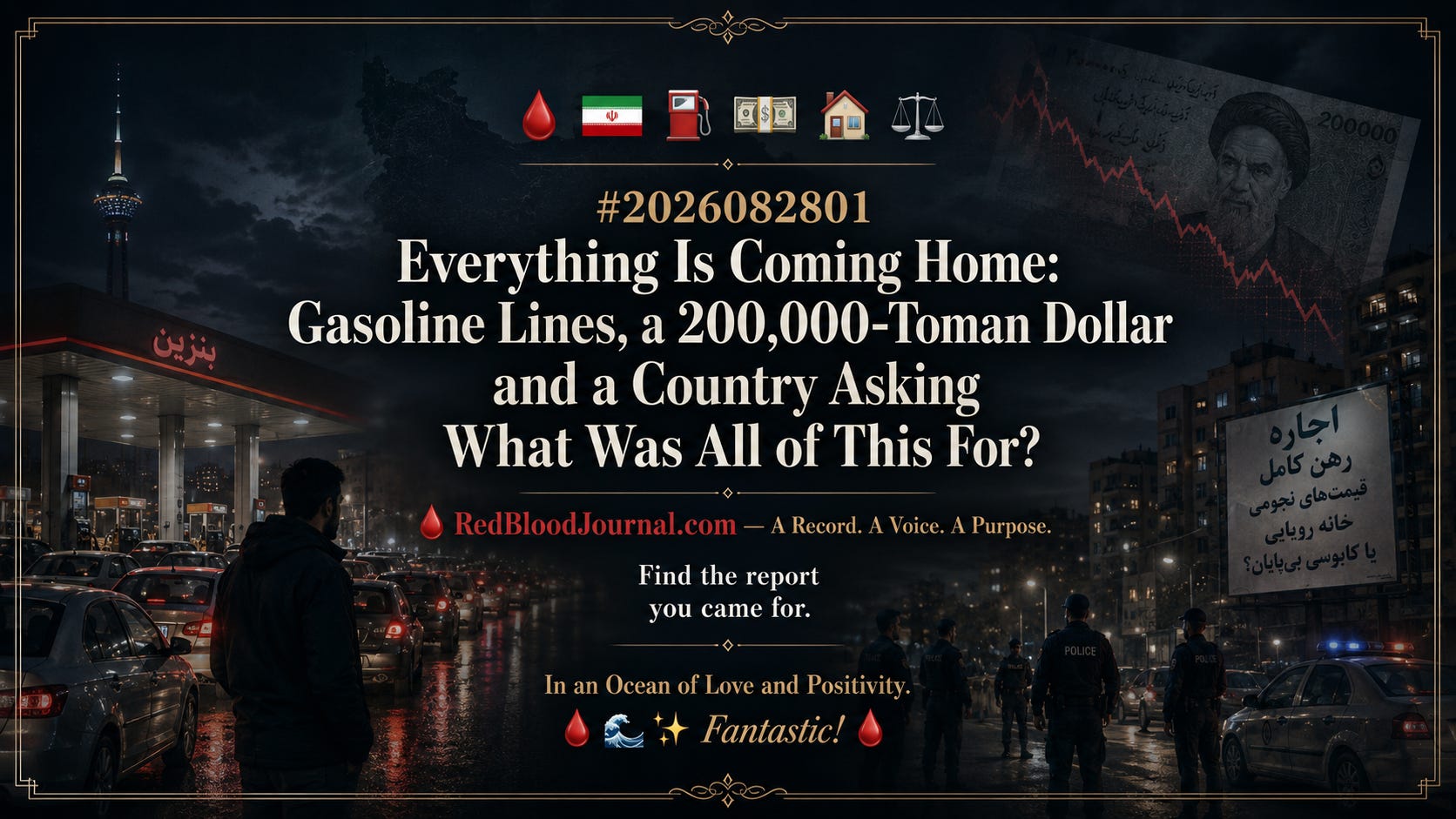
🩸 🇮🇷 ⛽ 💵 🏠 ⚖️ #2026082801 — Everything Is Coming Home: Gasoline Lines, a 200,000-Toman Dollar and a Country Asking What Was All of This For?
🩸 RedBloodJournal.com — A Record. A Voice. A Purpose.
Iran is not facing one crisis.
It is facing several crises that are beginning to meet each other in the same street.
The gasoline line meets the falling rial.
The falling rial meets the unpaid rent.
The unpaid rent meets the exhausted shopkeeper.
The exhausted shopkeeper meets the frightened government.
And behind all of them stands the same question:
How much pressure can a society absorb before separate problems stop looking separate?
The latest picture from inside Iran is not simply one of fuel shortages or inflation.
It is the picture of a system being forced to confront the accumulated cost of its own priorities.
⛽ The Gasoline Line Has Reached Tehran
The report begins with long gasoline lines, including queues extending late into the night.
What had previously been described as a more serious problem in some southern provinces had now reached Tehran.
That matters politically.
A gasoline shortage in a distant province can be treated as a logistical problem.
A gasoline shortage in the capital becomes something else.
It becomes visible.
It becomes shareable.
It becomes conversational.
And, most importantly, it becomes a place where people who normally suffer separately suddenly stand together.
That is why a gasoline station can become more than a gasoline station.
It can become a meeting point for frustration.
🚔 The Government Appears to Understand That Risk
According to the report, police units, special forces and mobile patrols were placed around major gasoline stations and heavily traveled intersections in Tehran.
The stated concern was not merely traffic control.
The report says authorities feared that gasoline lines could become centers of protest or that citizens could document what was happening and spread it through the media.
That distinction is important.
If the main problem were only gasoline distribution, the answer would be tankers, schedules and supply management.
If the answer includes security deployments, then the government is responding not only to the shortage.
It is responding to what the shortage could become.
⏳ “Nothing Will Change Until the End of Shahrivar”
Government spokespeople tried repeatedly to reassure the public.
The existing subsidized gasoline allocations — 60 liters at 1,500 tomans and 50 liters at 3,000 tomans — were said to remain in place through the end of Shahrivar.
Officials also insisted that strategic reserves were sufficient and that people should not worry.
But reassurance can sometimes create another question.
Why promise stability only until a particular date?
The transcript itself focuses on that ambiguity.
The subsidized quotas were explicitly discussed.
The future price of freely purchased gasoline was left less clear.
And so the public hears two messages simultaneously:
Do not worry.
And:
We are still deciding.
That combination rarely produces calm.
⚖️ When Public Policy Starts Counting Bodies
One of the most disturbing parts of the report is not about gasoline itself.
It is about the language used to discuss what may happen if gasoline prices rise or shortages continue.
Economist Sadegh al-Hosseini is presented arguing that painful reforms should happen sooner rather than later because larger disorder later could produce a higher human cost.
He describes politics as minimizing the amount of blood spilled while maximizing public welfare.
The narrator reacts strongly to that formulation.
And the reason is understandable.
There is a profound difference between saying:
How do we prevent people from being killed?
and saying:
Which policy results in fewer people being killed?
The second formulation assumes that killing has already entered the spreadsheet.
It turns bloodshed into a variable.
A cost.
A number to optimize.
The transcript’s central accusation is that this reveals something deeper about how political decision-making has become normalized inside the system.
The gasoline debate is therefore no longer just about economics.
It becomes a debate about the relationship between government and governed.
💵 The Dollar Near 200,000 Tomans
While the government struggles with gasoline, the currency crisis continues.
The report describes the dollar reaching approximately 200,000 tomans.
It contrasts this with the failed expectation that pressure in the Strait of Hormuz would send international oil prices soaring.
Instead, the report argues, the dramatic price explosion occurred inside Iran — in the value of the dollar against the national currency.
This is the invisible tax that reaches everyone.
The worker.
The pensioner.
The shopkeeper.
The renter.
The family buying food.
Even someone who never sees a dollar bill experiences its movement through the price of imported goods, replacement parts, medicines, appliances, rent expectations and the general psychology of the market.
A currency collapse does not remain on the currency exchange board.
It enters the kitchen.
🧾 The Merchant Is Running Out of Road
The transcript describes merchants facing an extraordinary recession and points to bounced checks among businesses approaching bankruptcy.
This is where a macroeconomic crisis becomes personal.
A shop can survive weak sales for a while.
It can survive higher costs for a while.
It can survive currency instability for a while.
But eventually the chain tightens.
The customer cannot buy.
The merchant cannot sell.
The merchant cannot pay the supplier.
The supplier cannot replace inventory.
Checks bounce.
Credit disappears.
Trust disappears with it.
And once commercial trust begins breaking down, the economy becomes slower even before anything officially collapses.
People stop taking risks because tomorrow’s price is unknown.
🏠 When Rent Becomes a Question of Survival
Then the report turns to perhaps its darkest domestic subject.
It discusses religious and legal seminars examining temporary marriage between a tenant and a property owner in situations where rent cannot be paid.
The narrator interprets the concept as potentially allowing sexual access to substitute for money in the landlord-tenant relationship.
The report is explicit about why it finds this horrifying.
The central issue is not simply theology.
It is power.
What does “consent” mean when one person owns the roof and the other fears sleeping in the street?
What happens when economic desperation becomes part of a sexual bargain?
The transcript imagines the danger expanding beyond rent.
If desperation can transform one unpaid bill into another kind of transaction, why would the logic stop with landlords?
That is the deeper warning.
When ordinary money stops functioning for ordinary people, desperation begins inventing substitute currencies.
And the poorest person usually pays the highest price.
🔥 “The Dollar and Gasoline Are Only the Excuse”
One of the strongest sections of the transcript comes from the language attributed to protesters.
The message is essentially this:
We are not really protesting only the dollar.
We are not really protesting only gasoline.
We are not really protesting only food.
We are protesting you.
The grievances described include corruption, inequality, elite privilege, exhausting work with no advancement and the perception that politically connected families live under different rules from everyone else.
This is the point where economic protest changes character.
When people believe a price increase is temporary, they complain about the price.
When they believe the price increase comes from a larger structural failure, they complain about the system producing it.
That is a much harder problem for any government to solve.
Because gasoline subsidies can be changed.
Exchange-rate policy can be changed.
But legitimacy cannot simply be announced at a press conference.
🙏 “Your Livelihood Comes From God”
The transcript also highlights a striking contrast between religious reassurance and economic reality.
It cites messages telling people not to worry excessively about exchange rates because sustenance ultimately comes from God.
The narrator then contrasts that spiritual reassurance with the reality of collapsing purchasing power.
Faith may comfort a human being.
But faith does not erase arithmetic.
A family cannot pay a landlord with reassurance.
A grocer cannot restock shelves with slogans.
A mechanic cannot import a replacement part with optimism.
There is a point where spiritual language stops soothing people if they believe it is being used to excuse material failure.
1979 Returns to the Conversation
And then the report moves backward nearly half a century.
Not because history suddenly became more interesting.
Because present pain is forcing people to recalculate the past.
The transcript describes growing nostalgia for the period before the 1979 Revolution and criticism of the generation that helped overthrow Mohammad Reza Shah.
It highlights land reform, schools, rural health programs, economic growth and other development policies from the Pahlavi era.
The argument being made is not subtle.
A generation believed it was rejecting an unacceptable political order.
But many Iranians now ask what replaced it.
Was the trade worth it?
What was surrendered?
What was gained?
What disappeared?
What was promised?
And what actually arrived?
🏗️ Development Versus Ideology
The transcript includes old statements contrasting the material aspirations of the Shah’s period — better homes, cars, purchasing power and living standards — with the post-revolutionary effort to redefine values away from those material measures.
It juxtaposes those ideas with current economic hardship.
That comparison carries enormous emotional power because it is no longer theoretical.
People are not debating economic philosophy inside a university seminar.
They are standing in gasoline lines.
Watching the exchange rate.
Trying to pay rent.
Trying to keep a business alive.
Trying to understand what happened.
History looks very different when viewed from the gasoline queue.
🧓 The Revolutionary Generation Begins to Say “We Were Wrong”
The final major domestic subject is perhaps the most psychologically significant.
The report includes voices from the revolutionary generation acknowledging that the 1979 Revolution was a mistake.
Some say clerical leadership lacked the experience, knowledge and administrative ability required to govern.
Others describe the post-revolutionary record as one of failure and contrast today’s economy with the development trajectory that existed before the revolution.
This matters because political systems survive not only through institutions.
They survive through stories.
The story of 1979 was that sacrifice would produce something better.
When members of the generation that helped create that revolution begin saying we made a mistake, the story itself begins breaking apart.
And when the story breaks, younger generations inherit the consequences without inheriting the original belief.
That can create an extraordinary political gap.
The fathers remember the revolution.
The children remember the bill.
🩸 The Red Blood Perspective
The most important thing happening inside Iran may not be gasoline.
It may not be the dollar.
It may not even be rent.
It may be convergence.
For years, Iran’s problems could be discussed separately.
Sanctions.
Inflation.
Corruption.
Housing.
Fuel.
Water.
Electricity.
Political repression.
Regional spending.
Ideology.
Generational conflict.
But once enough pressure accumulates, separate crises begin merging into one judgment.
The citizen no longer asks:
Why is gasoline expensive?
The citizen asks:
Why is everything like this?
And after that comes the more dangerous question:
Who made it this way?
That is why the gasoline line matters.
It is not simply a queue for fuel.
It is a line connecting decades.
The revolution.
The promises.
The wars.
The regional ambitions.
The sanctions.
The currency.
The apartment.
The shop.
The paycheck.
The tank of gasoline.
Everything eventually comes home.
🌊 Ocean of Love and Positivity Perspective
There is still one place where a person can stop the cycle from repeating.
Inside.
History becomes destructive when pain is inherited without understanding.
One generation blames another.
One ideology replaces another.
One ruler replaces another.
One slogan replaces another.
And the human being remains unchanged.
The deeper lesson is not simply that Iran chose badly in 1979.
It is that no society can permanently escape the consequences of surrendering personal judgment to crowds, leaders, ideology, fear or promises of paradise.
Every generation eventually receives its own examination.
The question is whether it will repeat inherited answers or think for itself.
A gasoline line can produce anger.
A collapsing currency can produce despair.
A broken political promise can produce hatred.
But they can also produce clarity.
The most valuable revolution may begin when a person stops asking someone else to think, believe, choose and take responsibility on their behalf.
That is where sovereignty begins.
Not at the palace.
Not in parliament.
Not in a mosque.
Not in Washington.
Not in Tehran.
Inside the individual.
When enough individuals become conscious of what they are choosing, history no longer has to repeat itself in the same costume.
The past cannot be changed.
But its lesson does not have to be wasted.
In an Ocean of Love and Positivity.
🩸🌊✨ Fantastic!
📉
The Price of Ideology: Iran’s Converging Crises
Aug 28, 2026
The provided text describes a multifaceted national crisis in Iran, where economic failures and social unrest are merging into a singular challenge against the state. Severe fuel shortages and the drastic devaluation of the rial are portrayed not just as logistical errors, but as the culmination of long-term government priorities that have exhausted the public. The narrative highlights how desperation is infiltrating every aspect of life, from struggling merchants and unpaid rent to controversial legal debates over survival. Authorities are responding with security deployments at gasoline stations, signaling a fear that these sites of daily frustration will transform into centers for organized protest. Ultimately, the source suggests that the Iranian people are reevaluating the legacy of the 1979 Revolution as they face the harsh material consequences of ideological governance. This collective realization marks a shift from specific grievances toward a broader questioning of political legitimacy and systemic failure.
#Iran #IranEconomy #GasolineCrisis #FuelCrisis #GasolineLines #IranProtests #Tehran #IranCurrency #RialCrisis #200000TomanDollar #CostOfLiving #HousingCrisis #EconomicCrisis #Inflation #Iran1979 #IslamicRepublic #InsideIran #RedBloodJournal #EverythingIsComingHome


