


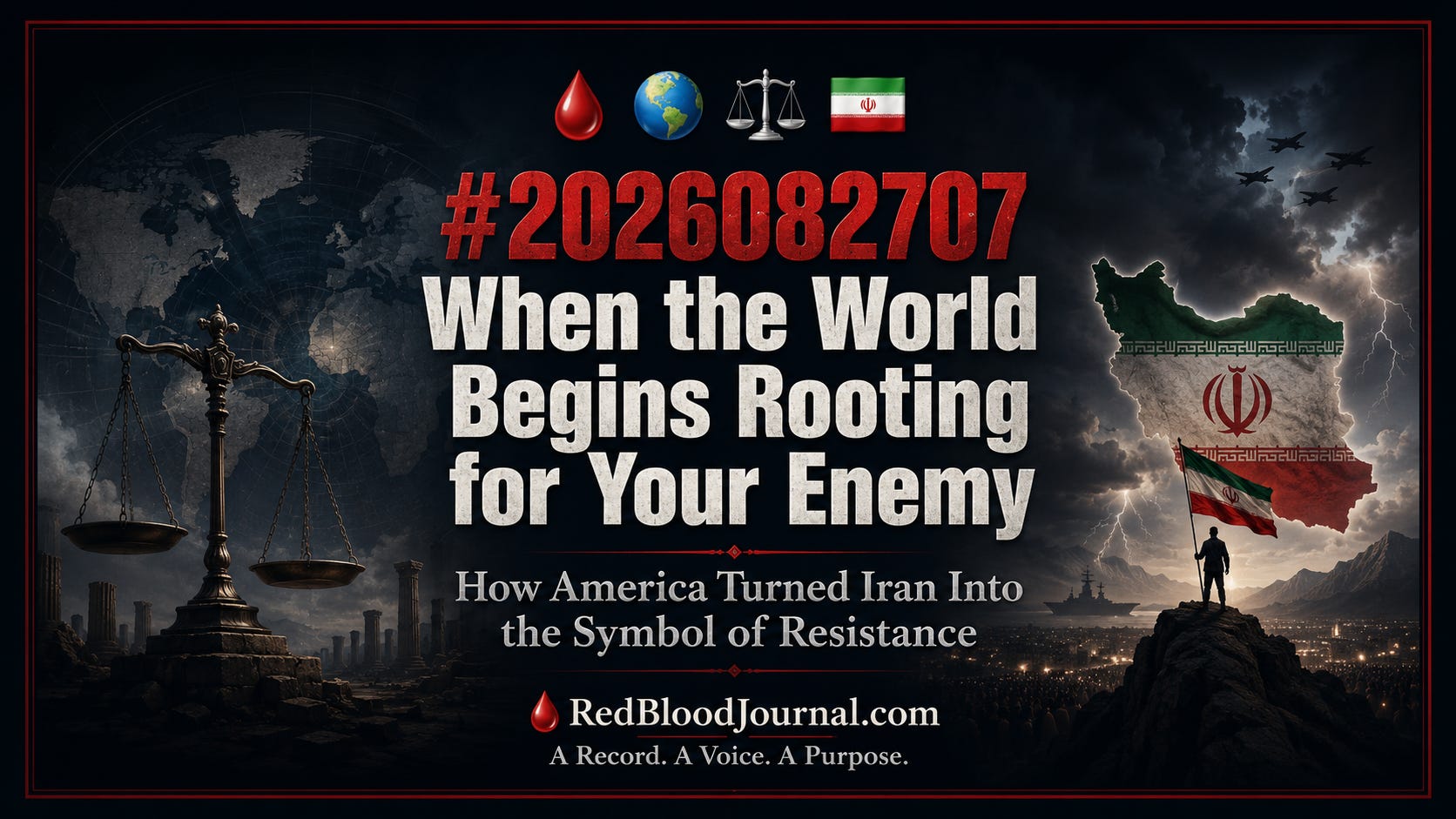
🩸 🌍 ⚖️ 🇮🇷 #2026082707 — When the World Begins Rooting for Your Enemy: How America Turned Iran Into the Symbol of Resistance
🩸 RedBloodJournal.com
A Record. A Voice. A Purpose.
There is a moment in the life of every powerful country when the most important question is no longer whether it can defeat its enemy.
The question becomes whether anyone still believes it deserves to.
That is the deeper significance behind John Mearsheimer’s observation that much of the world appears to be rooting for Iran.
The important point is not that the world has suddenly fallen in love with the Islamic Republic.
It has not.
The more troubling possibility is that many people have become so distrustful of American and Israeli power that they are willing to cheer almost anyone who successfully resists it.
That is a very different phenomenon.
And it may be much more important.
When Resistance Becomes More Important Than the Resister
A government does not have to be admired in order to become a symbol.
Sometimes it only has to refuse to surrender.
That distinction matters enormously in the case of Iran.
There are people throughout the world who may dislike the Islamic Republic, condemn its treatment of its own citizens, reject its ideology and have no desire whatsoever to live under its system.
And yet those same people may still look at a confrontation between Iran and the United States or Israel and instinctively hope that Iran does not collapse.
Why?
Because they may no longer be judging Iran by Iran alone.
They are judging the other side as well.
And after decades of wars, sanctions, interventions, intelligence operations, failed occupations, civilian casualties, contradictory standards and governments deciding which countries may possess which weapons, a large portion of the world has accumulated its own historical memory.
Iran therefore becomes something larger than Iran.
It becomes the country that did not kneel.
Whether that image is deserved is almost beside the point.
Images eventually become political facts of their own.
Rooting for Iran Is Not Necessarily Rooting for the Islamic Republic
This is where the discussion becomes especially important for the Iranian people.
Iran is not the Islamic Republic.
The Iranian population is not interchangeable with the government ruling it.
And resistance to foreign domination is not automatically support for domestic repression.
All three of these truths can exist simultaneously.
An Iranian citizen can strongly oppose the Islamic Republic while also opposing foreign bombing of Iran.
An Iranian can demand political freedom while rejecting economic warfare that impoverishes ordinary families.
An Iranian can despise the current leadership while refusing to accept the idea that Washington, Jerusalem, Moscow, Beijing or anyone else should determine Iran’s political future.
That position is not contradictory.
It may actually be one of the most consistent positions available.
A citizen can oppose both the jailer inside the house and the stranger trying to burn the house down.
Yet international politics constantly attempts to erase this distinction.
Oppose an attack on Iran, and someone may accuse you of defending the regime.
Oppose the regime, and someone may assume you must therefore support whatever foreign pressure is used against it.
Real life is not that simple.
Iranian citizens should not have to choose between submission to their own government and submission to somebody else’s geopolitical strategy.
The Superpower’s Most Dangerous Loss
Military power can be measured.
Aircraft.
Missiles.
Ships.
Satellites.
Money.
Bases.
Industrial capacity.
But moral authority is much harder to measure.
You usually discover that you have lost it only after it is gone.
That may be the real warning contained inside the phrase:
The world’s rooting for Iran.
If millions of people who have no affection for the Islamic Republic nevertheless begin emotionally siding with Iran against the United States, the issue is no longer simply Iranian propaganda.
Something deeper has happened.
The credibility account has been overdrawn.
A superpower can survive criticism.
It can survive protests.
It can survive hostile newspapers.
It can even survive being hated.
What becomes far more dangerous is when neutral observers begin assuming that whatever opposes the superpower must therefore contain some measure of justice.
That is how legitimacy begins reversing polarity.
The dominant power becomes the suspected aggressor before the facts of the newest crisis are even examined.
The weaker power becomes the presumed resistance.
And suddenly every confrontation arrives carrying the baggage of every confrontation that came before it.
America May Have Helped Create Iran’s Resistance Mythology
This is one of the great ironies.
For decades, Washington has attempted to isolate Iran.
Sanctions.
Financial restrictions.
Military containment.
Diplomatic pressure.
Regional alliances.
Covert operations.
Threats of regime change.
Repeated declarations that Iran must alter its behavior before it can fully return to the international system.
Yet every additional layer of pressure has also provided Tehran with another piece of evidence for its central political story:
We are surrounded because we refuse to submit.
That narrative has enormous weaknesses inside Iran.
Citizens living with corruption, censorship, inflation, political repression and economic deterioration have plenty of reasons to reject it.
But internationally?
The story can sound very different.
Someone thousands of miles away does not experience Iran’s internal political system personally.
What they may see instead is a weaker country surviving decades of pressure from far more powerful adversaries.
And once the story becomes David versus Goliath, facts begin competing with archetypes.
The stronger side can win almost every military measurement and still lose the emotional narrative.
Sanctions Have a Political Cost Beyond Iran
Sanctions are normally described as instruments applied to governments.
Ordinary people often experience them differently.
Currencies collapse.
Imported goods become expensive.
Medicines become harder to obtain.
Businesses lose access to banking.
Families watch their savings disappear.
Young people discover that their passports, nationality and banking system have become obstacles before they have personally done anything wrong.
Washington may describe the pressure as targeted.
Citizens living inside the target often experience something much broader.
And people outside Iran watch this too.
That matters.
A policy intended to weaken an adversarial government can gradually strengthen a global perception that powerful countries are willing to make civilian populations suffer in order to achieve geopolitical goals.
Even people who oppose Tehran can begin asking an uncomfortable question:
Why are ordinary Iranians paying the bill?
Once that question spreads, Iran’s government gains something sanctions were supposed to deny it:
sympathy.
The Same Problem Exists With Israel
Israel faces a related credibility problem.
Its supporters may view military operations through the language of deterrence, security and existential survival.
Its critics increasingly view them through occupation, disproportionate force, civilian casualties and unequal power.
Those interpretations collide constantly.
But perception has consequences regardless of which interpretation someone accepts.
When Iran confronts Israel, many people around the world are not evaluating that confrontation in isolation.
They are bringing Gaza.
Lebanon.
Settlements.
Occupation.
American military aid.
United Nations disputes.
Regional history.
And decades of unresolved grievance into the room.
Iran therefore inherits emotional support from conflicts that are not entirely about Iran.
That is politically powerful.
And extraordinarily dangerous.
The Defeat of One Power Is Not Automatically Liberation
This is where the celebration of resistance can become another intellectual trap.
If America loses, justice has not automatically won.
If Israel loses, Palestinians are not automatically free.
If the Islamic Republic survives, Iranians are not automatically liberated.
If the Islamic Republic falls, democracy does not automatically appear.
History has repeatedly punished societies for confusing the destruction of an old power with the creation of something better.
Removing a government is an event.
Building a functioning society afterward is a generation’s work.
That distinction is routinely forgotten during war.
People emotionally exhausted by one dominant power begin cheering its defeat without asking what comes next.
But the vacuum always gets filled.
Sometimes by democracy.
Sometimes by another authoritarian system.
Sometimes by civil war.
Sometimes by foreign occupation.
Sometimes by organized crime.
Sometimes by religious extremism.
Sometimes by something worse than what disappeared.
Justice therefore cannot simply mean:
My enemy lost.
That definition is too small.
The Iranian Citizen Must Remain at the Center
For Red Blood, the central issue is not whether Washington wins the argument.
It is not whether Tehran wins the argument.
It is not whether Israel wins the argument.
It is whether citizens survive the argument.
The Iranian mother buying groceries does not control ballistic missile policy.
The American worker paying taxes does not personally design sanctions.
The Israeli family running toward a shelter does not write military doctrine.
The Palestinian child does not choose the strategy of armed organizations.
And yet citizens repeatedly become the currency with which governments purchase geopolitical objectives.
That is the recurring tragedy.
Governments speak in maps.
Citizens live in homes.
Governments calculate deterrence.
Citizens count missing relatives.
Governments discuss acceptable losses.
Citizens know those losses by name.
The purpose of political analysis should therefore never be merely to determine which government deserves applause.
The better question is:
Which path leaves the greatest number of ordinary people alive, free and capable of determining their own future?
The Red Blood Perspective
There is an extraordinary warning buried inside the idea that the world may be rooting for Iran.
A powerful country should not immediately dismiss that reaction as ignorance, propaganda or anti-Americanism.
It should ask what produced it.
What accumulation of decisions caused people with no affection for the Islamic Republic to nevertheless hope that Iran withstands American pressure?
What happens when opposition to the strongest power becomes a substitute for morality?
And what happens when a government becomes so unpopular that its adversary automatically receives sympathy?
Those are questions not only for America.
They are questions for every powerful government.
Iran should ask them.
Israel should ask them.
Russia should ask them.
China should ask them.
Europe should ask them.
Every government eventually begins believing its own explanation for why its power is necessary.
That is exactly when it most needs to look at itself from outside.
Because a nation does not lose moral authority merely when its enemies criticize it.
Enemies are supposed to criticize it.
The real warning arrives when people who have no love for the enemy nevertheless begin hoping the enemy wins.
That is not necessarily proof that the enemy has become righteous.
It may be evidence that the powerful have forgotten how they look from the other side of the ocean.
And the final danger is even greater.
If the world begins cheering simply because America loses, America has a problem.
If the world begins confusing the Islamic Republic with the Iranian people, Iran has a problem.
And if humanity begins defining justice simply as the defeat of whoever it currently hates—
we all have a problem.
The purpose of resistance should never be to replace one master with another.
The purpose should be to reach the day when ordinary human beings no longer need masters at all.
That is the direction worth rooting for.
Not Washington.
Not Tehran.
Not Jerusalem.
Not one flag over another.
The citizen.
The human being.
The freedom to choose.
And ultimately the recognition that beneath every uniform, border, ideology and government—
we are still standing in the same ocean.
In an Ocean of Love and Positivity.
🩸🌊✨ Fantastic!
⚖️
The Price of Power and the Myth of Resistance
Aug 27, 2026
The provided text explores a global shift in perception where American and Israeli moral authority is being questioned, leading many to view Iran as a symbolic figure of resistance. This phenomenon does not necessarily reflect support for the Islamic Republic’s internal policies, but rather a growing distrust of superpower interventionism and the humanitarian toll of economic sanctions. The author emphasizes the critical distinction between the Iranian government and its citizens, arguing that the people should not be forced to choose between domestic oppression and foreign aggression. By highlighting the suffering of ordinary individuals over the strategic goals of states, the source warns that rooting for a side simply because it opposes a dominant power is a dangerous substitute for true justice. Ultimately, the narrative advocates for a human-centric perspective that prioritizes personal liberty and the welfare of human beings over geopolitical dominance or nationalistic agendas.
#RedBloodJournal #Iran #UnitedStates #Israel #Geopolitics #MiddleEast #Resistance #ForeignPolicy #Sanctions #War #GlobalPolitics #AmericanPower #MoralAuthority #IranianPeople #WorldOpinion #OceanOfLoveAndPositivity


