


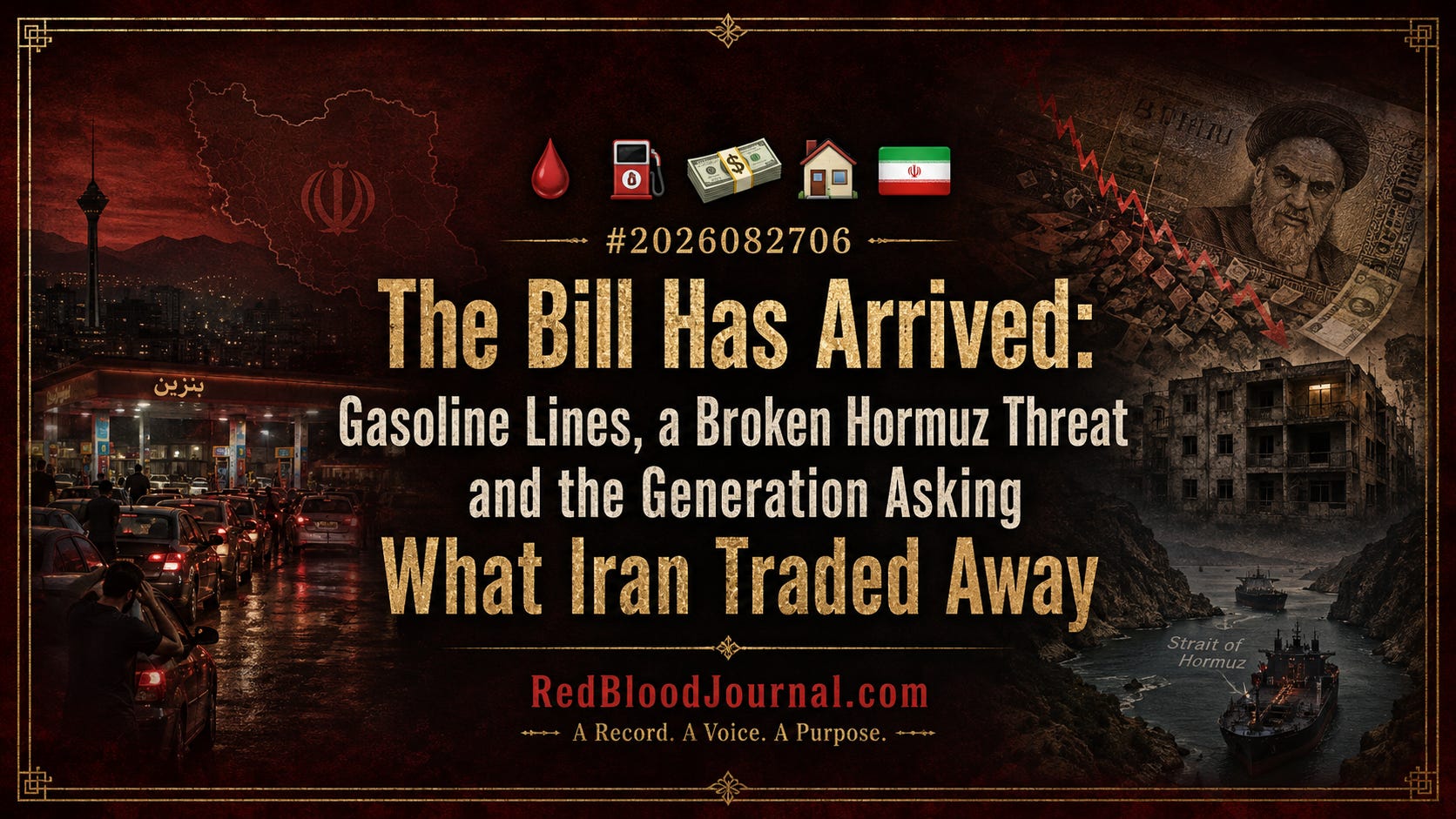
🩸 ⛽ 💵 🏠 🇮🇷 #2026082706 — The Bill Has Arrived: Gasoline Lines, a Broken Hormuz Threat and the Generation Asking What Iran Traded Away
When gasoline, the dollar, rent, oil, regret and revolution stop looking like separate crises
🩸 RedBloodJournal.com
A Record. A Voice. A Purpose.
Iran woke up to gasoline lines.
But gasoline may be the smallest part of the story.
A car waiting at a fuel station sees one crisis.
A merchant staring at bounced checks sees another.
A tenant unable to pay rent sees another.
A government watching the Strait of Hormuz lose its power as an economic weapon sees another.
An Iranian watching the rial collapse sees another.
And an older revolutionary looking backward toward 1979 may see something completely different:
a bill that took nearly half a century to arrive.
The remarkable thing about the material now coming out of Iran is not that there are many crises.
It is that the crises are beginning to connect.
Gasoline.
Currency.
Housing.
Oil.
Foreign policy.
Political legitimacy.
Historical regret.
They are increasingly becoming different windows into the same room.
The Morning Began at the Gas Station
The report opens with Iranians beginning Thursday, September 5 on the Iranian calendar, with news of a gasoline crisis.
Long lines were reported at filling stations, including queues continuing deep into the night.
The problem, according to the source, had already affected some southern provinces and was now reaching Tehran.
Government officials tried to reassure the public.
Existing subsidized gasoline allocations, they said, would remain unchanged at least through the end of Shahrivar.
Officials insisted strategic reserves were sufficient and repeatedly told the public there was no reason to worry.
But reassurance itself became revealing.
Because one subject remained strangely unclear:
What happens to unrestricted gasoline?
The government spoke specifically about maintaining the existing subsidized quotas but, according to the transcript, did not provide the same clarity about free-market gasoline.
The report interpreted that silence as a possible opening for an upcoming price change.
And suddenly a gasoline line became something larger.
It became a measurement of public trust.
The Government Was Watching the Line Too
The source describes police and security deployments around major Tehran gas stations and heavily traveled intersections.
The stated concern was not simply traffic.
Authorities were reportedly worried about filming, gatherings and the possibility that gasoline queues could become centers around which wider demonstrations might form.
That is worth noticing.
When a government sees a gasoline line and thinks first about gasoline, it has an economic problem.
When it sees a gasoline line and thinks about riot control, it has a political problem.
A queue has a strange power.
People who suffer privately suddenly stand beside others suffering from the same thing.
One driver says:
“My tank is empty.”
Another says:
“So is mine.”
One merchant says:
“My business is dying.”
Another answers:
“So is mine.”
Eventually the conversation changes.
The question stops being:
Why is this happening to me?
It becomes:
Why is this happening to all of us?
Meanwhile, the Strait Was Supposed to Terrify the World
For years, the Strait of Hormuz existed in Iranian strategic thinking as something approaching an ultimate bargaining weapon.
Threaten the strait.
Disrupt oil.
Shock global markets.
Make the world feel Iran’s pain.
The transcript presents statements attributed to President Trump saying that maritime energy traffic through Hormuz had returned to substantial levels and that large quantities of oil were again moving through the waterway.
The source also cites Iranian statements suggesting that previous expectations surrounding the closure or restriction of the strait had failed to materialize as imagined.
That matters because the mythology around Hormuz was not merely military.
It was economic.
The implicit promise was:
If Iran suffers, the world will suffer with it.
But what happens when the world finds another route?
$200 Oil Never Came
The transcript revisits earlier Iranian predictions that pressure on the Strait of Hormuz could send oil toward extraordinary prices.
One cited prediction suggested $200 oil.
Another reportedly asked whether the world was ready for oil above $500.
The actual market described in the source was nowhere close to those numbers.
That contrast creates one of the cruelest ironies in the entire report.
The great threat was supposed to be:
We will make your oil expensive.
Instead, according to the transcript:
Iran’s own currency became catastrophically cheap.
The strait did not produce the expected global economic earthquake.
But Iranian households were already living through one.
The World Learned to Go Around
The transcript describes large oil movements through the Gulf of Oman and reports of regional producers moving petroleum with assistance from American naval forces and through ship-to-ship transfers.
Some vessels were said to have switched off automatic identification systems during portions of those movements.
Whether every operational detail in that account is independently confirmed is not established by the transcript itself.
But the strategic idea is important.
A weapon becomes weaker the moment the opponent learns how to function without it.
A locked door is powerful until someone discovers another entrance.
Hormuz had enormous leverage because geography seemed permanent.
But markets, navies, logistics and technology adapt.
The geography does not have to change.
The value of the threat can.
The Great Reversal
And then the report delivers its most memorable economic contrast:
The Strait of Hormuz did not produce $200 oil.
But the dollar inside Iran, according to the transcript, reached approximately 200,000 tomans.
The national currency had deteriorated so badly, the report argues, that electronic payments partly conceal psychologically what physical cash would make impossible to ignore.
Imagine conducting ordinary life entirely in banknotes while prices are rising at that scale.
Stacks of currency would become visual reminders of collapse.
Digital numbers make inflation cleaner.
Tap.
Transfer.
Swipe.
The screen displays a number.
The transaction ends.
But behind that convenience, purchasing power may be disappearing.
The phone hides the mountain of paper money that would otherwise be required.
The economic wound becomes less visible even as it deepens.
The Merchant Sees It Differently
Outside the gasoline station another crisis is unfolding.
The transcript describes merchants confronting an extraordinary recession and highlights bounced checks and businesses approaching bankruptcy.
A government can publish an inflation statistic.
A merchant experiences inflation differently.
The customer stops buying.
Inventory sits.
Suppliers demand payment.
Rent arrives.
Payroll arrives.
Checks bounce.
Savings disappear.
Eventually the sign remains above the shop while the business underneath it is already dead.
Economic collapse is rarely one dramatic moment.
It is thousands of quiet closures.
Thousands of postponed purchases.
Thousands of families saying:
“Not this month.”
Until one day nearly everything has become “not this month.”
Then Comes the Most Disturbing Measure of Poverty
The transcript next enters territory considerably darker than gasoline or exchange rates.
It discusses jurisprudential sessions examining temporary marriage arrangements between a female tenant and a landlord when the tenant cannot afford rent.
The source describes the arrangement bluntly: intimacy replacing money as payment for housing.
The discussion is presented as having existed for several years rather than being an entirely new development.
But the economic environment makes its implications much more disturbing.
Because housing poverty changes the meaning of consent.
A wealthy person can say no and go somewhere else.
What choices remain for a mother with children who faces the street?
When an arrangement occurs under extreme economic desperation, the legal terminology surrounding it does not erase the imbalance of power.
The poor person’s body can become the last asset remaining after money has disappeared.
That is an extraordinary threshold for any society to reach.
The Problem With Making Desperation Legal
There is a deeper issue here.
Societies frequently encounter behavior created by poverty.
The humane response is to ask:
Why has a person been pushed into this position?
But institutions can sometimes do something very different.
They construct terminology around the desperation.
They categorize it.
Regulate it.
Authorize it.
Interpret it.
And eventually something extraordinary happens:
The abnormal begins to look administratively normal.
A woman cannot afford housing.
Instead of solving the economic conditions that made shelter unreachable, an intellectual framework develops around what she may exchange for it.
That does not solve poverty.
It teaches poverty how to wear a legal robe.
Gasoline Was Never the Real Complaint
Later in the transcript comes perhaps the most politically important statement in the entire source.
The complaints are described as being about gasoline one day.
The dollar another.
Food another.
Electricity another.
But voices in the report insist these are merely sparks.
The underlying grievance is directed toward the system itself:
inequality,
corruption,
privileged elites,
exhaustion,
lack of economic mobility,
and a sense that ordinary people work continuously without ever moving forward.
This is the distinction governments often understand too late.
A bread protest can be solved with bread.
A gasoline protest can theoretically be solved with gasoline.
A wage protest can be negotiated through wages.
But once the complaint becomes:
“We object to you.”
the problem has changed categories.
The product is no longer defective.
The customer has lost faith in the manufacturer.
And Then Comes the Religious Answer
Against this collapse, another message appears in the transcript:
Do not worry about the dollar.
Livelihood ultimately comes from God.
The dollar is just a number.
There is a beautiful spiritual truth buried somewhere inside the idea that human worth should not be measured by money.
But there is also a dangerous political misuse of spirituality.
Faith can teach a hungry person that his humanity survives hunger.
It should never be used by the well-fed to explain why the hungry should tolerate hunger.
Faith can help someone endure hardship.
It should not become an accounting method for government failure.
There is an enormous difference between:
“Money does not define your soul.”
and:
“Do not complain that your money has become worthless.”
The first liberates the individual.
The second can liberate government from responsibility.
Then the Story Turns Back Toward 1979
The final third of the transcript leaves gasoline almost completely behind.
It turns toward memory.
Toward the generation of 1979.
Toward the revolution.
Toward what Iran possessed before it.
Toward what Iran believed it was rejecting.
And toward the question now haunting many people:
What exactly did we trade away?
The report presents criticism of the generation that participated in the revolution and contrasts their ideological expectations with present-day living conditions.
Suddenly a gasoline line in 2026 is connected to a political decision made almost half a century earlier.
That is the larger historical frame.
The Country They Were Told to Reject
The transcript recalls reforms under Mohammad Reza Shah’s government:
land redistribution,
expanding schools,
the Literacy Corps,
the Health Corps,
rural medical access,
use of foreign doctors where Iranian physicians were insufficient,
and substantial economic growth.
The point of revisiting those policies is not that pre-1979 Iran was perfect.
It was not.
Nor does acknowledging development erase legitimate criticism of monarchy, political repression, inequality or authoritarian government.
History becomes useless when one side must be painted entirely white so that the other can be painted entirely black.
But the transcript raises a more uncomfortable question:
Was the system being destroyed actually moving toward greater material development, despite its political flaws?
Many Iranians who once answered no appear to be reconsidering.
The Revolutionary Reversal of Values
The report includes old revolutionary-era rhetoric criticizing the previous government’s focus on material prosperity—good homes, cars, purchasing power and the visible comforts of modern life.
There was an ideological belief beneath that rejection.
Human beings should pursue something higher than possessions.
That idea itself is not absurd.
In fact, spiritually, it contains enormous truth.
A person is not his house.
Not his automobile.
Not his bank account.
Not his clothing.
But here is where philosophy becomes dangerous when imposed through government:
Rejecting materialism is not the same thing as producing poverty.
A spiritual person may voluntarily live simply.
That is freedom.
A government making everyone poorer and calling the result virtue is something entirely different.
You cannot manufacture enlightenment by destroying purchasing power.
You cannot create spirituality by eliminating electricity.
You cannot teach detachment by making housing unaffordable.
And you cannot feed the soul by emptying the refrigerator.
What Did We Give?
Toward its conclusion the transcript describes a growing Iranian sadness over the exchange made in 1979.
What was surrendered?
What was received?
The report recalls voices who warned revolutionary crowds that the future might be considerably worse than the system they were overthrowing.
Years passed.
Then decades.
And some participants eventually began saying something rarely heard from political generations:
We were wrong.
“We Made a Mistake”
The transcript includes former revolutionary voices openly describing the 1979 revolution as a terrible mistake.
One speaker effectively condemns his own decision.
Another says directly:
“We made a mistake.”
Again.
And again.
Those may be some of the most important words in politics.
Not because they reverse history.
They cannot.
Not because confession restores what was lost.
It does not.
But because human beings have an extraordinary resistance to admitting that decades of their lives were built around a mistaken assumption.
The larger the sacrifice, the harder the admission.
If you sacrificed nothing, changing your mind costs little.
If you sacrificed a country, friends, years, careers, families and generations—
admitting error can feel like destroying yourself.
So people often defend the mistake instead.
Even Clerical Voices Admit the Failure
The transcript goes further.
It includes statements that the clergy should acknowledge that they lacked the management ability, knowledge and institutional capacity required to govern a modern country.
The quoted assessment is devastating:
The record is a failure.
There is no convincing answer to give the next generation.
What was done over four decades produced the condition visible today.
This is very different from an enemy saying:
“You failed.”
An enemy is expected to say that.
The important moment comes when people associated with the revolution itself begin saying:
We were not equipped to do this.
That is no longer propaganda from outside.
It is an autopsy conducted from inside the room.
The Question History Cannot Answer for Iran
The final argument of the transcript is impossible to prove because history does not allow controlled experiments.
What would Iran look like today had the monarchy survived?
Nobody knows.
Perhaps enormous reforms would have occurred.
Perhaps another political crisis would have come.
Perhaps democratization.
Perhaps repression.
Perhaps instability.
History contains no alternate timeline we can inspect.
But one comparison is possible.
The transcript argues that Iran in 1979 was economically advancing and that its economic position then cannot reasonably be compared with today’s circumstances.
And that is enough to explain why nostalgia is growing.
Nostalgia does not require believing the past was perfect.
It only requires believing the present became worse.
The Entire Report Is Really One Story
At first glance, these subjects appear disconnected.
Gasoline lines.
Security deployments.
Hormuz.
Oil.
The rial.
Bounced checks.
Housing.
Temporary marriage.
Religion.
The revolution.
The Shah.
Clerical admissions of failure.
But place them beside one another and the pattern becomes clearer.
They are stages of a single question:
What happens when ideology repeatedly defeats practical reality?
You can declare gasoline policy successful.
The line still forms.
You can declare the Strait of Hormuz an unstoppable weapon.
Tankers still move.
You can declare the dollar merely a number.
Purchasing power still disappears.
You can religiously formalize desperate housing arrangements.
The tenant is still desperate.
You can call poverty spiritual simplicity.
The refrigerator is still empty.
You can call the revolution liberation.
The generation that lived through its results can still look backward and ask:
What did we do?
Reality has extraordinary patience.
You may argue with it for years.
Sometimes decades.
Eventually it sends the bill.
🩸 The Red Blood Perspective
Perhaps the deepest lesson from Iran’s present condition is not about monarchy versus republic.
Not Islam versus secularism.
Not America versus Iran.
Not East versus West.
It is about the danger of ideology becoming more important than observation.
A healthy society must be able to look at the dashboard.
If the engine temperature is rising, you do not smash the gauge.
If the fuel tank is empty, you do not give a speech about the spiritual benefits of walking.
If the transmission is failing, you do not arrest the mechanic for insulting the automobile.
You stop.
You examine.
You admit.
You repair.
Iran’s great tragedy may not simply have been choosing the wrong road in 1979.
Human beings take wrong roads constantly.
The deeper tragedy was continuing down the road long after the signs began saying:
WRONG WAY.
Gasoline lines are another sign.
The currency is another.
The merchant’s bounced check is another.
The desperate tenant is another.
The weakened Hormuz threat is another.
The former revolutionary saying “we were wrong” may be the largest sign of all.
There is no shame in discovering that a road was wrong.
The tragedy is seeing it and refusing to turn.
🌊 Ocean of Love and Positivity Perspective
And now the political theater can disappear.
Leave Tehran.
Leave Hormuz.
Leave 1979.
Leave the Shah.
Leave the clerics.
Leave Washington.
Leave the gasoline line.
Because the same story takes place inside one human being every day.
How many times have we chosen a direction because we were absolutely certain we were right?
Then reality began sending signs.
The relationship deteriorated.
The body deteriorated.
The finances deteriorated.
Peace disappeared.
Joy disappeared.
Something inside whispered:
Turn around.
But another voice answered:
I have already come too far.
That is how one wrong turn becomes a lifetime.
Not because the original mistake was impossible to correct.
Because pride makes correction more painful than continuing.
The greatest freedom available to a human being may therefore be four simple words:
I may be wrong.
Those words do not make someone weak.
They return the steering wheel.
The observer wakes up.
The driver looks at the road instead of defending the route.
And suddenly forty-seven years of investment in the wrong direction no longer determines the next mile.
That applies to countries.
It applies to governments.
It applies to religions.
It applies to political movements.
And it applies most powerfully to the person looking through these eyes right now.
You cannot change the road already traveled.
But consciousness possesses something history does not:
the ability to choose the next turn.
Perhaps that is the real lesson hidden inside every gasoline line, every collapsed currency, every failed threat and every revolutionary confession.
The bill arrives not to punish us.
The bill tells us what the journey has cost.
Read it.
Understand it.
Pay attention to it.
Then decide whether you want to keep ordering the same thing.
The Ocean does not demand that yesterday was perfect.
It only asks that today be conscious.
And once the driver becomes conscious again—
the vehicle can finally turn.
In an Ocean of Love and Positivity.
🩸🌊✨ Fantastic!🩸
⚖️
The High Cost of Ideology: Iran’s Half-Century Bill Arrives
Aug 27, 2026
The provided text examines a multi-faceted systemic collapse in Iran, where various economic and social crises are merging into a singular challenge to the government’s political legitimacy. Long lines at gasoline stations, the catastrophic devaluation of the national currency, and extreme housing poverty are presented as evidence of a failing state ideology. The source highlights a strategic shift where Iran’s traditional leverage over the Strait of Hormuz is weakening as global markets find ways to bypass the waterway. Central to the narrative is a profound historical reckoning, as members of the 1979 revolutionary generation openly express regret, viewing modern hardships as the “bill” for past political choices. Ultimately, the text argues that the Iranian government has prioritized ideological preservation over practical governance, leading to a deep disconnect between the leadership and a suffering populace. The overview concludes that these interconnected failures serve as a warning about the dangers of refusing to correct a destructive national course.
#RedBloodJournal #Iran #IranCrisis #GasolineCrisis #FuelCrisis #IranEconomy #EconomicCrisis #IranianRial #CurrencyCollapse #StraitOfHormuz #Hormuz #OilMarkets #HousingCrisis #CostOfLiving #PoliticalCrisis #Iran1979 #IranianRevolution #RevolutionRegret #GovernmentFailure #RedBloodPerspective #OceanOfLoveAndPositivity #2026082706


