


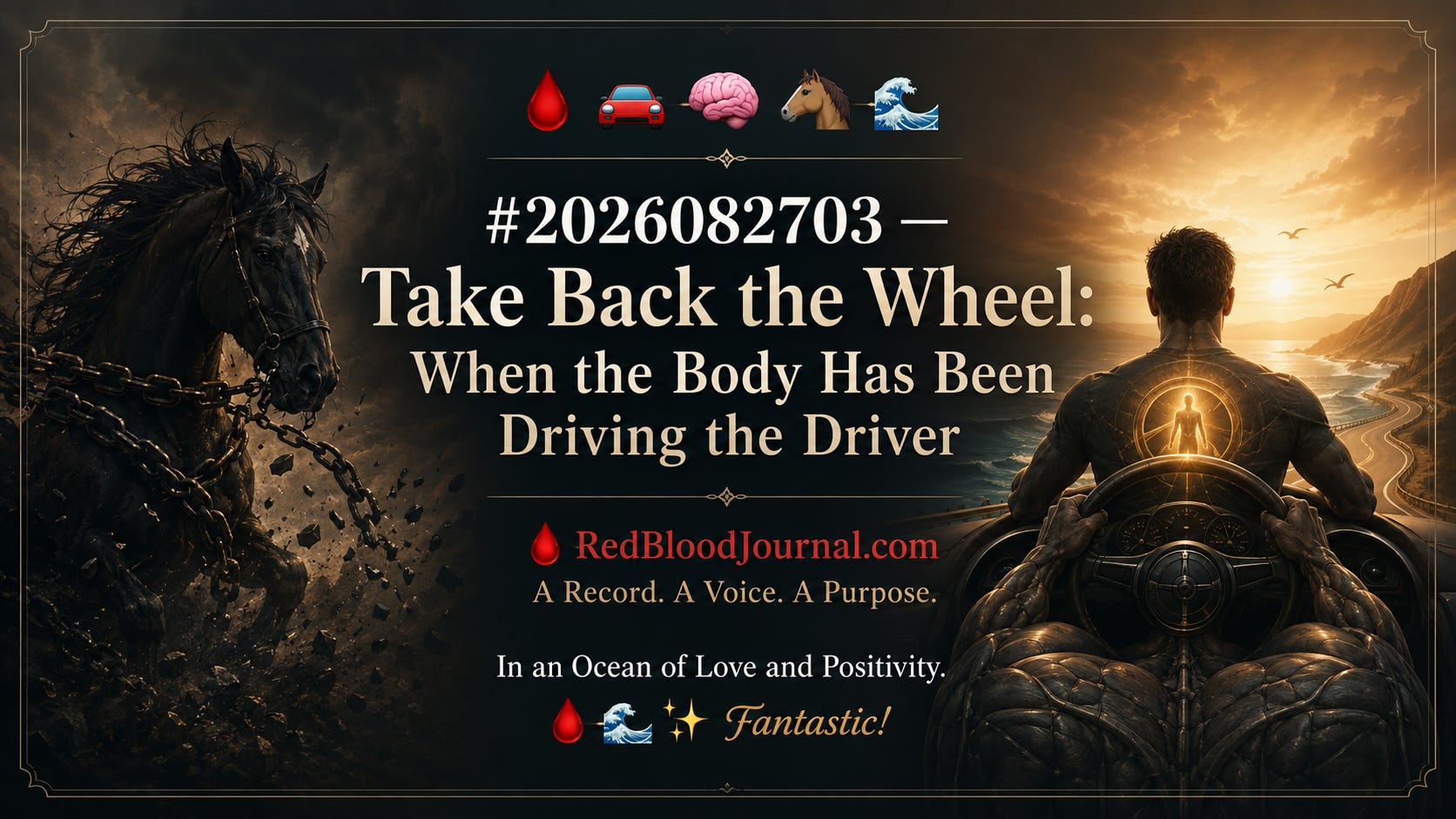
🩸 🚗 🏎️🧠 🐎 🌊 #2026082703 — Take Back the Wheel: When the Body Has Been Driving the Driver
🩸 RedBloodJournal.com
A Record. A Voice. A Purpose.
There comes a moment when a person may have to ask a question that reaches far beyond diet, exercise, appearance, discipline, or health:
Who is actually driving this life?
The human body is extraordinary.
It can heal.
It can adapt.
It can carry consciousness through decades of experience.
But the body is also a natural, instinctive, material being.
It seeks comfort.
It seeks food.
It seeks pleasure.
It avoids pain.
It reacts to fear.
It reacts to anger.
It develops habits.
It repeats what feels familiar.
In that sense, the body is much like an animal.
Powerful.
Useful.
Necessary.
But instinctive.
And instinct does not always know where the journey should go.
That is the job of the inner driver.
The Body Is the Vehicle
A car can be a useful comparison.
The car does not decide where to go.
The driver does.
The car may pull slightly to one side.
The engine may make noise.
The brakes may wear down.
The tires may lose pressure.
But the driver is supposed to notice these things, maintain the vehicle, and keep it on the road.
The body is not so different.
It gives signals.
Hunger.
Fatigue.
Pain.
Desire.
Fear.
Anger.
Comfort.
Craving.
But a signal is not automatically an order.
The problem begins when the driver stops driving.
Then the vehicle begins deciding the direction.
When the Vehicle Takes Over
The body says:
Eat more.
And the driver obeys.
The body says:
Stay on the couch.
And the driver obeys.
The body says:
Get angry.
And the driver obeys.
The body says:
Have another drink.
And the driver obeys.
The body says:
Do not change. This is comfortable.
And the driver obeys.
One decision may mean very little.
But repeated decisions begin creating a pattern.
And eventually the pattern begins becoming visible.
Just as a car that has not been washed for months may reveal neglect, and a car covered in dents may reveal a history of poor handling, the human vehicle can sometimes begin showing the history of how it has been driven.
The body can become a record.
The posture can become a record.
The habits can become a record.
The surroundings can become a record.
The condition of the home, the car, the desk, the body, the finances, and even relationships may sometimes reveal something about the quality of attention behind them.
Not always.
But sometimes.
The Difference Between Judgment and Analysis
This is where caution matters.
To look at another person and declare:
“That person has no discipline.”
is judgment.
To observe:
“There appears to be a pattern of neglect or lack of control here. What might be causing it?”
is analysis.
Judgment closes the case.
Analysis opens a question.
And the most useful analysis eventually turns inward.
The question is not:
“Why is that person’s vehicle so damaged?”
The deeper question is:
“How am I driving mine?”
Not Every Dent Comes From Bad Driving
This is important.
Not every damaged car was damaged by its owner.
Some were hit while parked.
Some were caught in storms.
Some were involved in accidents beyond the driver’s control.
Human beings are no different.
Illness.
Genetics.
Injury.
Aging.
Medication.
Trauma.
Stress.
Poverty.
Loss.
Circumstances.
All of these can affect the body and the life.
So the outside can offer clues, but it cannot tell the entire story.
That is why analysis should never become arrogance.
The visible condition may reveal something.
It may also hide something.
But Some Dents Are Ours
At the same time, personal responsibility cannot disappear.
Sometimes the dent really did come from careless driving.
Sometimes the warning light was ignored.
Sometimes maintenance was postponed.
Sometimes we knew better and chose otherwise.
That realization does not need to become shame.
It can become power.
Because if some part of the present condition came from repeated choices, then repeated choices can also begin changing it.
That is one of the most hopeful truths available to a human being.
Maybe You Lost Control
Perhaps there was a time when you had more discipline.
You exercised.
You slept better.
You ate differently.
You kept your surroundings organized.
You controlled your temper.
You respected your own boundaries.
Then life became complicated.
Work.
Children.
Bills.
Stress.
Disappointment.
Loss.
Age.
Responsibilities.
One compromise became another.
The body began winning more arguments.
The habits became stronger.
Eventually the driver became a passenger.
If that happened, there is no need to spend years condemning yourself.
The steering wheel is still there.
Take it back.
Maybe You Never Had Control
There is another possibility.
Perhaps nobody ever taught you.
Maybe the household you grew up in was chaotic.
Maybe food was used as comfort.
Maybe anger was normal.
Maybe neglect was normal.
Maybe nobody taught you how to manage money, emotions, appetite, health, discipline, or even basic routines.
Then the problem may not be that you lost control.
You may never have been taught how to drive.
That is not the end of the story.
It simply means the lessons begin now.
There is no age at which self-mastery becomes meaningless.
Control Is Not War Against the Body
Taking control does not mean hating the body.
It does not mean starving it.
Punishing it.
Exhausting it.
Or trying to dominate it through cruelty.
A good driver does not destroy the car to prove authority over it.
A good horseman does not beat the horse simply because the horse has instincts.
The goal is cooperation.
The driver learns the vehicle.
The driver respects the vehicle.
The driver maintains the vehicle.
The driver listens to the vehicle.
But the driver still chooses the destination.
That distinction is everything.
The Body Can Speak Without Becoming the Boss
The body says:
I am hungry.
The driver asks:
Am I actually hungry, or am I bored?
The body says:
I am angry.
The driver asks:
Will acting on this improve anything?
The body says:
I want comfort.
The driver asks:
Will this comfort help me or weaken me?
The body says:
I do not want to move.
The driver asks:
What does the vehicle actually need?
The body says:
One more.
The driver asks:
Who is making this decision?
That moment of questioning is the moment the inner driver begins returning.
Look at the Dashboard
The body gives feedback.
So does life.
Look around.
The car.
The home.
The bedroom.
The kitchen.
The desk.
The body.
The schedule.
The bank account.
The relationships.
The emotional reactions.
Not as sources of shame.
As gauges.
Some gauges may say everything is fine.
Others may be flashing.
Do not hate the warning light.
Read it.
The light is not your enemy.
It is information.
And information becomes valuable when the driver is awake enough to respond.
Start With One Small Correction
People often lose control again because they try to change everything at once.
Lose all the weight.
Exercise every day.
Never eat sugar.
Wake at five.
Stop every bad habit.
Organize the whole house.
Become a completely different person by next week.
That itself can be another form of impulsiveness.
Real control is often quieter.
Drink water once instead of soda.
Walk for ten minutes.
Stop eating when you are satisfied.
Wash the car.
Clean one room.
Go to bed thirty minutes earlier.
Delay one angry response.
Keep one promise to yourself.
Do one thing today that the old instinctive pattern would not have done.
That may look small.
But psychologically it is enormous.
The driver just moved the steering wheel.
🩸 The Red Blood Perspective
The Red Blood Perspective is not about condemning people because their bodies, cars, homes, or lives appear neglected.
It is about recognizing that the material world can sometimes reflect the invisible patterns operating behind it.
A neglected vehicle may sometimes reveal neglect.
A damaged vehicle may sometimes reveal careless handling.
A well-maintained vehicle may sometimes reveal attention, discipline, and respect.
But none of these observations are final verdicts.
Red Blood treats the visible world as evidence, not a courtroom.
The real question is not:
“What is wrong with that person?”
It is:
“What pattern is operating here?”
And then:
“Does that pattern exist inside me too?”
The body is an instinctive machine.
It wants what it wants.
But consciousness can examine those wants.
That is one of the greatest differences between merely reacting and actually living deliberately.
Personal responsibility is not punishment.
It is power.
If the vehicle has been driving you, recognize it.
If you lost control, take it back.
If you never had control, learn it.
If warning lights are appearing, read them.
If damage has accumulated, do not spend the rest of your life staring at the dents.
Learn how they happened.
Then drive differently.
Red Blood does not ask the driver to hate the vehicle.
It asks the driver to wake up.
🌊 Ocean of Love and Positivity Perspective
And here is where the entire idea changes.
The most positive thing about realizing that the vehicle has been in control is simply this:
you noticed.
The unconscious driver does not ask who is driving.
The awakening one does.
That moment of observation is already a shift in consciousness.
You may look at your life and see dents.
Neglect.
Habits.
Damage.
Mistakes.
Years that cannot be returned.
But the positive possibility is not in pretending those things never happened.
It is in recognizing that they have become teachers.
Every dent can teach attention.
Every warning light can teach awareness.
Every bad habit can reveal where instinct became stronger than consciousness.
Every loss of control can reveal where control must be developed.
That means even the years you regret can become useful.
Nothing has to be wasted.
Turn inward.
Behind the hunger is an observer.
Behind the anger is an observer.
Behind the fear is an observer.
Behind the craving is an observer.
Behind the reflection in the mirror is an observer.
That observer is not the body.
It is not the dent.
It is not the weight.
It is not the habit.
It is not yesterday.
It is the part of you capable of seeing all of them.
And that is where the positivity lives.
Because the moment the observer becomes conscious of the pattern, the pattern is no longer completely invisible.
And what is visible can be questioned.
What can be questioned can be changed.
What can be changed can become growth.
The body is not the enemy.
The material world is not the enemy.
Instinct is not the enemy.
They are part of the classroom.
The question is whether the student is awake.
So take care of the vehicle.
Wash it.
Maintain it.
Feed it properly.
Rest it.
Move it.
Repair what can be repaired.
Accept what cannot.
And above all, remember who was supposed to be driving.
The steering wheel may have been unattended for years.
But it is still there.
Place your hands on it.
Look at the road.
Choose the direction.
And when instinct says:
“Go this way.”
Become quiet enough to answer:
“No. I choose where we are going.”
That may be the moment control returns.
Or perhaps, for the first time in your life, the moment control truly begins.
In an Ocean of Love and Positivity.
🩸🌊✨ Fantastic!
🏎️
Take Back the Wheel: Mastering the Inner Driver
Aug 27, 2026
This text presents a metaphorical framework for self-mastery, comparing the human body to a vehicle and the conscious mind to its driver. It suggests that while our physical forms possess powerful natural instincts for comfort and pleasure, these impulses should not dictate the direction of our lives. By viewing external conditions—such as physical health, habits, and surroundings—as diagnostic gauges rather than sources of shame, individuals can identify where they may have surrendered control. The author emphasizes that personal responsibility is a form of empowerment, allowing one to transition from a passive passenger to an active participant through deliberate choices. Ultimately, the narrative encourages a harmonious relationship where the mind respects the body’s signals without allowing them to override the inner driver’s ultimate destination.
#RedBloodJournal #TakeBackTheWheel #SelfMastery #Consciousness #PersonalGrowth #MindBody #InnerDriver #SelfControl #Discipline #Awareness #PersonalResponsibility #BodyAndMind #PositiveChange #OceanOfLoveAndPositivity #2026082703


