


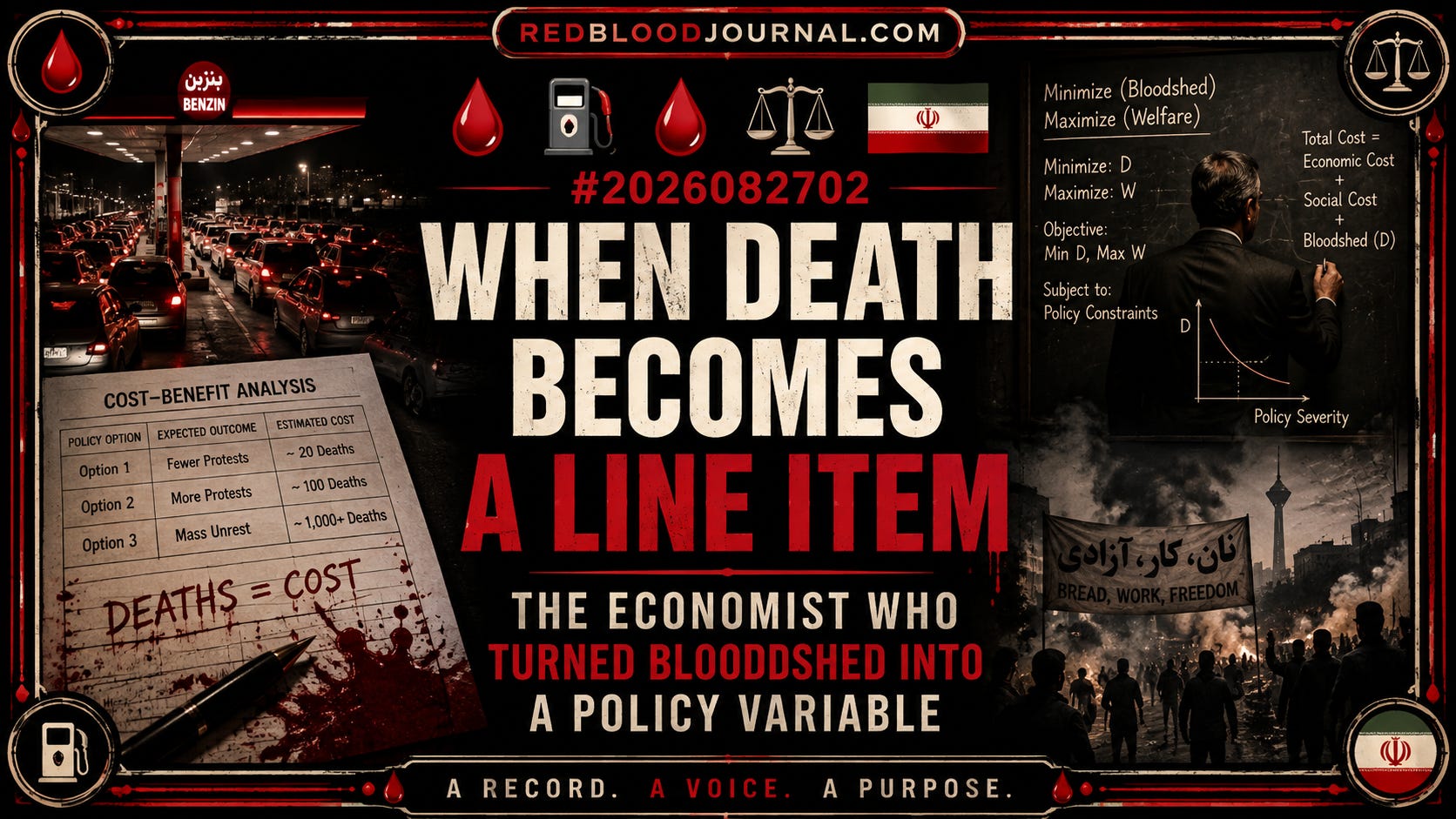
🩸 ⛽ 🩸 ⚖️ 🇮🇷 #2026082702 — When Death Becomes a Line Item: The Economist Who Turned Bloodshed Into a Policy Variable
When the question is no longer whether citizens should be killed—but how many deaths the system can afford
🩸 RedBloodJournal.com
A Record. A Voice. A Purpose.
There are moments when a political system reveals itself not through a secret document, a leaked order, or the testimony of an insider, but through the ordinary vocabulary of one of its own experts.
A sentence slips out.
A calculation is explained.
And suddenly the machinery behind the curtain becomes visible.
That is what makes the gasoline discussion now unfolding in Iran so much larger than gasoline.
The immediate story is familiar: long lines at filling stations, anxiety over supplies, rumors of price changes, government reassurances, police deployments, and fear that another increase in fuel prices could become the spark for something much larger. The source describes the gasoline crisis spreading from southern provinces into Tehran, accompanied by heightened security around major stations and intersections.
But then an economist entered the conversation.
And the story changed.
The Sentence Beneath the Gasoline Story
The transcript attributes a remarkable argument to economist Sadegh al-Hosseini.
His broader point was that difficult economic reforms should be undertaken before conditions deteriorate into much larger unrest.
That argument by itself is not unusual.
Governments everywhere make painful decisions on the theory that accepting a smaller disruption today may prevent a larger disaster tomorrow.
But the language described in this discussion went somewhere much darker.
Politics, according to the quoted argument, must seek the greatest possible public welfare while minimizing the amount of blood spilled.
The economic equivalent becomes minimizing costs while maximizing welfare.
And one of those costs?
Human beings losing their lives.
Read that carefully.
The calculation is no longer simply:
How much should gasoline cost?
It becomes:
Which policy produces fewer dead citizens?
That distinction changes everything.
The Most Important Number Wasn’t the Price of Gasoline
The public debate appeared to concern numbers:
1,500 tomans.
3,000 tomans.
Perhaps another price for unrestricted gasoline.
Monthly quotas.
Government subsidies.
Fuel imports.
Budget deficits.
But beneath those numbers appeared another number that should never become an ordinary variable in economic management:
the expected number of citizens who may die.
The source’s interpretation is severe: it argues that repression has become so normalized within the political framework that the question is no longer whether the government should kill people during unrest, but which policy will result in fewer people being killed.
That is the larger story.
Once death enters the spreadsheet as an anticipated cost, the moral structure of government has changed.
The citizen is no longer merely the person government exists to serve.
The citizen has become part of the risk model.
Two Completely Different Ways to Look at Unrest
Imagine a government facing the possibility that higher gasoline prices could cause demonstrations.
A government built around citizens might ask:
Why are people so economically fragile that a fuel-price increase could push them into the streets?
It might ask:
How can wages, transportation, subsidies, imports, taxation, corruption, energy policy and household purchasing power be reorganized to reduce the pressure?
It might ask:
How do we prevent violence?
But there is another possible framework.
That framework asks:
If unrest is inevitable, when is the cheapest moment to absorb it?
And from there:
Will fewer people die if the painful decision is made now rather than later?
These questions may sound similar because both speak the language of crisis management.
They are not similar.
One treats human life as the purpose of policy.
The other risks treating human life as one of policy’s costs.
A Disturbing Form of Cost-Benefit Analysis
Cost-benefit analysis is normal.
Every government does it.
Build the bridge or repair the highway?
Subsidize gasoline or public transportation?
Raise taxes or borrow money?
Spend now or postpone?
But there are things civilized governments are supposed to place outside the ordinary arithmetic.
The government cannot begin with:
How many innocent people may we reasonably kill while achieving the objective?
The instant that becomes an accepted starting assumption, something fundamental has already been surrendered.
Because then the debate becomes merely about efficiency.
Ten deaths instead of one hundred.
One hundred instead of one thousand.
Smaller uprising instead of larger uprising.
Earlier repression instead of later repression.
The mathematics can become perfectly logical while the premise underneath it is morally catastrophic.
Gasoline Is Only the Trigger
The transcript itself points toward this deeper reality.
Later voices describe the grievance as being about far more than gasoline, the dollar, food prices or electricity.
Those things are characterized as sparks.
The deeper complaints are inequality, corruption, exhaustion, privilege, inability to get ahead, and resentment toward the political structure itself.
That distinction matters enormously.
If the problem were simply gasoline, changing gasoline policy might solve it.
If the problem were simply the exchange rate, stabilizing the currency might solve it.
But if gasoline is merely where accumulated frustration becomes visible, then manipulating the gasoline price only moves the pressure from one chamber to another.
The pressure remains.
The Gas Station Becomes a Political Location
That may help explain another revealing part of the report.
The transcript describes security deployments around gasoline stations and heavily traveled Tehran intersections and claims authorities were concerned about filming, gatherings and the possibility that fuel queues could become centers of protest.
A gasoline station is normally one of the least political places imaginable.
Cars arrive.
Drivers fill their tanks.
They leave.
But when economic trust collapses, an ordinary queue can become something else.
A queue allows strangers to discover that everyone around them has the same problem.
One complaint becomes ten complaints.
Ten complaints become a conversation.
The conversation becomes recognition:
I am not alone.
That realization is politically powerful.
Perhaps more powerful than the shortage itself.
Why Governments Fear Lines
A shortage experienced privately is frustrating.
A shortage experienced collectively is politically dangerous.
At home, one person may believe his economic suffering is personal.
Standing in a kilometer-long gasoline line at two in the morning, the explanation changes.
He can see the problem.
He can count the cars.
He can speak with the person ahead of him.
He can speak with the person behind him.
The private problem becomes visible as a public condition.
This is why bread lines, bank lines, unemployment lines and gasoline lines have repeatedly mattered throughout political history.
They turn statistics into crowds.
The Government’s Impossible Choice
The gasoline problem therefore places authorities inside a trap partly created by years of accumulated economic distortion.
Keep gasoline artificially cheap and the subsidy burden grows.
Increase the price and household pressure rises.
Restrict supply and queues appear.
Import gasoline and foreign currency is required.
Reduce consumption and transportation becomes more expensive.
Raise prices suddenly and demonstrations may follow.
Raise them slowly and inflation can gradually absorb the difference anyway.
There may be no painless solution left.
That is precisely why the economist’s argument deserves attention.
He appears to be describing the government’s dilemma realistically.
But realism without a moral boundary can become something frightening.
Because the system may begin to say:
Somebody is going to bleed whichever option we choose.
Once that assumption becomes unquestioned, the government’s failure has already occurred before the first policy decision is made.
The Missing Option
There is another possibility absent from this grim equation.
What if the variable that changes is not the number of citizens killed?
What if the variable is the government’s relationship with citizens?
What if economic reform begins with transparency?
What if policymakers admit the scale of the problem?
What if citizens are treated as participants rather than security threats?
What if mistakes can be acknowledged without viewing acknowledgment as weakness?
What if corruption is confronted before subsidies?
What if those who have benefited disproportionately are asked to carry more of the burden?
What if the people standing in the gasoline line are regarded as the owners of the country rather than a crowd to be managed?
Suddenly the equation contains another possibility:
zero bloodshed.
Perhaps difficult.
Perhaps politically uncomfortable.
But morally essential.
When Violence Becomes Assumed
This may be the most revealing feature of the entire conversation.
Not that violence might occur.
Every society can experience violence.
Not that authorities prepare for disorder.
Every government does.
The danger begins when violence becomes assumed.
When everyone in the room accepts the premise that citizens will protest, the state will shoot, and therefore the sophisticated policy question is simply how to arrange events so fewer bodies fall.
At that point violence has moved from catastrophe to methodology.
From failure to expectation.
From scandal to forecast.
That is an extraordinary transition.
The Spreadsheet Can Hide the Human Being
Modern government loves numbers.
Inflation.
GDP.
Barrels.
Kilowatt-hours.
Exchange rates.
Subsidies.
Budget deficits.
Unemployment.
Casualties.
Numbers are useful because enormous systems cannot be managed without them.
But numbers have a dangerous property.
They can make suffering look clean.
Twenty casualties fits neatly inside a report.
Twenty mothers receiving telephone calls does not.
Twenty empty chairs at dinner tables does not.
Twenty funerals do not.
Twenty interrupted lives do not.
The spreadsheet compresses reality until the human being disappears.
That is why political systems require something above mathematics.
They require conscience.
🩸 The Red Blood Perspective
There is a strange inversion taking place when an economic debate about gasoline reaches the point where spilled blood becomes part of the calculation.
Gasoline was supposed to power the vehicle.
The economy was supposed to support the citizen.
Government was supposed to serve society.
Yet when the structure turns upside down, the citizen can gradually become fuel for the structure itself.
His purchasing power is consumed.
His labor is consumed.
His patience is consumed.
His freedom may be consumed.
And finally even his life can appear inside the equation as another acceptable cost.
That is the warning hidden inside this gasoline story.
The most important question is not whether gasoline becomes 3,000, 30,000 or 70,000 tomans.
The most important question is:
At what point did the life of the person standing beside the gasoline pump become another number in the government’s calculation?
And perhaps even more importantly:
Who accepted that equation before it was ever written down?
🌊 Ocean of Love and Positivity Perspective
And here, strangely enough, is where something positive can still be found.
Because the moment an ugly equation becomes visible is also the moment it can be rejected.
Awareness changes the observer.
A society cannot question what it cannot see.
A person cannot change an assumption that remains buried beneath language, bureaucracy and habit.
But once the assumption is exposed—
once someone notices that human life has quietly been placed on the cost side of the ledger—
another possibility appears.
The positive lesson is not merely political.
It is personal.
Every human being carries a smaller version of the same temptation.
We calculate.
We justify.
We decide that hurting another person is acceptable because the goal seems important.
We sacrifice relationships to win arguments.
We sacrifice peace to prove ourselves right.
We sacrifice compassion because fear tells us survival requires hardness.
The state is not the only place where cold calculations can overpower humanity.
The same battlefield exists inside each of us.
And that is where the Ocean begins.
Not by pretending darkness does not exist.
Not by excusing cruelty.
Not by refusing to see what is happening.
But by looking directly at it and refusing to become its reflection.
The government may calculate bodies.
We do not have to calculate one another that way.
The system may reduce people to numbers.
We can restore the human being behind the number.
Fear may tell us that violence is inevitable.
Consciousness can still ask whether another road exists.
And perhaps that is the hidden gift inside even this terrible story:
it gives us another chance to recognize the line we must never cross—not only in government, but inside ourselves.
The positive future begins when enough people refuse to accept the premise that another human life is simply the price of achieving an objective.
Because beneath every ideology, every government, every economic theory and every argument stands the same living human being.
Red blood.
One life.
One consciousness.
One piece of the same ocean.
In an Ocean of Love and Positivity.
🩸🌊✨ Fantastic!🩸
⚖️
The Human Cost in the State’s Economic Equation
Aug 27, 2026
The provided text examines a chilling shift in Iranian political discourse where human life has become a calculated variable in economic policy. Using the gasoline crisis as a backdrop, the source highlights how officials now weigh the cost of potential unrest and bloodshed against the necessity of financial reforms. This transition signifies a moral collapse, moving from serving the public to treating citizens as manageable risks on a spreadsheet. The narrative warns that when state violence is treated as an expected methodology rather than a failure, the fundamental relationship between a government and its people is severed. Ultimately, it calls for a rejection of this dehumanizing logic, urging a return to a society that values individual consciousness over cold political arithmetic.
#RedBloodJournal #Iran #IranCrisis #GasolineCrisis #FuelCrisis #EconomicCrisis #PoliticalRepression #HumanRights #StateViolence #EconomicPolicy #PublicUnrest #IranProtests #PolicyFailure #GovernmentAccountability #Bloodshed #RedBloodPerspective #OceanOfLoveAndPositivity #2026082702


