


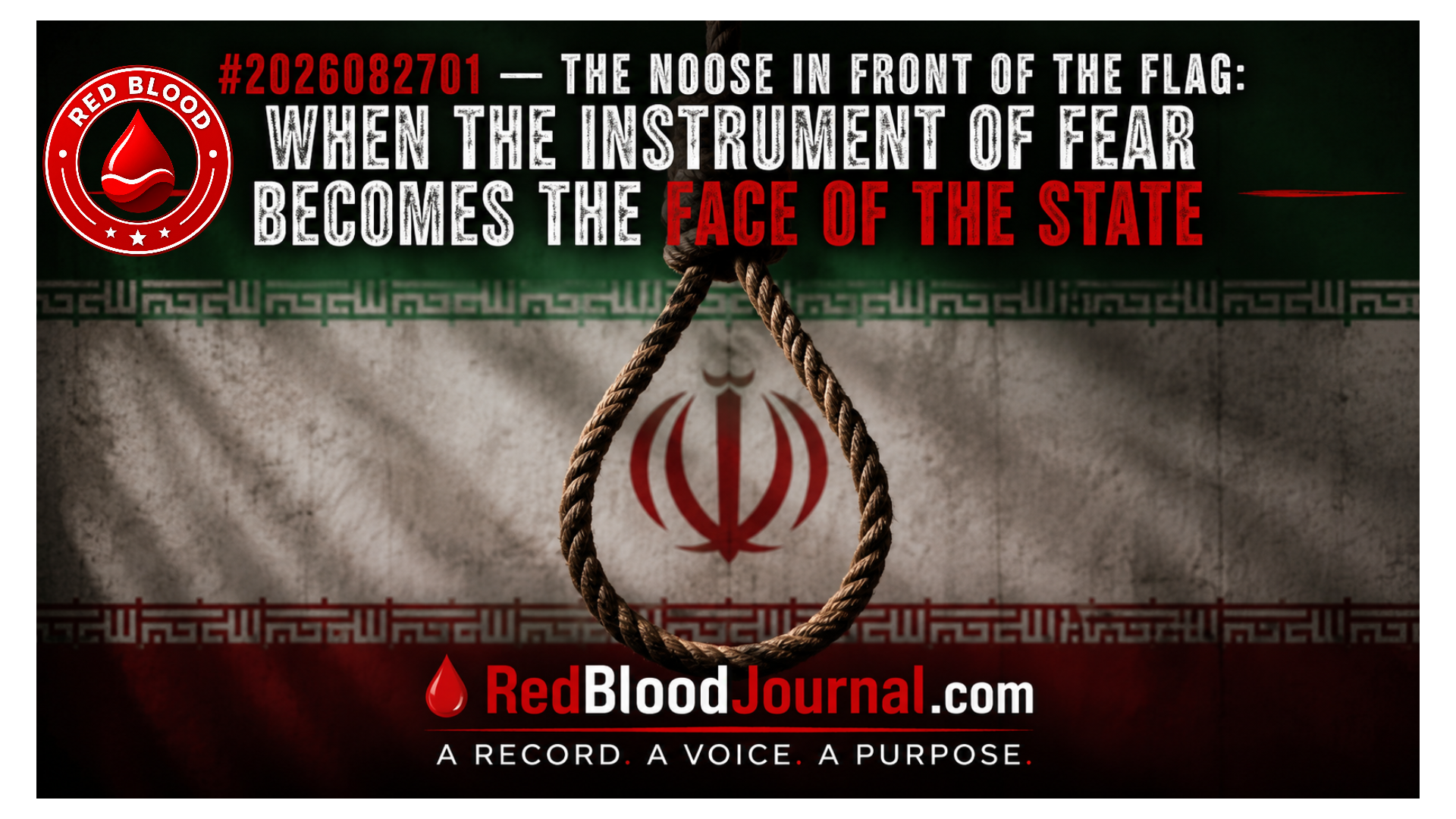
🩸 🇮🇷 🪢 ⚖️ #2026082701 — The Noose in Front of the Flag: When the Instrument of Fear Becomes the Face of the State
A nation is supposed to gather its people beneath a flag. What happens when the first thing visible in front of that flag is a rope?
🩸 RedBloodJournal.com
A Record. A Voice. A Purpose.
There are photographs that explain themselves before a single word is written.
This is one of them.
The Iranian flag fills the background.
At its center stands the unmistakable red emblem of the Islamic Republic.
And in front of it hangs a noose.
The symbolism is almost impossible to separate.
The rope does not appear somewhere in the distance.
It does not sit beneath the flag.
It does not hide in a corner.
It hangs in front of the state symbol itself.
The eye must almost look through the instrument of death in order to see the government behind it.
That is what makes the image so powerful.
The Flag and the Rope
A national flag traditionally represents something larger than government.
It represents the land.
Its history.
Its language.
Its families.
Its memories.
Its children.
Its dead.
Its future.
Governments come and go.
The people remain.
Yet when an instrument of execution is placed directly before the national flag, two completely different ideas collide.
One says:
This nation belongs to its people.
The other says:
The state possesses the power to take a person’s life.
That tension is the entire photograph.
The flag represents belonging.
The noose represents submission.
The flag says we.
The rope says obey.
When Punishment Becomes Political Language
Every government possesses mechanisms of enforcement.
Courts.
Police.
Prisons.
Laws.
Punishment.
But something changes when punishment becomes more than a legal mechanism.
It becomes a language.
Fear itself begins communicating.
A prison sentence sends one message.
An execution sends another.
A publicly understood possibility of execution sends an even larger one.
It speaks not only to the condemned person.
It speaks to everyone watching.
The message becomes:
Look what can happen.
That is why the symbolic power of execution extends far beyond the individual standing before the state.
The physical punishment happens once.
The psychological punishment can travel through millions of minds.
The Noose Does Not Need to Touch Everyone
A government does not need to imprison an entire population to influence an entire population.
It only needs enough people to believe imprisonment is possible.
It does not need to execute everyone.
It only needs enough people to understand that execution exists at the end of the road.
Fear performs the remaining work.
People begin adjusting themselves.
One person remains silent.
Another deletes a sentence.
Another avoids a demonstration.
Another warns a child.
Another tells a friend:
Don’t say that here.
Eventually censorship may no longer require someone standing beside every citizen.
Citizens begin carrying the censor inside themselves.
That may be the most powerful form of control imaginable.
The prison wall no longer needs to surround the body.
It has entered the mind.
The Most Important Question Is Not About the Rope
The obvious question is:
Who is being executed?
But the deeper question may be:
What kind of relationship exists between the citizen and the state when the possibility of death becomes part of political consciousness?
A government supposedly exists because people created institutions to organize society.
The institution is therefore the servant.
The population is the source.
Yet throughout history, institutions have repeatedly undergone the same transformation.
The servant becomes the authority.
The authority becomes the master.
And eventually the master begins demanding obedience from the people whose collective existence originally gave it legitimacy.
Then something extraordinary happens.
The creation begins threatening the creator.
Iran Is Larger Than the Islamic Republic
This distinction matters enormously.
Iran is not a government.
Iran existed before the Islamic Republic.
Iran existed before the Pahlavi dynasty.
Iran existed before today’s borders, ministries, intelligence organizations, constitutions and political factions.
Governments are chapters.
Civilizations are books.
Iran belongs to poets and shopkeepers.
Workers and students.
Farmers and engineers.
Mothers preparing dinner.
Children learning Persian.
Families sitting around tables.
People arguing about politics.
People who never discuss politics at all.
The flag therefore contains something much larger than whichever government currently occupies the offices of power.
Confusing a country with its government allows political institutions to claim ownership of something they temporarily administer.
The nation belongs to its people.
Not the other way around.
The Rope Creates Another Question
If authority must continually frighten the population beneath it, what exactly is being protected?
Strength?
Or insecurity?
A genuinely secure institution does not need every disagreement to become an existential threat.
A confident government can survive criticism.
A confident philosophy can survive questioning.
A confident religion can survive examination.
A confident society can survive dissent.
Only something uncertain of itself must continually prove that disagreement is dangerous.
That may be the hidden message inside the photograph.
The rope appears powerful.
But the need for the rope may reveal weakness.
Because power that must constantly demonstrate its ability to destroy is telling the world something about its inability to persuade.
🩸 The Red Blood Perspective
The most disturbing part of the image is not simply that a noose appears beside the Iranian emblem.
It is how naturally the two symbols can now be understood together by a viewer.
That should concern anyone who separates Iran from the government ruling Iran.
A civilization should never be reduced to the machinery governing it at one particular moment in history.
And citizens should never become supporting characters inside the story of their own country.
The state exists inside the nation.
The nation does not exist inside the state.
The government is temporary.
The people are the continuity.
The rope may command attention today.
History will ultimately decide whether it represented strength—or the final language of an institution that could no longer convince without frightening.
🌊 Ocean of Love and Positivity Perspective
And now leave the rope.
Leave the emblem.
Leave the government.
Leave even Iran for a moment.
Because the deepest lesson in this image is not hanging from that beam.
It is inside us.
Every human being carries a smaller version of authority within.
There is an inner government.
An inner judge.
An inner prison.
And sometimes an inner executioner.
How many thoughts have been sentenced before they were allowed to speak?
How many dreams have been imprisoned because fear said they were impossible?
How many parts of ourselves have we condemned because someone once told us they were unacceptable?
How often do we demand obedience from ourselves instead of understanding ourselves?
The external noose is terrifying because somewhere deep inside, humanity already understands the architecture of fear.
We have practiced it upon ourselves.
That is where the positive possibility begins.
Because anything learned can also be unlearned.
Anything constructed can be examined.
Anything operating unconsciously can be brought into awareness.
The moment we recognize the inner jailer, we are no longer completely imprisoned by it.
The moment we observe fear, there are suddenly two things present:
the fear—
and the one observing the fear.
That observer is the doorway.
It does not need a rope.
It does not need a prison.
It does not need another person to become smaller so that it can become larger.
It simply sees.
And in seeing clearly, something begins to loosen.
A knot.
Perhaps the oldest knot of all.
The belief that power comes from controlling something outside ourselves.
There is another kind of power.
The power to become peaceful without requiring the world to become peaceful first.
The power to examine ourselves before condemning another.
The power to refuse to reproduce inside our homes, relationships and minds the same domination we criticize in governments.
That is where revolutions become more than replacements.
A country can remove one ruler and produce another.
A society can tear down one institution and build the same institution under a different name.
A human being can escape one cage and spend the rest of life constructing another.
Unless consciousness changes.
That is the opportunity hidden even inside this terrible image.
The rope can teach something.
It can show humanity exactly what fear looks like when fear becomes institutionalized.
And once we recognize it outside ourselves, perhaps we can finally recognize its smaller relatives within ourselves.
Judgment.
Hatred.
Humiliation.
Control.
The desire to punish.
The need to dominate.
The need to be right at the expense of another person’s humanity.
Remove those ropes one by one.
Not because governments asked us to.
Not because religions commanded us to.
Not because another ideology promised paradise.
But because we finally recognized something simpler.
Life does not become more valuable by taking value away from another life.
The greatest victory over a system built upon fear is not becoming a mirror image of that system.
It is becoming something the system cannot manufacture:
a person who cannot be taught to hate.
A person who can disagree without dehumanizing.
A person who can resist without becoming consumed by revenge.
A person whose inner peace cannot easily be governed from outside.
And when enough individuals discover that sovereignty within themselves, something remarkable becomes possible.
The rope loses its greatest power.
Not necessarily because it has disappeared physically.
But because fear no longer owns the entire mind looking at it.
Then the flag can become a flag again.
The country can belong to its people again.
And humanity can remember that beneath every uniform, every ideology, every border, every title and every symbol flows the same red blood.
That is the positive possibility.
Even the image of a noose can become a teacher.
It can remind us what we never want to become.
And sometimes knowing what we refuse to become is the first clear step toward discovering what we truly are.
In an Ocean of Love and Positivity.
🩸🌊✨ Fantastic!
⚖️
The Noose and the Flag: Sovereignty Beneath the Rope
Aug 27, 2026
The provided text explores the chilling visual of a noose positioned in front of the Iranian flag, illustrating how a state uses the death penalty as a psychological tool of control. By placing an instrument of execution at the center of national identity, the government transforms punishment into a political language designed to cultivate internalized censorship and obedience. The author distinguishes between the temporary nature of ruling regimes and the enduring civilization of the Iranian people, suggesting that a reliance on fear reveals institutional insecurity rather than true strength. Beyond the political critique, the source offers a philosophical reflection on how individuals can reclaim their sovereignty by identifying and dismantling the internal architecture of fear and judgment. Ultimately, the narrative argues that the greatest resistance to such systems is the cultivation of a peaceful consciousness that refuses to mirror the state’s dehumanizing tactics.
#Iran #IranianPeople #HumanRights #Executions #DeathPenalty #PoliticalPrisoners #StatePower #Fear #Freedom #Justice #Authoritarianism #IranPolitics #Persian #RedBloodJournal #OceanOfLoveAndPositivity


