


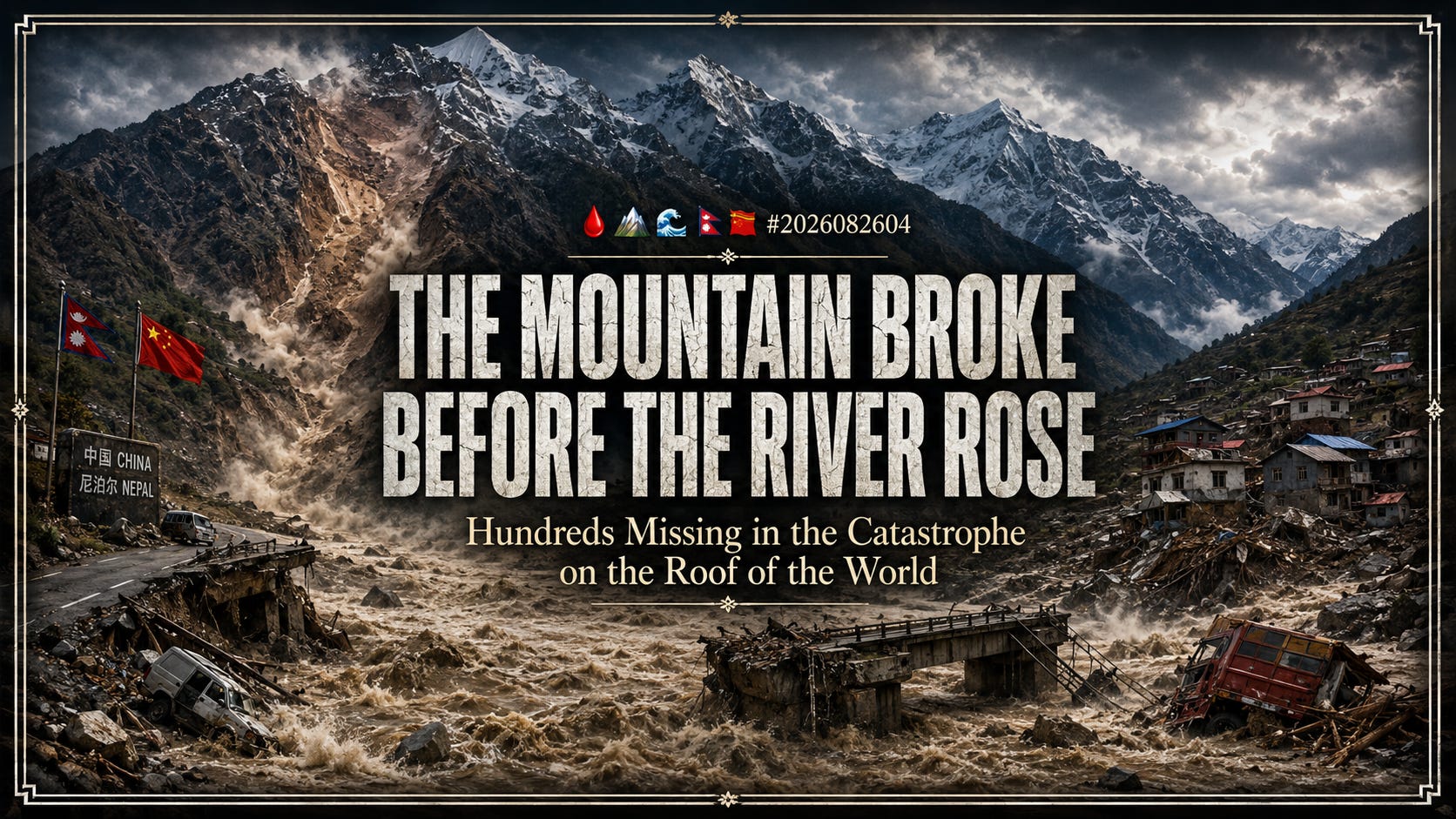
🩸 🏔️ 🌊 🇳🇵 🇨🇳 #2026082604 — The Mountain Broke Before the River Rose: Hundreds Missing in the Catastrophe on the Roof of the World
The Mountain Broke Before the River Rose
Hundreds Missing in the Catastrophe on the Roof of the World
🩸 RedBloodJournal.com
A Record. A Voice. A Purpose.
There are disasters that arrive slowly enough for people to see them coming.
The sky darkens.
The rain begins.
The river rises.
Warnings sound.
People run.
And then there are disasters in which the landscape itself suddenly changes.
On August 26, 2026, high in the Himalayas along the Nepal-Tibet border, something enormous appears to have broken loose from the mountains.
Ice.
Rock.
Earth.
Gravity.
And within minutes, communities far below were confronting a wall of water, boulders, sediment and debris.
The mountain appears to have broken before the river rose.
And that distinction may eventually become the most important part of this story.
🏔️ What Happened?
A catastrophic flood tore through the border region between Nepal and Tibet, devastating settlements around Nepal’s Rasuwa district and China’s Gyirong County in the Shigatse region.
Homes disappeared.
Vehicles were carried away.
Bridges collapsed.
Roads vanished.
Hydropower infrastructure was damaged.
Electricity and communications were cut in some communities.
By late August 26, Nepalese authorities had recovered 157 bodies, while Chinese authorities reported at least three deaths and hundreds missing on the Tibetan side. Hundreds of other people — residents, workers, pilgrims and tourists — remained unaccounted for.
Earlier in the day, Nepal’s Tourism Board reported that it had lost contact with 384 tourists and travelers — 291 foreign nationals and 93 Nepalis.
Those numbers were preliminary.
As communications were restored and travel companies, guides and authorities attempted to locate groups spread throughout the mountains, the missing-person figures continued changing.
That is important.
Missing does not automatically mean dead.
Some people may simply be isolated behind destroyed roads and failed communications.
Others may eventually be rescued.
Others, tragically, may not.
In a disaster this large and this fresh, every number should be understood as a snapshot rather than a final accounting.
🌊 This May Not Have Begun With Rain
The first descriptions sounded familiar:
flash flood.
But investigators are beginning to describe something much more complicated.
Satellite imagery examined by scientists indicates that a substantial portion of a high-altitude glacier may have collapsed at roughly 5,200 meters elevation, plunging more than a kilometer into the valley below.
That collapse may have produced an enormous ice-rock avalanche that displaced water, debris or temporarily obstructed the river system before releasing a violent downstream surge.
Reuters reported that the flood wave carried enormous amounts of sediment and rock through the Bhote Koshi and Trishuli river systems, with downstream water levels reportedly rising by as much as nine meters within roughly half an hour in some areas.
Scientists are still investigating exactly what initiated the collapse.
Recent heat and accelerated melting are among the possibilities being examined.
So is regional geological instability.
What should not yet be done is reduce a still-developing scientific investigation to one convenient explanation.
The mountain will eventually tell its story through satellite measurements, geology, hydrology and evidence.
For now, the evidence suggests something terrifyingly simple:
A piece of the Himalayas moved.
And everything downstream suddenly became vulnerable.
⚠️ The New Meaning of “Upstream”
For generations, communities have understood river danger largely by watching the water.
But a high-mountain river is connected to an enormous system above it.
Glaciers.
Glacial lakes.
Rock walls.
Permafrost.
Snowfields.
Unstable slopes.
Earthquakes.
Temperature changes.
Rainfall.
Each can influence another.
The danger therefore may not begin where the people live.
It can begin 50 kilometers away and several kilometers above them.
A village can experience clear weather while a catastrophe is already developing beyond the horizon.
That changes the meaning of early warning.
A river gauge downstream may tell people what is happening.
But monitoring glaciers, slopes, lakes and mountain movement may tell them what is about to happen.
🛰️ The Mountain Is No Longer Invisible
There is, however, something profoundly different about disasters in the modern world.
Humanity can now watch mountains.
Satellites can measure glacier retreat.
Radar can detect movement.
Remote sensors can measure river height.
Algorithms can recognize unusual changes.
Communication networks can transmit warnings almost instantly.
The same civilization capable of observing another planet can increasingly observe the movement of a mountainside on Earth.
The question is no longer simply whether the technology exists.
The question is whether societies will build systems capable of turning observation into warning — and warning into enough time for a human being to move uphill.
Sometimes five minutes is civilization.
Sometimes ten minutes is a family.
Sometimes one alarm means someone lives long enough to hear another sunrise.
🌍 The Himalayas Are Changing
The Himalayan region contains one of the greatest concentrations of ice outside the polar regions.
Those glaciers feed river systems supporting hundreds of millions of people.
But scientists have documented major losses of Himalayan ice over recent decades, with warming increasing the instability of glaciers, glacial lakes and surrounding slopes.
Reuters reported that Nepal has lost roughly one-third of its glacier ice over the past three decades and that the rate of loss has accelerated substantially in recent years.
That does not mean every avalanche or flood has one simple cause.
Mountains have collapsed for millions of years.
Earthquakes existed long before industrial civilization.
Floods are ancient.
But changing temperature, melting ice and destabilized frozen terrain can change the probability and scale of certain disasters.
And the Himalayas may increasingly become one of the places where humanity watches those changes occur in real time.
🧭 The Tourists Tell Another Story
Among the missing are people who traveled thousands of miles to reach these mountains.
Some were trekkers.
Some were tourists.
Some were religious pilgrims traveling toward sacred Himalayan destinations.
They came from different nations.
Different religions.
Different languages.
Different political systems.
Then the mountain moved.
And suddenly none of those labels mattered.
A Nepali villager.
An Indian pilgrim.
An American traveler.
A Chinese worker.
A British tourist.
A Tibetan resident.
When the river arrives, it does not ask for a passport.
The water does not recognize ideology.
The mountain does not distinguish left from right.
Gravity has no nationality.
Nature temporarily removes the imaginary borders that human beings spend enormous amounts of energy defending.
And underneath them appears something much older:
A human being trying to save another human being.
🚁 Then Something Extraordinary Happens
The disaster photographs show destruction.
But another story begins immediately after destruction.
Helicopters rise.
Soldiers enter mud.
Doctors prepare emergency wards.
Families search names.
Villagers pull strangers from water.
Guides look for missing tourists.
Countries begin checking on citizens.
Rescue teams move toward places everyone else is trying to escape.
This happens again and again after catastrophes.
And perhaps we have become so accustomed to it that we no longer recognize how extraordinary it is.
A person hears that strangers are trapped somewhere in the mountains.
And instead of asking:
“What do they believe?”
the rescuer asks:
“Where are they?”
That instinct deserves more attention.
Because perhaps beneath all the divisions humans manufacture, something very old remains alive.
🩸 The Red Blood Perspective
There is an uncomfortable lesson hidden inside every disaster.
Human beings spend enormous amounts of time arguing over things that nature can erase in seconds.
Property.
Status.
Titles.
Borders.
Positions.
Plans.
Schedules.
Possessions.
Yesterday someone may have been worried about a meeting next week.
A hotel reservation.
A delayed flight.
A business problem.
A political argument.
A bill.
A disagreement.
Then a mountain moved.
And suddenly the hierarchy of importance reorganized itself instantly:
Where is my family?
Is everyone alive?
Can we reach them?
Who needs help?
Perhaps catastrophe does not create those priorities.
Perhaps catastrophe merely reveals the priorities that were always there.
🌊 Ocean of Love and Positivity Perspective
Now leave the mountain.
Leave the river.
Leave Nepal.
Leave Tibet.
Leave the helicopters, the missing-person lists, the television screens and the casualty numbers behind for a moment.
Come back to the quiet place inside yourself.
You are reading these words.
That means something extraordinary has already happened today.
You are here.
Your eyes are moving across a page.
Your consciousness is observing.
Your heart is beating without requiring your permission.
Air is entering your lungs.
Life is happening.
And perhaps the greatest tragedy would be to witness people losing everything in seconds — and then return immediately to our own lives without realizing what we still possess.
The lesson does not have to be fear.
The positive lesson can be awakening.
Not:
“A mountain could collapse, therefore be afraid.”
But:
“A mountain could collapse, therefore recognize this moment.”
Look at the person sitting near you differently.
Hear the voice on the telephone differently.
Walk outside differently.
Drink the glass of water differently.
Watch tonight’s sunset differently.
The ordinary becomes extraordinary the moment we understand that ordinary was never guaranteed.
We spend much of life behaving as though tomorrow has already signed a contract with us.
It has not.
And strangely, that is not depressing.
It is liberating.
Because when tomorrow stops being an entitlement, today becomes a gift.
The argument becomes smaller.
The resentment becomes heavier than it is worth carrying.
The possession becomes less important than the person.
The need to win becomes less important than the ability to love.
And somewhere inside, the observer begins separating itself from the noise of the vehicle it temporarily inhabits.
The body worries about survival.
The mind worries about control.
The ego worries about importance.
But the deeper observer simply watches.
And perhaps whispers:
You were never here merely to accumulate days.
You were here to experience them.
The mountain in Tibet did not know who stood downstream.
The river in Nepal did not know whose house it carried away.
But the humans entering that river to search for strangers know something the river does not.
They know compassion.
They know sacrifice.
They know love.
That may be the positive truth hidden inside even this terrible event.
Nature can move mountains.
Nature can destroy bridges.
Nature can erase roads.
Nature can carry buildings away.
But after the water passes, human beings begin rebuilding.
Again.
And again.
And again.
Perhaps that is one of humanity’s most beautiful characteristics:
The ability to stand inside destruction and still imagine tomorrow.
So perhaps the question this catastrophe leaves behind is not:
Could the mountain above us someday fall?
The better question is:
While the mountain is still standing, how are we living?
Are we postponing love?
Are we carrying anger we no longer need?
Are we chasing approval from people who are themselves temporarily passing through this world?
Are we so occupied with possessing life that we have forgotten to experience it?
The mountain does not need to answer those questions.
We do.
Because the observer inside us already knows something the frightened animal sometimes forgets:
Everything around us is temporary.
But temporary does not mean meaningless.
Temporary is precisely what makes it precious.
A flower is beautiful partly because it does not bloom forever.
A sunset matters because it disappears.
A childhood matters because it ends.
A conversation matters because someday there will be a last one.
Life becomes sacred not despite its impermanence —
but partly because of it.
And once that is understood, something wonderful happens.
Fear can become gratitude.
Loss can become awareness.
Awareness can become compassion.
Compassion can become love.
And love can become the way we choose to spend whatever portion of this extraordinary journey remains.
That is how even beneath a broken mountain, beneath a raging river, beneath one of the darkest days imaginable—
we search for the light.
We find the lesson.
We find one another.
And we return once again to the Ocean.
🩸 RedBloodJournal.com 🩸
In an Ocean of Love and Positivity.
🩸🌊✨ Fantastic!
🏔️
The Mountain Broke Before the River Rose
Aug 26, 2026
On August 26, 2026, a massive geological collapse in the high Himalayas triggered a catastrophic flash flood that devastated communities across the border of Nepal and Tibet. Evidence suggests that an ice and rock avalanche at extreme altitudes displaced a violent surge of water and debris, resulting in hundreds of missing persons and significant destruction of infrastructure. While the disaster highlights the increasing instability of glaciers and the necessity for modern satellite monitoring systems, it also serves as a profound meditation on human resilience and unity. The text emphasizes that in the face of such overwhelming natural forces, nationalities and ideologies vanish, revealing a shared human instinct for compassion and sacrifice. Ultimately, the tragedy invites a philosophical reflection on the impermanence of life, urging survivors to prioritize gratitude and love over trivial concerns. This perspective frames the event not just as a loss, but as a powerful reminder to cherish the sacred nature of the present moment.
#RedBloodJournal #Nepal #China #Tibet #Himalayas #Shigatse #Floods #Landslide #GlacierCollapse #FlashFlood #NaturalDisaster #ClimateChange #MissingTourists #DisasterNews #BreakingNews #Humanity #OceanOfLove #Positivity #InAnOceanOfLoveAndPositivity #2026082604


