


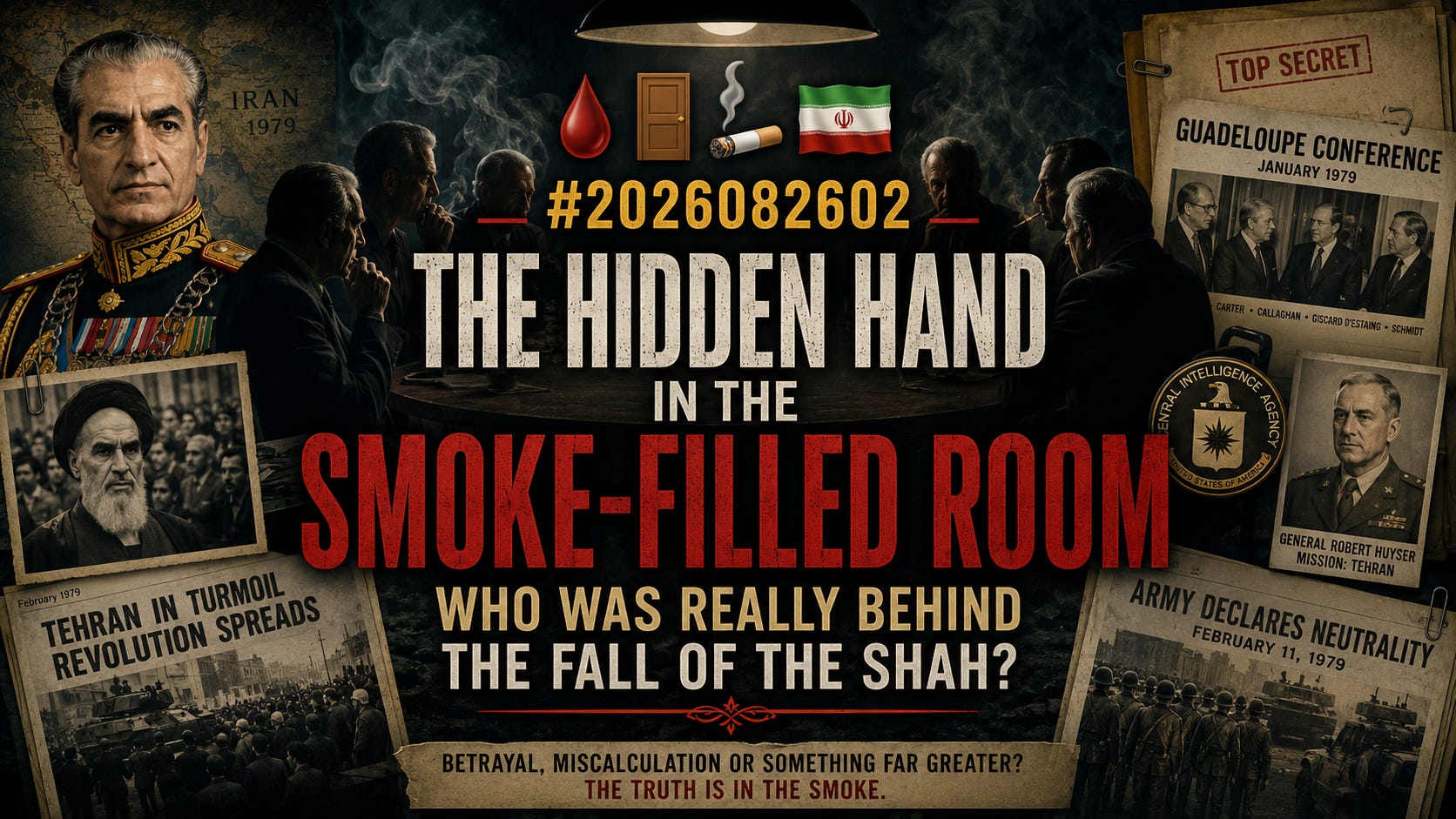
🩸 🚪 🚬 🇮🇷 #2026082602 — The Hidden Hand in the Smoke-Filled Room: Who Was Really Behind the Fall of the Shah?
RedBloodJournal.com
An Independent Third-Party Assessment
Imagine entering a smoke-filled room in January 1979.
Around the table sit men who do not necessarily like one another.
Some want the Shah preserved.
Some believe he is finished.
Some fear communism.
Some fear Khomeini.
Some fear the Iranian military.
Some fear an Iranian civil war.
Some worry about oil.
Some worry about Soviet expansion.
Some are protecting their careers.
Some are protecting their institutions.
Some are trying to preserve Iran.
Others are trying to preserve their influence over Iran.
Outside the room, millions of Iranians are demonstrating.
Inside the room, decisions are being made.
Now imagine that there is no single chairman.
That may be the best way to understand the Iranian Revolution of 1979.
The question is frequently framed too simply:
Who betrayed the Shah?
Hossein Fardoust?
Jimmy Carter?
General Robert Huyser?
Britain?
The CIA?
The Iranian generals?
Khomeini?
The Iranian people?
The evidence suggests a more complicated answer.
It was almost certainly not one person.
It may not even have been one conspiracy.
It appears much more like a convergence of interests in which numerous actors, working for different reasons, pushed the same political structure toward the edge—until one final series of decisions made the collapse irreversible.
The real hidden hand may therefore have had many fingers.
🚪 Enter the Smoke-Filled Room
Before accusing anyone, establish one principle:
A historical outcome does not require everyone involved to share the same objective.
Ten people can push a car downhill for ten completely different reasons.
One wants to steal it.
One wants it out of the driveway.
One thinks the brakes work.
One believes someone else will stop it.
One is simply following orders.
But gravity does not care about their motives.
The car moves.
Iran in 1978–79 increasingly resembles this model.
There were internal revolutionaries.
There were clerical networks.
There were secular opposition movements.
There were labor strikes.
There was an increasingly uncertain monarchy.
There was a fractured political establishment.
There were foreign governments.
There was the United States.
There was Britain.
There was France.
There was the Soviet strategic factor.
There was an Iranian military leadership trying to calculate an unknowable future.
And there was Khomeini, sitting outside Iran for much of the decisive period and successfully becoming the symbolic center of an extraordinarily diverse opposition.
The result did not require all of these actors to meet secretly and agree upon a master plan.
It required only enough of them to arrive at decisions that became mutually reinforcing.
🗝️ Suspect No. 1: Hossein Fardoust
Fardoust is an obvious place to begin.
He was not an ordinary general.
He had known Mohammad Reza Shah since childhood.
Their association stretched across roughly 52 years.
He occupied extraordinary positions within Iran’s intelligence and military establishment.
And according to the source examined in the previous report, he played an important role in the military neutrality decision that accompanied the monarchy’s final collapse.
That makes Fardoust important.
It does not, however, make him powerful enough to explain the entire revolution.
For Fardoust alone to have engineered the outcome, he would have needed to control:
the demonstrations,
Khomeini,
Bakhtiar,
Washington,
the Iranian military command,
foreign governments,
the strikes,
the political opposition,
and the Shah himself.
There is no evidence establishing such control.
So Fardoust may have been a decisive participant.
He may have betrayed the Shah.
He may have miscalculated.
He may have been maneuvering for survival.
But treating him as the architect of the entire collapse gives one man more power than the evidence justifies.
Something larger was happening.
🇺🇸 Suspect No. 2: Washington
Now the investigation becomes more interesting.
The United States unquestionably mattered.
For decades, Washington had been one of the Shah’s most important international partners.
Iran occupied an enormous strategic position:
oil producer,
Soviet neighbor,
military power,
Western ally,
Persian Gulf anchor.
When Washington’s confidence in the Shah weakened, Tehran noticed.
When American officials debated Iran’s future, Iranian officials noticed.
And when American military officers communicated with Iranian generals, those generals understood that Washington’s position mattered.
General Robert Huyser’s January 1979 mission therefore cannot be dismissed as a historical footnote.
Even President Carter later wanted a precise accounting of “Huyser’s function” when the administration reviewed what had happened in Iran.
That alone tells us something important:
Washington itself understood that Huyser’s mission was central enough to require explanation.
✈️ What Was Huyser Really Doing?
This question has generated competing interpretations for decades.
One interpretation says Huyser was sent to prevent the Iranian military from staging a coup.
Another emphasizes maintaining military cohesion.
Another says Washington wanted the generals to support the Bakhtiar government.
Another argues that by discouraging independent military action, the United States effectively removed the only force capable of preventing Khomeini’s victory.
These positions are not necessarily mutually exclusive.
That is the fascinating part.
Suppose Washington’s objective was:
Prevent military dictatorship. Avoid civil war. Keep the army intact. Support an orderly transition.
That does not mean Washington’s objective was:
Create the Islamic Republic.
But the first set of actions could unintentionally contribute to the second result.
There is an enormous distinction between intended consequence and actual consequence.
History repeatedly punishes governments that confuse the two.
🧠 Washington Was Not One Mind
There is another problem with the theory that “America decided.”
America itself was divided.
The Carter administration contained competing schools of thought.
Secretary of State Cyrus Vance generally favored diplomatic and political approaches.
National Security Adviser Zbigniew Brzezinski was often more willing to consider forceful measures.
The Defense Department had its own concerns.
The CIA had its assessments.
The U.S. Embassy in Tehran had its assessments.
President Carter had to receive all of them.
Therefore, when someone says:
“The United States wanted X,”
the first question should be:
Which part of the United States government?
The White House?
State Department?
Pentagon?
CIA?
Embassy?
National Security Council?
They did not always see the Iranian crisis the same way.
The smoke-filled room existed in Washington too.
🇬🇧 Suspect No. 3: Britain
Britain is unavoidable in any serious Iranian investigation because of its long history in Iranian politics.
Oil.
The Anglo-Iranian Oil Company.
The 1953 coup.
Political influence.
Intelligence relationships.
Its earlier role surrounding Reza Shah.
All of this created a historical memory in Iran in which British activity was suspected almost automatically whenever something major occurred.
Fardoust himself later made sweeping allegations about British penetration of the Pahlavi environment.
But his later testimony requires caution.
The source used for the earlier report explicitly raises questions about whether Fardoust’s post-revolution accounts were entirely independent, particularly when he appeared in Islamic Republic media.
So Britain belongs in the room.
But there is an important evidentiary boundary:
Britain’s historical influence does not prove that London secretly designed the 1979 Revolution.
Possible influence is not evidence of total control.
🇫🇷 Suspect No. 4: France
Then there is France.
Khomeini spent the final period of his exile at Neauphle-le-Château outside Paris.
From there, he gained extraordinary international media access.
Journalists could reach him.
Television could reach him.
His statements could reach Iran.
His messages circulated rapidly.
France did not invent Khomeini.
France did not create Iranian dissatisfaction.
But geography and communications provided something extremely valuable:
a global broadcasting platform.
This is another example of how history can be changed without a secret mastermind.
One actor provides sanctuary.
Another provides cameras.
Another distributes recordings.
Another organizes mosques.
Another organizes strikes.
Another loses confidence.
Another refuses to fire.
The individual actions appear separate.
The cumulative effect becomes revolutionary.
☭ Suspect No. 5: The Soviet Factor and the Iranian Left
The Cold War cannot be removed from the room.
Iran shared a long border with the Soviet Union.
Washington feared communist expansion.
Iranian leftist organizations participated in opposition to the Shah.
Other revolutionary factions operated beside Khomeini’s religious movement.
For American policymakers, the question was not simply:
Shah or Khomeini?
It was also:
What happens if the state collapses and Soviet-aligned forces exploit the vacuum?
That fear could produce decisions that appear irrational when viewed only through the lens of monarchy versus Islamic revolution.
Washington may have considered a moderate post-Shah arrangement preferable to uncontrolled collapse or a military confrontation that opened opportunities for the Soviet Union.
The problem was that events were moving faster than anyone could reliably control.
🕌 Suspect No. 6: Khomeini’s Network
Khomeini cannot be reduced to a pawn.
Whatever foreign governments may have calculated, his movement possessed something enormously important that outsiders could not manufacture overnight:
domestic networks.
Mosques.
Clergy.
Religious legitimacy among supporters.
Communication networks.
Political organizers.
Street mobilization.
Martyrdom narratives.
Anti-Shah sentiment.
Messages reproduced and circulated inside Iran.
Khomeini also proved exceptionally capable of allowing different groups to see different possibilities in the revolution.
Religious conservatives could imagine one future.
Secular liberals another.
Leftists another.
Nationalists another.
Students another.
Anti-monarchists another.
Many were united primarily by what they opposed.
The Shah.
That is a powerful revolutionary formula.
Everyone can postpone the argument about tomorrow until today’s enemy has disappeared.
And when tomorrow finally arrives, the best-organized faction frequently wins.
👔 Suspect No. 7: The Shah Himself
A genuinely independent investigation cannot exclude Mohammad Reza Shah.
This does not mean blaming him for everything.
It means acknowledging that rulers shape the systems that eventually protect—or fail to protect—them.
The monarchy had become highly centralized.
The Shah dominated major political decisions.
Independent political institutions remained weak.
Much depended on palace authority.
That arrangement worked while the Shah remained decisive.
But what happens when the central decision-maker becomes uncertain?
The weakness travels through the entire system.
Officials hesitate.
Generals wait for instructions.
Ministers watch one another.
Foreign allies wonder who is actually in control.
Opponents become bolder.
A centralized system can look extremely powerful right until the center begins to wobble.
Then the strength becomes fragility.
🪞 The Shah’s Fatal Paradox
The Shah built an enormously capable military.
But political power had become so concentrated around the monarchy that the military’s ultimate political purpose was tied to the monarch.
When the monarch left the country, the question changed.
What exactly was the army defending?
The constitution?
The Shah?
Bakhtiar?
The state?
The monarchy?
Public order?
Its own survival?
Those are not the same mission.
And once generals begin asking those questions during a revolution, command cohesion is already endangered.
🎩 Suspect No. 8: Shapour Bakhtiar
Bakhtiar entered the game extraordinarily late.
He tried to create something between revolution and dictatorship.
Keep constitutional government.
Reduce repression.
Release political prisoners.
Allow greater freedom.
Keep the monarchy in some constitutional form.
Prevent Khomeini from replacing one authoritarian structure with another.
But he had almost no time.
The source describes a proposed operation to arrest major members of Khomeini’s revolutionary network. A sudden curfew change appears to have alerted the opposition and contributed to the plan being abandoned.
Was this simple operational failure?
Was information leaked?
Was someone inside the government sabotaging Bakhtiar?
Was military leadership unwilling?
Those are legitimate investigative questions.
But evidence must come before accusation.
The existence of a disastrous outcome does not automatically prove deliberate sabotage.
🎖️ Suspect No. 9: The Generals
Now return to the military.
This may be where the mystery is greatest.
The Iranian military possessed enormous firepower.
Yet power on paper and willingness to use power are different things.
Senior commanders confronted impossible calculations.
If they crushed demonstrations, how many would die?
Would the army split?
Would junior officers obey?
Would soldiers fire on civilians?
Would Khomeini become a martyr?
Would Washington condemn them?
Would the Shah return?
Would Bakhtiar survive?
Would intervention produce civil war?
Could the military govern afterward?
And perhaps most importantly:
Were they being told that neutrality offered them a safer future?
The source behind the Fardoust report claims Huyser provided assurances that the military could retain a place after the political transition, although those particular assertions require independent corroboration.
If commanders believed such assurances, neutrality becomes easier to understand.
Not necessarily as treason.
Possibly as a catastrophic survival calculation.
⚰️ Then Came the Executions
If military neutrality was intended to preserve the armed forces, the result was devastatingly different.
Senior officers were executed.
The old command structure disintegrated.
The revolutionary government built new institutions of armed power.
Fardoust and Gharabaghi stood out precisely because they did not immediately share the fate of several fellow generals.
This strengthens suspicion.
But suspicion still does not answer the question.
Did they possess an agreement?
Did they believe they possessed an agreement?
Did revolutionary leaders temporarily find them useful?
Did their roles in neutrality earn them protection?
Were there other reasons?
The evidence available here cannot conclusively resolve that.
That uncertainty should remain visible.
💰 The Elephant in the Room: Oil
Now place another chair at the table.
Oil.
Iran was not just another country undergoing political turmoil.
Iran was one of the world’s most important petroleum producers.
The Iranian crisis was already affecting energy calculations internationally.
Carter met British Prime Minister James Callaghan, French President Valéry Giscard d’Estaing and West German Chancellor Helmut Schmidt in Guadeloupe in early January 1979; U.S. records show Iran and related energy questions were among the issues under discussion.
This does not prove four Western leaders sat down and selected Khomeini as Iran’s next ruler.
It does prove something more mundane—and more important.
Iran’s future was an international strategic issue.
Oil-producing Iran could not collapse without the world’s major powers calculating consequences.
That is the smoke-filled room.
Not necessarily a conspiracy.
An alignment of interests.
🌎 Guadeloupe: The Meeting That Became a Legend
The Guadeloupe summit has acquired almost mythological status in Iranian political memory.
The popular version is simple:
Four Western leaders met.
They decided the Shah had to go.
They selected Khomeini.
The revolution followed.
The documentary picture available publicly is less clean.
The summit did involve Iran.
Western leaders were clearly evaluating the Shah’s viability and the consequences of instability.
But the public documentary record does not establish a neat four-man order:
Remove Shah. Install Khomeini.
That distinction is crucial.
However, there is another possibility between “nothing happened” and “they designed the revolution.”
They may have concluded that the Shah was no longer politically salvageable.
That conclusion alone could have enormous consequences.
Because great powers do not need to overthrow an ally directly.
Sometimes they simply stop believing the ally can survive.
And everybody around that ally notices.
🚬 This Is Where the Smoke Becomes Thick
Consider the sequence.
The Shah’s position deteriorates.
Western governments lose confidence.
Washington sends Huyser.
The Iranian military is discouraged from acting independently.
Bakhtiar tries to construct a transitional government.
Khomeini returns.
The streets remain mobilized.
Military cohesion deteriorates.
The army declares neutrality.
The government falls.
Each step can be explained individually.
But when viewed together, they form a corridor.
And at the end of that corridor sits the Islamic Republic.
That naturally produces the suspicion:
Someone must have designed the corridor.
But perhaps that is the wrong conclusion.
🕸️ The Network Theory
The stronger explanation may be what we might call the Network Theory of Historical Collapse.
There was no single hidden hand.
There were overlapping hands.
Washington
Wanted stability, feared civil war and Soviet exploitation, and had declining confidence in the Shah.
London
Had longstanding strategic and commercial interests and its own assessment of whether the monarchy remained viable.
Paris
Provided the geographical environment from which Khomeini could communicate with global media.
Iranian opposition groups
Wanted the Shah removed but disagreed radically about what should replace him.
Khomeini’s network
Wanted revolutionary victory and possessed organization capable of transforming collapse into power.
The generals
Wanted to preserve the military and perhaps themselves.
Bakhtiar
Wanted constitutional government without revolutionary theocracy.
Fardoust
Had extraordinary proximity to military and intelligence decision-making, but his final motivations remain disputed.
The Shah
Wanted to avoid mass bloodshed while preserving the monarchy but had increasingly lost control of the political timetable.
Nobody needed to want precisely the same outcome.
They only needed to push against the same weakened structure.
🧠 The Hidden Hand May Have Been Miscalculation
This deserves serious consideration.
Perhaps the mysterious mastermind everyone has spent decades searching for was partly something far more ordinary:
Human beings believing they could control what came next.
Washington may have believed a post-Shah government could remain moderate.
Military leaders may have believed neutrality would preserve the army.
Secular revolutionaries may have believed Khomeini could later be contained.
Liberals may have believed political pluralism would follow.
Leftists may have believed the clerics were temporary allies.
Foreign governments may have believed strategic relations could eventually normalize.
Bakhtiar believed time could still produce compromise.
And Khomeini?
Khomeini may have been among the few major actors who understood exactly what political structure he wanted to build.
If so, his greatest advantage was not that everyone worked for him.
It was that everyone else thought they could use everyone else.
♟️ The Greatest Player Is Sometimes the One Who Waits
This is where the revolution becomes extraordinary.
Khomeini did not need to control Washington.
He needed Washington not to restore the Shah.
He did not need to control the Iranian military.
He needed the military not to crush the revolution.
He did not need to control secular opposition groups.
He needed them to help remove the monarchy.
He did not need the West to support an Islamic Republic.
He needed Western governments to conclude that preserving the Shah was no longer worth the cost.
Those are much smaller requirements.
And history frequently turns upon the difference.
🔍 Was There a Mastermind?
A neutral assessment must say:
There is presently no evidence in the material examined here proving that one individual, intelligence agency or government secretly designed and controlled the entire Iranian Revolution.
But that does not mean outside actors were irrelevant.
Quite the opposite.
Foreign governments were deeply involved in calculations about Iran.
Huyser’s mission was real.
Western discussions about the Shah’s viability were real.
Contacts with Iranian political actors were real.
Strategic concern about oil was real.
Cold War calculations were real.
The Iranian military’s relationship with Washington was real.
The Carter administration itself later undertook extensive reviews of its Iran decisions, including the options given to the Shah and Huyser’s mission.
So the intellectually serious position lies between two simplistic extremes:
“Foreign powers had nothing to do with it.”
and
“One foreign power secretly controlled everything.”
Neither adequately explains the evidence.
🚪 So Who Was in the Smoke-Filled Room?
If we reconstruct the metaphorical room, the seats look something like this:
Mohammad Reza Shah — trying to preserve a monarchy while avoiding catastrophic bloodshed.
Shapour Bakhtiar — trying to create constitutional breathing room after the clock had almost expired.
Hossein Fardoust — childhood confidant, intelligence insider and controversial participant in the final military decisions.
Iranian senior generals — calculating survival, loyalty, civil war and foreign signals.
Jimmy Carter’s administration — divided internally while trying to prevent strategic disaster.
Robert Huyser — communicating directly with the military at the most delicate moment.
Britain — historically influential and deeply interested in Iran’s strategic future.
France — hosting Khomeini during the crucial communications phase.
The Soviet Union and communist factor — shaping Western fears even when not directly controlling events.
Khomeini’s clerical network — translating revolutionary momentum into organized political power.
Secular revolutionaries and liberals — weakening the monarchy while assuming they would participate in the system that followed.
Iranian citizens — millions of individuals acting for countless reasons, without whom no revolution of this magnitude could have occurred.
And standing behind everyone:
oil, geopolitics, fear and uncertainty.
Now the room begins to make sense.
🚬 The Hidden Hand Was a Room Full of Hands
Perhaps that is the answer.
People keep searching for the hand because a single hand makes history understandable.
Find the villain.
Identify the mastermind.
Close the investigation.
But what if the real answer is more disturbing?
What if nobody fully controlled what happened?
What if powerful people sitting in separate rooms made decisions that seemed rational from their own narrow perspective?
What if those decisions interconnected?
What if each assumed someone else understood the larger picture?
What if everyone believed there would still be another move?
And then suddenly there wasn’t.
The Shah was gone.
Bakhtiar was gone.
The army was neutral.
Khomeini possessed the political initiative.
The monarchy had ended.
🩸 The Red Blood Perspective
This investigation therefore reaches a very different conclusion from the simple betrayal narrative.
Fardoust matters.
Huyser matters.
Carter matters.
Britain matters.
Bakhtiar matters.
The generals matter.
Khomeini matters.
The opposition matters.
The Shah matters.
But none alone adequately explains February 1979.
The stronger hypothesis is convergence.
Multiple interests.
Multiple fears.
Multiple calculations.
Multiple betrayals.
Multiple mistakes.
Multiple organizations.
And one collapsing political structure.
The “hidden hand” may therefore not have belonged to one mysterious man sitting behind a curtain.
It may have been the collective effect of powerful people sitting around many tables, each moving one piece of a machine whose total movement nobody fully controlled.
That is far more frightening than a conspiracy.
Because a conspiracy at least implies somebody knows what he is doing.
History may be telling us something much less comforting:
Sometimes nobody does.
🌊 Ocean of Love and Positivity Perspective
And here is where the darkness produces something useful.
For almost half a century Iranians have been asking:
Who did this to us?
America?
Britain?
The Shah?
The mullahs?
The generals?
The communists?
Fardoust?
The revolutionaries?
But after examining the smoke-filled room, another question becomes possible:
Why must our peace depend upon discovering one person to blame?
That does not mean abandoning history.
Quite the opposite.
Study every document.
Open every archive.
Question every government.
Follow every intelligence relationship.
Investigate every hidden meeting.
Demand truth.
But do not hand the past permanent ownership of the present.
There is something positive hidden inside the complexity.
Once we understand that history was made by thousands of human decisions rather than one supernatural hidden hand, something changes.
The future becomes human too.
And therefore changeable.
If one all-powerful force controlled everything, there would be almost nothing an individual could do.
But if history emerges from millions of decisions—
then every decision matters.
Every refusal to surrender judgment matters.
Every person who questions before following matters.
Every citizen who chooses truth over tribe matters.
Every leader who builds institutions stronger than personalities matters.
Every human who learns not to outsource consciousness matters.
That is the positive gift hiding inside the smoke.
We do not need to fear one giant hand controlling humanity.
We need to become conscious of the thousands of smaller hands—including our own—that continually shape the world.
And before searching forever for the people sitting inside someone else’s smoke-filled room, there is another room worth examining.
The room within.
Who sits around that table?
Fear?
Anger?
Tribal loyalty?
Memory?
Ego?
Love?
The observer?
Which one is making the decisions?
That is the room over which each human being can actually exercise sovereignty.
And perhaps that is where history begins changing.
Not by finding one final villain.
But by producing human beings who are harder to manipulate, harder to frighten, harder to divide, and much more aware of the hand they themselves place upon history.
In an Ocean of Love and Positivity.
🩸🌊✨ Fantastic!
🕵️♂️
The Hidden Hand in the Smoke-Filled Room
Aug 26, 2026
The provided text examines the 1979 Iranian Revolution not as the result of a single conspiracy, but as a complex convergence of diverse interests and miscalculations. It challenges the “hidden hand” theory by suggesting that numerous actors—including Western governments, Iranian military leaders, and revolutionary factions—pushed the monarchy toward collapse for different, often conflicting, reasons. While figures like General Huyser, Hossein Fardoust, and Ayatollah Khomeini played pivotal roles, the source argues that no single entity exercised total control over the outcome. Instead, the fall of the Shah is presented as a Network Theory of Historical Collapse, where individual strategic decisions created an irreversible momentum. Ultimately, the narrative suggests that the revolution succeeded because Ayatollah Khomeini skillfully navigated a vacuum created by the fragmented goals of his opponents. This assessment encourages a shift from seeking a solitary villain toward understanding how collective human actions and geopolitical fears shape history.
#Iran #IranianRevolution #FallOfTheShah #MohammadRezaShah #HosseinFardoust #RobertHuyser #JimmyCarter #ShapourBakhtiar #Khomeini #PahlaviDynasty #IranianArmy #1979Revolution #GuadeloupeConference #USIranRelations #BritishInfluence #RegimeChange #Geopolitics #Intelligence #HiddenHand #SmokeFilledRoom #RedBloodJournal #OceanOfLoveAndPositivity


