


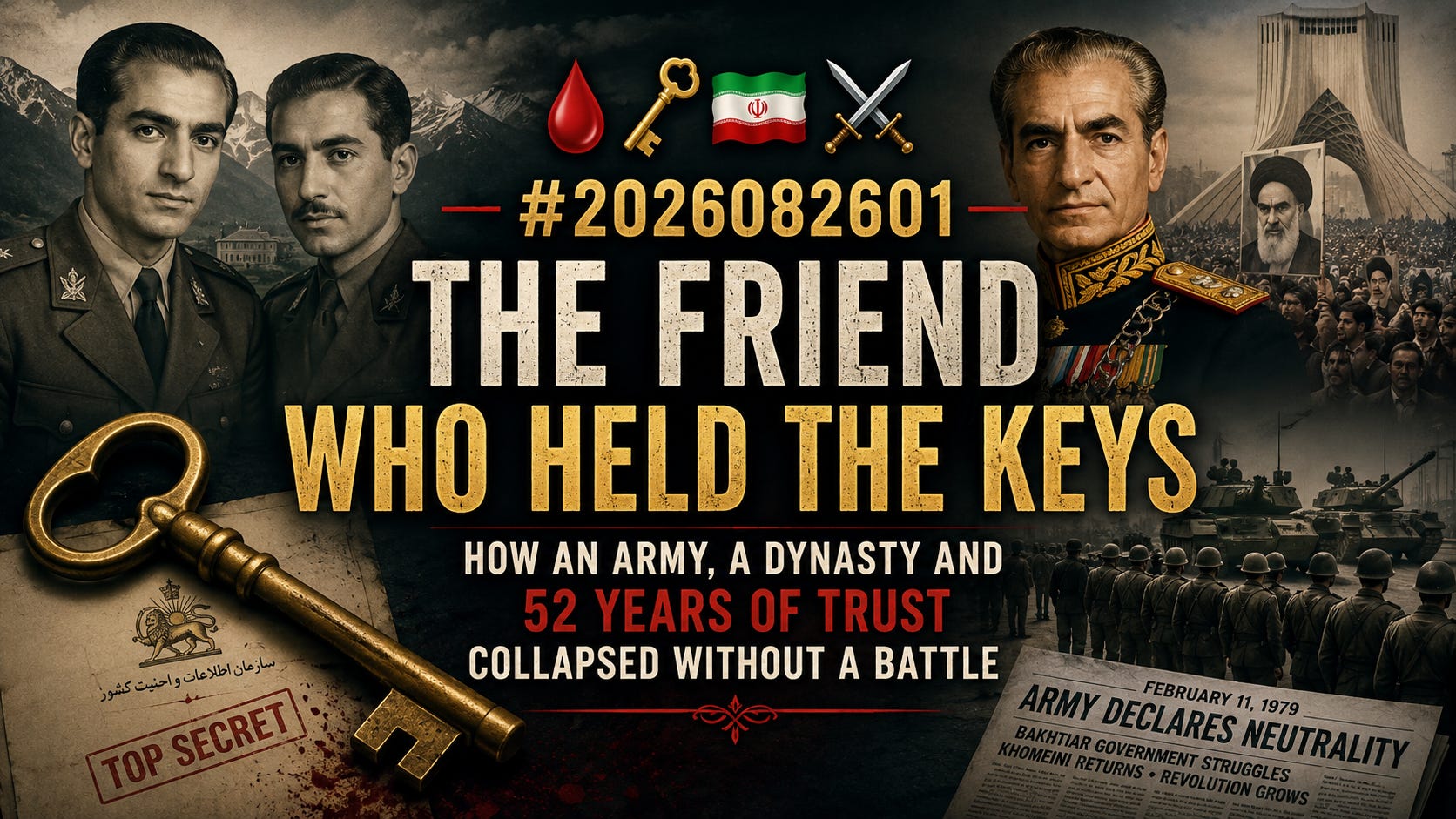
🩸 🗝️ 🇮🇷 ⚔️ #2026082601 — The Friend Who Held the Keys: How an Army, a Dynasty and 52 Years of Trust Collapsed Without a Battle
There are revolutions that defeat armies.
There are revolutions that exhaust armies.
There are revolutions in which soldiers fight until one side can no longer continue.
And then there is Iran in February 1979.
One of the strongest military establishments in the Middle East did not suffer a decisive battlefield defeat.
Its tanks were not destroyed.
Its air force was not eliminated.
Its command headquarters were not conquered by an invading army.
Instead, at the decisive moment, the military announced that it would no longer stand between the revolution and the government.
And behind that moment stands one of the strangest characters in modern Iranian history:
General Hossein Fardoust.
A poor child who became the closest childhood companion of Mohammad Reza Pahlavi.
A boy Reza Shah trusted enough to send to Switzerland alongside his son.
A military officer who rose into the deepest levels of Iranian intelligence.
A man who spent roughly 52 years beside Mohammad Reza Shah.
And finally, according to the narrative examined here, a man whose actions during the final hours of the monarchy helped remove the last barrier standing between Ayatollah Ruhollah Khomeini and power.
This is therefore not merely the story of one alleged betrayal.
It is a story about trust, institutions, foreign influence, personal loyalty, political panic, propaganda, survival—and what happens when the fate of a nation becomes concentrated in the hands of too few people.
👦 The Poor Boy Who Entered the Palace
Hossein Fardoust did not begin life as a prince, aristocrat or member of Iran’s political elite.
According to the source narrative, he was born into a poor Tehran family but demonstrated enough intelligence as a child to enter military schooling.
There he encountered another boy.
Mohammad Reza Pahlavi.
The future Shah of Iran.
Their relationship became far more than ordinary friendship.
Fardoust became the Crown Prince’s classmate, companion and confidant.
When Reza Shah decided to send Mohammad Reza abroad for schooling in Switzerland, Fardoust was selected to accompany him.
That decision would change both men’s lives.
A childhood friendship became intertwined with the future government of Iran.
What had begun in a classroom eventually reached the highest levels of military and intelligence power.
The remarkable feature of this story is not simply that Fardoust knew the Shah.
It is how long the relationship lasted.
More than half a century.
Childhood.
Adolescence.
Military training.
The palace.
Intelligence services.
The monarchy.
And finally, revolution.
🇨🇭 The Third Boy
Switzerland introduced another figure into the story:
Ernest Perron.
Perron became close to Mohammad Reza and Fardoust during their years in Switzerland and later returned to Iran with them.
His presence would become the subject of extraordinary accusations.
Fardoust later claimed that Perron had connections to British intelligence and had been positioned around the future Shah as an instrument of foreign influence.
But here an important distinction must be maintained.
Those claims came largely through Fardoust’s later testimony and writings.
The source itself acknowledges that historians have questioned the reliability of some of those accounts.
That uncertainty will become extremely important later.
Because Fardoust eventually became not merely a witness to history.
He became one of the people telling Iran what its history supposedly had been.
And he did so while under the authority of the regime that replaced his childhood friend.
🕵️ From Companion to Intelligence Chief
Fardoust’s rise through the military and intelligence establishment was extraordinary.
The Shah’s trust gave him access that few men in Iran possessed.
He eventually became associated with the Special Intelligence Bureau, an organization positioned to receive highly sensitive information from government ministries, security organizations and military institutions.
He also served as deputy chief of SAVAK.
Later came responsibilities connected to the Imperial Inspectorate, dealing with corruption and misconduct among high-ranking officials.
The childhood friend had become one of the eyes and ears of the monarchy.
The source also recounts Fardoust’s assertion that he received advanced intelligence training in Britain. But it explicitly notes that firm official documentation confirming the account is lacking.
That caveat matters.
Because this entire history contains a mixture of:
documented positions,
personal testimony,
later recollection,
political accusation,
revolutionary propaganda,
and interpretation.
Separating them is essential.
Yet one fact remains difficult to dispute within the narrative:
Fardoust occupied an extraordinarily sensitive position because Mohammad Reza Shah trusted him.
🔑 The Weakness Hidden Inside Trust
Every government requires trust.
A ruler incapable of trusting anyone cannot govern.
But trust creates another danger.
The more power that accumulates around people trusted personally rather than institutions trusted structurally, the more fragile the entire system becomes.
Fardoust was not merely another general.
He was the Shah’s childhood companion.
That distinction matters psychologically.
A minister can be replaced.
A commander can be dismissed.
A bureaucrat can be investigated.
But a childhood friend belongs to a different compartment of the human mind.
The relationship becomes emotional before it becomes institutional.
And perhaps that was the hidden vulnerability.
The Shah was not merely trusting a general.
He was trusting Hossein.
The boy who had been beside him since childhood.
🌪️ 1978–79: The System Begins to Collapse
By late 1978 Iran was entering a political storm.
Mass demonstrations intensified.
Khomeini’s movement expanded.
The Shah’s authority weakened.
Political pressure increased domestically and internationally.
Western governments were attempting to determine what would happen if the monarchy could no longer survive.
The source places particular importance on the Guadeloupe Conference, presenting it as a turning point in Western calculations about the Shah.
It goes further and argues that Western leaders had effectively decided to stop sustaining the monarchy.
That stronger interpretation should be treated as the source’s argument rather than an uncontested historical fact.
But regardless of how much weight one gives foreign decisions, by January 1979 the Shah’s position had become precarious.
And on January 16, 1979, Mohammad Reza Shah left Iran.
The king departed.
His army remained.
Fardoust remained.
And Shapour Bakhtiar remained.
🧳 The Shah Leaves the Country
Before departing, according to the narrative, the Shah told senior military commanders to obey Prime Minister Shapour Bakhtiar.
But the source describes an extraordinary second instruction.
After Bakhtiar left the meeting, the Shah allegedly told military commanders that if serious problems arose, Fardoust was the man he trusted.
Think about the significance.
At the end of his reign, surrounded by uncertainty, Mohammad Reza Shah still relied upon the friend who had accompanied him since childhood.
The monarchy had lost control of the streets.
The king was leaving the country.
And yet psychologically the Shah apparently believed one relationship remained solid.
Fifty-two years of friendship.
✈️ Khomeini Returns
Khomeini returned to Iran on February 1, 1979.
Bakhtiar faced an extraordinary dilemma.
Stopping Khomeini physically could have created an enormous confrontation.
Allowing him to return created another danger.
The source includes Bakhtiar’s own reasoning that killing Khomeini could transform him into a martyr whose symbolic power might exceed his political power while alive.
It is one of history’s impossible choices.
Kill the revolutionary leader and perhaps create a legend.
Allow him into the country and perhaps lose the government.
Bakhtiar chose the second path.
Khomeini landed.
And history accelerated.
🕰️ The Four-Hour Decision
One of the most fascinating episodes in the transcript concerns Bakhtiar’s alleged plan to arrest roughly fifty key revolutionary figures.
The concept was straightforward.
Wait until curfew.
Remove the revolutionary command structure.
Prevent the movement from coordinating.
Restore governmental control before the revolutionary forces could consolidate power.
But on February 10, 1979, the curfew was moved forward.
Instead of beginning at 8 p.m., it was announced for 4 p.m.
The source portrays this as a catastrophic operational mistake.
The sudden change alerted those around Khomeini that something extraordinary might be planned.
Khomeini responded by telling people to ignore the curfew and remain in the streets.
The streets filled.
The proposed arrests became vastly more difficult.
Bakhtiar’s operation was abandoned.
Four hours.
Sometimes history does not turn on centuries.
Sometimes it turns on four hours.
⚔️ The Army That Was Never Defeated
Now we reach the center of the story.
February 11, 1979.
The Iranian military announced neutrality.
That word sounds harmless.
Neutrality.
It sounds almost peaceful.
But in the circumstances of February 1979, neutrality had enormous political meaning.
The government depended on the military.
The revolution needed the military not to suppress it.
Once the armed forces stepped aside, the final institutional shield protecting Bakhtiar’s government disappeared.
The source directly identifies Fardoust as an important figure in the neutrality decision and treats that decision as the decisive break in the survival of the monarchy.
The question therefore becomes unavoidable:
How does one of the strongest armies in the region disappear from the political battlefield without being militarily defeated?
No foreign tanks crossed Tehran.
No invading air force destroyed Iran’s runways.
No opposing armored divisions conquered the capital.
The army simply stopped defending the existing political order.
That distinction changes everything.
🧩 Fardoust’s Explanation
According to the source, Fardoust later argued that Bakhtiar could not be trusted and might move Iran toward republican government.
But the narrator points toward an obvious contradiction.
If the goal was protecting the monarchy from republicanism, how could standing aside while Khomeini’s revolutionary movement took power accomplish that goal?
The resulting state literally became:
The Islamic Republic of Iran.
So either the explanation is incomplete,
or Fardoust’s calculations were catastrophically wrong,
or there were additional motivations we still do not fully understand.
And that is where the story begins intersecting with Washington.
🇺🇸 General Robert Huyser Arrives in Tehran
In January 1979, U.S. Air Force General Robert Huyser arrived secretly in Tehran.
His presence has produced decades of argument.
Why was he there?
What exactly did Washington want from Iran’s military leadership?
Did the United States fear a military coup?
Was Washington trying to hold the armed forces together?
Was it trying to prevent bloodshed?
Was it facilitating political transition?
The source advances a much stronger interpretation.
It argues that Huyser’s mission helped persuade senior Iranian officers—including Fardoust—not to use the military against the revolutionary movement.
It further claims Huyser conveyed assurances that the military would remain protected and that relations could continue under whatever political arrangement followed.
Those specific claims belong to the source narrative and require independent historical verification before being treated as established fact.
But they raise an important investigative question:
What did Iranian generals believe Washington wanted them to do?
Because decisions are often driven not merely by what is true.
They are driven by what decision-makers believe is true.
♟️ The Possibility of a Fatal Miscalculation
Imagine the calculation from inside Tehran’s military elite.
The Shah has departed.
America appears unwilling to restore him.
The revolutionary movement dominates the streets.
Bakhtiar’s government appears fragile.
A military crackdown could create civil war.
Foreign allies may oppose intervention.
Perhaps the generals conclude:
Do not fight the inevitable. Preserve the army. Survive the transition.
If that was the calculation, history delivered a brutal answer.
The army did not survive intact.
The old command structure was rapidly dismantled.
Senior officers were arrested.
Some were executed.
The institution that had been preserved by neutrality was itself transformed.
The transcript describes what followed as the destruction of the Imperial Iranian military establishment.
💀 The Generals Who Did Not Survive
Senior commanders including Rahimi, Jahanbani, Khosrodad and Nassiri were executed by the revolutionary authorities.
Yet two names immediately stood out.
Abbas Gharabaghi.
Hossein Fardoust.
Men associated in the source with the neutrality decision were not immediately treated like many of their fellow commanders.
Even the exiled Shah reportedly found this difficult to understand.
The transcript contains Mohammad Reza Shah questioning why individuals so close to the old establishment had remained untouched by the revolution.
And thus another mystery was born.
Why Fardoust?
Why was the childhood friend still alive?
Why had the man who knew some of the deepest secrets of the monarchy not met the same immediate fate as other senior officers?
👻 Then Fardoust Disappeared
After the revolution, Fardoust seemed to vanish.
For years his location was unclear.
Rumors circulated that he had left Iran.
Others believed he remained hidden inside Tehran.
Eventually revolutionary authorities located him.
Not in London.
Not Washington.
Not Switzerland.
Not some distant intelligence safe house.
According to the account:
he was hiding in his father’s home in Tehran.
The former intelligence giant had become a hidden old man.
The man once surrounded by the machinery of state power was discovered sitting quietly inside a house.
History has a strange sense of theater.
❓ Why Didn’t He Run?
During later interrogation, Fardoust reportedly faced the obvious question.
Why hadn’t he escaped Iran?
His answer, according to the account, was devastatingly simple:
He trusted nobody.
The source also describes an unsuccessful effort associated with Mehdi Bazargan to help him leave Iran and connects Fardoust’s decision to remain with expectations allegedly created during his contacts surrounding the Huyser period.
Whether that interpretation is ultimately correct or not, the irony is enormous.
The man whose entire life had been built upon the Shah’s trust eventually found himself unable to trust anyone.
📺 The Friend Returns—On Revolutionary Television
Eventually Fardoust reappeared publicly.
But not beside Mohammad Reza Shah.
Not defending the monarchy.
Not explaining his actions from exile.
He appeared on television under the Islamic Republic.
And began talking.
He described the palace.
The Shah.
Foreign influence.
The Pahlavi system.
Its weaknesses.
Its personalities.
Its secrets.
The childhood companion became a witness against the world in which he had spent almost his entire adult life.
The source describes these broadcasts as damaging to the Shah’s reputation and portrays Fardoust as emphasizing dependence on Britain and the United States.
But another problem immediately appears.
How freely was he speaking?
📖 Can We Trust Fardoust’s Testimony?
This may be the most important question in the entire story.
Fardoust’s memoirs and television interviews have been used repeatedly to explain the Pahlavi monarchy.
But the source itself raises serious doubts about their reliability.
It notes the political circumstances under which the interviews took place and suggests that questioning sometimes appeared to steer his testimony toward particular conclusions.
That creates a historical paradox.
Fardoust may have possessed extraordinary firsthand knowledge.
Few people knew Mohammad Reza Shah better.
Few individuals occupied more sensitive positions.
Few had access to more secrets.
Yet the circumstances under which much of his testimony became public make unquestioning acceptance impossible.
Therefore Fardoust becomes simultaneously:
one of the most valuable witnesses to the Pahlavi era
and
one of the witnesses who must be treated with the greatest caution.
🎭 Witness, Prisoner or Propaganda Instrument?
There are several possibilities.
Perhaps Fardoust spoke truthfully.
Perhaps he selectively told truths that benefited the new regime.
Perhaps he adjusted his stories to survive.
Perhaps interrogators shaped the narrative.
Perhaps some accounts contain genuine memories surrounded by political interpretation.
Perhaps different possibilities are true in different portions of his testimony.
This is why history cannot simply quote Fardoust and declare the matter finished.
The question must always accompany the quotation:
When did he say it?
Where did he say it?
Under whose authority?
What incentive did he have?
What independent evidence supports it?
Those questions matter whether the testimony praises the Shah or condemns him.
🕸️ Was Fardoust Really the Traitor?
Calling Fardoust a traitor produces an emotionally satisfying explanation.
One man betrayed his friend.
The monarchy collapsed.
Case closed.
But history rarely operates so conveniently.
No single man created the Iranian Revolution.
No single general created decades of political resentment.
No single foreign government controlled millions of Iranians.
No single cleric alone dismantled the existing state.
No single mistake produced February 1979.
Instead, multiple systems converged.
The Shah’s weakening authority.
Popular unrest.
Religious organization.
Political opposition.
Foreign calculations.
Military hesitation.
Institutional fragility.
Bakhtiar’s limited time.
Khomeini’s political momentum.
The Shah’s departure.
Huyser’s mission.
The military neutrality declaration.
And inside all of it:
Hossein Fardoust.
Perhaps not the man who created the storm.
But possibly one of the men standing beside the final switch.
🗝️ One Friend Holding Too Many Keys
And this may be the larger lesson.
The extraordinary question is not merely:
Why did Fardoust do what he did?
The deeper question is:
Why could one man’s decision matter so much?
Why was a childhood friend permitted to accumulate such enormous access to intelligence, military leadership and the ruler himself?
Why should the personal confidence of one king become intertwined with the security architecture of an entire country?
A strong government cannot depend upon the moral perfection of its insiders.
Institutions exist precisely because humans are imperfect.
Friends change.
Generals miscalculate.
Presidents misunderstand.
Kings become isolated.
Advisers seek survival.
Foreign allies change policy.
People panic.
People become frightened.
People betray.
People also make sincere decisions that later prove disastrous.
A political system designed around personalities eventually inherits every weakness of those personalities.
⚔️ The Army’s Greatest Defeat May Have Been Psychological
Perhaps Iran’s army did not lose its final battle because it never fought one.
Perhaps the decisive battlefield existed inside the minds of its commanders.
Should we intervene?
Will America support us?
Can Bakhtiar survive?
Will the revolutionaries preserve the military?
Would intervention create civil war?
Will the Shah return?
Is Khomeini temporary?
Can the institution survive by remaining neutral?
Every answer contained uncertainty.
And once neutrality was announced, the uncertainty ended.
The revolutionaries understood the meaning immediately.
There would be no final military barrier.
The political contest was effectively over.
🔥 The Cruelest Irony
If the source’s interpretation is even partly correct, the greatest irony is almost unbearable.
Some military leaders may have believed neutrality would save the army.
Instead, neutrality helped create the conditions in which the old military leadership was dismantled.
Some officers may have believed accommodation would protect them.
Many were executed.
Some may have assumed Washington understood what would follow.
Washington itself soon confronted a government deeply hostile to the United States.
And Fardoust—the man who had spent his life inside the monarchy—ended his story explaining that monarchy on television controlled by its successor.
Everyone may have thought they were managing history.
History managed them.
🩸 The Red Blood Perspective
The easiest way to tell this story is to choose heroes and villains.
The Shah was betrayed.
Fardoust was evil.
America engineered everything.
Khomeini fooled everyone.
The generals were cowards.
The people made a mistake.
Simple stories are emotionally comfortable.
But Red Blood exists precisely to investigate the uncomfortable territory beyond simple stories.
Fardoust’s life teaches something far more important than whether one particular man deserves a particular historical label.
It shows what happens when personal loyalty substitutes for resilient institutions.
It shows the danger of a government becoming dependent upon individuals whose decisions can suddenly redirect the entire system.
It shows how political actors make enormous decisions while possessing incomplete information.
And it shows why history written after a revolution must always be examined carefully—especially when former insiders begin speaking under the authority of the people who won.
The question is therefore not merely:
Did Fardoust betray the Shah?
It is:
How did Iran become a system in which the decision of one childhood friend could matter this much?
That is the larger story.
🌊 Ocean of Love and Positivity Perspective
And now the external theater can be left behind.
The Shah.
Fardoust.
Huyser.
Khomeini.
Bakhtiar.
Washington.
London.
The generals.
The revolution.
For a moment, let them all disappear.
Because beneath this enormous historical tragedy sits something completely human.
Trust.
Every person carries a smaller version of the same problem.
We give someone else the keys to our peace.
Someone else the keys to our happiness.
Someone else the keys to our identity.
Someone else the keys to our confidence.
Someone else the authority to tell us who we are.
And then we become shocked when another human being—imperfect, frightened, confused and mortal—fails to carry that responsibility perfectly.
That is where the positive lesson appears.
The collapse of external trust can become the beginning of inner sovereignty.
Not distrust.
Not isolation.
Not bitterness.
Something much more powerful.
Knowing oneself well enough that friendship remains friendship without becoming ownership.
Knowing oneself well enough that love does not require surrendering consciousness.
Knowing oneself well enough that another person’s betrayal cannot destroy the observer within.
The Shah’s story, Fardoust’s story and Iran’s story are gigantic versions of something happening inside every human being.
There is the ruler.
There is the adviser.
There is fear.
There is temptation.
There is uncertainty.
There is loyalty.
There is survival.
There is the voice from outside saying:
Trust me. Follow me. I know what comes next.
And somewhere beneath all of those voices is another presence.
Quiet.
Watching.
The observer.
The spiritual driver.
The part that does not need a palace, army, government or childhood friend to exist.
Perhaps that is the unexpected gift inside this painful history.
A reminder that the safest place to build sovereignty is not around a throne.
It is within consciousness.
When the outside world becomes chaotic, the opportunity to know the inner world becomes greater.
When trusted structures collapse, we can discover what cannot be taken away.
When old certainty dies, deeper awareness can be born.
And once a person learns to recognize that inner observer, betrayal itself can become a teacher.
Pain becomes information.
Loss becomes perspective.
History becomes wisdom.
Even one of Iran’s darkest passages can therefore contain something constructive:
a warning not to surrender the keys to ourselves.
That is how darkness becomes useful.
That is how tragedy produces consciousness.
That is how even betrayal can eventually return us to the Ocean.
In an Ocean of Love and Positivity.
🩸🌊✨ Fantastic!
🗝️
The King’s Confidant and the Collapse of a Dynasty
Aug 26, 2026
This source examines the collapse of the Iranian monarchy in 1979 through the lens of General Hossein Fardoust, the Shah’s lifelong confidant and intelligence chief. It details how a childhood friendship granted Fardoust immense power, ultimately making the regime vulnerable when he played a key role in the military’s decision to remain neutral during the revolution. The text explores the strategic miscalculations of military leaders and the alleged influence of Western officials, such as General Robert Huyser, in facilitating the transition of power. By analyzing Fardoust’s later controversial testimony under the Islamic Republic, the narrative questions the reliability of historical accounts shaped by revolutionary pressure. Ultimately, the source illustrates how a government built on personal loyalty rather than resilient institutions can disintegrate when internal trust fails. This historical overview serves as a broader meditation on the dangers of consolidating national security within a small circle of unaccountable individuals.


