


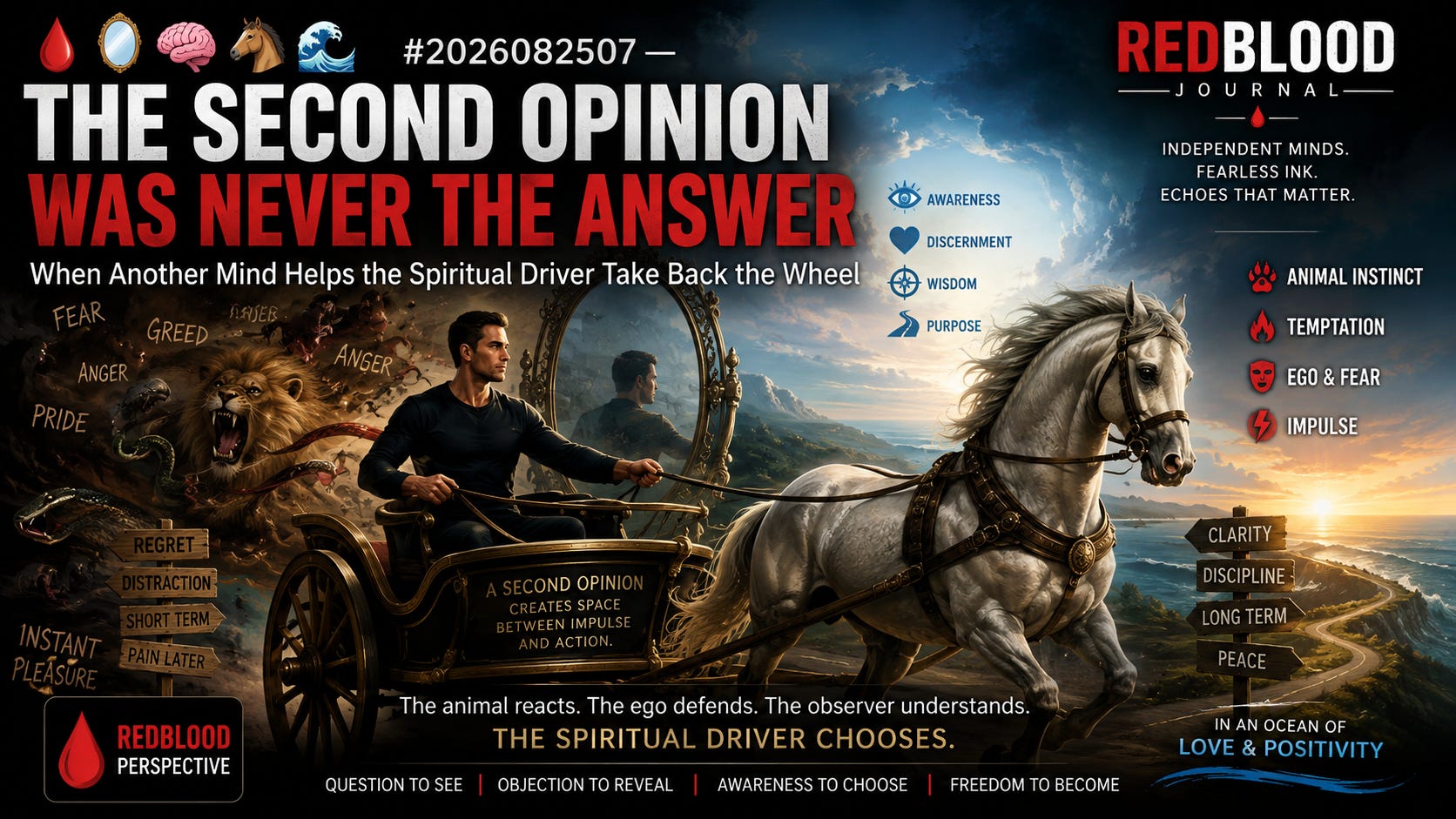
🩸 🪞 🧠 🐎 🌊 #2026082507 — The Second Opinion Was Never the Answer: When Another Mind Helps the Spiritual Driver Take Back the Wheel
There is a strange moment that happens in life more often than people admit.
We ask someone for advice.
We explain the situation.
We describe the opportunity.
We explain why we are excited.
We list the risks.
We listen carefully to what the other person says.
And then something unexpected happens.
We realize:
I already knew the answer.
The other person did not give it to us.
They exposed it.
That may be the real value of a second opinion.
Not to replace our judgment.
Not to surrender our future to another person.
Not to find someone willing to make the decision for us.
But to place our thinking in front of another mind long enough to discover whether what we are feeling is wisdom—
or impulse.
Because inside every human being there is more than one voice competing for the steering wheel.
And sometimes what we call a decision is really a struggle between the animal and the observer.
The Animal Is Fast
The animal part of the human being is ancient.
It was here long before philosophy, universities, corporations, governments, retirement plans, mortgages, business proposals, or investment accounts.
It understands survival.
Food.
Sex.
Fear.
Territory.
Status.
Pleasure.
Pain.
Competition.
Belonging.
Escape.
It reacts quickly because quick reactions once kept bodies alive.
There is nothing inherently evil about this machinery.
We need it.
Fear can warn us.
Desire can move us.
Anger can tell us that a boundary has been crossed.
Attraction can connect us.
Ambition can push us forward.
Instinct can sometimes recognize danger before conscious thought catches up.
The problem begins when the passenger grabs the steering wheel.
The animal does not naturally ask:
What will this choice look like ten years from now?
It asks:
What do I want now?
And that difference has shaped an enormous amount of human history.
Temptation Is the Animal Making a Sales Pitch
Temptation deserves special attention because temptation often disguises itself as reasoning.
It rarely introduces itself by saying:
Hello. I am about to lead you somewhere you will regret.
It sounds much more convincing.
You deserve this.
Everyone else is doing it.
This opportunity will disappear.
You can fix the consequences later.
Nobody will know.
You have earned the right.
This one time will not matter.
Imagine how good this will feel.
Imagine what people will think of you.
Imagine how much money you could make.
Imagine what happens if someone else gets there first.
Temptation sells the immediate reward.
It hides the invoice.
That is why resisting temptation is not simply an old moral command.
It is an exercise in consciousness.
The lesson is not:
Never feel temptation.
Temptation will come.
The lesson is:
Recognize who is asking for the steering wheel.
The Spiritual Driver Does Something Different
The observer does not necessarily scream.
That may be why it is so easy to ignore.
The animal says:
DO IT.
The observer asks:
Why?
The animal says:
Take it before somebody else does.
The observer asks:
Do I actually need it?
The animal says:
They embarrassed you. Get even.
The observer asks:
Who will I become if I follow this anger?
The animal says:
You cannot walk away now. You have already invested too much.
The observer asks:
Am I protecting my future, or protecting my pride?
The animal says:
This feels right.
The observer asks:
Will it still feel right tomorrow?
That tiny distance between feeling and observing the feeling is where something extraordinary becomes possible.
Choice.
And This Is Where the Second Opinion Becomes Valuable
Sometimes we are too close to our own desire to see it clearly.
We are standing inside the emotional weather.
Another person is standing outside it.
We feel the rain.
They may see the storm.
That is why a good second opinion can become a temporary interruption between impulse and action.
Not an authority.
Not a commander.
Not someone taking control of our life.
A mirror.
A person might ask:
Why do you really want this?
What happens if your assumption is wrong?
What are you not seeing because you want this outcome so badly?
Are you responding to opportunity—or fear of missing out?
Would tomorrow’s version of you thank today’s version of you?
Would you still choose this if nobody ever knew you had done it?
Are you protecting your future—or your ego?
And suddenly the animal has competition.
The observer has returned to the conversation.
A Second Opinion Is Not Supposed to Tell You What to Do
This is where advice often goes wrong.
People ask:
“What would you do?”
Then they unconsciously transfer responsibility.
If it works, wonderful.
If it fails:
“You told me to do this.”
That is not the highest purpose of a second opinion.
A useful second opinion should not remove responsibility.
It should increase awareness.
It should introduce objections.
Reveal assumptions.
Expose emotional reasoning.
Point toward consequences.
Ask uncomfortable questions.
And then step aside.
The decision must return to the person who will live with it.
Because the person giving the second opinion will eventually go home.
The consequences will not.
Experience Is Valuable Because Someone Already Paid the Tuition
There is another reason second opinions matter.
Human beings often say:
Experience is how we grow.
True.
But that statement is incomplete.
Some experiences are necessary.
Others are simply expensive ways of learning something someone could have told us in five minutes.
Imagine civilization if every generation had to personally rediscover everything.
Every child would have to burn a hand before believing fire is hot.
Every entrepreneur would have to repeat every business failure.
Every marriage would have to rediscover every communication mistake.
Every investor would have to independently learn every form of fraud.
Every generation would have to begin again.
That is not growth.
That is amnesia.
Human beings advance because experience can be transferred.
Someone else already paid the tuition.
A second opinion gives us the opportunity to read some of their notes.
We are still free to enroll in the class.
But at least we know where some of the traps are.
Not Every Struggle Is Necessary
There is a romantic idea that suffering automatically produces wisdom.
It does not.
Sometimes suffering produces wisdom.
Sometimes it produces damage.
Sometimes it produces nothing except lost years.
There are mistakes that teach lessons.
There are also mistakes that could have been avoided by one sincere objection delivered at the right moment.
That does not deprive someone of growth.
It may allow them to spend their growth somewhere more useful.
Avoiding an unnecessary ditch does not mean the road taught you nothing.
It means somebody warned you that the ditch was there.
The Objection May Be the Gift
One of the strangest things about modern encouragement culture is the assumption that support means agreement.
Someone announces a plan.
Everybody says:
Fantastic.
Go for it.
Follow your dream.
Believe in yourself.
Sometimes that is exactly what a person needs.
Sometimes it is the worst possible advice.
A serious friend may occasionally say:
I think you are missing something.
That can feel negative.
But an objection is not necessarily negativity.
It can be a stress test.
Strong ideas survive examination.
Weak ideas should be grateful for early destruction.
It is far better for an idea to collapse during a conversation than after consuming five years of someone’s life.
The person who challenges your idea may therefore be doing something far more loving than the person who applauds it.
The Experiment Happened in This Very Idea
Consider the irony.
The thought arose:
What if Red Blood offered completely free second opinions to anyone who wanted one?
No charge.
No obligation.
No hidden financial reward.
The satisfaction of helping another person would be the compensation.
Beautiful idea.
Then came the second opinion.
What could go wrong?
Quite a few things.
People might confuse a second opinion with professional advice.
Readers could mistake Red Blood journalism for a personal counseling service.
Private information might begin flowing into a publishing environment.
Some people might become dependent on another person’s judgment.
“Nonbiased” would be an impossible promise because every human perspective is shaped by experience.
The service could unintentionally create responsibility for decisions that properly belong to the individual.
And the identity of the publication itself could become confused.
The interesting part was not that those objections produced the answer.
The answer was already there.
The objections made it visible.
That is the entire report in miniature.
Sometimes we ask another person because we do not know.
Sometimes we ask another person because we already know—
and want to see whether the answer survives resistance.
The Second Opinion Can Expose Which Part of Us Is Speaking
This may be the deepest purpose of the process.
Before a major decision, ask:
What part of me wants this?
Not only:
What do I want?
But:
Who inside me is speaking?
Fear?
Pride?
Loneliness?
Greed?
Anger?
Sexual attraction?
Status?
The need for approval?
The fear of looking like a failure?
The desire to prove somebody wrong?
The panic of being left behind?
Or something quieter?
Something that remains after all of those voices stop shouting?
The second opinion can help expose that distinction because another person does not experience our temptation with the same intensity.
They can sometimes see the hook while we are staring at the bait.
Resistance Is Training
This changes the meaning of temptation itself.
Perhaps temptation is not merely an obstacle.
It is also practice.
You cannot develop patience in a universe where nothing makes you impatient.
You cannot develop courage without fear.
You cannot develop restraint without desire.
You cannot develop forgiveness without being hurt.
You cannot develop discernment without encountering convincing false choices.
You cannot learn to drive if nothing ever tries to pull the wheel.
Temptation therefore contains a strange positive possibility.
Every time an impulse arises and the observer notices it before obeying it, something strengthens.
The spiritual driver becomes more familiar with the vehicle.
The point is not to hate the animal.
The animal is part of the human experience.
The point is to know its voice well enough that it cannot impersonate the driver.
🩸 The Red Blood Perspective
Perhaps the real purpose of a second opinion has been misunderstood.
It is not necessarily:
Tell me what to do.
It may be:
Help me discover who inside me is trying to make this decision.
That is an entirely different relationship.
Now the other person is not above us.
They are beside us.
They do not take the wheel.
They ask us to notice who is holding it.
And perhaps this is why disagreements, objections, uncomfortable questions, and opposing perspectives are so valuable.
They create friction.
Friction exposes structure.
An idea that remains standing after serious examination is much stronger than an idea protected from every objection.
And a person who remains capable of choosing after hearing conflicting opinions is far stronger than someone who merely follows whichever voice sounds most confident.
The goal is not perfect decision-making.
There may be no such thing.
The goal is conscious decision-making.
🌊 Ocean of Love and Positivity Perspective
Now leave the adviser.
Leave the business idea.
Leave Red Blood.
Leave the argument.
Leave the external world for a moment.
Go inward.
There is the horse.
There is the rider.
There is instinct.
There is awareness of instinct.
There is temptation.
And there is the one who recognizes temptation.
That distinction may be one of the greatest gifts hidden inside the human experience.
The animal is not the enemy.
It is the vehicle carrying us through this world.
It wants food because the body must survive.
It fears danger because survival matters.
It seeks connection because isolation once meant death.
It desires pleasure because nature built reward into the machinery.
There is intelligence in all of it.
But perhaps the positive purpose of the struggle is learning the difference between having an impulse and being the impulse.
Fear appears.
We observe fear.
Desire appears.
We observe desire.
Anger appears.
We observe anger.
Temptation appears.
We observe temptation.
And in that observation something extraordinary reveals itself:
There is something here capable of watching all of them.
That observer is where the journey turns inward.
Another person may temporarily help awaken it.
A second opinion may expose it.
A mistake may awaken it.
A temptation may exercise it.
Even a bad idea can serve it.
That is the positivity hidden inside resistance.
The struggle itself can teach the driver how to drive.
And perhaps that is why another human being can be incredibly valuable without ever becoming our authority.
They can hold up a mirror.
They can challenge our certainty.
They can point toward the animal pulling at the wheel.
But then their work is finished.
Because eventually the second person must disappear from the equation.
There remains only the observer.
The decision.
And the quiet question:
Who is driving?
When we can ask that question before acting, temptation loses some of its disguise.
When we can hear an objection without feeling attacked, ego loses some of its power.
When we can receive another perspective without surrendering our sovereignty, wisdom begins replacing dependency.
And when we recognize that even temptation, resistance, mistakes, disagreement, and uncertainty can become instruments of self-knowledge, something beautiful happens.
Life stops looking like a collection of enemies trying to defeat us.
It begins looking like a classroom teaching the observer to awaken.
The second opinion was never supposed to become the answer.
It was there to help us hear the answer beneath the noise.
The animal speaks.
The world speaks.
Other people speak.
Temptation speaks.
Fear speaks.
Then the observer listens to all of them.
And the driver chooses.
In an Ocean of Love and Positivity.
🩸🌊✨ Fantastic!
🪞
The Observer at the Wheel
Aug 25, 2026
This text explores the psychological and spiritual value of seeking a second opinion, framing it not as a way to outsource responsibility but as a tool for self-discovery. It distinguishes between the animal instinct, which reacts impulsively to immediate desires, and the spiritual observer, who possesses the awareness to make conscious choices. By inviting another perspective, an individual can better identify whether their motivations are driven by wisdom or ego, as an outside observer often acts as a mirror to expose hidden biases. The source argues that external objections are gifts that stress-test ideas, preventing people from repeating expensive mistakes while strengthening their own discernment. Ultimately, the process is designed to empower the internal driver to take control of the steering wheel of life. This shift toward mindful decision-making allows one to navigate the friction of conflicting voices with greater clarity and personal sovereignty.
#SecondOpinion #SelfAwareness #SpiritualGrowth #DecisionMaking #Consciousness #InnerWisdom #PersonalSovereignty #Temptation #SelfControl #ObserverMind #SpiritualDriver #HumanInstinct #CriticalThinking #LifeLessons #InnerPeace #Mindfulness #PersonalGrowth #Wisdom #RedBloodPerspective #OceanOfLoveAndPositivity #RedBloodJournal


