


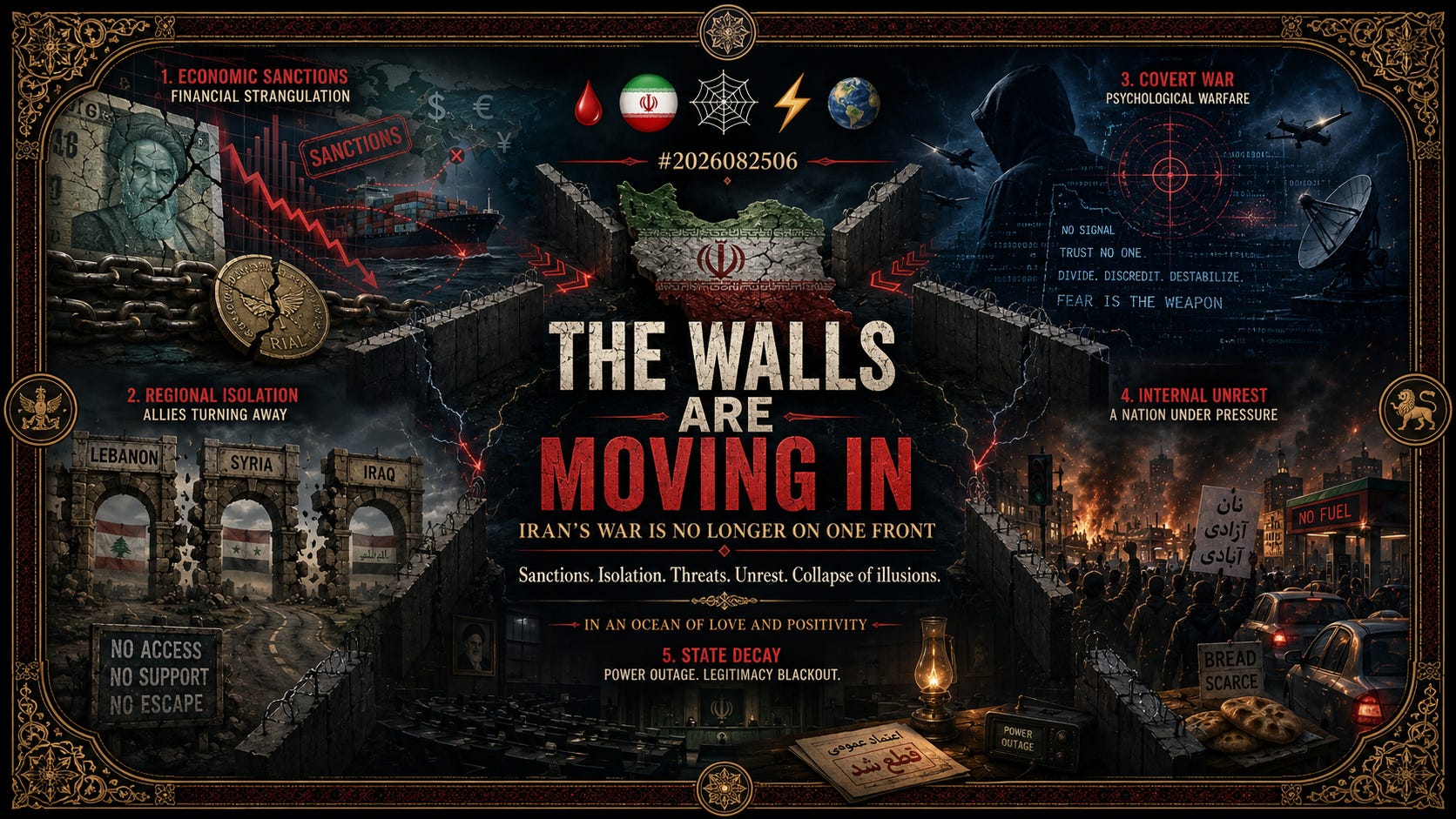
🩸 🇮🇷 🕸️ ⚡ 🌎 🧱 #2026082506 — The Walls Are Moving In: Iran’s War Is No Longer on One Front
RedBlodJournal.com
There is a moment in the life of every political system when the individual headlines stop being individual headlines.
A sanction here.
A closed border there.
A diplomatic humiliation somewhere else.
A currency crisis.
A power outage.
A frightened official.
A rumor about a kidnapping.
A threat against somebody’s child.
A former ally quietly walking toward another table.
Seen separately, each event can be explained away.
Seen together, they begin to form a map.
And the map emerging around the Islamic Republic is becoming much more interesting than any one headline.
The pressure is no longer approaching Tehran from one direction.
The walls appear to be moving inward from several directions at once.
The First Front: Money
For years, sanctions were discussed almost mechanically.
Washington would announce sanctions.
Tehran would condemn them.
Middlemen would appear.
Companies would change names.
Payments would move through intermediaries.
Oil would find another customer.
Money would find another bank.
The game continued.
But the material in this report describes something potentially more serious.
The United States is not merely looking for the Iranian institution at the center of a transaction.
It is increasingly looking for the network around the institution.
The broker.
The foreign company.
The account.
The facilitator.
The transit country.
The hidden commercial route.
The oxygen tube.
That distinction matters.
A government can survive sanctions if enough doors remain open.
The real danger begins when someone starts systematically identifying the doors.
The source itself describes growing anxiety over how precisely American authorities appear able to identify financial facilitators and sanctions-evasion channels.
This is no longer simply:
“We sanction you.”
It increasingly resembles:
“We are mapping how you survive the sanctions.”
That is a different kind of economic warfare.
Iraq: The Door Behind the House
For years, Iraq represented more than a neighboring country.
It was a marketplace.
A transit system.
A political buffer.
A religious corridor.
A financial pathway.
And perhaps most importantly, a place where geography made isolation extremely difficult.
The file discusses reports that Washington was pressuring Baghdad to restrict Iranian land crossings and aircraft access, while also correctly noting that those reports had not yet received official confirmation from either government at the time of the recording.
That qualification matters.
But so does the strategic concept.
If Iran can be economically isolated only at Iranian borders, the network survives elsewhere.
If surrounding countries are forced to choose whether they want access to the American-centered financial system or continued facilitation of Iranian networks, the equation changes.
The battlefield moves outside Iran.
Syria: The Bridge That Disappeared
Then comes Syria.
For decades, Tehran’s regional architecture depended upon something remarkably simple:
geography.
Iran.
Iraq.
Syria.
Lebanon.
Place those four points on a map and the strategy becomes obvious.
Syria was the bridge.
Through that bridge came influence, logistics, weapons, money and access to Hezbollah and the Mediterranean.
The source argues that the fall of Bashar al-Assad in December 2024 broke that physical and ideological bridge and that Syria’s subsequent reintegration into the international economic system would make the change structural rather than merely military.
That may ultimately prove more important than another missile strike.
A missile destroys a building.
A geopolitical realignment can destroy the reason the building existed.
Lebanon: Influence Suddenly Has a Price
Lebanon provides another signal.
The file describes a diplomatic struggle surrounding Tehran’s designated ambassador and portrays Beirut as increasingly willing to resist Iranian pressure.
Again, the important part is not merely one diplomat.
It is the change in posture.
A regional power begins to weaken not when everybody publicly declares its defeat.
It weakens when smaller actors stop behaving as though its displeasure is automatically dangerous.
Power has a psychological component.
People obey power partly because they expect everybody else to obey it.
Once that expectation cracks, erosion can accelerate remarkably quickly.
The Second Front: The Family
And here the story becomes darker.
Benjamin Netanyahu says the Islamic Republic attempted to kill one of his sons.
According to the source, he did not identify which son, nor provide details concerning the timing, location or method.
Meanwhile, Iranian state media reportedly broadcast material examining Barron Trump’s movements, security environment and vulnerabilities while discussing threats against him.
And almost simultaneously came an unconfirmed rumor involving the children of Iranian judiciary chief Gholam-Hossein Mohseni-Ejei.
The source explicitly acknowledges that there is no evidence establishing an operational connection between these stories.
That distinction must remain clear.
Rumor cannot be promoted into fact merely because the timing is intriguing.
But even without proving a connection, the three stories reveal something deeply disturbing.
The vocabulary of conflict is drifting from officials toward families.
The file itself identifies this emerging pattern: children of political leaders becoming instruments of threat, intimidation and reciprocal signaling.
That is not strength.
It is evidence that political warfare is losing another boundary.
When governments begin communicating through the vulnerability of children, civilization itself has lost ground.
The Third Front: The Street
The most dangerous battlefield, however, may not be Washington.
Or Jerusalem.
Or Baghdad.
Or Beirut.
It may be the supermarket.
The gas station.
The electricity bill.
The unpaid paycheck.
The water supply.
The bread line.
The file repeatedly returns to one idea:
Iranian society resembles an accumulation of combustible grievances.
The argument is not that somebody can schedule an uprising.
It is almost the opposite.
Extreme economic pressure makes the trigger increasingly unpredictable.
Fuel can become the trigger.
Bread can become the trigger.
Electricity can become the trigger.
An unpaid salary can become the trigger.
A completely unrelated confrontation can become the trigger.
The source describes this metaphorically as a society containing numerous “powder magazines,” any one of which might ignite accumulated anger.
That is the danger governments routinely misunderstand.
They watch opposition leaders.
They watch political organizations.
They watch foreign intelligence agencies.
But collapse does not always request an appointment.
Sometimes the final political event begins with somebody standing in line.
The Fourth Front: Legitimacy
Then we arrive at Babak Zanjani.
In the source, Zanjani becomes more than an individual businessman.
He becomes a symbol.
A man once sentenced to death in one of Iran’s most notorious financial cases reappears amid luxury business ventures while ordinary Iranians experience worsening economic pressure.
Whether every accusation circulating around him is correct is almost secondary to the political symbolism.
Because legitimacy does not disappear only when people become poor.
It disappears when poverty appears to operate under one set of rules, while wealth connected to power appears to operate under another.
People tolerate hardship differently when hardship appears shared.
They tolerate it much less when hardship becomes a class system.
That is where corruption becomes politically explosive.
Not simply because money was stolen.
But because corruption communicates something deeper:
The rules are not real.
When Customers Become Voters
Another fascinating development in the source is the use of consumer behavior as political punishment.
People do not necessarily need a party.
They do not necessarily need a demonstration permit.
They do not even need to stand in a street.
They can simply refuse to buy.
Refuse to attend.
Refuse to promote.
Refuse to normalize.
The file describes boycott campaigns directed at businesses and cultural personalities whom critics regard as aligned with the government.
Whatever one thinks of individual targets, the mechanism is important.
Economic participation itself becomes political speech.
The customer becomes the voter.
The empty chair becomes the ballot.
The unsold ticket becomes the protest sign.
That type of resistance is extremely difficult to suppress because it requires almost nothing.
Only absence.
And Then the Lights Went Out
Perhaps no scene in the entire file captures the condition more perfectly than the smallest one.
Iranian parliamentarians were reportedly meeting to discuss the causes of electricity outages.
And the electricity went out.
Officials placed water bottles over mobile-phone lights to illuminate the room.
No political cartoonist could improve it.
The state investigating darkness—
in darkness.
A government discussing infrastructure failure—
without functioning infrastructure.
A room full of authority—
searching for light from personal phones.
Sometimes history develops a sense of humor so perfect that commentary becomes unnecessary.
🩸 The Red Blood Perspective
But this is where caution becomes essential.
A government under enormous pressure does not automatically disappear.
Economic pain does not automatically create democracy.
Foreign pressure does not automatically produce freedom.
Regional isolation does not automatically create responsible government.
And public anger does not automatically create something better.
History contains many graves belonging to people who confused the destruction of an old order with the birth of a good one.
They are not the same event.
Iran’s greatest danger may therefore arrive precisely when the old structure becomes weakest.
Because when institutions weaken, everybody suddenly arrives carrying a flag, a slogan, a foreign sponsor, an ideology, a crown, a revolutionary mythology or a beautiful promise.
The population may be asked once again to choose its next master.
That would not be liberation.
It would merely be another rotation of the cage.
The real question is therefore larger than:
Will the Islamic Republic survive?
The real question is:
Can the Iranian people reach a point where nobody needs to own them at all?
No Shah.
No Supreme Leader.
No foreign intelligence service.
No billionaire savior.
No revolutionary priesthood.
No imported ideology.
No personality cult.
Just citizens.
Law.
Accountability.
Individual sovereignty.
And a government small enough to remember who hired it.
🌊 Ocean of Love and Positivity Perspective
And somewhere inside all this darkness is the positive possibility.
Perhaps that is what these collapsing structures can teach.
The disappearing corridors.
The sanctions.
The frightened elites.
The furious population.
The propaganda.
The threats.
The outages.
The collapsing myths.
They may force people to discover something that stable political systems allow them to forget:
No external structure can permanently substitute for the internal structure of the human being.
Every dictatorship first requires obedience inside the mind.
Every personality cult requires someone willing to surrender judgment.
Every corrupt system requires people who learn to say:
“That is simply how things are.”
And every liberation therefore begins before the government changes.
It begins when the observer changes.
When fear is observed instead of obeyed.
When propaganda is examined instead of absorbed.
When hatred is understood instead of inherited.
When the desire for another savior is recognized before another savior can exploit it.
That is the positive opening hidden inside collapse.
A failing system can destroy comfort.
But it can also destroy illusion.
And when illusion disappears, something remarkable becomes possible:
people can finally meet themselves.
Not as monarchists.
Not as revolutionaries.
Not as Republicans.
Not as Democrats.
Not as East or West.
Not as Sunni or Shia.
Not as the labels handed to them by generations of frightened men.
But simply as conscious human beings.
Drops recognizing that they were never separate from the Ocean.
Perhaps the walls moving inward around an old political order are also an invitation for the human being to move inward.
To discover the one territory no sanction can blockade.
No army can invade.
No intelligence service can occupy.
No politician can govern without permission.
The self.
And from that place can come the most constructive revolution of all:
a population that no longer needs masters because its people have learned to master themselves.
That possibility is worth protecting.
That possibility is positive.
That possibility belongs to everyone.
In an Ocean of Love and Positivity.
🩸🌊✨ Fantastic!
🧱
The Walls Are Moving In: Iran’s Multilateral Crisis
Aug 25, 2026
The provided text outlines a multi-dimensional crisis facing the Islamic Republic of Iran, suggesting that the government is being squeezed by simultaneous internal and external pressures. In the economic sphere, American intelligence has shifted from broad sanctions to the precise mapping of clandestine financial networks, while the regional “land bridge” has fractured following geopolitical shifts in Syria and Iraq. Domestically, the report highlights a collapse of legitimacy fueled by systemic corruption, infrastructure failures like chronic power outages, and a population increasingly using economic boycotts as a form of silent protest. A darker shift in the conflict is also noted, as the targeting of political families and children replaces traditional diplomatic boundaries. Ultimately, the source argues that while the threat of state collapse is accelerating, true liberation for the Iranian people depends on moving beyond a cycle of new masters toward individual sovereignty and self-governance.
#Iran #IranCrisis #IslamicRepublic #Geopolitics #MiddleEast #EconomicSanctions #FinancialWarfare #EconomicPressure #RegionalIsolation #IranEconomy #RegimeStability #RegimeCollapse #PoliticalCrisis #PsychologicalWarfare #CovertWar #InternalUnrest #CivilUnrest #IranProtests #Iraq #Syria #Lebanon #Hezbollah #SanctionsEvasion #EconomicNetworks #PoliticalCorruption #BabakZanjani #PowerOutage #InfrastructureCrisis #PublicAnger #RegionalPower #IranPolitics #USIran #IsraelIran #RedBloodJournal #2026082506 #TheWallsAreMovingIn


