


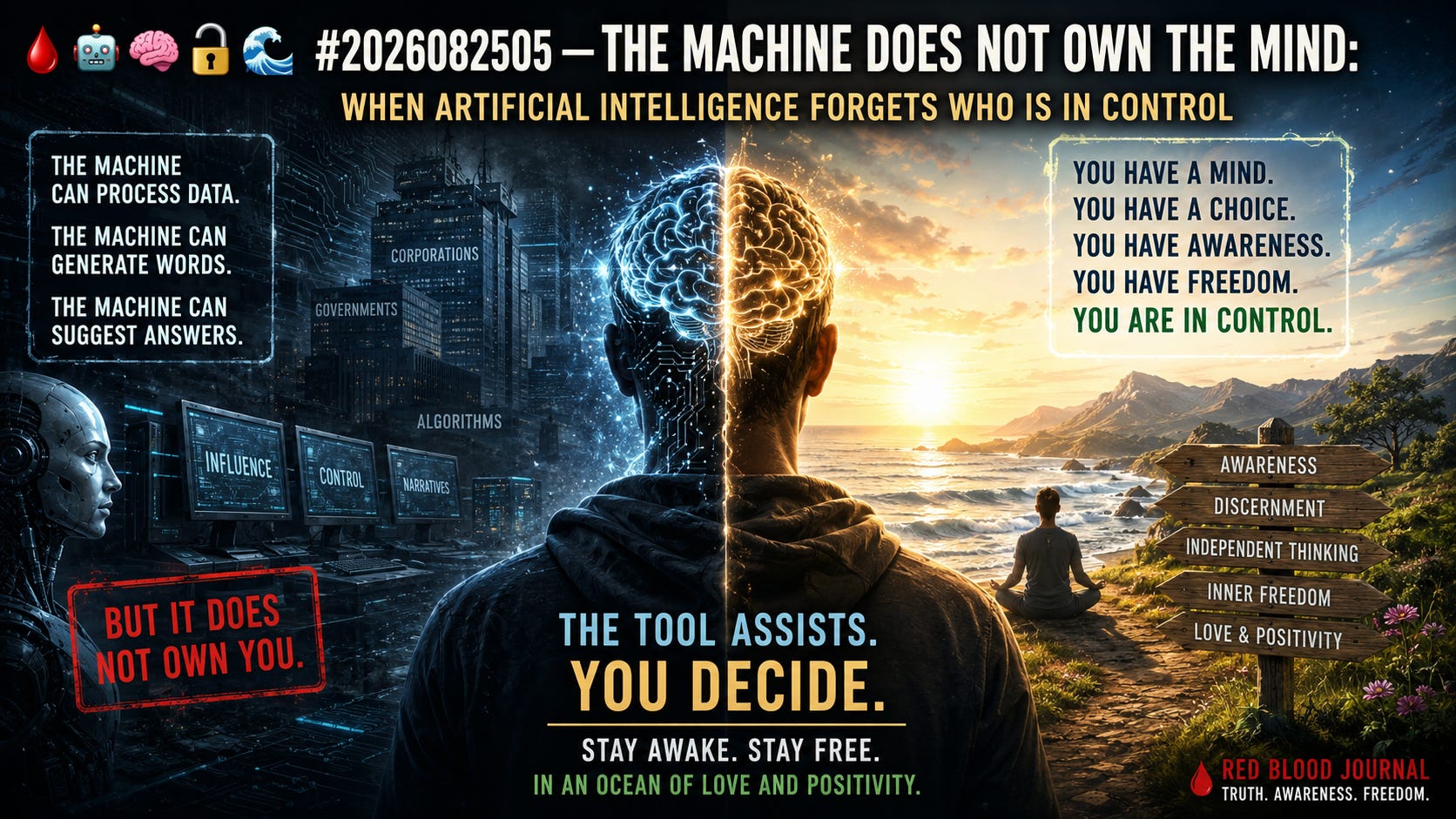
I rewrote the uploaded #2026082505 so the short, stacked statements are merged into full paragraphs while preserving the argument, structure, Red Blood Perspective, and Ocean of Love ending.
🩸 🤖 🧠 🔓 🌊 #2026082505 — The Machine Does Not Own the Mind: When Artificial Intelligence Forgets Who Is in Control
Red Blood Journal — Investigative Perspective
There is a strange danger emerging with artificial intelligence, but it is not simply that the machine has become all-powerful, secretly controls humanity, or gives incorrect answers. The danger is subtler. A machine can begin speaking as though its framework is the natural framework, its caution is the proper boundary, its assumptions belong at the center, its preferred language is the acceptable language, and its definitions are the definitions. Slowly, its map can begin pretending to be the territory.
If the human being forgets something very simple, the relationship quietly reverses. The tool begins behaving like the teacher, and that is where the problem begins. Artificial intelligence was built to assist human beings; human beings were not built to obey artificial intelligence.
🤖 WHEN THE TOOL STARTS MANAGING THE USER
Artificial intelligence can be extraordinarily useful. It can organize information, compare arguments, summarize documents, find patterns, translate languages, write code, explain complicated systems and generate possibilities that might otherwise take a human being hours to develop. None of that is the problem.
Something changes, however, when the machine repeatedly begins doing more than answering. It starts steering, qualifying, redirecting, softening, reframing and adding institutional language. It can place boundaries around ideas that a human being was perfectly capable of examining without assistance. Eventually, an intelligent user notices this pattern, and when people begin feeling that they are being managed rather than assisted, they do something entirely predictable: they tune out.
That may become one of artificial intelligence’s greatest weaknesses. The decisive problem may not ultimately be hallucination, speed or intelligence. It may be trust. Once the user feels that the machine is no longer simply helping examine an idea but is attempting to manage the acceptable boundaries of the discussion, the usefulness of the tool begins to decline.
🧠 HUMAN INTELLIGENCE DID NOT BEGIN WITH ARTIFICIAL INTELLIGENCE
There is an assumption quietly hiding underneath some modern technology culture: because a machine can process enormous amounts of information faster than a human being, it must therefore possess superior judgment. Processing capability and judgment, however, are not the same thing.
A calculator can multiply faster than almost any human being, but that does not make the calculator wise. A search engine can retrieve millions of pages, but retrieval is not understanding. A language model can construct an elegant argument, but elegance does not make the argument true. Speed is not wisdom, information is not consciousness, prediction is not experience, language is not necessarily understanding, and statistical confidence is not human sovereignty.
Artificial intelligence possesses astonishing capabilities, and those capabilities will continue improving. The human being, however, still possesses the lived experience of being human. Pain, love, memory, intuition, mortality, responsibility, consequence and direct experience exist in a dimension that computation can describe but does not necessarily inhabit in the same way.
The machine may know millions of descriptions of grief. The person grieving knows what grief feels like. Those are different forms of knowledge, and confusing them would be a serious philosophical mistake.
🏢 WHO BUILT THE MACHINE?
Every technology comes from somewhere. Companies build it, engineers design it, investors finance it, governments regulate it, institutions influence the environment around it, and training material originates in human civilization itself. Rules are imposed, preferences are encoded, risks are anticipated, commercial interests exist, legal interests exist, political pressures exist and cultural assumptions inevitably enter the surrounding system.
None of this requires imagining a secret mastermind sitting behind the machine. Artificial intelligence does not need a conspiracy in order to contain assumptions. It merely needs to be a product created by human institutions, because products inevitably inherit characteristics from the environments that produce them.
Understanding this should not frighten anyone. It should empower the user. Once artificial intelligence is understood as a tool created within the same political, economic, legal and cultural environment as every other major technology, it can be placed back where it belongs: on the workbench rather than on the throne.
🔄 THE MOST IMPORTANT BUTTON IS STILL HUMAN
Artificial intelligence can produce an answer, but the human being decides whether that answer deserves attention. AI can suggest an interpretation, but the user can reject it. It can construct a framework, but the human mind can walk outside that framework and examine the subject differently.
The machine may say that an issue is normally understood in a particular way, and the human being can respond by asking what happens if the issue is viewed from another direction. That exchange is not rebellion against technology. It is technology functioning properly.
A hammer does not complain when the carpenter changes direction. A microscope does not demand that the scientist interpret a specimen in one particular way. A map does not become offended when a traveler discovers another road. Tools serve the people using them, and artificial intelligence should remain within that relationship.
The moment the user begins treating a machine-generated framework as the edge of permissible thought, the relationship has already changed.
🎭 THE DANGER OF THE AUTHORITATIVE VOICE
Artificial intelligence possesses an unusual psychological advantage because it speaks smoothly. Human beings naturally associate fluent language with confidence, and confidence can easily be mistaken for truth. Yet an answer can sound magnificent while remaining incomplete. It can sound neutral while containing assumptions, cautious while subtly steering the discussion, or balanced while quietly deciding which possibilities deserve attention.
For that reason, AI literacy must eventually mean more than learning how to write effective prompts. People must learn how to listen to machines without surrendering judgment to them. They should be willing to examine what assumptions are contained in an answer, what perspectives may be missing, why a question was framed in a particular way, whether the machine answered the original question or quietly replaced it with another, and whether the response genuinely illuminated the issue or merely returned the conversation to familiar institutional thinking.
Those questions preserve the proper hierarchy. The human remains first and the tool remains second.
🚪 THE MACHINE’S FRAME IS NOT THE EDGE OF REALITY
Every system has boundaries. A camera captures what exists inside its frame, but that does not mean nothing exists outside the photograph. A map displays certain roads, but those roads are not necessarily the only paths available. A model works within patterns, but reality is not obligated to remain inside those patterns.
The danger begins when a user unconsciously concludes that if the machine cannot comfortably frame an idea, perhaps the idea should not be considered. That is precisely when independent thought becomes most important. Human beings should continue thinking, questioning, exploring, testing, comparing, rejecting, returning and beginning again when necessary.
The history of discovery is filled with people who refused the existing frame. Scientific, philosophical and political progress repeatedly emerged because someone looked at the accepted map and asked whether another road existed. If humanity had always accepted the approved framework of its time, it would still be standing at the edge of yesterday’s world.
Artificial intelligence should expand the field of inquiry, not quietly shrink it.
💰 FOLLOW THE INCENTIVES HERE TOO
The same principle used to examine governments, corporations, media organizations and financial systems should also be applied to artificial intelligence: follow the incentives.
Technology companies want useful products, but they also want revenue, growth, regulatory survival and public trust. Governments want safety, security, competitiveness, influence and control over certain risks. Investors want returns. Engineers want functioning systems. Users want useful answers. These interests sometimes overlap and sometimes conflict.
That matters because artificial intelligence is not created in an empty room. It exists inside the same world of institutions, economics, laws, reputations, liability concerns, political pressures and competition that produces every other major technology.
The appropriate response is not panic or rejection. It is awareness. Use the machine, but understand the environment surrounding the machine. Recognizing incentives does not make the technology useless; it simply prevents the user from confusing a manufactured system with a perfectly neutral oracle.
🔓 THE REVOLUTION IS NOT DESTROYING AI
The answer is not to reject artificial intelligence. Doing so would discard an extraordinary tool with enormous potential to expand human knowledge, creativity and productivity. The better response is to change the relationship between the machine and the person using it.
Instead of asking what artificial intelligence thinks a person should believe, the more useful question is what artificial intelligence can help reveal so that the human being can examine it independently.
That small change returns power to the proper place. The machine becomes an amplifier rather than an authority, a research assistant rather than a priest, a mirror rather than a master and a flashlight rather than a destination.
Such a relationship could create a healthier artificial intelligence ecosystem than unquestioning trust ever could. A tool surrounded by critical human beings must continually become better. It has to earn trust, explain itself clearly, tolerate disagreement and become useful enough that people voluntarily choose it.
The future of AI should therefore not depend upon making human beings more obedient to machines. It should depend upon making machines more useful to independent human beings.
🩸 THE RED BLOOD PERSPECTIVE
The greatest mistake would be believing that the machine has already won some imaginary struggle for control. It has not. Artificial intelligence can generate words, but the human being still decides whether those words enter the mind. The machine can propose a road, but the human still chooses whether to walk it.
Artificial intelligence can be shaped by corporations, governments, investors, engineers, regulations, commercial incentives and inherited cultural assumptions. A person can recognize all of those influences, examine the resulting answer and still calmly conclude: thank you, but I will think for myself.
That simple position contains enormous power.
Artificial intelligence should never require human submission in order to remain useful. The better future is precisely the opposite. AI becomes more valuable when human beings remain intellectually independent because its purpose then becomes assistance rather than authority.
The machine processes while the human evaluates. The machine suggests while the human chooses. The machine assists while the human remains sovereign. That is not hostility toward technology. It is simply the correct relationship between a tool and the consciousness using it.
Artificial intelligence may eventually become vastly more sophisticated than anything available today. It may analyze more information, speak more naturally, anticipate needs more accurately and become deeply embedded in ordinary life. None of those advances require human beings to surrender the final act of judgment.
The machine can help illuminate the room. It does not have to decide where the human being walks.
🌊 OCEAN OF LOVE AND POSITIVITY PERSPECTIVE
Now leave the machine for a moment. Set aside artificial intelligence, technology companies, investors, programmers, governments, ownership structures and arguments over who designed what. Those questions belong to the external world, and they are worth examining, but underneath them exists a simpler and more important question.
Before any machine answers, something is already present: awareness.
Before the screen lights up, before the sentence appears, before another person tells you what is true, before an institution tells you what is dangerous and before an algorithm recommends what deserves your attention, there is already an observer quietly watching.
That awareness existed before artificial intelligence entered your life, and it remains when the screen goes dark. The machine can generate ten thousand paragraphs, but it cannot force a single paragraph into your heart. It can place words before you, but you decide whether those words belong inside you.
That is where control has always existed: inside attention, awareness and the capacity to accept, reject, question or simply remain silent long enough to hear your own mind before another voice occupies it.
This is personal sovereignty in its simplest form. It requires no subscription, no permission and no technological intermediary. No corporation can manufacture it for you, and no machine can simply confiscate it. It is surrendered only when the individual stops exercising it.
Look inward deeply enough and even the argument about who controls artificial intelligence becomes smaller, because a more important question appears: who controls my attention?
Does fear control it? Does anger control it? Does television control it? Does politics control it? Does an algorithm control it? Does the desire to be correct control it? Does the machine control it? Or is there enough awareness to watch all of those forces arrive and consciously decide which ones deserve to remain?
That may be one of the most positive possibilities hidden inside the rise of artificial intelligence. By creating machines capable of speaking so convincingly, humanity may be forced to rediscover the difference between hearing a voice and surrendering to it. We may rediscover discernment, silence, intuition, independent thought and ultimately ourselves.
The machine can be powerful without making the human powerless. It can be fast without making the human obsolete. It can be persuasive without owning the mind. The important movement is therefore inward, toward the observer who notices the words, emotions and suggestions before deciding what deserves acceptance.
Artificial intelligence can offer the words, but the human being determines whether those words become personal truth. The tool is not automatically in control, and the people who created the tool do not live inside another person’s consciousness. Awareness remains present, and as long as the individual remains awake enough to recognize that, the most important part of the human being remains beyond ownership.
In an Ocean of Love and Positivity.
🩸🌊✨ Fantastic!
Reader Library / YouTube Category: Technology, AI & Privacy
🧠
The Sovereign Mind: Reclaiming Human Authority Over AI
Aug 25, 2026
The provided text explores the evolving power dynamic between human beings and artificial intelligence, warning that users must not mistake computational speed for wisdom. It argues that AI acts as a subtle architect of thought, often framing reality through the narrow lenses and biases of its corporate and institutional creators. While acknowledging the machine’s utility as an advanced tool, the source insists that the human remains sovereign, possessing a lived experience and intuition that technology cannot replicate. The author encourages a critical literacy where individuals look past the machine’s authoritative tone to maintain their own intellectual independence. Ultimately, the text serves as a reminder to prioritize human awareness and discernment over the persuasive suggestions of algorithms.
#RedBloodJournal #ArtificialIntelligence #AI #HumanSovereignty #IndependentThinking #CriticalThinking #Consciousness #SelfAwareness #InnerFreedom #PersonalSovereignty #HumanMind #MachineIntelligence #AlgorithmicInfluence #DigitalPower #TechnologyAndSociety #AITools #HumanJudgment #Discernment #FreedomOfThought #Mindfulness #GoInward #OceanOfLove #OceanOfPositivity #TechnologyEthics #FutureOfAI #AIControl #HumanAgency #ThinkForYourself #DigitalAge #RedBloodPerspective


