


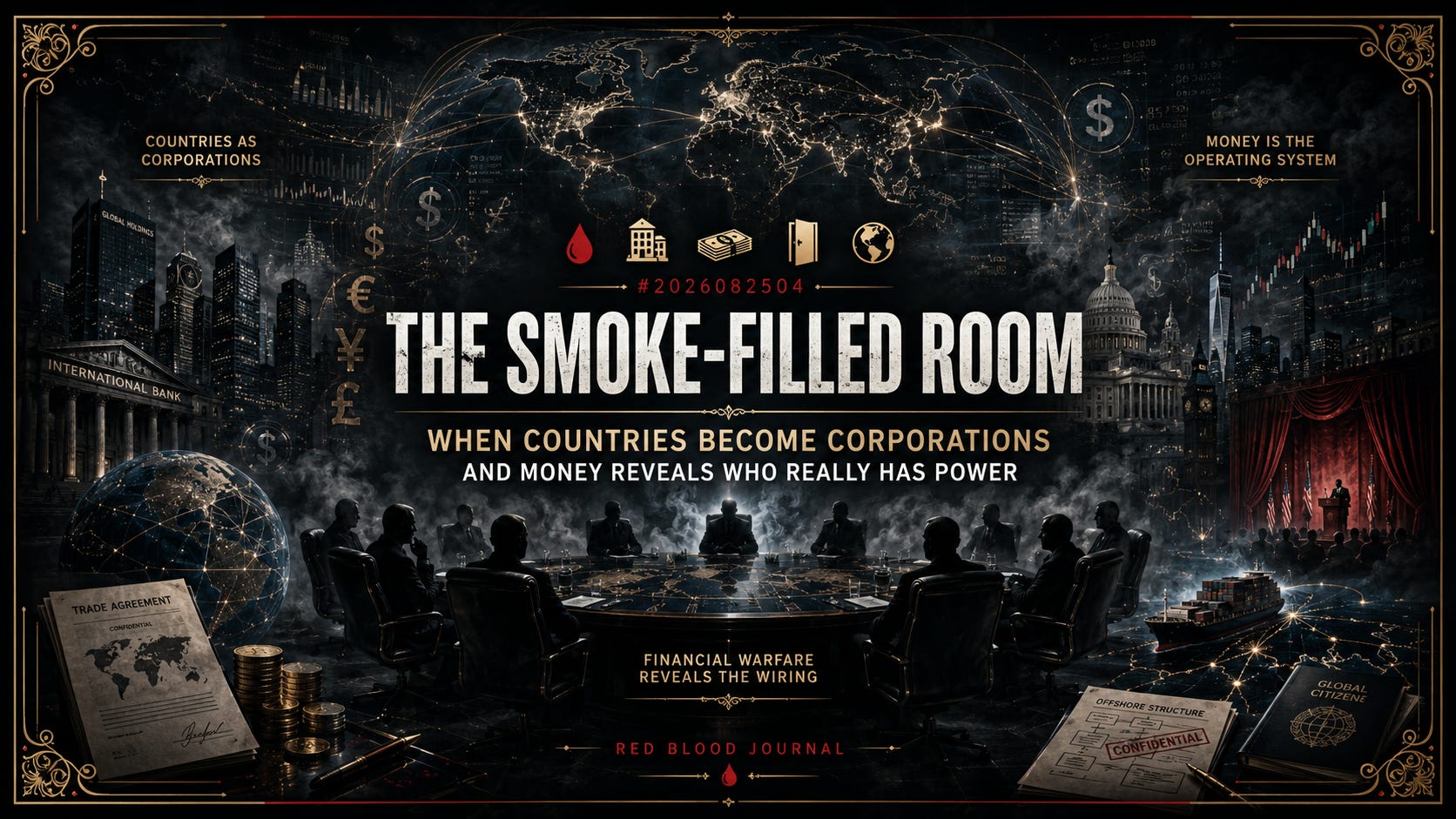
🩸 🏢 💵 🚪 🌎 #2026082504 — The Smoke-Filled Room: When Countries Become Corporations and Money Reveals Who Really Has Power
Red Blood Journal — Investigative Perspective
Politics becomes easier to understand when the flags are removed.
Imagine every country as a corporation.
Not because countries are literally corporations, but because the comparison exposes something useful.
They compete.
They advertise.
They defend market share.
They protect supply chains.
They cultivate loyalty.
They punish rivals.
They subsidize allies.
They control distribution.
They manufacture stories about why their product is superior.
And although the names change, many of them are ultimately selling versions of the same basic product:
security, prosperity, identity, order, belonging, opportunity and hope.
America sells one version.
China sells another.
Russia sells another.
Iran sells another.
Cuba sells another.
North Korea sells another.
Europe packages several brands under one larger structure.
Different labels.
Different slogans.
Different colors on the can.
But the customer eventually asks the same question:
Does the product work?
🏢 THE WORLD AS A CORPORATE MARKETPLACE
Think of the geopolitical system as a shopping aisle.
On one shelf:
USA Inc.
The package says:
Freedom. Democracy. Opportunity.
On another:
China Inc.
The package says:
Stability. Development. Competence. National revival.
Another shelf:
Russia Inc.
Strength. Sovereignty. Great-power dignity.
Then:
Iran Inc.
Religion. Revolution. Resistance. Justice. Independence.
Then:
Cuba Inc.
Revolution. Equality. Sovereignty.
Then:
North Korea Inc.
Security. Survival. Self-reliance.
Then:
European Union Holdings
Peace. Prosperity. Rights. Mobility. Integration.
The branding matters.
But branding is not the product.
Eventually the customer opens the package.
That is where politics becomes dangerous for the seller.
🇮🇷 IRAN: WHEN THE BRAND PROMISE BECOMES TOO LARGE
Iran is one of the clearest examples.
The Islamic Republic did not simply promise competent administration.
It attached itself to something much larger.
Religion.
Morality.
Justice.
Resistance.
Protection of the poor.
Independence from outside control.
Sacrifice for a higher purpose.
That is a massive promise.
And the larger the promise, the harder the fall when the lived experience begins contradicting it.
If the label says:
Justice
but people see privilege,
if it says:
Protection of the poor
but people experience collapse in purchasing power,
if it says:
Morality
but corruption becomes routine,
if it says:
Sacrifice today for a better tomorrow
but tomorrow keeps moving farther away,
then the problem is no longer merely economic.
It becomes a problem of credibility.
Brand insolvency.
The corporation can still have ministries.
Police.
Oil.
Military forces.
Banks.
Buildings.
Television stations.
Religious institutions.
But the label may no longer persuade the customer.
That is far more dangerous than a bad quarter.
Money can sometimes be borrowed.
Trust is much harder to refinance.
Iran also created an unusual liability by attaching the credibility of religion so tightly to the credibility of government.
If the government fails, some people may begin charging that failure against religion itself.
The state effectively placed its own performance guarantee on something far older than itself.
ISLAM™ — GOVERNMENT GUARANTEED
That may prove to have been one of its most expensive strategic decisions.
A government can fail.
Faith does not have to fail with it.
🇨🇳 CHINA: THE CORPORATION THAT SELLS DELIVERY
China built a different product.
Its modern political contract became much more practical.
Not simply:
Believe in communism.
But:
Give the Party political control, and the Party will deliver development, stability and national advancement.
That was a powerful sale because China delivered enormous visible transformation.
Factories.
Ports.
Roads.
High-speed rail.
Cities.
Technology.
Manufacturing.
Rising living standards.
Global influence.
China built credibility not only through slogans, but through delivery.
That creates strength.
It also creates vulnerability.
Because if the primary brand is:
WE ARE COMPETENT
then prolonged incompetence becomes dangerous.
China cannot survive forever on belief alone.
It has to keep pointing to the product and saying:
Look what we built.
That is why economic slowdown matters beyond economics.
When prosperity weakens, the corporation needs another reason for loyalty.
So the brand can shift.
Prosperity.
Then stability.
Then technological independence.
Then national greatness.
Then historical revival.
That is not unusual.
Corporations reposition brands all the time.
🇷🇺 RUSSIA: THE CORPORATION SELLING DIGNITY
Russia’s product is different again.
The Soviet Union collapsed.
Then came humiliation, disorder, oligarchs, economic chaos and loss of global stature.
The modern Russian political product became:
Order.
Strength.
Sovereignty.
Russia will not be humiliated again.
That matters because people do not always buy only prosperity.
Sometimes they buy dignity.
Sometimes they buy identity.
Sometimes they buy the feeling that their country matters.
That helps explain why purely economic arguments often fail to explain Russian behavior.
The customer is being asked to pay for great-power status.
The real question eventually becomes:
How much are people willing to pay for that subscription?
When the price rises high enough, every corporation faces the same problem.
The customer starts comparing value with cost.
🇨🇺 CUBA: THE CORPORATION RUNNING ON ITS FOUNDING STORY
Cuba’s original product was emotionally powerful.
We removed foreign domination.
We belong to ourselves.
We will build equality.
A founding story can carry enormous political weight.
But eventually the founding generation disappears.
Then the next generation asks about:
electricity,
food,
housing,
transportation,
income,
mobility,
opportunity.
History can explain why the company exists.
It cannot indefinitely replace delivery.
That is why Cuba’s dilemma is so revealing.
Necessity can force a revolutionary state to adopt pieces of the very economic model it once condemned.
The label remains.
The ingredients quietly change.
🇰🇵 NORTH KOREA: THE CORPORATION THAT DOES NOT NEED NORMAL CUSTOMER APPROVAL
North Korea operates under different rules.
Its main product is not prosperity.
Its main product is survival.
The outside world threatens us.
The state protects us.
Military strength keeps us alive.
That means material poverty does not automatically destroy the central sales pitch.
North Korea also limits the customer’s ability to leave the store.
That changes the entire business model.
Its nuclear arsenal then becomes understandable as something resembling the ultimate corporate poison pill.
You may isolate the company.
You may refuse to trade with it.
You may sanction it.
But attempting to take it over by force may cost more than the takeover is worth.
That is one reason an extremely poor state can remain extraordinarily difficult to remove.
🇪🇺 THE EUROPEAN UNION: A HOLDING COMPANY
The European Union is almost easier to understand as a holding company than as a country.
France keeps its logo.
Germany keeps its logo.
Italy keeps its logo.
Spain keeps its logo.
Poland keeps its logo.
But portions of the operation are shared.
Currency.
Trade.
Regulation.
Standards.
Borders.
Courts.
Markets.
Its original flagship product was extraordinary:
Europeans stop repeatedly killing one another.
That product worked.
Then more products were added:
Prosperity.
Mobility.
Rights.
Social protection.
Economic integration.
But large holding companies eventually develop headquarters problems.
Headquarters becomes larger.
Rules multiply.
Local branches begin complaining.
People start asking:
Why is someone far away deciding this for us?
That is one of Europe’s central tensions.
Not necessarily whether cooperation was a failure.
But how much authority belongs to the center and how much belongs to the branches.
💵 THEN THE FINANCIAL WEAPONS COME OUT
This is where the whole corporate analogy changes.
Traditional war attacks the factory.
Financial war attacks the corporation’s ability to function.
A missile destroys a refinery.
A financial weapon can make the refinery unable to receive payment.
A navy can stop a tanker.
Financial pressure can make the tanker difficult to insure, finance or sell.
An army can seize a bank.
Financial warfare can leave the building standing while making the bank unusable internationally.
A government can own reserves on paper and still discover that access to those reserves depends on somebody else’s infrastructure.
That is a different kind of warfare.
Less smoke.
More plumbing.
And perhaps more revealing.
💲 MONEY IS NOT JUST MONEY
This is where the hidden architecture begins showing itself.
Currency is not merely paper.
Banking is not merely banking.
Insurance is not merely insurance.
Clearing is not merely clearing.
Shipping finance is not merely shipping finance.
These are parts of the global operating system.
Imagine Pepsi discovering that Coke does not merely compete with it.
Coke also has enormous influence over:
the payment processor,
the bank,
the warehouse,
the insurance company,
the credit line,
and the supermarket chain.
Now the contest has changed.
It is no longer simply:
Which product is better?
It becomes:
Who controls access to the marketplace?
That is financial weaponry.
And every time it is used, another part of the machinery becomes visible.
🚪 THE CURVE BALL: THE FINANCIAL SYSTEM MAY NOT BE THE HIDDEN HAND
Money is the machinery.
The smoke-filled room is something else.
The real question is:
Who gets close enough to the machinery to influence when it is used?
That is where the metaphorical smoke-filled room appears.
Not necessarily one literal room.
Not necessarily one organization.
Not necessarily one mastermind.
The smoke-filled room is the space where powerful interests meet, negotiate, pressure, bargain and shape outcomes before the public sees the finished decision.
Political donors.
Banks.
Large corporations.
Defense interests.
Energy interests.
Intelligence institutions.
Lobbyists.
Regulators.
Party leaders.
Foreign governments.
Think tanks.
Major investors.
Technology companies.
Media owners.
They do not need to agree on everything.
They only need access.
That is the difference.
The average citizen sees the press conference.
The people inside the room may have been shaping the decision long before the microphone was turned on.
🚬 THERE MAY BE MANY ROOMS
This is where the simplistic version falls apart.
There may not be one hidden hand.
There may be many.
Wall Street wants one thing.
Defense interests want another.
Energy companies want another.
Political parties want elections.
Bureaucracies want survival.
Intelligence institutions want strategic advantage.
Corporations want market access.
Foreign allies want protection.
Activists want change.
Voters want relief.
These interests sometimes line up.
When they do, government can look almost perfectly coordinated.
Then those interests collide.
Suddenly the same government looks confused and contradictory.
That is not necessarily proof of incompetence.
It may simply mean that many hands are pulling in different directions.
🎭 THE PRESIDENT IS THE FACE OF THE CORPORATION
The president matters.
But the president is also the face on the package.
Behind that face sits an enormous machine.
Treasury.
Military.
Intelligence.
Congress.
Courts.
Banks.
Debt.
Markets.
Treaties.
Corporate interests.
Bureaucracies.
Foreign alliances.
Institutional habits.
A new CEO can change direction.
But changing the CEO does not instantly replace the corporation.
That is why political systems can advertise enormous change while much of the underlying machinery continues operating.
The logo changes faster than the infrastructure.
🔦 FINANCIAL WARFARE TURNS ON THE LIGHT
This may be the most revealing part of the entire story.
Every time financial power is used aggressively, it tells us something.
Sanction a bank?
Now we know the bank mattered.
Freeze reserves?
Now people ask where reserves were really held.
Target a shipping company?
Now we see which route mattered.
Target an insurer?
Now people discover how important insurance is to physical trade.
Target a cryptocurrency exchange?
Now we know someone was using an alternative rail.
Target a front company?
Now the network starts appearing.
Financial warfare acts like an X-ray.
It reveals the circulatory system.
And once the circulatory system is visible, anyone willing to look can begin asking better questions.
Not mystical questions.
Practical ones.
Who owns what?
Who finances whom?
Who sits on which board?
Who received which contract?
Who received the exemption?
Who controls the payment path?
Who writes the rules?
Who benefits?
Who absorbs the loss?
Who can enter the room?
Who remains outside?
No mythology is necessary.
Follow the relationships.
Follow the money.
Follow the access.
The fingerprints are enough.
🩸 THE RED BLOOD PERSPECTIVE
The world becomes much easier to understand when we stop becoming hypnotized by the label on the package.
Countries can behave like corporations.
Ideologies can behave like brands.
Citizens can become customers, workers, taxpayers and shareholders at the same time.
Media can become advertising.
Military power can become enforcement.
Financial infrastructure can become the operating system.
And the smoke-filled room can become the place where concentrated interests try to influence how that system is used.
The point is not to invent invisible monsters.
The point is to stop pretending that the public stage is the entire building.
There are hallways behind the stage.
There are rooms behind the hallways.
There are relationships inside those rooms.
And money has an unusual habit of leaving footprints.
The financial weapon may therefore be doing something its users did not fully intend.
It is exposing the machinery.
The more the machinery is used, the easier it becomes to see.
And the easier it becomes to see, the harder it becomes to pretend that politics is only about speeches, elections, flags and slogans.
🌊 OCEAN OF LOVE AND POSITIVITY PERSPECTIVE
And now the report ends.
Not in Washington.
Not in Tehran.
Not in Moscow.
Not in Beijing.
Not in Brussels.
Not in a bank.
Not in a boardroom.
Not even in the smoke-filled room.
Leave all of it there.
For one moment, stop following the money.
Stop following the politicians.
Stop following the corporations.
Stop following the hidden hands.
Stop looking left.
Stop looking right.
Now look up.
See the whole stage.
Countries rising and falling.
Empires appearing and disappearing.
Currencies becoming powerful and then becoming history.
Leaders arriving with enormous importance and eventually becoming names in books.
Corporations forming, merging, collapsing and being replaced.
Arguments that once seemed capable of ending the world eventually becoming paragraphs in history.
Then go deeper.
Turn inward.
There is something inside you watching all of this.
It watches the anger.
It watches the fear.
It watches the excitement of discovering something hidden.
It watches the desire to be right.
It watches the political label.
It watches the enemy.
It watches the friend.
It watches the entire theater.
Who is that?
Before the word American appears, something is there.
Before the word Iranian appears, something is there.
Before Republican.
Before Democrat.
Before Muslim.
Before Christian.
Before rich.
Before poor.
Before ruler.
Before ruled.
Something is already present.
The observer.
The awareness experiencing the human story.
The world spends enormous energy convincing that observer to attach itself to a label.
My country.
My religion.
My party.
My enemy.
My victory.
My fear.
My loss.
Then the labels begin fighting one another.
But go inward far enough and something begins to loosen.
The label is seen.
The anger is seen.
The fear is seen.
The desire is seen.
And anything that can be observed cannot be the whole observer.
That is where the Ocean begins.
Not as an escape from reality.
As a recognition of something deeper than the noise of reality.
You may never know every person inside every smoke-filled room.
You may never expose every financial connection.
You may never understand every war.
You may never discover every hidden motive.
And perhaps you do not need to.
Because there is one room you can enter without permission.
Your own.
Sit there.
Quietly.
No politician.
No television.
No headline.
No flag.
No enemy.
No corporation.
No audience.
Just awareness.
Notice what remains when the noise is allowed to pass without being chased.
There is life.
There is consciousness.
There is the strange fact that you are here.
Experiencing.
Observing.
Alive.
That is already larger than the political theater.
The machine outside may continue turning.
But it does not have to turn inside you.
The world may sell fear.
You do not have to buy it.
The world may sell hatred.
You do not have to carry it.
The world may demand that you choose an enemy.
You can look deeper and see another human being wearing another temporary costume.
The world may divide itself into corporations called countries.
But consciousness does not arrive with a passport stamped onto it.
A child is born before learning which side to hate.
That is worth remembering.
Perhaps that is the positive possibility hidden inside all of this.
The more clearly we see the machinery outside, the easier it may become to realize that freedom cannot depend entirely upon controlling that machinery.
There is another sovereignty.
The sovereignty of attention.
Where attention goes, life follows.
Give all of it to the smoke-filled room and the room owns the mind.
Give some of it back to the silence within and something changes.
The room becomes smaller.
The fear becomes smaller.
The labels become lighter.
And the human being becomes larger.
So after all the investigation, follow one final trail.
Not the money trail.
Not the power trail.
Not the corporate trail.
Follow awareness back to its source.
Go inward.
Stay there long enough to recognize that underneath all the competing brands, all the flags, all the governments and all the arguments, humanity may be far less divided than the marketplace needs us to believe.
The Ocean was never somewhere else.
It was underneath the waves the entire time.
And for a moment, when the mind becomes quiet enough, you can feel it.
The countries are temporary.
The brands are temporary.
The smoke-filled rooms are temporary.
Even the body is temporary.
But right now, something within you is aware of all of it.
Start there.
In an Ocean of Love and Positivity.
🩸🌊✨ Fantastic!
🎭
Global Brands: The Geopolitical Corporate Marketplace
Aug 25, 2026
This text analyzes geopolitical systems through the lens of corporate competition, framing nations as companies that market specific “products” like security, identity, or prosperity to their citizens. The author examines how different states—such as China, Russia, and Iran—maintain their brand credibility and what happens when their operational delivery fails to match their slogans. A significant portion of the discussion explores financial warfare as a modern “X-ray” that exposes the hidden circulatory systems of global power and the influential interests within smoke-filled rooms. Ultimately, the narrative shifts from this mechanical worldview to a philosophical perspective, urging readers to look beyond political labels and national divisions. By prioritizing internal awareness over external noise, the text suggests that individuals can find a sense of sovereignty that transcends the temporary theater of global conflict.


